Guest Post by Willis Eschenbach
Well, I started a post on Kiribati, but when it was half written I found Andi Cockroft had beaten me to it with his post. His analysis was fine, but I had a different take on the events. President Tong of Kiribati says the good folk of the atolls are again looking for some place to move their people if they have to. However, this time, it’s different. This time, they’re not blaming it on sea level rise. This time, they’re not talking about suing the industrialized nations. And this time, they’re making their own plans, they’re not waiting for the world to act. The headline in USA Today says:
Pacific nation may move entire population to Fiji
 Figure 1. The island nation of Kiribati, which is comprised of the Gilbert and Phoenix groups and the Line Islands. I call it the world’s biggest tiny country. The Kiribati EEZ (Exclusive Economic Zone) is the eighth largest in the world … and it is 99.99% ocean.
Let me comment that if I had a chance to pull up stakes in Kiribati and move to Fiji, I’d do it in a second. Fiji is high volcanic islands, with rich soil and lots of it. And Kiribati, on the other hand, is tiny coral atolls with … well … nothing. Life on the atolls is tough, tough, tough. The highest point on any of the atolls of Kiribati is about 3 metres (10 feet) above sea level, and there is no real soil, only lime coral sand. It is a testament to the ingenuity and perseverance of humans that anyone lives on the atolls at all. The people from Kiribati are great folks, consummate seamen, and very interesting people in general. The ones I’ve known have been great folks. Don’t cross the women, though, bad mistake, the women will clean your clock if you cross them, that’s one of the reasons I like them so much.
But the fact that life is tough in Kiribati is not the reason that they’re talking about moving. And indeed, although the report mentions climate change, the President of Kiribati actually didn’t blame rising sea levels. The article goes on to say:
Fearing that climate change could wipe out their entire Pacific archipelago, the leaders of Kiribati are considering an unusual backup plan: moving the populace to Fiji.
Kiribati President Anote Tong told The Associated Press on Friday that his Cabinet this week endorsed a plan to buy nearly 6,000 acres on Fiji’s main island, Viti Levu. He said the fertile land, being sold by a church group for about $9.6 million, could be insurance for Kiribati’s entire population of 103,000, though he hopes it will never be necessary for everyone to leave.
“We would hope not to put everyone on one piece of land, but if it became absolutely necessary, yes, we could do it,” Tong said. “It wouldn’t be for me, personally, but would apply more to a younger generation. For them, moving won’t be a matter of choice. It’s basically going to be a matter of survival.”
Kiribati, which straddles the equator near the international date line, has found itself at the leading edge of the debate on climate change because many of its atolls rise just a few feet above sea level.
Tong said some villages have already moved and there have been increasing instances of sea water contaminating the island’s underground fresh water, which remains vital for trees and crops. He said changing rainfall, tidal and storm patterns pose as least as much threat as ocean levels, which so far have risen only slightly.
Now, before getting into the story, a few facts. First. name of the nation is pronounced “Kih-rih-bas”, with the accent on the first syllable. Why the strange spelling? Turns out that’s how you spell “Gilberts”, the old name of the islands, in the local language. There’s no “s” in the language, so they use “ti” for the “s” sound, based on how “ti” is pronounced in “motion”. Also, as in many Pacific missionary-derived orthographies of the local language, there are no diphthongs consonant pairs in the Kiribati language. So the “lb” in “Gilberts” becomes “rib” because … you guessed it, no “l” in the language, so they use “r” instead. So in Figure 1, you see that “Christmas” in the local language is spelled “Kiritimati”. Also, the people are called “i-Kiribati”, with the “i” pronounce like “ee”.
Returning to the idea of the i-Kiribati moving to Fiji, curiously, that would not be the first historical intersection between the people of Kiribati and the people of Fiji. In the early days of WWII, it became obvious that the Japanese would invade one of the Gilbert Islands called “Ocean Island” or Banabas. The Gilberts were British at the time, as was Fiji, so the Brits decided to act.
Basically, the British took all of the inhabitants of Banabas Island, and moved them lock, stock, and fishing lines to the island of Rabi in Fiji. Rabi is a beautiful island, and it is ruled domestically not by the Fijians, but by the Rabi Island Council. It’s like a little bit of Kiribati in Fiji, almost everyone on the island is i-Kiribati. So this would not be the first group of i-Kirbati to resettle in Fiji.
Nor would it be the first move by i-Kiribati away from the Gilberts group. The Phoenix group of islands were settled in the late 1930s by people from the Gilberts group. This occurred as a direct result of what would become a recurring problem—when atoll populations intersect with modern medicine, overpopulation is not far off.
As a result, the obliging British, who likely felt some responsibility, gave the Phoenix group to be settled by the i-Kiribati. They settled the islands between 1938 and 1940. But the water was bad and scarce. Communications were hard, as was transportation, and the war made it worse. In 1952, after a series of dry years, the experiment was declared a failure.
However, of course, by then there was no room for the Phoenix folks back in the Gilberts. Besides, by then there were newly overcrowded islands in the Gilberts too, people keep having kids. So … the Brits were looking for people to work on the plantations in the Solomon islands. In the early 1950s, they gave Wagina Island and land on Gizo Island in the Solomons to anyone willing to sign up for the Solomon Islands Settlement Scheme. Many of the folks who emigrated were from the Phoenix Islands, where poor water sources and a drought had combined to make the islands uninhabitable. Compared to that, the Solomons were a paradise. Except for the malaria, of course.
Drought has long been the bane of Kiribati. When your only water comes from a small lens of fresh water renewed only by rain, it is a matter of life and death. There is a fascinating report by some National Academy of Science folks, published in 1957, of their researches in Kiribati in the early ’50s. It was very clear, even back then, that droughts were a huge issue. Among many other interesting things they say are:
As for the rainfall, the attached graphs will show how it varies between the groups in the North, Central and South Islands (Fig. 4). One of the most important ecological factors in the Gilbert Islands is drought. These islands are periodically affected by it. There was a two-year drought in 1917-1919, a three-year drought in 1937-1939, and another which lasted a year and a half in 1949-1951. These periods of drought particularly affect the south islands. Comparative statistics in Figure 4 show the’ monthly rainfall of one island of each group over a period of 4 years, comparing periods or normal rainfall with periods of drought which occurred from August, 1949 to December, 1950.
And here is their Figure 4:
 Figure 2. Monthly rainfall on three different atolls of Kiribati. Click image for a larger version.
Tarawa, the middle row, is the capital of Kiribati. Like the other islands, it depended entirely on rainfall for drinking water. Look at what happened in 1950 to the rainfall in Tarawa … yes, that would definitely cause problems. You can see why the British were wanting to move people in the early 1950s, they’d been dying of thirst on some of the atolls. Plus the population on the atolls was already very high. The NAS report says:
It would seem that the Gilbert Islands, where the soil is so poor, and which suffer from recurrent severe droughts, should have a small population. We observe, on the contrary, a very high demographic density. The population of the sixteen islands of the Group amounted at the time of the 1947 census to 27,824, or an average density of 243.9 per square mile. This figure is just given as an average and does not claim to have any great demonstrative value as, in fact, the density varies considerably as between one island and another. Thus Tamana has 441.5 per square mile while Aranuka has only 61.3.
But of course, moving folks from the Gilberts to the Solomon Islands didn’t solve the population problem either. To understand why it made no difference, here’s a historical look at the population of Kiribati
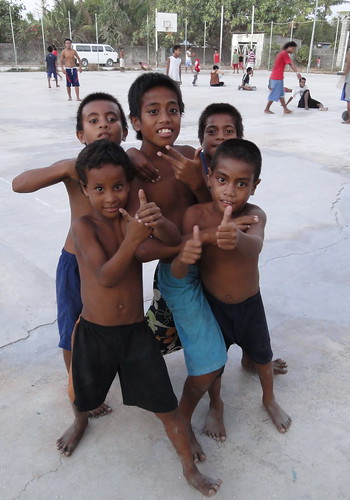
 Figure 3. Kiribati population change over time. I picked the photo because for me it exemplified the irrepressible spirit of the i-Kiribati people. Population information is from the FAO and the NAS report cited above.
Remember that in 1947, people were already commenting on the high population density … and now the density is three times as great. So you can understand why the President is looking for more land. Here’s another bit of information. The article says that they want to buy a 6,000 acre parcel in Fiji. In Texas, that would only be a small ranch.
But that land in Fiji is nearly 10% of the total area of Kiribati, and nearly 15% of the inhabited area of Kiribati. So I understand why they want to buy it.
You can see the danger. The population is skyrocketing. And unlike just about every country on the planet, there is absolutely no sign of any slowdown in the Kiribati population growth rate.
But the rain … the rain is unchanged. It’s still years of wet and then years of dry, just like always … but when you have three times the people, the dry years become unsustainable. President Tong correctly notes “increasing instances of sea water contaminating the island’s underground fresh water”. He does not note the obvious reason that the well water is becoming brackish—there are three times the people drinking from each and every well, while the rainwater recharging the wells hasn’t changed.
As a result, I fear there is no obvious solution. Buying land in Fiji in 2012, while it is a good stopgap measure, will do no more to solve the underlying problem than did exporting people to the Solomon Islands in 1954. There is only one solution to their problem, and it has nothing to do with CO2, or the climate, or the industrialized nations, or the sea level. The people of Kiribati have to, must, reduce their birth rate.
I understand that there are issues of religion and social pressure and the like, but look at the blue line in Figure 2. Kiribati is already busting at the seams with people, and the rate of population growth is not decreasing … they will be lucky to come out of this without huge social, economic, and political problems. So I wish President Tong the best of luck in his efforts to reduce some of those problems.
And if anyone can pull it off, it would be the i-Kiribati. Let me close by quoting the 1950s NAS report again:
Another aspect of their nature is their total confidence in others, both in moral and material dealings. We also appreciated their independent spirit and their frankness, which is often disarming. Their answers, whether positive or negative, are always direct. But the Gilbertese’ forthrightness does not preclude a form of respect devoid of obsequiousness. His often unexpected reactions are never arrogant, and are a corollary of his independent, individualistic nature, as are his teasing spirit and fanciful mind. Both are expressed in choreographic attitudes, in which mimicry always has a deserved success.
Finally, these people have a highly-developed artistic sense, and it would be difficult to find anything to equal some of their extraordinarily beautiful choral singing, It is really in their dances and choral singing only that the Gilbertese express the whole genius of their race, and can give rein to an exuberance which, because of a surprising modesty, is no longer manifested in the ordinary course of their everyday life.
The Gilbertese are an intelligent people. Many show real pride in having risen above the general level, but it did not seem to us that this was ever expressed in a contemptuous or even haughty way. Those working with Europeans are generally avid to learn and to understand everything and are full of gratitude for whoever may have increased their knowledge, even about their own territory.
Yeah, that’s the i-Kiribati I know. Interesting, good-natured, hardworking folks. I wish them only the best.
w.
PS—Population density in Kiribati is currently about 750 people per square mile. If they were all moved to the land in Fiji as the headline claims, the population density there would be about 11,000 per square mile … by comparison, Bangladesh has a density of about 2,500 per square mile. So whether they buy the land or not, they won’t be able to move everyone there.
Discover more from Watts Up With That?
Subscribe to get the latest posts sent to your email.
They become US terrirtory. We provide nuclear energy, technology to mine sea floor, build floating cities. Problem solved. Not exactly simple, but could be done. At some point we do need to learn to live on the other 70% of the Earth.
One other big benefit: Contain China, or they may do what I just described and claim big chunks of the western Pacific as their exclusive economic zone. Consider what China has done with the Spratly so-called islands to support claims for control over petroleum resources. http://en.wikipedia.org/wiki/Spratly_Islands
Janice says:
March 10, 2012 at 6:29 am
While I agree in theory, unless you solve the population growth problem, it doesn’t matter if you double your water supply. All you are doing by providing abundant water is encouraging folks to not worry about the population …
Also, while water is the crucial item in the shortest supply, you must remember that an atoll is a pile of lime sand. Things don’t grow well there even on a good day with a following wind. There are zero mineral resources. There is zero good soil. Basically, there is nothing there to use, nothing there to sell, and it is amazing that humans can eke out a living under such conditions.
So while you might solve the water problem, that still leaves the food problem and the money problem …
w.
Hector M. says:
March 10, 2012 at 7:27 am
Hector, population growth not only “seems impressive in the chart”, it has already caused huge damage, and continues to do so. Sixty years ago people commented on how overpopulated the islands already were. Since then, the population has quadrupled. I’m sorry, but all your platitudes about percentages and growth per year don’t turn that into an acceptable situation. It has been a disaster.
Kiribati cannot afford a 1.7% growth rate, Hector. The US can afford that. We have lots of room.
But Kiribati cannot afford ANY growth rate. That’s the part you seem to be missing with your claims that somehow the growth is “not that fast”. It’s not that fast by your standards, clearly, and it’s not that fast for a country with lots of land … but on tiny islands that are already bursting at the seams, I’m sorry, but any growth is way too fast.
w.
Jason says:
March 10, 2012 at 8:47 am
That was what surprised me as well, Jason, and I give big props to President Tong for his honesty.
w.
bladeshearer says:
March 10, 2012 at 7:40 am
“Wonder how the i-Kiribati will adapt to city life?”
There is nothin else but city life on their capital Island of Male. No place to farm, no place to store enough water. They are completely on the dole, supported mainly by Australia.
“In early 2012, Kiribati president Anote Tong announced he is desperately working with the city of Fiji to evacuate the islands due to rising sea levels that seem to be the result of climate change.”
Is there anything in that sentence that isn’t completely wrong? I guess the date and the president’s name, but other than that…
Betapug says:
March 10, 2012 at 8:06 am
Fijians do not seem to tolerate large populations of non-Fijians well. Does anyone have their opinion of this scheme?
We lived in Fiji for awhile. One of our children was born there, just after a coup, and all the embassies were closed. Thus we could not get the necessary travel documents to allow us to leave with our new-born. So instead we applied for a Fijian passport for her.
On the application, there is a section where you tick a box for “race”. There were literally dozens of “races” listed. The clerk suggested that “European” was the correct race for the child, but since neither parent was from Europe we made up our own race on the line marked “other” and ended up with passport number 320000001.
In our case, the Fijians cooperated and gave us a passport so we could leave. Another boat we were cruising with was not so fortunate. They left Fiji to have their child in Australia. After the birth when they applied for papers they were deported for having brought an illegal alien into the country.
Smokey says:
March 10, 2012 at 10:09 am
bladeshearer says:
March 10, 2012 at 7:40 am
“Wonder how the i-Kiribati will adapt to city life?”
There is nothin else but city life on their capital Island of Male. No place to farm, no place to store enough water. They are completely on the dole, supported mainly by Australia.
Smokey:
Perhaps you missed the typo in the Wikipedia quote, “…working with the city of Fiji to evacuate the islands…” 😉
Bladeshearer,
That’s Wikipedia or you.
Smokey says:
March 10, 2012 at 10:09 am
Actually, Male is the capital of the Maldives. But what you said is equally true for Tarawa, the capital of Kiribati. For example:
and
Those are huge numbers, comparable to Hong Kong and Singapore.
w.
wsbriggs says:
March 10, 2012 at 7:33 am
Would it not be more realistic to lump Haiti in with the Dominican Republic? They are in he same place, had similar histories and social and political influences. Just as importantly, both have virtually identical climates and soil conditions, yet one of them is verdant and the other one virtually denuded.
How do you figure the outcomes were so different when both had identical origins, similar “help”, and both were left more or less equally “to their devices” and exposed to more or less identical levels of “plenty of religious teaching of all flavors”?
Do the moving people have to change their citizenship or is the
newly purchased lands integrated as Alaska into the purchasors realm and
everybody stays with its present citizenship?
Or are we all islanders and nobody cares?
I’m always reminded of Hans Rosling when population issues arise.
http://www.gapminder.org/videos/what-stops-population-growth
With regard to atolls and tsunamis, since atolls are like skyscrapers
starting at the bottom of the ocean, there is no gradual rise to a beach
which is how tsunamis build up. On the open ocean the tsunami wave
is just a minor extra blip.
The economics are interesting. This is from the US Department of State …
It’s a big world.
Sounds like if they could get their water situation under control that they’d be a natural for a booming tourism industry.
Willis – it’s my understanding that the main reason for the relocation of population from Banaba to Rabi was because most (90%?) of the surface area of Banaba had been removed by (highly profitable) phosphate mining.
I recommend to you the book “A Pattern of Islands” by Arthur Grimble, who was a colonial administrator in the (then) Gilbert and Ellis Islands from just before World War 1. It is one of the most charming books I have ever read, a mixture of personal history, anthropology, traveller’s yarns and humour. Originally a series of radio broadcasts, he made it into a book by popular acclaim.
Kiribati is a strong cautionary tale for seasteading advocates, who wouldn’t even have the asset of an atoll, but only whatever they could bring from land or extract from the sea.
Walter H. Schneider says:
March 10, 2012 at 11:00 am
Can you say Papa Doc? The worst of the Dominican dictators pales in comparison. Baby Doc was more of the same, and Aristide substantially as well. Cultural differences also contribute, but I’d guess that the French Colonial policies did the most damage.
All their rain is currently in Australia…
Joachim Seifert says:
March 10, 2012 at 11:17 am
Good questions, Joachim. Governments everywhere care about citizenship. The i-Kiribati on Rabi are Fijian citizens, perhaps dual nationality with Kiribati, I didn’t know. However, because they have their own island, they have their own Island Council. For the proposed new purchase, I don’t know how it would work.
w.
Alvin W says:
March 10, 2012 at 11:57 am
Ooooh, not true at all. See here for one example among many.
w.
Rhoda Ramirez says:
March 10, 2012 at 12:25 pm (Edit)
Sadly, Rhonda, Kiribati is a bunch of tiny narrow strips of sand with people living in most every square foot of space, and generally using the beaches as their toilets … does that spell “booming tourism” to you? I don’t mean to dis it, and toilet beaches are standard all over the Pacific, you don’t want to pollute the freshwater lens with pit outhouses or septic systems … but still, everyone is living in everyone else’s laps, there’s no privacy, it’s not what most people think of as “secluded island hideaway”.
w.
There is a good book called “A Pattern of Islands” written by a British colonial assistant about his experience in the then Gilbert and Ellice Islands.
An interesting book.