Guest post by Bob Fernley-Jones by Bob Fernley-Jones AKA Bob_FJ
CAUTION: This is written in Anglo-Oz English.
Here is the diagram as extracted from their 2009 paper, it being an update of that in the IPCC report of 2007 (& also 2001):


The unusual aspect of this diagram is that instead of directly showing radiative Heat Transfer from the surface, it gives their depiction of the greenhouse effect in terms of radiation flux or Electro-Magnetic Radiation, (AKA; EMR and a number of other descriptions of conflict between applied scientists and physicists). EMR is a form of energy that is sometimes confused with HEAT. It will be explained later, that the 396 W/m^2 surface radiation depicted above has very different behaviour to HEAT. Furthermore, temperature change in matter can only take place when there is a HEAT transfer, regardless of how much EMR is whizzing around in the atmosphere.
A more popular schematic from various divisions around NASA and Wikipedia etc, is next, and it avoids the issue above:
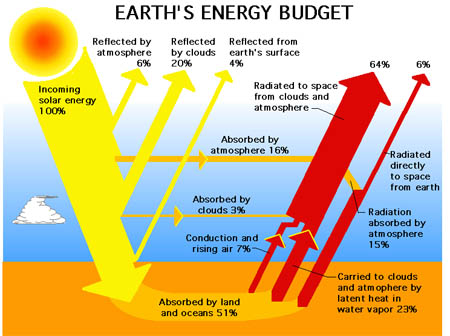
- Figure 2 NASA
Returning to the Trenberth et al paper, (link is in line 1 above), they give that the 396 W/m2 of EMR emitted from the surface in Fig.1 is calculated primarily by using the Stefan–Boltzmann law, and global year average conditions. Putting aside a few lesser but rather significant issues therein, it is useful to know that:
1) The Stefan-Boltzmann law (S-B) describes the total emission from a flat surface that is equally radiated in all directions, (is isotropic/hemispherical). Stefan found this via experimental measurement, and later his student Boltzmann derived it mathematically.
2) The validity of equally distributed hemispherical EMR is demonstrated quite well by observing the Sun. (with eye protection). It appears to be a flat disc of uniform brightness, but of course it is a sphere, and at its outer edge, the radiation towards Earth is tangential from its apparent surface, not vertical. It is not a perfect demonstration because of a phenomenon called limb darkening, due to the Sun not having a definable surface, but actually plasma with opacity effects. However, it is generally not apparent to the eye and the normally observed (shielded) eyeball observation is arguably adequate for purpose here.
3) Whilst reportedly the original Stefan lab test was for a small flat body radiating into a hemisphere, its conclusions can be extended to larger areas by simple addition of many small flat bodies of collectively flat configuration, because of the ability of EMR waves to pass through each other. This can be demonstrated by car driving at night, when approaching headlights do not change in brightness as a consequence of your own headlights opposing them. (not to be confused with any dazzling effects and fringe illumination)
4) My sketch below demonstrates how radiation is at its greatest concentration in the lateral directions. It applies to both the initial S-B hemispherical surface radiation and to subsequent spherical radiation from the atmosphere itself.

5) Expanding on the text in Figure 3: Air temperature decreases with altitude, (with lapse rate), but if we take any thin layer of air over a small region, and time interval, and with little turbulence, the temperature in the layer can be treated as constant. Yet, the most concentrated radiation within the layer is horizontal in all directions, but with a net heat transfer of zero. Where the radiation is not perfectly horizontal, adjacent layers will provide interception of it.
A more concise way of looking at it is with vectors, which put simply is a mathematical method for analysing parameters that  possess directional information. Figure 4, takes a random ray of EMR (C) at a modestly shallow angle, and analyses its vertical and horizontal vector components. The length of each vector is proportional to the power of the ray, in that direction, such that A + B = C. Of course this figure is only in 2D, and there are countless multi-directional rays in 3D, with the majority approaching the horizontal, through 360 planar degrees, where the vertical components also approach zero.
6) Trenberth’s figure 1 gives that 65% of the HEAT loss from the surface is via thermals and evapo-transpiration. What is not elaborated is that as a consequence of this upward HEAT transfer, additional infrared radiation takes place in the air column by virtue of it being warmed. This initially starts as spherical emission and absorption, but as the air progressively thins upwards, absorption slows, and that radiation ultimately escapes directly to space. Thus, the infrared radiation observable from space has complex sources from various altitudes, but has no labels to say where it came from, making some of the attributions “difficult”.
DISCUSSION; So what to make of this?
The initial isotropic S-B surface emission, (Trenberth’s global 396 W/m2), would largely be absorbed by the greenhouse gases instantaneously near the surface. (ignoring some escaping directly to space through the so-called “atmospheric window”). However, a large proportion of the initial S-B 396 surface emission would be continuously lateral, at the Trenberth imposed constant conditions, without any heat transfer, and its horizontal vectors CANNOT be part of the alleged 396 vertical flux, because they are outside of the vertical field of view.
After the initial atmospheric absorptions, the S-B law, which applied initially to the surface, no longer applies to the air above. (although some clouds are sometimes considered to be not far-off from a black body). Most of the air’s initial absorption/emission is close to the surface, but the vertical distribution range is large, because of considerable variation in the photon free path lengths. These vary with many factors, a big one being the regional and more powerful GHG water vapour level range which varies globally between around ~0 to ~4%. (compared with CO2 at a somewhat constant ~0.04%). The total complexities in attempting to model/calculate what may be happening are huge and beyond the scope of this here, but the point is that every layer of air at ascending altitudes continuously possesses a great deal of lateral radiation that is partly driven by the S-B hemispherical 396, but cannot therefore be part of the vertical 396 claimed in Figure 1.
CONCLUSIONS:
The vertical radiative flux portrayed by Trenberth et al of 396 W/m^2 ascending from the surface to a high cloud level is not supported by first principle considerations. The S-B 396 W/m^2 is by definition isotropic as also is its ascending progeny, with always prevailing horizontal vector components that are not in the field of view of the vertical. The remaining vertical components of EMR from that source are thus less than 396 W/m^2.
It is apparent that HEAT loss from the surface via convective/evaporative processes must add to the real vertical EMR loss from the surface, and as observed from space. It may be that there is a resultant of similar order to 396 W/m^2, but that is NOT the S-B radiative process described by Trenberth.
~~~~~~~~~~~~~~~~~~~~~~~~~~~~~~~~~~~~~~~~~~~~~~~~~~~~~~~~~~~~~
ADDENDUM FOR AFICIONADOS
I Seek your advice
In figure 5 below, note that the NIMBUS 4 satellite data on the left must be for ALL sources of radiation as seen from space, in this case, at some point over the tropical Pacific. The total emissions, amount to the integrated area under the curve, which unfortunately is not given. However, for comparison purposes, a MODTRAN calculator, looking down from 100 Km gives some interesting information for the figure, which is further elaborated in the tables below. Unfortunately the calculator does not give global data or average cloud/sky conditions, so we have apples and pears to compare, not only with Nimbus, but also with Trenberth. However, they all seem to be of somewhat similar order, and see the additional tabulations.

| Compare MODTRAN & “Trenberth”, looking down from 2 altitudes, plus Surface Temperature | ||||
| Location | Kelvin | 10 metres | 100 Km. | (Centigrade) |
| Tropical Atmosphere | 300K | 419 W/m^2 | 288 W/m^2 | (27C) |
| Mid-latitude Summer | 294K | 391 W/m^2 | 280 W/m^2 | (21C) |
| Mid-latitude Winter | 272K | 291 W/m^2 | 228 W/m^2 | (-1C) |
| Sub-Arctic Winter | 257K | 235 W/m^2 | 196 W/m^2 | (-16C) |
| Trenberth Global | 288K ? | 396 W/m^2 | 239 W/m^2 | (15C ?) |
| Compare MODTRAN & “Trenberth”, looking UP from 4 altitudes: W/m^2 | ||||
| Location | From 10 m | From 2 Km | From 4Km | From 6Km |
| Tropical Atmosphere | 348 | 252 | 181 | 125 |
| Mid-latitude Summer | 310 | 232 | 168 | 118 |
| Mid-latitude Winter | 206 | 161 | 115 | 75 |
| Sub-Arctic Winter | 162 | 132 | 94 | 58 |
| Trenberth Global | 333 Shown as coming from high cloud area (= BS according to MODTRAN) | |||
Discover more from Watts Up With That?
Subscribe to get the latest posts sent to your email.
“”””” R. Gates says:
October 26, 2011 at 10:04 pm
ferd berple says:
October 26, 2011 at 9:34 pm
A large block of ice and a small candle flame both emit the same amount of EMR. However, only one is capable of warming a human being.
………………………………………………..
Also, on what basis do you contend that a “large” block of ice and “small” candle flame emit the same “amount” of EMR? How can you know this? “””””
Well clearly ferd berple’s statement is correct, if we agree on say total WATTS of power output, and then agree on how large a block of ice is necessary to achieve equality, assuming we know the flame temperature or otherwise know its output power.
But R Gates’ objection is valid too, since the optics of illumination by a large block of ice, and a near point source candle, are quite different, and never could produce the same result; even if they were spectrally identical; which they are not.
So I agree with R on this and ferd’s example is not instructive.
I know this is going to sound really dumb to a lot of you out there,
but I’m just a humble individual whose job it is to control, temperature and humidity…so could someone explain to me please exactly how or more precisely where heat would accumulate in the Warmist model.
Given that the air temp at 300kPa is minus 30 degrees C over the equator and minus 50 over the poles…(and we all know from traveling in planes that air reguarly rises to this height then cools and falls) I’ve just never understood WHERE the warming is meant to BE and when it is there what stops it from rising up to the frigid void at the top of our atmosphere?
Be gentle with me!
“”””” CRISP says:
October 26, 2011 at 7:33 pm
The 333W/m2 back-radiation supposedly heating the Earth is nonense.
You CANNOT transfer heat from a colder body (the upper atmosphere) to a hotter body (the lower atmosphere and Earth surface) without doing work.
The 2nd Law of Thermodymanics avbsolutely forbids it. “””””
Well CRISP, nobody (but you) is transporting “heat” from a colder body to a hotter body, with or without doing work; so the second law of thermodynamics is not invoked. What IS being transported from the colder body to the hotter body, and can do so with impunity is ELECTROMAGNETIC RADIATION which is a form of energy, which is quite unrelated to “heat”; which is a different form of energy requiring physical matter to be present. EM radiation needs NOTHING in order to go where it chooses to.
EM radiation knows absolutely nothing about either “heat” or “Temperature.”, and it can go wherever it darn well pleases .
For me, thermals seemed always greatly underestimated.
Second, all atmospheric molecules radiate IR, not only so called “greenhouse gases”. Those fantasy diagrams being obsessed with wrong greenhouse analogy ignore 99% of the atmosphere and things like simple heat retention.
As I look at Trenberth’s work, I have to wonder if some of these climatologists have a fundamental grasp of how radiation (electromagnetic/photonic*) interacts with matter. Anyone who works with gamma, X-ray, IR, light, radio, and et cetera radiation quickly recognizes the 3D issues presented as photonic radiation interacts either by full or partial adsorption of the energy. Perhaps a primer on how radiation interacts with matter would be useful to readers of this article?
* Of course there is a large amount of energy transferred to the earth via particulates (muons, pions, et al) but much gets converted to photonic energy in the atmosphere.
kuhnkat says:
October 26, 2011 at 8:21 pm
Sorry, but it seems to me that that assertion was refuted by the replication of Al Gore’s high-school science experiment. CO2, at least, is a green-house gas that actually retards the speed of heat transfer through the atmosphere.
.. and they call us skeptics ‘Flat Earthers’ when their calculations are based exactly on that notion.
Walter H. Schneider….. During the ATTEMPTED replication of Al Gore’s high-school science experiment….. AKA, Science 101…..;-)
Anthony Watts showed quite clearly that Al’s experiment was busted….. But did prove to be informative of the fact that pure, or high concentrations of CO2 have a different thermal conductivity than that of air….
Very interesting discussion, which demonstrates clearly that the view that sceptics are politically rather than scientifically motivated is false.
Good to see R Gates removing more of his mask. He starts off posting in the arctic threads arguing with steve m, then reveals he is a buddy of Trenberth, and now demonstrates in this thread that his understanding of the subject goes way above a layman. R Gates is I believe someone far closer to the heart of the debate than he has let on until now. Genuinely sceptical mind turned, or trojan horse?
I think everyone is making this way too complicated. Physics is all about symmetries. For the purpose of explaining Figure 1 (which, after all, is a cartoon) imagine the processes shown are equal across the sphere of the Earth. Since there is no preferred direction in that case, there can be no net radiative or convective transport, except in the direction normal (up or down) to the surface. There is no net horizontal energy flow.
Obviously the real Earth breaks this symmetry and has a preferred direction – namely the axis of rotation. That is why calculations are done for energy transfer as a function of latitude. When you do that you get Hadley cell circulation north and south, which then produce the trade winds, etc., by the Coriolis effect.
Suffice it to say that Trenberth understands this, and that Figure 1 is a very useful and informative graphic.
Bob Fernley-Jones says:
October 26, 2011 at 9:51 pm
Gail Combs @ur momisugly 7:18 pm
What may not be commonly realized is that the GHG molecules are not the sole carriers of thermal energy as a consequence of their absorption of photons from EMR energy. There are countless molecular collisions between them and the N2 and O2 molecules etc that comprise the vastly greater bulk of the atmosphere…..
_____________________________________________
Thanks,
That is sort of what I was getting at. (bouncing being collisions) however I did forget that during a collision energy can be split with some transfered as heat or added momentum without absorption or did I mix that up? (my physics training is over forty years old)
A collision unlike absorption and emission of a photon does not have to be in “discrete packets” that is at specific wavelengths.
So this means there are at least 4 separate types of activities happening to the radiation leaving the earth.
1. absorption of a photon
2. emission of a photon
3. Collision (bounce) with no transfer of energy (reflection)
4. Collision with some transfer of energy to the atom.
I also specified atom (or molecule to be more precise) because air is a mix of gases and absorption can take place with CO2, H2O, CO and possibly others. Collisions with all the different molecules.
Hopefully my fumbling around will help clarify this for others who are lurking. WUWT can proved to be one heck of an education in physics!
DocMartyn says:
October 26, 2011 at 7:19 pm
“Trenberth ignores this complexity and presents box diagrams that were abandoned by everyone else some decades ago.
The Earths average temperature, see the BEST June+July vs Dec+Jan, is lower when it is closer to the sun than when it is further away.”
Sunlight, falling on the Earth when it’s about 3,000,000 miles closer to the sun in January, is about 7% more intense than in July. Because the Northern Hemisphere has more land which heats easier then water most people state that the Earth’s average temperature is about 4 degrees F higher in July than January, when in fact they should be stating that the ATMOSPHERE is 4 degrees higher in July. In January this extra SW energy is being pumped into the oceans where the “residence time” within the Earth’s ocean land and atmosphere is the longest. There are also other factors, such as the Northern hemispheres winter increase in albedo exceeds the southern hemisphere’s winter albedo due to the far larger northern hemisphere land mass. So at perihelion we have a permanent loss to space of ? W/2m SWR due to increased albedo and a loss of SWR to the atmosphere as at perihelion the SWR is falling on far more ocean, where it is absorbed into the oceans for far longer then if that SWR fell on land. Do these balance (unlikely) or is the earth gaining or losing energy during perihelion??? The TOA flux should tell us and climate models should accurately predict the observation.
Leg says:
October 26, 2011 at 11:29 pm
As I look at Trenberth’s work, I have to wonder if some of these climatologists have a fundamental grasp of how radiation (electromagnetic/photonic*) interacts with matter. Anyone who works with gamma, X-ray, IR, light, radio, and et cetera radiation quickly recognizes the 3D issues presented as photonic radiation interacts either by full or partial adsorption of the energy. Perhaps a primer on how radiation interacts with matter would be useful to readers of this article?
* Of course there is a large amount of energy transferred to the earth via particulates (muons, pions, et al) but much gets converted to photonic energy in the atmosphere.
_________________________________________________
Go for it.
The uninformed like me would love to see the information and Anthony has asked the WUWT community to pinch hit for him for a while so this would be a really good time.
Just a thought! anti phase sine waves of the same frequency cancel out. Does this happen at infra red wavelengths?
R. Gates @ur momisugly 9:56 pm
I was hoping this matter of semantics would not arise, and which I discussed in an earlier draft of this article which was not approved by Ric Werme, (For Anthony Watts)
In the classical meaning of HEAT, it can be calculated within any particular material phase from its specific heat (factor) and temperature per unit mass, but can also be described as sensible heat. If there is phase change involved then latent heat needs to be added or subtracted. BTW, doesn’t Trenberth/NASA mention sensible and latent heat?
Gail @ur momisugly 12:47
You are getting at the basics of how radiation interacts with matter, which makes it a little easier to understand Trenberth’s graph and its refutation in this article. Adding to your list of potential radiation interactions: for incoming cosmic radiation, which may be >10E6 eV/photon, there is enough energy in the photon to disrupt the nucleus of an atom. This is how we get C-14 from nitrogen in our atmosphere as one example. Just looking at the atomic level, energy distribution from radiative forces in our atmsophere is clearly complex.
One thing I have not seen is how all the different forms of electromagnetic energies are measured for determining the relative amounts of energy transfer to earth and space (once measured and summed, conversion to potential energy such as watts/meter square is relatively easy). I know we have instruments that measure incoming radiation for a lot of spectrums (maybe the entire spectrum), but do we have instruments measuring outgoing radiation? Is outgoing measured or just calculated? I’d love to see some references that talk to how they measure outgoing radiation if someone has this handy.
@ur momisugly Eric Rambert
The key word in your post is : IMAGINE. That seems to be what too many climate “scientists” are doing. The article of Bob Fernley-Jones raises important questions, as do many of the posts, those of George E. Smith being one example. And no, it is not true “that everyone is making this way too complicated.” The fact is, REALITY is much more complicated than the simplistic “models”, “cartoons”, “theories”, “assumptions” employed in climate “science” suggest.
This is really disappointing – both the article and the meandering, and largely confused, blog responses about 3-D geometry. It casts no light at all for me on the important central questions:
1. Does back radiation to the Earth’s surface occur at all or is it “unphysical”?
2. If it does, what proportion of that back radiation is due to CO2?
3. What proportion of the back radiation due to CO2 is due to man-made CO2?
Any answers to the above questions should then be tested for credibility against the real-world data which indicates that near-surface average temperatures between 1850 and 2010 increased at the decidedly unalarming long-term trend rate of about 0.4degC per century. (See: http://www.thetruthaboutclimatechange.org/tempsworld.html.)
Cmon guys – please let’s get focussed!
Few points:
– both diagrams, Trenberth and NASA, show the summary of simple energy balance models over an idealized 24h day and from poles to equator for the whole globe, assuming that any other parameters are in steady state. The diagrams are useful to grasp orders of magnitude but not to explain the underlying physical processes. Each flux is the results of many parameters that cannot be discussed at that coarse summary level.
o Trenberth diagram: to emit 396 W m-2 with an assumed emissivity of 1.0, the irradiating Earth surface (a mix of land, ice and sea) should have a temperature of 16°C (289K).
o NASA: if 70% (240 W m-2) of the incoming solar radiation is re-emitted to the outer space by Earth surface and atmosphere, then either the average surface temperature should be -18°C (255 K) or the average emissivity should be 0.604, or something in between.
But average temperatures or average emissivities don’t have any physical meaning. They are just calculation aids for these simplistic models.
– The NASA diagram is more understandable because it does not introduce the “back radiation” concept
– In the Trenberth diagram I could not understand why the 333 W m-2 back radiation is only going back and not also forth? Has anyone an idea?
– Ground and sea surfaces, as well as dust particles and droplets suspended in air emit radiation at their surface temperature following Planck’s law. At Earth temperature levels it is in the infrared range (IR) of roughly of 2 to 100 micrometers. The Stefan Boltzmann equation is the integral of Planck’s law over the whole spectrum. Gases do not irradiate (or only at very high temperature in the plasma state like in a flame or at the surface of the sun).
– IR absorption takes place at finite wavelengths. Each IR absorbing gas like CO2, H2O has an own absorption spectrum calculated line by line from the possible rotational and vibrational transitions that the given molecule allows. The absorption spectra can be downloaded from the HITRAN Database with a 0.1 cm-1 resolution from http://spectra.iao.ru/ .
– The radiated energy would not “largely be absorbed by the greenhouse gases instantaneously near the surface”, as writes Bob Fernley-Jones.
In a line by line calculation over a 2000 metre layer the absorbed energy (also called forcing) is approx. 10% of the total in dry air, and 28% in very wet one.
See graphs: http://dl.dropbox.com/u/6905434/Air-Full-Spectrum.png and http://dl.dropbox.com/u/6905434/Air-Full-Spectrum-tropic.png
– The CO2 forcing can be calculated: results are in line with the typical forcing of 3.7 W m-2 for any doubling of the CO2 concentration, as published by Myhre et al. in Geophysical Research Letters, vol. 25, no.14, p. 2715-2718, July 15, 1998.
That should no more be a debated issue, neither in its nature, nor in its extent.
– However, looking again at the numbers: 3.7 W m-2 are only approx. 1% of the Earth re-emitted IR energy, one order of magnitude less than what can be related to changes of humidity. The Trenberth and NASA diagrams are helping us grasping these sizes.
– This is why we should concentrate on the consequences of the increase of CO2 in atmosphere:
o Water displacement? Change of emissivity?
o Resulting in Warming? Cooling?
o and combined with other driving forces?
– And let’s not forget that neither weather nor climate have ever been in a steady state that would need to be preserved.
Trenberth’s ‘Back Radiation’ is the biggest scientific cock-up in History. He has confused it with ‘Prevost Exchange Energy’, exactly offset by IR from the ground plus a bit from lower, hotter gas. A Dutch PhD student recently shinned up an 800 foot radio mast and showed that the [up-down] signal decayed exponentially to zero, Beer’s Law.
Because the modellers include this imaginary energy in their CO2-AGW myth, they have to hide it by cloud cooling. The first thing they do is to overestimate low level cloud albedo by >2. The second is to claim the 1st AIE applies to thicker clouds. It doesn’t, so the sign is wrong.and it’s the real AGW which heated the World as Asian industrialisation spewed out aerosols which switched off a direct backscattering mechanism. It’s why Asian low level clouds look dull from the top compared with 30 years’ ago; they transmit more energy. It’s self-limiting hence the oceans stopped warming in 2003, and Trenberth’s ‘missing heat’.
Because they also overestimate present greenhouse warming by a factor >3, the IPCC ‘consensus’ CO2 climate sensitivity is a factor of at least 9 too high.
So long as Trenberth continues his elementary mistake [he clearly wasn’t taught the correct physics] , he is condemning himself to be considered by history as a failure. As for Hansen with his recent claim of over double 1st AIE to keep his 4.2K climate sensitivity despite no warming, he is an expert on aerosol optical physics so has no excuse for what is almost certainly fraud, the claim by NASA from 2004 of imaginary ‘surface reflection’ purporting that clouds with small droplets have high albedo,.
Look at any rain cloud – it’s dark underneath because albedo is high, and it’s a complex large droplet phenomenon. Yet workers in climate science believe the surface reflection myth.
The answer to the “paradox” is contained in the two emission curves depicted. The flux emitted through the “atmospheric window” (approx.750-1150 cm-1) can be seen to approximate to a black-body curve for about 298°K, or about 25°C, consistent with the “Tropical Pacific” source, and an emissivity close to 1. There is no paradox.
Secondly, a correction – K&T 2009 does not compute surface radiation for a “surface temperature of 16 °C and an emissivity of 1.0”. They did so in K&T 1997:
“For example, in KT97, we used a single column model constrained by observations, to represent the average fluxes in the atmosphere. We compared results at TOA with those from the NCAR CCM3 and found good agreement, so that the spatial structure was accounted for. At the surface, the outgoing radiation was computed for blackbody emission at 15°C using the Stefan–Boltzmann law”
In K&T 2009:
“To compute these effects more exactly, we have taken the surface skin temperature from the NRA at T62 resolution and sampling and computed the correct global mean surface radiation from (SB) as 396.4 W/m² . If we instead take the daily average values, thereby removing the diurnal cycle effects, the value drops to 396.1 W/m² , or a small negative bias. However, large changes occur if we first take the global mean temperature. In that case the answer is the same for 6-hourly, daily, climatological means at 389.2 W/m² . Hence, the lack of resolution of the spatial structure leads to a low bias of about 7.2 W/m² . Indeed, when we compare the surface upward radiation from reanalyses that resolve the full spatial structure the values range from 393.4 to 396.0 W/m² .
The surface emissivity is not unity, except perhaps in snow and ice regions, and it tends to be lowest in sand and desert regions, thereby slightly offsetting effects of the high temperatures on LW upwelling radiation. It also varies with spectral band (see Chédin et al. 2004, for discussion). Wilber et al. (1999) estimate the broadband water emissivity as 0.9907 and compute emissions for their best-estimated surface emissivity versus unity. Differences are up to 6 W/m² in deserts, and can exceed 1.5 W m² in barren areas and shrublands.”
I see plenty to argue about in the detail of K&T 2009, but let’s get the facts straight.
According to Trenberth’s figure the downward radiation from the GH gasses in the atmosphere. is 333 W/m2. But there must be an equal amount upward. Does’nt the atmosphere radiate infrared in all directions. If 333 W/m2 were radiated from the atmosphere to space we would have far more energy leaving the Earth then received! Surely this backradiation figure is a nonsense.
Can some one answer another question. All up 239 units of IR radiation are emitted to space, 40 directly from the Earths surface, 199 from the atmosphere (including clouds). How is this 199 units radiated to space? – It has to be by Greenhouse Gases in the atmosphere. If these gases were not present this energy could not be emitted. By increasing GH gas concentrations the ability for the atmosphere to radiate energy to space is increased. Where does warming come from?
FJ a most profound analysis of an old graph, all imputs to the discombubilation of the hockey team are a step forward to reality and common sense. Well done mate.
MODTRAN looking down will almost always be different than satellite measurements because a significant amount of the available heat is moved from the equator toward the poles via the wind. Thus, at the equator a satellite measures less heat than computed, and at the winter poles, much more.
Because the energy coming from clouds is sometimes much more than predicted by Stefan’s equation, it makes more sense to treat them as mirrors than as blackbody emitters. Yes, I have measured the energy using an IR thermometer. Very interesting.
Bob Fernley-Jones says: October 26, 2011 at 8:57 pm
“Tim Folkerts @ur momisugly 6:21 pm
I can understand that you find the vector consideration a tad obscure, but nevertheless, vectors are very useful for analysing parameters having directional information.
Actually, I don’t find vectors particularly obscure, I work with vectors regularly, and I have done the vector surface integrals that show the upward flux will indeed remain constant (in the idea case: uniform temperature, transparent atmosphere, not TOO high above the surface). Furthermore, these integrals are indeed overkill, as Erik Ramberg said earlier: “I think everyone is making this way too complicated. Physics is all about symmetries.” The symmetry of the idea case makes it obvious that the net upward flux is indeed constant.