Guest post by Bob Fernley-Jones by Bob Fernley-Jones AKA Bob_FJ
CAUTION: This is written in Anglo-Oz English.
Here is the diagram as extracted from their 2009 paper, it being an update of that in the IPCC report of 2007 (& also 2001):


The unusual aspect of this diagram is that instead of directly showing radiative Heat Transfer from the surface, it gives their depiction of the greenhouse effect in terms of radiation flux or Electro-Magnetic Radiation, (AKA; EMR and a number of other descriptions of conflict between applied scientists and physicists). EMR is a form of energy that is sometimes confused with HEAT. It will be explained later, that the 396 W/m^2 surface radiation depicted above has very different behaviour to HEAT. Furthermore, temperature change in matter can only take place when there is a HEAT transfer, regardless of how much EMR is whizzing around in the atmosphere.
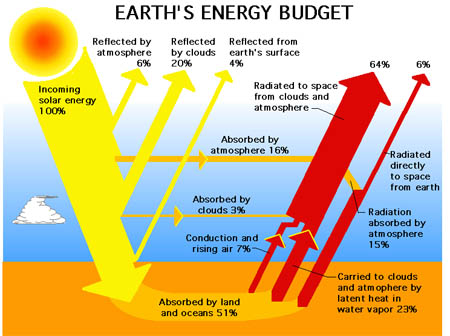
A more popular schematic from various divisions around NASA and Wikipedia etc, is next, and it avoids the issue above:
- Figure 2 NASA
Returning to the Trenberth et al paper, (link is in line 1 above), they give that the 396 W/m2 of EMR emitted from the surface in Fig.1 is calculated primarily by using the Stefan–Boltzmann law, and global year average conditions. Putting aside a few lesser but rather significant issues therein, it is useful to know that:
1) The Stefan-Boltzmann law (S-B) describes the total emission from a flat surface that is equally radiated in all directions, (is isotropic/hemispherical). Stefan found this via experimental measurement, and later his student Boltzmann derived it mathematically.
2) The validity of equally distributed hemispherical EMR is demonstrated quite well by observing the Sun. (with eye protection). It appears to be a flat disc of uniform brightness, but of course it is a sphere, and at its outer edge, the radiation towards Earth is tangential from its apparent surface, not vertical. It is not a perfect demonstration because of a phenomenon called limb darkening, due to the Sun not having a definable surface, but actually plasma with opacity effects. However, it is generally not apparent to the eye and the normally observed (shielded) eyeball observation is arguably adequate for purpose here.
3) Whilst reportedly the original Stefan lab test was for a small flat body radiating into a hemisphere, its conclusions can be extended to larger areas by simple addition of many small flat bodies of collectively flat configuration, because of the ability of EMR waves to pass through each other. This can be demonstrated by car driving at night, when approaching headlights do not change in brightness as a consequence of your own headlights opposing them. (not to be confused with any dazzling effects and fringe illumination)
4) My sketch below demonstrates how radiation is at its greatest concentration in the lateral directions. It applies to both the initial S-B hemispherical surface radiation and to subsequent spherical radiation from the atmosphere itself.

5) Expanding on the text in Figure 3: Air temperature decreases with altitude, (with lapse rate), but if we take any thin layer of air over a small region, and time interval, and with little turbulence, the temperature in the layer can be treated as constant. Yet, the most concentrated radiation within the layer is horizontal in all directions, but with a net heat transfer of zero. Where the radiation is not perfectly horizontal, adjacent layers will provide interception of it.
A more concise way of looking at it is with vectors, which put simply is a mathematical method for analysing parameters that  possess directional information. Figure 4, takes a random ray of EMR (C) at a modestly shallow angle, and analyses its vertical and horizontal vector components. The length of each vector is proportional to the power of the ray, in that direction, such that A + B = C. Of course this figure is only in 2D, and there are countless multi-directional rays in 3D, with the majority approaching the horizontal, through 360 planar degrees, where the vertical components also approach zero.
6) Trenberth’s figure 1 gives that 65% of the HEAT loss from the surface is via thermals and evapo-transpiration. What is not elaborated is that as a consequence of this upward HEAT transfer, additional infrared radiation takes place in the air column by virtue of it being warmed. This initially starts as spherical emission and absorption, but as the air progressively thins upwards, absorption slows, and that radiation ultimately escapes directly to space. Thus, the infrared radiation observable from space has complex sources from various altitudes, but has no labels to say where it came from, making some of the attributions “difficult”.
DISCUSSION; So what to make of this?
The initial isotropic S-B surface emission, (Trenberth’s global 396 W/m2), would largely be absorbed by the greenhouse gases instantaneously near the surface. (ignoring some escaping directly to space through the so-called “atmospheric window”). However, a large proportion of the initial S-B 396 surface emission would be continuously lateral, at the Trenberth imposed constant conditions, without any heat transfer, and its horizontal vectors CANNOT be part of the alleged 396 vertical flux, because they are outside of the vertical field of view.
After the initial atmospheric absorptions, the S-B law, which applied initially to the surface, no longer applies to the air above. (although some clouds are sometimes considered to be not far-off from a black body). Most of the air’s initial absorption/emission is close to the surface, but the vertical distribution range is large, because of considerable variation in the photon free path lengths. These vary with many factors, a big one being the regional and more powerful GHG water vapour level range which varies globally between around ~0 to ~4%. (compared with CO2 at a somewhat constant ~0.04%). The total complexities in attempting to model/calculate what may be happening are huge and beyond the scope of this here, but the point is that every layer of air at ascending altitudes continuously possesses a great deal of lateral radiation that is partly driven by the S-B hemispherical 396, but cannot therefore be part of the vertical 396 claimed in Figure 1.
CONCLUSIONS:
The vertical radiative flux portrayed by Trenberth et al of 396 W/m^2 ascending from the surface to a high cloud level is not supported by first principle considerations. The S-B 396 W/m^2 is by definition isotropic as also is its ascending progeny, with always prevailing horizontal vector components that are not in the field of view of the vertical. The remaining vertical components of EMR from that source are thus less than 396 W/m^2.
It is apparent that HEAT loss from the surface via convective/evaporative processes must add to the real vertical EMR loss from the surface, and as observed from space. It may be that there is a resultant of similar order to 396 W/m^2, but that is NOT the S-B radiative process described by Trenberth.
~~~~~~~~~~~~~~~~~~~~~~~~~~~~~~~~~~~~~~~~~~~~~~~~~~~~~~~~~~~~~
ADDENDUM FOR AFICIONADOS
I Seek your advice
In figure 5 below, note that the NIMBUS 4 satellite data on the left must be for ALL sources of radiation as seen from space, in this case, at some point over the tropical Pacific. The total emissions, amount to the integrated area under the curve, which unfortunately is not given. However, for comparison purposes, a MODTRAN calculator, looking down from 100 Km gives some interesting information for the figure, which is further elaborated in the tables below. Unfortunately the calculator does not give global data or average cloud/sky conditions, so we have apples and pears to compare, not only with Nimbus, but also with Trenberth. However, they all seem to be of somewhat similar order, and see the additional tabulations.

| Compare MODTRAN & “Trenberth”, looking down from 2 altitudes, plus Surface Temperature | ||||
| Location | Kelvin | 10 metres | 100 Km. | (Centigrade) |
| Tropical Atmosphere | 300K | 419 W/m^2 | 288 W/m^2 | (27C) |
| Mid-latitude Summer | 294K | 391 W/m^2 | 280 W/m^2 | (21C) |
| Mid-latitude Winter | 272K | 291 W/m^2 | 228 W/m^2 | (-1C) |
| Sub-Arctic Winter | 257K | 235 W/m^2 | 196 W/m^2 | (-16C) |
| Trenberth Global | 288K ? | 396 W/m^2 | 239 W/m^2 | (15C ?) |
| Compare MODTRAN & “Trenberth”, looking UP from 4 altitudes: W/m^2 | ||||
| Location | From 10 m | From 2 Km | From 4Km | From 6Km |
| Tropical Atmosphere | 348 | 252 | 181 | 125 |
| Mid-latitude Summer | 310 | 232 | 168 | 118 |
| Mid-latitude Winter | 206 | 161 | 115 | 75 |
| Sub-Arctic Winter | 162 | 132 | 94 | 58 |
| Trenberth Global | 333 Shown as coming from high cloud area (= BS according to MODTRAN) | |||
Mr. Watts,
The earth is a globe. Horizontal radiation will leave the atmosphere at an angle if it makes it that far. Shallower angles would leave at angles approaching vertical. Of course, with so much more atmosphere to traverse the likelihood of it leaving on that path is much smaller than straight up, the shortest path!!! As the emission point rises the angle that can irradiate the earth is increasingly small and the radiation has a larger area that points to space through increasing amounts of atmosphere (your cone).
The IR from the surface is most likely going to be absorbed by GHG’s close to the surface anyway. At the pressures and density there I am told collisions will transfer much of that energy to oxygen or nitrogen and be convected away as collisions happen oftener than the emission of IR.
As we go up in the atmosphere that gradually changes until the Strat. where the density apparently favors emission.
GHG’s therefore speed the heating and cooling of the bulk of the atmosphere which has a magnitudes lower absorption and emission rate in the far IR. This also brings into question just how much IR there is to actually get back to the surface if the energy is being preferentially transferred though collisions in the far IR opaque lower trop.
Another interesting bit is that GHG’s absorb in slightly wider frequencies near the ground due to the line broadening. It would seem if they emit at the same frequency the IR going up would have a better chance of escaping as the pressure/temp decreases narrowing the bands and not absorbing as much as the lower.
This would all seem to be especially apropros as to why Venus does NOT have a huge Greenhouse. The effect drops off so quickly only near the surface is it possible to be so massive, yet, the collisional transfer even though it is from CO2 to CO2 must be almost total under such temp/pressure/density!! It would almost seem to be more like water, conducting instead of radiating internally.
I must be wrong, but I don’t know enough to see why.
Tim Folkerts @ur momisugly 6:07 pm,
I don’t have an issue with your transparent atmosphere discussion, if I understand it correctly. (there do seem to be a few typos). However, we do have in our atmosphere GHG’s, particulates, clouds, and precipitation. Note that the MODTRAN calculations in the tables in the addendum, suggest that up-down radiation diminishes with increasing altitude.
See also Wayne @ur momisugly 6:44 pm below and that ol’ T^4 thingy
jimmi_the_dalek,
“The horizontal fluxes will cancel. ”
The surface is a sphere. The adjoining points would NOT cancel. Surface irregularities will confuse this so that the surface is irradiating itself just as the surface of the water does. One of the requirements for S-B to apply is that the surface geometry does NOT allow it to irradiate itself. OOOPS!!!!
Billy @ur momisugly 6:17 pm,
I think my item 5) in the article should answer your concern, if not, please elaborate.
jimmi_the_dalek says:
“Sorry , but no. Temperature is directly affected by absorption of radiation – so how and why are you distinguishing HEAT (in capitals!) from EMR.”
Since long wave radiation is absorbed and then re transmitted, how can there be a NET absorbtion to affect temperature?
>>
KevinK says:
October 26, 2011 at 7:46 pm
In summary, while these nice little graphics do a reasonably good job of describing the first “order” understanding of the energy flows through the Sun / Atmosphere / Earth / Atmosphere / Universe system they have MANY faults. The largest of which is totally discarding any consideration of the speed at which each of these energy flows travel through the system.
<<
These diagrams are “steady-state.” That means the transients have had time to damp out or stabilize.
>>
In electrical engineering this is considered as a “DC” (direct current) analysis. Once the “speed” / “lag time” / “response time” / “delay time” is incorporated into the analysis a totally different prediction of the systems response usually results.
<<
That is unless you’re measuring flows that have had time to stabilize. These diagrams represent such measurements. I admit that these diagrams have a multitude of problems, but bad DC analysis isn’t high on the list of those problems.
Jim
Billy said:
I’m sure that, if you consider the earth as a sphere, these effects all average out and your concern is misplaced.”
I agree that in theory at any point in space all the scattered rays would cross, “averaging out” to be the total energy. However, don’t need to test the measuring device to see if it properly registers the energy from a beam scattered on a very shallow angle?
Its design could reflect those rays.
An interesting analogy is a PV cell on my roof. Calculating the angle of the sun and its cosine allows me to produce the expected electricity production from the cell. Effectively it is the ratio of the area exposed to the sun, compared to the area of the PV cell. But because of the design of the cell when the sun is low in the sky, most of the rays reflect off the surface of the protective cover of the PV cell. So whenI should see ~300W, I see ~30W.
I wonder if the measuring devices have been calibrated or designed to measure emissions at low angles of incidence. The height of satellite orbit would also affect this, the higher the better for reducing this problem.
Tim Folkerts @ur momisugly 6:21 pm
I can understand that you find the vector consideration a tad obscure, but nevertheless, vectors are very useful for analysing parameters having directional information. In fact I wondered if someone might come up with your concern, and contemplated instead showing the classic inclined plane with a mass upon it, but decided it was too tedious and possibly thought to be off-topic.
If you place a mass upon an incline, where it overcomes the coefficient of friction, assuming it, and flatness, to be constant, and ignoring elasticity in the materials, then it will exert a perpendicular force upon the reacting surface according to the vertical component of its mass. If you complete the vector loop there is also an unseen horizontal component vector. This is pure vector maths, but nevertheless the mass can only slide down the direction of the incline
I’m not sure I understand this article but just to clear a few things up, radiation is not heat. Heat is the result of the absorption of radiation by a surface or molecule. 2nd Law of Thermodynamics does state that heat (without work) will only travel from higher to lower temperature, that is correct, however, radiation is not heat. Radiation can travel in any direction and because of this radiation reflected or re-emitted can also travel in any direction, up, down, sideways. Is the question here how much of the radiation is actually absorbed by the system, surface and atmosphere, and how much is lost (unused) out to space, leaves the system without being absorbed? I just don’t know how any of these figures are even calculated. If the earth reflects 4% that presumes that every day, the same amount of energy and direction of radiation and absorbing surfaces never change. This presumption is preposterous. Climate scientists and Physicists cannot do their calculations until they have an average figure but the real world is an every changing system that doesn’t know what an average is. I’m still trying to work out how long wave radiation can produce more heat than short wave radiation thereby causing global warming. I suspect it just ain’t so.
Wayne @ur momisugly 6:34 pm,
Thanks for your comments. I’ve actually been ruminating over the Trenberth/IPCC cartoon for several years, and wondering why I’ve not seen anything in the literature critiquing it. (and I have not seen your comments on it). Oh well, I thought just recently; why not be brave and challenge the great authority.
Myself i am a layman, but i know that the sun is a flaming band and it ebbs and flows. So my question is who came up with the figure on the amount of radiation coming in and is that always constant. Can anyone tellme how it is measured and is it the same amount in the UK as in the USA or Australia, or is it what is measured at the Eqautor and considered the measurement for all of Earth? I have been told by warmist that a specific radiation amount sqaured is constant, on paper yes, but IMHO, the real world, i do not see it.
Sorry, Flaming BALL not Band
jimmi_the_dalek @ur momisugly 6:49 pm
Jimmi, you are describing ONE of the ways of transporting HEAT. In the case of radiation this ONLY happens when there is a potential difference between two sources of radiation.
Check – out Wikipedia on heat transfer, for a start;
http://en.wikipedia.org/wiki/Heat_transfer
A large block of ice and a small candle flame both emit the same amount of EMR. However, only one is capable of warming a human being.
Trenberth’s analysis ignores this simple observation and assumes that since two object emit the same EMR, they contribute the same amount of warming.
I would love to see this in a 3d ray traced model animation. With the multiple freq bands it would have to be broken up into several animations to visualize it. I really enjoy these type threads even though I only understand about 2/6th of the content! Thanks for the puzzle.
I have several problems with these types of simplistic diagrams, and the first of which was mentioned by others that there is no way in hell that you can provide an average measurement with a granularity of 0.1 w/m2. Not possible.
I do a pretty good bit of engineering and space science. We have done a lot of work on the Nimbus II HRIR data sets and clouds are a lot more of an influence than what these simplistic diagrams indicate. In the Nimbus data the temperature of clouds were all the way down to below the 210 kelvin calibration of the sensor over large areas. This indicated a very high altitude for these clouds and a LOT of reflection.
I have measured a 90% decrease in insolation at the surface from cloud cover. This is a broad spectrum measurement with solar panels. Multiply this by the average global cloud cover and it is a hell of a lot more than is indicated.
I also hate using this funky 396 w/m2 average number. The vertical number is 1366 w/m2 and so the second graph does a better job of fixing this problem.
R. Gates says:
October 26, 2011 at 5:46 pm
A perfect example is the compression of air when it flows between zones of different pressure…this is work done on the air molecules, their temperatures will rise as they are compressed and the average kinetic translational energy rises from the work done.
Under that argument, air rising and falling also has work done on it. Sort of like the explanation that the brakes on a car stop the car by turning the motion of the car into heat.
Gail Combs @ur momisugly 7:18 pm
What may not be commonly realized is that the GHG molecules are not the sole carriers of thermal energy as a consequence of their absorption of photons from EMR energy. There are countless molecular collisions between them and the N2 and O2 molecules etc that comprise the vastly greater bulk of the atmosphere. It is commonly called thermalization, of non-greenhouse gasses. These collisions result in a change of kinetic energy (heat) of individual molecules, and just because a GHG molecule absorbs a photon, it does not mean that it will re-emit it, because there is a lot of other stuff going on.
Bob Fernley-Jones says:
October 26, 2011 at 6:12 pm
R. Gates @ur momisugly 5:46 pm,
Yes, you are correct, that work can result in heating, or cooling. An oversight on my part, where I was trying to show the difference between heat and EMR.
____
Thanks for your reply. I assumed it was an oversight on your part. But to be clear, in a pure sense, heat is a measurement of energy in transit, and should not be taken to be a measurement of the average translational kinetic energy (normally called temperature) nor the total internal energy of the object. Again, heat is a energy in transit flowing between objects. An excellent resource on this can be found at:
http://hyperphysics.phy-astr.gsu.edu/hbase/hframe.html
and on the whole issue of heat and thermodynamics, see:
http://hyperphysics.phy-astr.gsu.edu/hbase/hframe.html
To your point about the difference between heat and EMR, They are completely different things,as one is the measurement of the flow energy, and one is a form of energy.
How is it that solar radiation is partially reflected by the surface, but back radiation is 100% absorbed? How is it that the is 0% reflection of back radiation?
Well I have always been critical of the Trenberth “cartoon” earth energy budget, or whatever they currently call it in your new posting. And I should add, that I do not use the word”cartoon” in any derogatory sense; simply a descriptive label for a diagram that is not very scientific.
So tell me; why would anyone (including me) take any notice of anything written by a “scientist” apparently with a Doctorate Degree (Dr Laura has a PhD, and she doesn’t know beans about climate either) who uses “Watts” or “Watts per metre squared” as units of ENERGY.
When I went to school and studied Physics, Watts, was a unit of POWER, and “Watts per metre squared” would be a unit of AREAL POWER DENSITY.
And at the position of earth’s orbit (average) the arriving power density is 1362 Watts per metre squared; it certainly is NOT 341 W/m^2.
The response of real materials to an incident power density of 1362 W/m^2 (irradiance) will be quite different to the response to 341 W/m^2. For example the former might melt or vaporize a material whereas the latter may not. Such a change might be irreversible, in that the altered material may then become widely dispersed.
An example would be, a somewhat attenuated proportion of each of those purported radiances being incident on the surface of say an Arctic (of Greenland) ice mass.
The former larger radiance might result in warming the ice surface sufficiently for it to melt, whereas the latter could do no such thing.
Remember that WATTS is a rate of supply (or loss) of energy, and if the supply rate does not exceed the loss rate from other processes, such as simple thermal radiation; or conduction, then melting will NEVER occur, no matter how long that condition is maintained.
And since the earth rotates, under that incident power density (radiance) of 1362 W/m^2, if melting does not occur, during the irradiation portion of the daily cycle it never will melt, and it certainly won’t melt under 341 W/m^2 irradiance.
So Trenberth’s cartoon is unscientific gobbledegook.
ferd berple says:
October 26, 2011 at 9:34 pm
A large block of ice and a small candle flame both emit the same amount of EMR. However, only one is capable of warming a human being.
_____
Depends how cold that human being might be. Energy will flow from a block of ice to a human if that human is chilled below the temperature of the block of ice (by floating in interstellar space for a few minutes for example). Also, on what basis do you contend that a “large” block of ice and “small” candle flame emit the same “amount” of EMR? How can you know this?
I have just published a little monograph on this subject titled ‘The Dynamic Greenhouse Effect and the Climate Averaging Paradox’ . The links are:
Paperback:
http://www.amazon.com/Dynamic-Greenhouse-Climate-Averaging-Paradox/dp/1466359188/ref=sr_1_2?s=books&ie=UTF8&qid=1319675042&sr=1-2
Kindle:
http://www.amazon.com/Dynamic-Greenhouse-Climate-Averaging-ebook/dp/B005WLEN8W/ref=sr_1_1?s=books&ie=UTF8&qid=1319675042&sr=1-1
I put my dynamic or time dependent version of the K-T diagram on the front cover. Just copy it from Amazon. This may be challenge to Trenberth that you are looking for. Journals like Nature and Science wouldn’t dare touch this one. Once the dynamics are understood then the whole global warming problem disappears into the noise of the daily surface energy transfer. The ‘average’ solar heating and convective cycle is 12 hours not 24.
The funamental issue is that there is no such thing as a climate equilibrium state. The whole radiative forcing approach is just plain wrong. There are no ‘forcings’ or ‘feedbacks’. The climate models have been wrong at least since 1967 when Manabe and Wetherald started down the wrong path.
There is more info on my little web site at http://www.Venturaphotonics.com for those who are interested.
What he said:
George E. Smith; says
October 26, 2011 at 10:00 pm
Since delving in the mire of IPCC climate modeling I came to the opinion that some climate “scientists” think that physics is a la cart: pick and choose what you like, feel free to redefine what you like and create new terminology that sounds like physics. They have managed to dominate their field so even quite solid climate scientists use some of their terminology, making life very hard for physicists :). It feels like wading through hair.
There is a lot more examples of contention even in the second NASA version. While it is headed ENERGY budget, it diesn’t give units so that is ok.
BUT !! just let’s start with the INPUT at the left edge in yellow. Starting at 100%, 20% is reflected by clouds. Well average global cloud cover is supposed to be in excess of 60%, so if only 20% is reflected from 60% coverage, then the cloud reflectance must only be 33%. And the reflectance of clouds over the solar spectrum is well known to be much higher than 33%, so that 20% number doesn’t fly.
Now look there at the cloud ABSORPTION; only 3%
Now if the clouds REFLECT 20% and ABSORB 3%, what does that say about how much of the solar energy the clouds TRANSMIT ?
Well anyway, that is just an aside; the real point is that in CLEAR AIR there are NO clouds; so the clear air losses of solar energy are then 6% REFLECTED by the atmosphere; 16% ABSORBED by the atmosphere and 4% REFLECTED by the surface (oceans plus land). So assuming that is all true, then the ground level solar insolation (clear air) is 26% less than the TSI or 74% of 1362 which comes out to 1007 W/m^2, and that seems like a believable number since 1,000 W/m^2 is the usually accepted maximum power density for solar energy availability.
The 6% reflectance of the atmosphere is news to me; I’ve never been aware of it. Is it possible that they are using the term REFLECTANCE to describe processes like Raleigh scattering, that produces the blue sky color, and results in a like amount of solar energy being scattered to space.
The incoming solar rays are certainly not obeying the reflection laws of geometrical optics, so it is incorrect to describe Raleigh or Mie scattering as REFLECTANCE.
As to the 4% reflected from oceans and land, about 75% of the earth surface in the major solar input latitudes, is ocean, and the normal relfectance is 2%. That leaves another 2% to be reflected from the land, which comprises only 25% of that surface area. a simple calculation then shows that the land reflectance must only be 10%; and that would be a maximum, because, while 2% is the normal incidence reflection coefficient of water, over all angles, the total reflectance is more like 3%, since the 2% number holds relatively constant up to teh Brewster angle (57 deg incidence), but then increases rapidly beyond that.
So in that case, the land must only contribute 1% to the total reflectance and that reduces the land reflection coefficient down to 7%.
Whether 7% or 10%, both numbers are way too low for the reflectance of land areas.
But at least it looks as if they may be closer than Trenberth, and they avoid the incorrect units problem, and its consequences