Guest post by Bob Fernley-Jones by Bob Fernley-Jones AKA Bob_FJ
CAUTION: This is written in Anglo-Oz English.
Here is the diagram as extracted from their 2009 paper, it being an update of that in the IPCC report of 2007 (& also 2001):


The unusual aspect of this diagram is that instead of directly showing radiative Heat Transfer from the surface, it gives their depiction of the greenhouse effect in terms of radiation flux or Electro-Magnetic Radiation, (AKA; EMR and a number of other descriptions of conflict between applied scientists and physicists). EMR is a form of energy that is sometimes confused with HEAT. It will be explained later, that the 396 W/m^2 surface radiation depicted above has very different behaviour to HEAT. Furthermore, temperature change in matter can only take place when there is a HEAT transfer, regardless of how much EMR is whizzing around in the atmosphere.
A more popular schematic from various divisions around NASA and Wikipedia etc, is next, and it avoids the issue above:
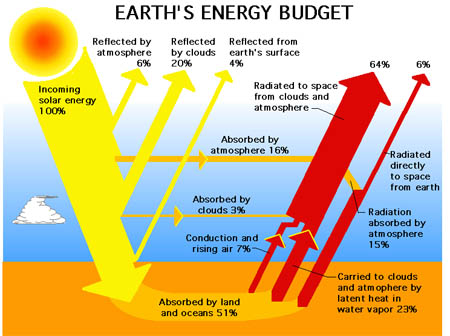
- Figure 2 NASA
Returning to the Trenberth et al paper, (link is in line 1 above), they give that the 396 W/m2 of EMR emitted from the surface in Fig.1 is calculated primarily by using the Stefan–Boltzmann law, and global year average conditions. Putting aside a few lesser but rather significant issues therein, it is useful to know that:
1) The Stefan-Boltzmann law (S-B) describes the total emission from a flat surface that is equally radiated in all directions, (is isotropic/hemispherical). Stefan found this via experimental measurement, and later his student Boltzmann derived it mathematically.
2) The validity of equally distributed hemispherical EMR is demonstrated quite well by observing the Sun. (with eye protection). It appears to be a flat disc of uniform brightness, but of course it is a sphere, and at its outer edge, the radiation towards Earth is tangential from its apparent surface, not vertical. It is not a perfect demonstration because of a phenomenon called limb darkening, due to the Sun not having a definable surface, but actually plasma with opacity effects. However, it is generally not apparent to the eye and the normally observed (shielded) eyeball observation is arguably adequate for purpose here.
3) Whilst reportedly the original Stefan lab test was for a small flat body radiating into a hemisphere, its conclusions can be extended to larger areas by simple addition of many small flat bodies of collectively flat configuration, because of the ability of EMR waves to pass through each other. This can be demonstrated by car driving at night, when approaching headlights do not change in brightness as a consequence of your own headlights opposing them. (not to be confused with any dazzling effects and fringe illumination)
4) My sketch below demonstrates how radiation is at its greatest concentration in the lateral directions. It applies to both the initial S-B hemispherical surface radiation and to subsequent spherical radiation from the atmosphere itself.

5) Expanding on the text in Figure 3: Air temperature decreases with altitude, (with lapse rate), but if we take any thin layer of air over a small region, and time interval, and with little turbulence, the temperature in the layer can be treated as constant. Yet, the most concentrated radiation within the layer is horizontal in all directions, but with a net heat transfer of zero. Where the radiation is not perfectly horizontal, adjacent layers will provide interception of it.
A more concise way of looking at it is with vectors, which put simply is a mathematical method for analysing parameters that  possess directional information. Figure 4, takes a random ray of EMR (C) at a modestly shallow angle, and analyses its vertical and horizontal vector components. The length of each vector is proportional to the power of the ray, in that direction, such that A + B = C. Of course this figure is only in 2D, and there are countless multi-directional rays in 3D, with the majority approaching the horizontal, through 360 planar degrees, where the vertical components also approach zero.
6) Trenberth’s figure 1 gives that 65% of the HEAT loss from the surface is via thermals and evapo-transpiration. What is not elaborated is that as a consequence of this upward HEAT transfer, additional infrared radiation takes place in the air column by virtue of it being warmed. This initially starts as spherical emission and absorption, but as the air progressively thins upwards, absorption slows, and that radiation ultimately escapes directly to space. Thus, the infrared radiation observable from space has complex sources from various altitudes, but has no labels to say where it came from, making some of the attributions “difficult”.
DISCUSSION; So what to make of this?
The initial isotropic S-B surface emission, (Trenberth’s global 396 W/m2), would largely be absorbed by the greenhouse gases instantaneously near the surface. (ignoring some escaping directly to space through the so-called “atmospheric window”). However, a large proportion of the initial S-B 396 surface emission would be continuously lateral, at the Trenberth imposed constant conditions, without any heat transfer, and its horizontal vectors CANNOT be part of the alleged 396 vertical flux, because they are outside of the vertical field of view.
After the initial atmospheric absorptions, the S-B law, which applied initially to the surface, no longer applies to the air above. (although some clouds are sometimes considered to be not far-off from a black body). Most of the air’s initial absorption/emission is close to the surface, but the vertical distribution range is large, because of considerable variation in the photon free path lengths. These vary with many factors, a big one being the regional and more powerful GHG water vapour level range which varies globally between around ~0 to ~4%. (compared with CO2 at a somewhat constant ~0.04%). The total complexities in attempting to model/calculate what may be happening are huge and beyond the scope of this here, but the point is that every layer of air at ascending altitudes continuously possesses a great deal of lateral radiation that is partly driven by the S-B hemispherical 396, but cannot therefore be part of the vertical 396 claimed in Figure 1.
CONCLUSIONS:
The vertical radiative flux portrayed by Trenberth et al of 396 W/m^2 ascending from the surface to a high cloud level is not supported by first principle considerations. The S-B 396 W/m^2 is by definition isotropic as also is its ascending progeny, with always prevailing horizontal vector components that are not in the field of view of the vertical. The remaining vertical components of EMR from that source are thus less than 396 W/m^2.
It is apparent that HEAT loss from the surface via convective/evaporative processes must add to the real vertical EMR loss from the surface, and as observed from space. It may be that there is a resultant of similar order to 396 W/m^2, but that is NOT the S-B radiative process described by Trenberth.
~~~~~~~~~~~~~~~~~~~~~~~~~~~~~~~~~~~~~~~~~~~~~~~~~~~~~~~~~~~~~
ADDENDUM FOR AFICIONADOS
I Seek your advice
In figure 5 below, note that the NIMBUS 4 satellite data on the left must be for ALL sources of radiation as seen from space, in this case, at some point over the tropical Pacific. The total emissions, amount to the integrated area under the curve, which unfortunately is not given. However, for comparison purposes, a MODTRAN calculator, looking down from 100 Km gives some interesting information for the figure, which is further elaborated in the tables below. Unfortunately the calculator does not give global data or average cloud/sky conditions, so we have apples and pears to compare, not only with Nimbus, but also with Trenberth. However, they all seem to be of somewhat similar order, and see the additional tabulations.

| Compare MODTRAN & “Trenberth”, looking down from 2 altitudes, plus Surface Temperature | ||||
| Location | Kelvin | 10 metres | 100 Km. | (Centigrade) |
| Tropical Atmosphere | 300K | 419 W/m^2 | 288 W/m^2 | (27C) |
| Mid-latitude Summer | 294K | 391 W/m^2 | 280 W/m^2 | (21C) |
| Mid-latitude Winter | 272K | 291 W/m^2 | 228 W/m^2 | (-1C) |
| Sub-Arctic Winter | 257K | 235 W/m^2 | 196 W/m^2 | (-16C) |
| Trenberth Global | 288K ? | 396 W/m^2 | 239 W/m^2 | (15C ?) |
| Compare MODTRAN & “Trenberth”, looking UP from 4 altitudes: W/m^2 | ||||
| Location | From 10 m | From 2 Km | From 4Km | From 6Km |
| Tropical Atmosphere | 348 | 252 | 181 | 125 |
| Mid-latitude Summer | 310 | 232 | 168 | 118 |
| Mid-latitude Winter | 206 | 161 | 115 | 75 |
| Sub-Arctic Winter | 162 | 132 | 94 | 58 |
| Trenberth Global | 333 Shown as coming from high cloud area (= BS according to MODTRAN) | |||
Tim,
Thank you for cherry-picking part of a line of mine that was couched in irony.
If you check back on my article, the prime topic related to isotropic radiation in an absorptive atmosphere. I have little interest in the actual numbers, but just to show that the vertical components of the 396 must be less than 396. The addendum showing absorption spectra etc, was just that: an addendum as a puzzling matter of interest, which I doubt can be solved within current knowledge. (See also Spector’s posts above)
WRT your philosophy on science:
There was a great Bishop a few centuries ago, (Upshott?), famous for precisely calculating the age of the Earth at that time as being 6004 years. It was based on sound data in the Holy Bible, a forerunner of the IPCC report. Then along came Kelvin, and shock-horror whilst personally facing ridicule, he said nah, Earth is much older, based on calculations on rate of heat loss through the Earth’s crust. (even though he knew not the origins of that heat…. Erh sorry, but for you Tim, read; thermal energy ILO heat). But, they were both wrong by some billions of years; so it seems.
Take Alfred Wegener; not all that long ago he had a fairly sound hypothesis of “continental drift”, (tectonics), but I understand he never got it past peer review, and got a good deal of cheek from his church. Yeah, that’s right, he didn’t have any numbers!
As for your concluding:
I can kind of visualize an integration somewhere around the TOA, wherever that is, isotropically to space, ignoring transitions. However at the surface and above in an opaque atmosphere? Eh? If you really think that, why not submit an article to Anthony and see how it goes?
Incidentally, my laptop is starting to run seriously slow at over 450 comments, including those Myrhh monsters.
Tis time for a new updated post methinks, if Anthony might agree, or bye-byes from me here.
Bob, I don’t think the key is mere calculations. A theory that has a quantitative component makes it easier to check against experiments and provides more useful predictive capabilities (from which we can also further test the theory).
I haven’t looked up Wegener, but I am sure the current theories are superior to whatever he presented, even if they adopted the essence of his theory.
It’s only a matter of time before good theories gain acceptance, but it does take time, partly because there are many many more “great” theories that fail in various ways under the microscope. Science isn’t about faith, it’s about weeding out to find the most useful models of reality (eg, repeatability/verifiability, comprehensive yet as simple as possible, computational components/utility, etc).
One of the biggest problems I have with challenges to current climate science is that there is no theory being presented that beats what exists. Most likely (“if I were a gambling man”) I’d say that nearby future changes will not be revolutionary but instead adjust the current theories.
The computer models can do a very good job of solving many differential equations (including doing all the necessary “integrating”) to improved degrees of precision as computational power increases. Most people challenging the status quo are not aggressively looking at these software programs, and so are really hurting their chances of providing a competitive computational framework. There are some open source versions of complex climate models that can be used for free, analyzed, documented, and forked if necessary. [giss/nasa has at least their model E as open source.. google.]
Jose_X @ur momisugly November 18, at 3:55 pm
you wrote in part:
• Do you know of any empirical evidence that shows a connection between global warming and CO2?
• Please explain why more powerful computers will give better results on GIGO models? Won’t they just pump-out Garbage more quickly?
• Did you see that recent article at WUWT, where the IPCC has allegedly reported a change in heart about AGW over the next 20 or 30 years?
• I responded to your latest comment on my website, (which is not intended as a blog), concerning Donna Laframboise’s book. Don’t be a meanie; spend $4.99, it won’t kill you.
Jose_X
Please ignore/do not respond to my last post to you. I guess I was thinking you needed some help, but it is really going too far off topic
Bob,
I’ll have to just agree to disagree with your understanding of “the vertical component of the 396 W/m^2”.
~~~~~~~~~~~~~~~~~~~~~~~~~~~~~~~~~~~~~~~~
I *do* disagree with your characterization of science (or more specifically, your characterization of my characterization of science).
“It was based on sound data in the Holy Bible”
The Bible is an authoritative source of religious information for Christians, but it is not an authoritative scientific source of “sound data”.
” … based on calculations on rate of heat loss … ”
Now you are agreeing with me! He had *numbers* that allowed a scientific understanding of a situation. He didn’t have all the data (no one ever does!) but he could *calculate* a number for the age based on the assumptions he made. His knowledge was no longer “meager and unsatisfactory”. We wasn’t just guessing an age, or accepting an authority. He could be quite sure that the earth was not just 6000 years old.
“Take Alfred Wegener … “
OK. He had a fascinating hypothesis. According to wikipedia “He supposed the cause might be the centrifugal force of the Earth’s rotation (“Polflucht”) or the astronomical precession.”
From the 20’s to the 60’s, scientists made measurements and performed calculations to support or rule out various hypotheses. For example, both precession nor centrifugal force were ruled out by calculating the magnitude of such effects. As better data and better calculations come forward, the theory took shape and became accepted.
~~~~~~~~~~~~~~~~~~~~~~~~~~~~~~~~~~~~~~~~~
IMHO, your theory is similar to continental drift in the 1920’s — an interesting hypothesis in need of calculations to give it a firmer foundation. On the other hand, I see MODTRAN more like continental drift in the the 1960’s. MODTRAN uses detailed calculations based on absorption data of real gases and comes up with spectra that match data quite well (your Figure 5).
If you want to convince me, you will have to show why MODTRAN is wrong (even though it matches real spectra well) and/or show that your approach gives BETTER results.
Tim Folkerts @ur momisugly November 21, at 5:59 pm
[1] Well actually old chap, I’m NOT putting forward a theory or hypothesis, but a simple first principles statement of fact for you, in which I assume that you agree with elementary quantum theory and the greenhouse effect. The initial S-B surface emission is indisputably isotropic, (hemispherically on average), and BECAUSE the atmosphere is absorbent, a good deal of it is absorbed. (apart from in those unaffected wavelengths escaping directly to space through “the window”). As a consequence, there are subsequent emissions of various values from the GHG’s at successive ascending levels in the atmosphere. (arguable from Kirchhoff’s law for a surface). These emissions are isotropic spherically, and would not exist in a transparent atmosphere, by definition. Because these emissions are isotropic, there are undeniable horizontal components in which the photons are annihilated in absorption, but it is a CONSTANT process of renewal by virtue of the gas temperature; consequent from a global constant surface T average specified by Trenberth. Thus, as I think you agreed somewhere, there is all this horizontal EMR whizzing around, in which there is no heat transfer, yet this EMR must have come from somewhere, and it ain’t part of the vertical stuff. To quantify the components at ascending levels would be phenomenally difficult, (see [2]), and frankly that is not my purpose. It is exquisitely adequate to say that the vertical components are less than the isotropic total….. ZERO need for a calculation!
[2] Concerning the DIFFERENT topic of MODTRAN modelling, Spector was also keen on it, but when I asked if he/she knew if and how the modelling included Evapotranspiration, Thermals, Solar absorbed, (and I forgot to mention incoming solar IR), and how that untagged stuff might be graded by altitude, he responded to the effect: Dunno.
OK Tim: What do YOU know?
Is your confidence based on real knowledge, or respect for “authority”
Do you like comparing bananas with apples?
Bob,
I can agree with everything you said up through “…yet this EMR must have come from somewhere”
Where we diverge is where the energy comes from and goes to. Consider a band of wavelengths where the IR gets absorbed by a small bit of the atmosphere right above the ground — suppose this band has 6 W/m^2 of photons being emitted from the ground. You could say that (in this band) ~ 1/6 of the energy absorbed from IR photons coming from the ground goes in each of the “six directions” N, S, E, W, Up, & Down — ie 1 W/m^2 in each direction. If that was the whole story, then the upward component of IR would indeed get dramatically attenuated — ie only 1 W/m^2 continuing upward instead of 6 W/m^2.
However, because the atmosphere to the south is about the same temperature as the ground (and because it is an efficient emitter of IR in that same band), it will ALSO be sending 6 W/m^2 to our bit of atmosphere. And again 1 W/m^2 will go generally in each of the six directions. The same holds true for the other directions.
NET RESULT: 6 W/m^2 is coming from each of the “six directions” and 6 W/m^2 will be heading out in each of the “six directions”.
NOTE: This assumes a constant temperature for the atmosphere. Now in reality, there is a lapse rate, and this will mean less coming in and less going out in the IR bands as you go higher. But I argue that this is a result of a change in temperature, not due to energy ‘getting scattered sideways’.
As for MODTRAN, I am not an expert, but I do know it reproduces the actual spectra pretty well (as shown in your figure above). This is the single most important feature of a calculation.
Looking at the output from MODTRAN, it appears that it assumes a temperature and pressure profile based on typical values. This would be a bit of a simplification, since all the other factors you mentioned are simply assumed to have an effect that produces the profile they use. In effect they are taking the standard lapse rate and calculating from there. For minor adjustments of the parameters, this is probably fairly safe. In more extreme cases, this would be a problem. For example, removing O3 from the stratosphere should remove much of the temperature rise in the stratosphere, but it has no effect on the assumed profile in MODTRAN. I suspect that the temperature profiles could adjusted, but not easily in the interface I have seen.
I don’t thinks this is really a apples/bananas comparison. You are saying that the energy upward must decrease significantly as you go up. MODTRAN says the energy upward does not show much change thru several km of altitude, even though nearly all of the IR photons from the ground (in IR absorption bands) must have been absorbed and “re-emitted mostly sideways”. To that extent, you are directly competing with MODTRAN to describe how the photons flow.
In 1954, Hoyt C Hottel conducted an experiment to determine the total emissivity/absorptivity of carbon dioxide and water vapour. From his experiments, he found that the total emissivity of carbon dioxide is almost xero below 33 deg C (551 deg R) in combination with a partial pressure of 0.00039 atm.
17 years later B Leckner verified Hottel’s results finding that the emissivity of carbon dioxide was insignificant below 33 deg C and a pp of 0.00039 atm.
Hottel and Leckner’s graphs show a total emissivity for carbon dioxide of zero under those conditions.
The same investigators found by experiment that the emissivity/absorptivity for 5% atmospheric water vapour at 33 deg C was 0.4.
The absorption/emission spectral bands of CO2/H2O overlap and for atmospheric concentrations of 5% H2O and 0.039% CO2 it was found that CO2 attenuates the total absorptivity/emissivity of water vapour and acts to cool rather than warm the atmosphere.
@Robert S, I could not find the paper by Hottel (didn’t check for others). Can you provide a link?
Let me ask, at what wavelength does the quoted emissivity apply?
Over what depth of atmosphere does the emissivity apply?
How was this measured?
Doesn’t such an allegedly negligible value disagree with satellite measurements?
I don’t have data for the above, but I seriously get the feeling anyone alleging CO2 has negligible effect in our atmosphere hasn’t looked at the relevant data and/or is confused about the meaning of various measurements. I think the accepted theories agree to first order with satellite measurements. I imagine the depth of the atmosphere is not being factored in properly by those saying CO2 has negligible effect. Additionally, emissivity is useful for seeing how much energy leaves from the body at equilibrium but not at how the internal temperatures of the components of the body vary or what temp value they reach.
Jose_X, and Robert S
Your comments are a tad off-topic, but interesting. I think that Robert may be referring to Prof Nasif Nahle. It seems that Hottel and Leckner are not the only authors to write on this. See:
Determining the Total Emissivity of a Mixture of Gases Containing Overlapping Absorption Bands: A Note from Nasif S. Nahle (My bold)
http://jennifermarohasy.com/2011/04/determining-the-total-emissivity-of-a-mixture-of-gases-containing-overlapping-absorption-bands/
Check-out the 15 references
I’ve not researched it, but it looks interesting at a quick look.
BTW Jose, not all the literature is in papers in journals; (possibly behind a pay-wall); some is in books, some of which cost even more than the massive US$ 4:99, you imply elsewhere that you can’t afford!
Funny how Hottel and Leckner are unknown to the IPCC and climategate I & II Email personnel according to boolean search.
Jose,
I share your concerns about CO2 emissivity. This is a good link to a relevant summary of the topic: http://dspace.mit.edu/handle/1721.1/42950.
1) 5% H2O is very high. Typical numbers are 1-4% near the ground. Higher up where the air is colder, this number drops to ~ 0. Since the higher altitudes are where the radiation to space mostly occurs, water becomes mostly irrelevant.
2) From one of the graphs, the emissivity of CO2 @ur momisugly ~ 300 K is ~0.04 for 1 cm-ATM. For air with a 400 ppm CO2, the partial pressure would be 1/2500 ATM. So the situation quoted would be for 2500 cm, or 25 m of the atmosphere. I suppose they can say that 4% absorption is “almost zero” for lengths of a few tens of meters, of that less than 1% would be “almost zero” for lengths of less than a few meters.
For 2500 m, this would increase to an emissivity of ~ 0.18 according to the table. Given that much for much of the spectrum, CO2 is transparent to IR, the bands where it DOES absorb must be close to 100% absorbed over the first couple km.
In the upper atmosphere, absorption/emission would be nearly complete over lengths of maybe a few 10’s of km. This implies the “TOA” is on the order of 25 km thick.
Tim Folkerts @ur momisugly November 24, at 1:31 pm
Sorry Tim, I don’t get it, but it doesn’t matter anyway. Regardless of how much EMR you think there is whizzing around in the horizontal, (which is part of the total isotropic EMR), there is no net energy transfer. The only portion that gives net energy transfer is vertical.
Yes, the only part that gives a net transfer is vertical. But I would say that near the surface, this net transfer upward is due (almost entirely) to the “gaps” in the IR spectrum, not in the absorption bands of the GHGs. Near 15 um, where CO2 absorbs well, the net flow will be very close to 0 in the vertical direction, because ~ as many IR photons will be emitted downward from the CO2 above you as are emitted upward from the ground below you. And the CO2 will emit that same amount upward (the “6 W/m^2) in my previous example).
[There will be a very small net upward flow because the lapse rate pretty much guarantees the CO2 above you is cooler than the ground below you. But with an inversion layer in the atmosphere, I would conclude there would be MORE 15 um IR heading down to the earth than there is going up from the ground. More interestingly, there would also be MORE IR heading up from the top of the inversion layer than there is heading up from the surface. The CO2 will ENHANCE the upward flow of IR photons, not diminish it as. In other words, the arrow in the trenberth diagram for upward IR would be INCREASING from 396 W/m^2 as it went up from the surface until it hit the top of the inversion layer, before it started decreasing again.]
In the “gaps” (say around 11 um) , the earth is still emitting IR upward, but the GHGs are emitting nothing downward. This is what is responsible for the net vertical flux. It is not the absorption (and scattering in various directions) that reduces the upward flux, it is the transmission upwards (with no compensating downward flux) that is responsible for the net flow.
Let me do a gedanken experiment, and add gases to the atmosphere that absorbed IR at ALL frequencies. Supppose the gases were dense enough that 99.99% of the IR photons from the ground were absorbed in the first 100 m. Suppose the ground emits 360 W/m^2 at whatever temperature it happens to be. How much IR flux would you expect to see if you looked down from 100 m? I would expect to see 360 W/m^2. I would also expect to see 360 W/m^2 if I looked up.
Tim Folkerts @ur momisugly November 24, at 1:48 pm
Tim, if you look at fig 5a, it describes the data as being …over a point in the tropical Pacific Ocean… Oh OK; but it makes no mention of day, night, season, or cloud cover, and the tropical Pacific is quite a big place, with some islands and other stuff, such as substantially varying regional weather patterns.
Whilst fig 5b is remarkably similar, (by my selection, which is why I queried it as a matter of interest in the addendum), it too is lacking ID as far as certain essential parameters required for comparison with 5a are concerned.
BTW, I’ve just spotted a mistake in my text for 5b. Where I wrote NIMBUS, I meant to write MODIS…… Sorry.
Oh, and you admit that you don’t know how the MODTRAN modelling is done. Have you considered the possibility that they may have fed-in some data from NIMBUS for looking down?
I think that this truncated quote is pure speculation and of no value.
If you try to compare 5a with 5b and Trenberth’s 396 W/m^2, then you are not comparing apples with apples.
Note that the Trenberth 396 does not include the multiple other inputs that you speculate MODTRAN has somehow incorporated.
Jose_X says:
November 25, 2011 at 10:44 pm
@Robert S, I could not find the paper by Hottel (didn’t check for others). Can you provide a link?
Yes, the paper referred to is in the following:
http://www.biocab.org/Mean_Free_Path.pdf
This is the first time I have seen a reference to any experiments by Hottel on atmospheric CO2 and water vapour at 33 deg C with the very special conclusion that the emissivity of CO2 is almost zero and insignificant.
My own calculations are close to Tim Folkerts perhaps we were using the same charts for CO2 and H2O from Hottel’s 1935 papers which are reproduced in McAdams ‘Heat Transmission’ chapter 4.
Using a partial pressure of 0.0231atm for water vapour I calculated that the absorbable LWIR is absorbed to extinction in 120 m giving an emissivity of 0.57.
These comments may be a tad off comment but as global warming is all about CO2 and its absorption of LWIR I think it is important to point out that,(1) there is no correlation betwween CO2 and global Warming and, and (2) that Hottel ond others found that the emissivity of CO2 was either close to zero or insignificant in the atmospheric context.
Robert S, you aren’t making sense to me. Tim Folkerts’ note, if I understood, was that atmosphere CO2 has significant absorption, the opposite of what I think you are saying. And the charts he pointed to show that CO2 emissivity is negligible if you consider a small enclosing of CO2 but are very significant if you look at large enclosures (including anything resembling a mile of travel distance in a dimension). Additionally, I have no idea what you mean by CO2 and global warming having no correlation? Where are you getting that from? One of the favorite arguments by many “skeptics” includes that historically CO2 clearly lags temperature. Climatologists agree that historically CO2 lags temperature. Clearly lagging something else is a strong correlation. Are you saying you don’t agree with that data?
Jose_X, I am saying that after the absorbable LIR wavelengths have been absorbed by water vapour and CO2, an increase in atmospheric CO2 will not absorb any more heat, it will merely change the absorption distance slightly but there will no additional warming. If CO2 was leading temperature, which it does not, you would get a feedback and a runaway (hockey stick) temperature increase which is clearly not happening. In the last decade there has been a reduction if anything.
@Robert S, I will assume from “I am saying that ..[something Robert S had not said]..” that you are Robert Stevenson.
What physics are you invoking in saying that adding more CO2 won’t lead to higher temperature? More CO2 molecules means more opportunities to absorb and re-emit ever closer to the ground and in higher densities as we move away from the ground. Why do you think this increase in absorption instances won’t lead to greater average kinetic energy (temp)? The average time a CO2 molecule would be exited would be going up (and with LTE, we know that all other gas molecules will also be increasing).
Note that I am not asking for an equation or claiming the relationship will be linear, but why do you think temp would essentially stop increasing (all else remaining the same)?
Also, CO2 is not a constant multiple of temperature. There are other variables. When people talk about “leading”, they likely mean when looked at over long period averages (steady state and with assumptions on how other variables behave).
Robert S,
I agree that near the surface, a little more CO2 will have little affect on the the absorption of IR because of the significant overlap with water absorption. However, high in the troposphere there is little H2O, and there CO2 is the major GHG.
Look at Bob’s figure 5. There is a “bite” out of the spectrum near 15 um due to CO2 radiating from the cold upper troposphere. With more CO2 in the troposphere, the “TOA” for IR radiation to space from CO2 would be a bit higher, and hence a bit cooler. This would make the “bite” deeper, lowering the IR radiation to space. With the same sunlight in but less IR out, the earth must warm a bit. Eventually the ground will become slightly warmer and can radiate a little extra to make up for the reduced amount of IR energy that CO2 is radiating to space.
That is the basic theory. Of course, then you can start talking about other feedbacks that could enhance or diminish the warming (eg changes in cloud cover).
Bob,
The hypothesis that MODTRAN assumes a temperature profile was a little more than speculation on my part. I had tried some rather drastic changes in he atmosphere (eg removing all the CO2) and the temperature profile remained exactly the same.
>If you try to compare 5a with 5b and Trenberth’s 396 W/m^2,
>then you are not comparing apples with apples.
Quite right, Those figures are connected to the 239 W/m^2 emitted to space.
>Note that the Trenberth 396 does not include the multiple other
>inputs that you speculate MODTRAN has somehow incorporated.
What I speculated was that MODTRAN has incorporated the net energy flows by assuming a temperature profile consistent with the observed profile, which is a result of all the energies.
However, MODTRAN’s energy and spectrum calculations are for IR only, and hence should relate to trenberth’s IR numbers (396, 333, 239) when looking at appropriate outputs from appropriate locations/directions.
@Robert S, I forgot to finish the reply..
Could you explain what you interpret as “leading” and then also explain what you meant by, not leading or else “you would get a feedback and a runaway (hockey stick) temperature”?
Reading Tim Folkerts reply, I should qualify that I was addressing the behavior of raising ghg gases, generally.
Specifically for CO2 at low heights (where a much greater concentration of water vapor exists) and in overlapping bands with water vapor, the water vapor effect overshadows the CO2 effect as long as the CO2 level is rather small. Put differently, a 20% increase in CO2 in a volume where that increase constitutes say a 1% increase in ghg effect (for a given absorption band) will be as if the increase was of around 1% and not 20%.
Regardless, at any given band where the earth is radiating, adding more of any gas that absorbs in that band should continue to increase the temp (under this simple model.. ie, ignoring other potentially counterbalancing effects), I think, for the reason I mentioned earlier: essentially that there is more traffic to intercept the photons, so their energies will remain in the atmosphere for a longer period of time, implying the atmosphere will remain at a higher temperature.
Tim Folkerts @ur momisugly November 27, at 5:42 am
Tim, if there were 6 W/m^2 going up, and the same amount going down, the upward emission in that layer would be 6 W/m^2. The downward flux from either within or above the referenced layer would not impede the upward emissions in any layer.
If you are describing an S-B calculation, the total emission from the surface would be in all hemispherical directions, (isotropic). Thus, if you look down from 100m, you would not see the horizontal components, and would thus see less than 360 in total.
Oh BTW, the atmospheric widow is a separate issue, where I’ve repeatedly said like; ignoring stuff escaping directly to space.