Guest post by Bob Fernley-Jones by Bob Fernley-Jones AKA Bob_FJ
CAUTION: This is written in Anglo-Oz English.
Here is the diagram as extracted from their 2009 paper, it being an update of that in the IPCC report of 2007 (& also 2001):


The unusual aspect of this diagram is that instead of directly showing radiative Heat Transfer from the surface, it gives their depiction of the greenhouse effect in terms of radiation flux or Electro-Magnetic Radiation, (AKA; EMR and a number of other descriptions of conflict between applied scientists and physicists). EMR is a form of energy that is sometimes confused with HEAT. It will be explained later, that the 396 W/m^2 surface radiation depicted above has very different behaviour to HEAT. Furthermore, temperature change in matter can only take place when there is a HEAT transfer, regardless of how much EMR is whizzing around in the atmosphere.
A more popular schematic from various divisions around NASA and Wikipedia etc, is next, and it avoids the issue above:
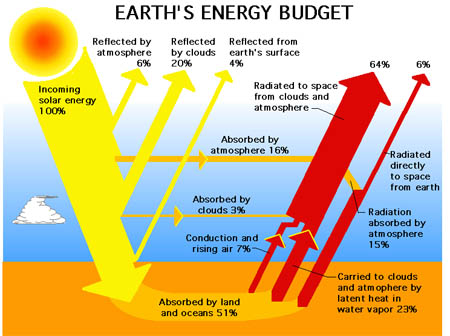
- Figure 2 NASA
Returning to the Trenberth et al paper, (link is in line 1 above), they give that the 396 W/m2 of EMR emitted from the surface in Fig.1 is calculated primarily by using the Stefan–Boltzmann law, and global year average conditions. Putting aside a few lesser but rather significant issues therein, it is useful to know that:
1) The Stefan-Boltzmann law (S-B) describes the total emission from a flat surface that is equally radiated in all directions, (is isotropic/hemispherical). Stefan found this via experimental measurement, and later his student Boltzmann derived it mathematically.
2) The validity of equally distributed hemispherical EMR is demonstrated quite well by observing the Sun. (with eye protection). It appears to be a flat disc of uniform brightness, but of course it is a sphere, and at its outer edge, the radiation towards Earth is tangential from its apparent surface, not vertical. It is not a perfect demonstration because of a phenomenon called limb darkening, due to the Sun not having a definable surface, but actually plasma with opacity effects. However, it is generally not apparent to the eye and the normally observed (shielded) eyeball observation is arguably adequate for purpose here.
3) Whilst reportedly the original Stefan lab test was for a small flat body radiating into a hemisphere, its conclusions can be extended to larger areas by simple addition of many small flat bodies of collectively flat configuration, because of the ability of EMR waves to pass through each other. This can be demonstrated by car driving at night, when approaching headlights do not change in brightness as a consequence of your own headlights opposing them. (not to be confused with any dazzling effects and fringe illumination)
4) My sketch below demonstrates how radiation is at its greatest concentration in the lateral directions. It applies to both the initial S-B hemispherical surface radiation and to subsequent spherical radiation from the atmosphere itself.

5) Expanding on the text in Figure 3: Air temperature decreases with altitude, (with lapse rate), but if we take any thin layer of air over a small region, and time interval, and with little turbulence, the temperature in the layer can be treated as constant. Yet, the most concentrated radiation within the layer is horizontal in all directions, but with a net heat transfer of zero. Where the radiation is not perfectly horizontal, adjacent layers will provide interception of it.
A more concise way of looking at it is with vectors, which put simply is a mathematical method for analysing parameters that  possess directional information. Figure 4, takes a random ray of EMR (C) at a modestly shallow angle, and analyses its vertical and horizontal vector components. The length of each vector is proportional to the power of the ray, in that direction, such that A + B = C. Of course this figure is only in 2D, and there are countless multi-directional rays in 3D, with the majority approaching the horizontal, through 360 planar degrees, where the vertical components also approach zero.
6) Trenberth’s figure 1 gives that 65% of the HEAT loss from the surface is via thermals and evapo-transpiration. What is not elaborated is that as a consequence of this upward HEAT transfer, additional infrared radiation takes place in the air column by virtue of it being warmed. This initially starts as spherical emission and absorption, but as the air progressively thins upwards, absorption slows, and that radiation ultimately escapes directly to space. Thus, the infrared radiation observable from space has complex sources from various altitudes, but has no labels to say where it came from, making some of the attributions “difficult”.
DISCUSSION; So what to make of this?
The initial isotropic S-B surface emission, (Trenberth’s global 396 W/m2), would largely be absorbed by the greenhouse gases instantaneously near the surface. (ignoring some escaping directly to space through the so-called “atmospheric window”). However, a large proportion of the initial S-B 396 surface emission would be continuously lateral, at the Trenberth imposed constant conditions, without any heat transfer, and its horizontal vectors CANNOT be part of the alleged 396 vertical flux, because they are outside of the vertical field of view.
After the initial atmospheric absorptions, the S-B law, which applied initially to the surface, no longer applies to the air above. (although some clouds are sometimes considered to be not far-off from a black body). Most of the air’s initial absorption/emission is close to the surface, but the vertical distribution range is large, because of considerable variation in the photon free path lengths. These vary with many factors, a big one being the regional and more powerful GHG water vapour level range which varies globally between around ~0 to ~4%. (compared with CO2 at a somewhat constant ~0.04%). The total complexities in attempting to model/calculate what may be happening are huge and beyond the scope of this here, but the point is that every layer of air at ascending altitudes continuously possesses a great deal of lateral radiation that is partly driven by the S-B hemispherical 396, but cannot therefore be part of the vertical 396 claimed in Figure 1.
CONCLUSIONS:
The vertical radiative flux portrayed by Trenberth et al of 396 W/m^2 ascending from the surface to a high cloud level is not supported by first principle considerations. The S-B 396 W/m^2 is by definition isotropic as also is its ascending progeny, with always prevailing horizontal vector components that are not in the field of view of the vertical. The remaining vertical components of EMR from that source are thus less than 396 W/m^2.
It is apparent that HEAT loss from the surface via convective/evaporative processes must add to the real vertical EMR loss from the surface, and as observed from space. It may be that there is a resultant of similar order to 396 W/m^2, but that is NOT the S-B radiative process described by Trenberth.
~~~~~~~~~~~~~~~~~~~~~~~~~~~~~~~~~~~~~~~~~~~~~~~~~~~~~~~~~~~~~
ADDENDUM FOR AFICIONADOS
I Seek your advice
In figure 5 below, note that the NIMBUS 4 satellite data on the left must be for ALL sources of radiation as seen from space, in this case, at some point over the tropical Pacific. The total emissions, amount to the integrated area under the curve, which unfortunately is not given. However, for comparison purposes, a MODTRAN calculator, looking down from 100 Km gives some interesting information for the figure, which is further elaborated in the tables below. Unfortunately the calculator does not give global data or average cloud/sky conditions, so we have apples and pears to compare, not only with Nimbus, but also with Trenberth. However, they all seem to be of somewhat similar order, and see the additional tabulations.

| Compare MODTRAN & “Trenberth”, looking down from 2 altitudes, plus Surface Temperature | ||||
| Location | Kelvin | 10 metres | 100 Km. | (Centigrade) |
| Tropical Atmosphere | 300K | 419 W/m^2 | 288 W/m^2 | (27C) |
| Mid-latitude Summer | 294K | 391 W/m^2 | 280 W/m^2 | (21C) |
| Mid-latitude Winter | 272K | 291 W/m^2 | 228 W/m^2 | (-1C) |
| Sub-Arctic Winter | 257K | 235 W/m^2 | 196 W/m^2 | (-16C) |
| Trenberth Global | 288K ? | 396 W/m^2 | 239 W/m^2 | (15C ?) |
| Compare MODTRAN & “Trenberth”, looking UP from 4 altitudes: W/m^2 | ||||
| Location | From 10 m | From 2 Km | From 4Km | From 6Km |
| Tropical Atmosphere | 348 | 252 | 181 | 125 |
| Mid-latitude Summer | 310 | 232 | 168 | 118 |
| Mid-latitude Winter | 206 | 161 | 115 | 75 |
| Sub-Arctic Winter | 162 | 132 | 94 | 58 |
| Trenberth Global | 333 Shown as coming from high cloud area (= BS according to MODTRAN) | |||
Tim Folkerts @ur momisugly November 11, at 9:06 pm
Tim, briefly, you wrote in part:
Most of the 356 does not make it to space
Despite that the 1997 and 2009 diagrams show the vertical arrow into the high clouds, (which might be a mistake), the main concern is not that issue. The 396 has horizontal vectors which are not vertical, and which are extinguished. If you want to consider that these constantly prevailing horizontal vectors are vertical, don’t expect me to agree. This is getting a bit like sawing sawdust.
Can’t be bothered with the rest of it.
“Despite that the 1997 and 2009 diagrams show the vertical arrow into the high clouds, (which might be a mistake), …
I strongly disagree that the “the vertical arrow into the high clouds” might even partially be a “mistake”. The diagram specifically says it is “schematic”. The paper itself is clearly discussing only broad energy flows among the sun, the surface as a whole (land and water), the atmosphere as a whole (clouds and GHGs and non-GHGs). The arrow in no way represents energy flowing to any specific part of the atmosphere. Drawing the picture to look vaguely like the earth is only a visual aid to make it easier to remember, but it could just as well had 4 distinct boxes at the four corners of the diagram labeled “sun”, “surface” “atmosphere” and “outer space”.
“…the main concern is not that issue. The 396 has horizontal vectors which are not vertical, and which are extinguished.
Define “extinguished”. I would take that to mean “absorbed by the atmosphere, thereby transferring their energy to the atmosphere”. Obviously you do not mean the IR energy was destroyed.
Which of the following do you specifically disagree with?
1) If 396 W/m^2 of IR photons from the ground continuously enters some region of atmosphere and some of those photons get “extinguished”, then that region would be continuously gaining energy.
2) Since the temperature is not continuously rising, that region must be continuously losing the same amount of energy.
3) We know the region is not losing that energy via “horizontal vectors” since the horizontal vectors would merely exchange like amounts of photons with neighboring regions, for no net transfer horizontally.
4) The ONLY direction for net transfer is either down or up.
If you don’t like logic, then try an experiment. A completely analogous situation would be visible light in a high temperature furnace (say 1200 C). Put anything in the furnace – clear glass, colored glass, shiny metal, white ceramics, black ceramics. All of these “extinguish” the visible light coming from the hot wall of the furnace behind them in various ways. But all will look nearly indistinguishable inside the furnace once they reach the temperature of the surrounding walls. Whatever photons they are “extinguishing” from behind, they are emitting/reflecting from the other side. As long as it is all the same temperature, the color is the same.
See Bob, I told you that would be raised:
Tim says: “1) If 396 W/m^2 of IR photons from the ground continuously enters some region of atmosphere and some of those photons get “extinguished”, then that region would be continuously gaining energy.”
I told you above to watch out. Tim is so lost in physics, credentials or not, he is still simply wrong.
Dr. Richard Feynman explained all of this some forty years ago. All transfer of energy and photon-electron-matter interactions via those three (or four) processes of conduction, convection, radiation, and evaporation/condensation are all identical at the atomic/quantum level. Those processes are manifestations of this one principle. That is why the 396 is a figment, an imagination of someone who does not understand all of physics. The surface cannot manifest this difference in temperature, therefore difference in energy levels, between various points in the Earth climate system in a strictly radiation manner, ignoring the other three, except at the edge of the void of space. At that point there is no convection and conduction, no evaporation, to be manifested so all is IR radiation at this special “surface”.
The transfer by all non-radiative processes take energy away (see microstates) from the possible S-B hypothetic power (396 Wm-2) due to temperature differences and emissivity totally dry and against a void at zero K.
BUT, at the surface the energy held by the top few centimeters where the atmosphere touches the surface is divided between these four paths, convection, conduction, evaporation/condensation and radiation. It is evident Tim, Trenberth, Kiehl and others have never learned that aspect of quantum electro-dynamics and that is why you are so correct Bob, the 17 and 80 Wm-2 must firstly be subtracted from all four IR radiation terms listed on Trenberth’s diagram, 396, 356, and the two 333 Wm-2, for those 17 & 80 are net transfers of energy from the surface to space ignoring any and all inter-atmosphere processes and those IR radiation terms are all overstated in the diagram by approximately 97 Wm-2.
Tim is also ignoring energy moving opposite as you keep trying to explain it to him. But once again you are correct Bob, there is cancellation, it happens in the very room you are sitting in just like it happens as you step outside into the open atmosphere. A to B cools A and warms B, BUT, at all times, energy is also going from B to A cooling B and warming A and both are in the power Wm-2 terms. Yes Tim, there is cancellation in energy transfers depending on the vectors. There is no automatic “accumulation”. You are simply wrong on those aspects so stop trying to defend the mistakes of Kiehl-Trenberth et al. For starters at least subtract what is not in contention.
Or that is what my forty years of studying physics has left me with.
I still say it is very curious to me that if you take the (333-97)Wm-2 correction as temperature you get approx. minus 20°C which is what most people have reported their radiative thermometers read as they point it toward a cloudless sky. That is curious to me. It also tends to say those corrections are very real and correct.
Suppose you have a traffic monitor on a mountain pass. You measure an average of 333 vehicles per hour going east and 396 vehicles per hour going west. Suppose that road goes down into a valley with multiple intersections with other roads and then up into a second pass that is the only way through those mountains. Suppose, your traffic measured there is 239 cars per hour going west and 341 cars per hour going east. Is there a contradiction?
It is also curious that an analysis of readings from Mars Global Surveyor Thermal Emission Spectrometer pointed backwards toward Earth during it’s trip to Mars in 1976 gave a good whole-Earth emissivity of 0.75xx with readings across all frequencies responses averaged. Sorry, can’t remember the last two digits.
If you take the 396 Wm-2 * 0.75 emissivity you get guess what? … 297 Wm-2 in very good agreement with the same 396-97 = 299 Wm-2 according to Trenberth’s graphic after thermals and evapo-transpiration are removed. One more reason to properly assume that the 396 and related numbers are totally fictional.
Hang in there Bob, seems you are really on to something.
I see I overlooked one very important point, the reflected energy that reduces the net in-coming short wave radiation power to 239 W/m². (Cars going east = 239.) The net solar energy flow arriving at ground level is 161 W/m². The net energy flow leaving the ground is 63+17+80=160 W/m². The additional unexplained 0.9 W/m² “Net absorbed” might make up the inconsequential difference.
Tim Folkerts @ur momisugly November 12, at 6:48 am
Tim, your following words are worth a comment:
Tim, you have nicely put your finger right on the issue, but should have added another point to complete the picture.
5) Since the EMR in 3) is continuous and greater than in 4), and both are part of the continuous 396 S-B surface emission, the vertical flux component must be less than 396.
I believe that the most important point made by the Trenberth diagram is that most of the energy being radiated from the top of the atmosphere actually originates in the atmosphere. I am not all that concerned about the actual accuracy of the diagram itself.
I have generally restricted my use of MODTRAN to clear Tropical air in its default setting. So far, I have not been interested in the modeled effects of clouds because I do not want to introduce too many uncontrolled variables.
It has been my understanding that the energy observed with the sensor looking down (energy flowing up) minus the energy observed with the sensor looking up (energy flowing down, i.e. back-radiation) should be the net energy moving out. Here is one example of results from a sensor altitude sweep I obtained with MODTRAN:
Note that ‘back-radiation’ virtually disappears above the Troposphere in clear Tropical air.
Spector @ur momisugly November 12, at 4:45 pm
An interesting comment Spector.
In your MODTRAN table for the tropics, I see that there is a significant increase in net radiative loss between about 1.0 and 10.0 kilometres, and then a levelling off up to 99Km. I guess this is related to the effects of thermals, evapotranspiration and solar absorbed. It is only a model of course and I have no idea how they would have determined and distributed such data over the altitude and spectral range. Do you?
Bob,
“Sorry RW if I misunderstood, but I thought you inferred somewhere that the isotropic radiation from the surface was vertical.”
I think the average LW flux from the surface is vertical, but on a photon by photon basis it going all over as you say.
I don’t understand the thing about lateral angles at a cross section. To look at a simple limiting case, if you take a cross section far away from the earth, you find that almost every photon through it originating from the earth is parallel to the next (ie, not lateral but “up” almost perfectly if the cross section is slanted as I think you intended.. and, no matter the slant of the hypothetical cross section, the photons would be radial from the point-like earth). However, within the atmosphere, we have photons being generated all over, so we get a much nicer mix.. if perhaps still with a bias to be in the earth radial direction.
So if I understand the “lateral” claim, I think the truth tends to be rather the opposite. Maybe the author is confusing that some photons come from points where they left laterally, but they tend to go through a cross-section more and more parallel as you move further from the originating source (note that the same number of photons spread out over a growing volume of the universe so the density decreases as R increases).
And as for angle of origination (vs angle of arrival), the odds of lateral appear to be no greater than leaving at any other angle (I think this is a quantum mechanics/wave equation assumption.. although assumed probably no matter the standard theory used). Lateral origination might even be at a lower probability since it might imply greater energy needed to escape the surface as opposed to being normal to it (I haven’t done the math or experiments, but this might be my guess).
Also, a line normal to a surface is a standard way to represent something coming from a surface, as it is a simple diagram form to convey a particular piece of information that can be understood to apply evenly to the entire surface.
RE: Bob Fernley-Jones: (November 12, 2011 at 6:54 pm)
“I have no idea how they would have determined and distributed such data over the altitude and spectral range. Do you?”
No, I have no inside information on this program. I understand that it was generated by the Air Force for quality control purposes. I assume that these calculations are based on a typical static atmosphere.
If you select the “[save text for later retrieval]” save option, you can use “View the whole output file” to capture the calculation printout details. Note that they appear to be using cgs units for the radiance, i.e. watts per square centimeter. There is also a solid angle and bandwidth correction required. The values are calculated over the wave number range from 100 to 1500 kayzers (cycles per centimeter, CM-1) in 2 kayzer steps. I suspect the results would have been a little more accurate if the upper range had been extended to 2500 kayzers.
Nasif Nahle’s paper – ‘Emissivity of a mixture of gases – 5% water vapour and o.o39% CO2’ states that CO2 emissivity is almost zero below 33 C for PcL of 0.6096 atm cm. From Hottel’s graphs I found that for PcL 0.6096 atm cm (0.019988 ft atm) CO2 emissivity is 0.045 at 33 C (551 R) and for water vapour it is about 0.4. Emissivity of CO2 is small but not zero; it is 10% of water vapour emissivity .Allowing for spectral overlaps the combined emissivity would be 0.436
Bob, Since you were wondering about at what point the two dimensional approximation of the tropopause might be come significant in error, I thought you might find this method of approximating surface emissivity/transmittance amusing.
http://redneckphysics.blogspot.com/2011/11/building-better-model.html
Jose_X @ur momisugly November 12, at 11:08 pm
Jose,
The issue applies to opaque parts of the atmosphere, particularly with the Stefan-Boltzmann radiation from the surface. (where the Trenberth alleged vertical 396 W/m^2 is in dispute). This is isotropic, hemispherically, the largest portion of which is lateral. Much the same applies at all emitting parts of the atmosphere, except that it is spherical. Perhaps my following exchange with Tim Folkerts above, (a physicist), may help.
Also, if you scan up a short way there is a table submitted by Spector that you may find interesting
>> This is isotropic, hemispherically, the largest portion of which is lateral.
I am not sure what you are trying to get at with this, but can you explain what derivation, logic, assumption, etc, leads you to claim that the “largest portion” is lateral? It’s a vague comment to say “largest portion is lateral”, so maybe you can give some sort of bounds by degree rise from horizontal (the x-axis). And if you talking about energy flux from point of origination being greatest in the lateral directions, are you also claiming this is the case when we look at a cross section higher up as a destination of photons? Note that if you move away from the earth, the near “lateral” angles trace back to points not on the planet. In contrast, the up direction traces back radially to the planet’s surface. Far enough away, the earth is like a point and only the photons coming exactly from that point hit the cross section (and at a 90 degree angle).
The other point is that, as has been mentioned by others, the lateral radiation is on average met by radiation of the same quantity in the opposite direction. The up radiation is the only one that generally dominates as we look at nearby horizontal slices one just above the other because the lower slice has more radiation than the higher up slice (on average) keeping in mind that some fraction of the originating radiation from the lower areas will not be absorbed by the higher areas (and note that extra radiation moving up that is not caught eventually makes its way into space while extra radiation downward eventually hits the ground leading to a steady state temperature and flux that are higher at the earth boundary than if there were no back radiation at all). Anyway, this is a hand waving (non-mathematical) argument, but the Spector table you mentioned shows experimental evidence of this effect for up/down, where the higher slices have a greater and greater upward component (and, again, I’m assuming the side-side versions of this would give about the same numbers with no net lateral).
Note, for comparison’s sake, the electric field lines direction for conductive surfaces in the presence of nearby charges (as taught in text): the field lines are normal at these conductive surfaces, as any other direction would imply a net current along that same electrical potential.. something that statistically is calculated (based on natural assumptions) to cancel out (net 0) and which appear to agree with experiments (and hence why it is taught in text books that field lines are normal to the conductive surfaces). For radiation distribution among large objects or molecules at large atomic separations within at the earth’s solid/gas boundary, we may not see the same extreme case as with electrons on a conductive surface, but we probably get close (at a different time scale). The “lateral” component of various gradients would generally be near zero at any point. [haven’t attacked this problem or looked it up, so I am willing to see if you have calculations or a more precise/rigorous discussion.]
Jose_X, as to ““largest portion” is lateral” Bob mentioned I always view it like this. A 1-cm2 spot on the surface of the Earth is covered by a glass hemisphere (imaginary will do) with a surface area of 1-m^2. That one cm^2 spot radiates randomly and evenly distributed through any and all points on that hemisphere. I mentally take a sharpie and draw 1 cm^2 squares to cover all of that bowl, 10,000 of them, then the same amount of radiation from that spot is going to pass through every square in equal quantity.
But, there are many more squares near the surface where the radius of the bowl is large that near the top of the bowl where the radius is small. In fact there is only one cm^2 square that is strictly zenith.
Now expand that example to be one meter^2 but the principle is the same, much more radiation travels horizontally (or laterally) than mainly pointed upwards and if integrated it is 2/3 mainly pointing horizontal and 1/3 mainly pointing upward with a hemisphere. If a complete sphere it is 1/6 down, 1/6 up, and 4/6 lateral. I think that is what Bob was saying, for that is exactly how I also view it and it explains Mars and why we see the net upward is approx 1/6th of 396 (if the 396 Wm-2 is even accurate which I think is not, due to the sharing of energy transfer modes leaving the 16°C surface, being convection, water state-change, and radiation, I think more like 396-80-17 or 299Wm-2 giving 59.3 though 63.114 is given by MODTRAN, but, we are on a sphere and not a flat plane).
You seemed to mentioned understanding the existence of lateral cancellation in your posts above so I probably need not go further on that.
Hope that helps and if you feel any of that is wrong please say so and why. I am, and I’m sure Bob, searching for confirmation on some of these thoughts with actual physics to back it up.
wayne, thanks for that. I never got back to the golf ball example or I may have realized what Bob meant.
A few notes:
One, that notation is acceptable when this is seen as a block diagram. This point was brought up (I looked back and could not find the comment).
Two, this simplification at ground level is justified (as several have mentioned) because all of these values originating at the “flat” ground eventually make it into some cross section or other at any given height from the ground (in the limit case far away from the earth’s curved surface and deep into space, the photons are actually normal to the earth). If you try to measure with a sensor at some point in the atmosphere, the sensor will get those photons coming at 90 degrees as well as some coming near 0 degrees (as a 2d projection angle) in all such directions in space (360 deg rotation) unless we go too far up in the atmosphere. The sensor shows how the average pick up is that figure, even if some photons came from miles away.
So the diagram is indeed a simple model, with the arrows representing net average rates measured near that level. [Note, I don’t know enough to say if the numbers are accurate or in what range. Also, a computer model would use, I assume, data from many many points (corresponding to actual measurements all around the planet) and not just at a few points. The model is useful at some level, but I would not use it to make too many predictions about the future.]
Jose, glad that gave you a clearer view, but I don’t know if you should elevate it to a full ‘model’ status, for if I was interpreting Bob correctly, he seemed to just to be highlighting some incredibly simple physics principles that conflict with what the Kiehl-Trenberth diagram tends to leave you with. And your right, holds no predictions of the future! ☺
http://greenhouse.geologist-1011.net/
Source of their AGW fictional world without convection – Arrhenius misunderstands Fourier.
wayne, the diagram is informative to the degree it follows measurements and would be consistent with an increasing effect on ghg. As concerns modelling, it is useful perhaps only for very rough modelling.
While I might be understanding Bob, I don’t see too much use in that presentation (except conceptually in order to move forward) or see it as inconsistent with the diagram; each is of marginal use by itself. Bob’s point seems consistent with what the Trenberth diagrams say, that there is an *average net* flux upwards. Bob appears not to like the idea that the diagram only shows average net. That it correct IMO that to model adequately (eg, for predictions) such a simplified diagram is too simplified to unleash on time-dependent differential equations and get much out of it (my inexpert opinion).
One paper-in-progress that tried to use the Trenberth diagrams to recalculate equilibrium climate sensitivity (to a lower value in that case) appears to have assumed those values would represent steady state in the future at 2xCO2. To calculate equilibrium climate sensitivity (as per IPCC definition), you need something much more complex than anything you could derive from those diagrams.
Myrrh, AGW doesn’t deny the cooling effect of convection. (a) “greenhouse effect” in atmosphere (re-rediation) and (b) the fact real greenhouses keep an elevated temperature that would otherwise drop if convection could take place freely with outside cooler environment are two separate things and consistent with each other.
Woods did not do much of an experiment (almost zero detail write-up). A professor, Nahle, tried to support Woods and failed to support anything against greenhouse effect despite concluding otherwise in the paper (I commented on that here http://climateclash.com/2011/07/19/wood-is-correct-there-is-no-greenhouse-effect/comment-page-1/#comment-2122 ). Pratt did a good experiment that clearly shows a greenhouse effect.
wayne, I should have clarified that I agree (but not 100%): The way the Trenberth’s diagram is drawn can give a bad oversimplified/misleading view of reality. Bob calls him up on it although I think via a presentation that itself might be a bit misleading to the extent it might suggest there is no (to first approximation, I believe) average net flux in the up direction at an arbitrary point on the earth surface.
>> average net flux in the up direction at an arbitrary point on the earth surface.
I don’t mean to say that the arrow represents the average at such an arbitrarily chosen point. Rather, the arrow represents (I think) an average for every point together.
Bob, the more I think of what you and I have discussed on the horizontal aspects of radiation from the surface and low troposphere the more this seems to be of great importance. Really, it has opened up my eyes.
See these before I say more and think radiation going out instead of starlight coming in (these mainly speak of astronomy in relation to visible light frequencies, not IR to which the atmosphere is much more opaque):
Air mass (astronomy)
http://en.wikipedia.org/wiki/Air_mass_(astronomy)
Mass attenuation coefficient
http://en.wikipedia.org/wiki/Mass_attenuation_coefficient
You seemed to grasp my comment on Mars horizontal radiation being more or less unencumbered by the extremely thin co2 atmosphere (1/100th of Earths’) except exactly in co2’s absorption frequencies. Therefore all of the 5/6th can travel unabsorbed no matter the angle components (+x,-x,+y,-y&+z). Not so on Earth and the main factor is the water bands and water’s continuum across the IR spectrum.
Since a much greater portion of radiation does tend to be more horizontal than vertical then an atmosphere is more controlled by the simple mass that the atmosphere contains than its specific chemical components vertically, the thickness of the atmosphere. How could I have not seen this for a year and half! Well, I know, they had me thinking 1-D, up and down, and tracing photons like they seem to have trained most people to do. And, every absorption starts the same process all over again with a re-emission going all directions, more horizontal and through much more mass of the atmosphere than up or down. Woo. Others here need to get that view. Have you considered another post on this?
One more ah-ha. Saw a plot about a year ago of Venus, Earth, Mars, Jupiter and Titan that shows that the turn of the lapse rate curves (where main-line absorption of energy ends and at that given altitude) always all but Mars occurs at close to the same density even though Venus is near pure co2, Titan methane, Jupiter hydrogen and helium and Earth of course water vapor with Mars so thin there is little absorption at all occurring and Mars is basically off the chart. The chemical components seem to have so little relative influence and the mass seems to set the surface temperature. Very curious.
I guess you might see where I am leading, that possibly climate science has been looking at this whole physics problem somewhat backwards, placing all emphasis on what is entering and leaving when it is what is held strictly by the mass, not pressure, not density, not co2’s 15 micron lines but mass by the mass attenuation coefficient of IR (hard to find references) and the mass. To me what is possible to go exit will exit no matter what, energy flows, in an open end system you cannot ‘trap’ it, but, if the horizontal is thick, that component cancels by symmetry if absorptions occur. Does that make sense to you? Not worded very good but you might get the drift.
I would offer some collaboration if you should need any. No strings. Heck, have spent two years now trying to untangle ‘atmospheric energy’ and this is the closest approach to a clear view, thank you much for this post! Boy, I jumped on this topic a bit hard the minute the first few paragraphs were read, hope I didn’t over-fill the thread. Just hoping there is not some overlooked aspect that negates this concept but can’t see any so far.
And to give credit where it belongs, the talk in my comments above of NET energy never returning to the surface once it has entered and been absorbed by the atmosphere, both solar SW in and surface IR out… that is from Dr. Miskolczi’s papers, not me. Being an astrophysicist I think he does know what he is talking about. He’s right, that keeps it strictly on thermodynamics, no back-radiation in that particular frame of reference, strictly net.
Bob says (in reply to my comments about flow of IR photons)
“5) Since the EMR in 3) is continuous and greater than in 4), and both are part of the continuous 396 S-B surface emission, the vertical flux component must be less than 396.
We are indeed getting closer to agreeing. In some ways I might even get more extreme than you, but I would be very wary of a phrase like “part of the 396 S-B surface emission”.
At an altitude of 0 km (ie at the surface), there will be an average S-B surface emission of 396.
At some altitude like 2 km, I would suggest that very close to ALL of the SB surface emission in certain bands has been absorbed. In particular, the band that CO2 absorbs around 13.5 – 16.5 um (wave number ~ 600 – 750 cm^-1) there would be effectively NONE of the “396 S-B surface emission” still present. Not because it has be “emitted horizontally” but because it has been absorbed in to the GHG molecules and ceases to exist as IR photons. Conversely, outside the bands where GHGs absorb, very nearly 100% of the surface IR photons will still be heading generally upward. The spectrum of IR photons would have huge gaps in in.
For the sake of argument, let’s suppose that GHG’s absorb 1/3 of the possible wavelengths (the exact number is not critical). Then 264 W/m^2 out of 264 W/m^2 of surface IR photons OUTSIDE the GHG absorption bands will pass upward thru the surface 2 km up (because the atmosphere has little or no effect on those photons). But 0 W/m^2 out of 132 W/m^2 of surface IR photons INSIDE the GHG absorption bands will pass upward thru the surface 2 km up. So in this case, only 264 W/m^2 of surface IR photons will pass up thru a 1 m x 1 m square 2 km up. (The cut off at the edges of the band is not perfectly sharp, of course. The bands tend to have ragged edges, but that can just factor into the net fraction of IR photons absorbed.) )
On the other hand, if you look at MODTRAN output looking down from 2 km, you do not see 100% missing from any bands. Why is that? Simply because those are also the bands where GHGs emit IR photons. To the extent that the GHGs are the same temperature as the surface, the spectrum would still look the same — ie like a S-B blackbody curve. By the time you are 2 km up, the gas is getting cooler, and the power is a little less in the GHG absorption/emission bands. If you go back to 0.1 km in MODTRAN looking down, the spectrum is indistinguishable from the BB curve, even though the gases from 0 – 100 m must be absorbing a big chunk of the IR surface photons.
(there are several other interesting comments lately, but I don;t have time to reply to them all right now.)