Guest post by Bob Fernley-Jones by Bob Fernley-Jones AKA Bob_FJ
CAUTION: This is written in Anglo-Oz English.
Here is the diagram as extracted from their 2009 paper, it being an update of that in the IPCC report of 2007 (& also 2001):


The unusual aspect of this diagram is that instead of directly showing radiative Heat Transfer from the surface, it gives their depiction of the greenhouse effect in terms of radiation flux or Electro-Magnetic Radiation, (AKA; EMR and a number of other descriptions of conflict between applied scientists and physicists). EMR is a form of energy that is sometimes confused with HEAT. It will be explained later, that the 396 W/m^2 surface radiation depicted above has very different behaviour to HEAT. Furthermore, temperature change in matter can only take place when there is a HEAT transfer, regardless of how much EMR is whizzing around in the atmosphere.
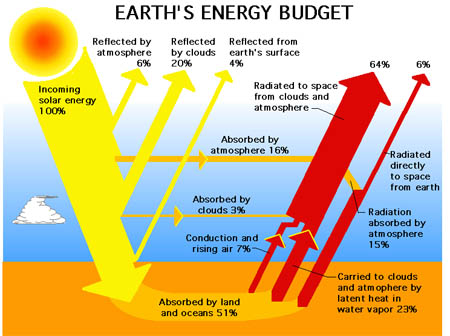
A more popular schematic from various divisions around NASA and Wikipedia etc, is next, and it avoids the issue above:
- Figure 2 NASA
Returning to the Trenberth et al paper, (link is in line 1 above), they give that the 396 W/m2 of EMR emitted from the surface in Fig.1 is calculated primarily by using the Stefan–Boltzmann law, and global year average conditions. Putting aside a few lesser but rather significant issues therein, it is useful to know that:
1) The Stefan-Boltzmann law (S-B) describes the total emission from a flat surface that is equally radiated in all directions, (is isotropic/hemispherical). Stefan found this via experimental measurement, and later his student Boltzmann derived it mathematically.
2) The validity of equally distributed hemispherical EMR is demonstrated quite well by observing the Sun. (with eye protection). It appears to be a flat disc of uniform brightness, but of course it is a sphere, and at its outer edge, the radiation towards Earth is tangential from its apparent surface, not vertical. It is not a perfect demonstration because of a phenomenon called limb darkening, due to the Sun not having a definable surface, but actually plasma with opacity effects. However, it is generally not apparent to the eye and the normally observed (shielded) eyeball observation is arguably adequate for purpose here.
3) Whilst reportedly the original Stefan lab test was for a small flat body radiating into a hemisphere, its conclusions can be extended to larger areas by simple addition of many small flat bodies of collectively flat configuration, because of the ability of EMR waves to pass through each other. This can be demonstrated by car driving at night, when approaching headlights do not change in brightness as a consequence of your own headlights opposing them. (not to be confused with any dazzling effects and fringe illumination)
4) My sketch below demonstrates how radiation is at its greatest concentration in the lateral directions. It applies to both the initial S-B hemispherical surface radiation and to subsequent spherical radiation from the atmosphere itself.

5) Expanding on the text in Figure 3: Air temperature decreases with altitude, (with lapse rate), but if we take any thin layer of air over a small region, and time interval, and with little turbulence, the temperature in the layer can be treated as constant. Yet, the most concentrated radiation within the layer is horizontal in all directions, but with a net heat transfer of zero. Where the radiation is not perfectly horizontal, adjacent layers will provide interception of it.
A more concise way of looking at it is with vectors, which put simply is a mathematical method for analysing parameters that  possess directional information. Figure 4, takes a random ray of EMR (C) at a modestly shallow angle, and analyses its vertical and horizontal vector components. The length of each vector is proportional to the power of the ray, in that direction, such that A + B = C. Of course this figure is only in 2D, and there are countless multi-directional rays in 3D, with the majority approaching the horizontal, through 360 planar degrees, where the vertical components also approach zero.
6) Trenberth’s figure 1 gives that 65% of the HEAT loss from the surface is via thermals and evapo-transpiration. What is not elaborated is that as a consequence of this upward HEAT transfer, additional infrared radiation takes place in the air column by virtue of it being warmed. This initially starts as spherical emission and absorption, but as the air progressively thins upwards, absorption slows, and that radiation ultimately escapes directly to space. Thus, the infrared radiation observable from space has complex sources from various altitudes, but has no labels to say where it came from, making some of the attributions “difficult”.
DISCUSSION; So what to make of this?
The initial isotropic S-B surface emission, (Trenberth’s global 396 W/m2), would largely be absorbed by the greenhouse gases instantaneously near the surface. (ignoring some escaping directly to space through the so-called “atmospheric window”). However, a large proportion of the initial S-B 396 surface emission would be continuously lateral, at the Trenberth imposed constant conditions, without any heat transfer, and its horizontal vectors CANNOT be part of the alleged 396 vertical flux, because they are outside of the vertical field of view.
After the initial atmospheric absorptions, the S-B law, which applied initially to the surface, no longer applies to the air above. (although some clouds are sometimes considered to be not far-off from a black body). Most of the air’s initial absorption/emission is close to the surface, but the vertical distribution range is large, because of considerable variation in the photon free path lengths. These vary with many factors, a big one being the regional and more powerful GHG water vapour level range which varies globally between around ~0 to ~4%. (compared with CO2 at a somewhat constant ~0.04%). The total complexities in attempting to model/calculate what may be happening are huge and beyond the scope of this here, but the point is that every layer of air at ascending altitudes continuously possesses a great deal of lateral radiation that is partly driven by the S-B hemispherical 396, but cannot therefore be part of the vertical 396 claimed in Figure 1.
CONCLUSIONS:
The vertical radiative flux portrayed by Trenberth et al of 396 W/m^2 ascending from the surface to a high cloud level is not supported by first principle considerations. The S-B 396 W/m^2 is by definition isotropic as also is its ascending progeny, with always prevailing horizontal vector components that are not in the field of view of the vertical. The remaining vertical components of EMR from that source are thus less than 396 W/m^2.
It is apparent that HEAT loss from the surface via convective/evaporative processes must add to the real vertical EMR loss from the surface, and as observed from space. It may be that there is a resultant of similar order to 396 W/m^2, but that is NOT the S-B radiative process described by Trenberth.
~~~~~~~~~~~~~~~~~~~~~~~~~~~~~~~~~~~~~~~~~~~~~~~~~~~~~~~~~~~~~
ADDENDUM FOR AFICIONADOS
I Seek your advice
In figure 5 below, note that the NIMBUS 4 satellite data on the left must be for ALL sources of radiation as seen from space, in this case, at some point over the tropical Pacific. The total emissions, amount to the integrated area under the curve, which unfortunately is not given. However, for comparison purposes, a MODTRAN calculator, looking down from 100 Km gives some interesting information for the figure, which is further elaborated in the tables below. Unfortunately the calculator does not give global data or average cloud/sky conditions, so we have apples and pears to compare, not only with Nimbus, but also with Trenberth. However, they all seem to be of somewhat similar order, and see the additional tabulations.

| Compare MODTRAN & “Trenberth”, looking down from 2 altitudes, plus Surface Temperature | ||||
| Location | Kelvin | 10 metres | 100 Km. | (Centigrade) |
| Tropical Atmosphere | 300K | 419 W/m^2 | 288 W/m^2 | (27C) |
| Mid-latitude Summer | 294K | 391 W/m^2 | 280 W/m^2 | (21C) |
| Mid-latitude Winter | 272K | 291 W/m^2 | 228 W/m^2 | (-1C) |
| Sub-Arctic Winter | 257K | 235 W/m^2 | 196 W/m^2 | (-16C) |
| Trenberth Global | 288K ? | 396 W/m^2 | 239 W/m^2 | (15C ?) |
| Compare MODTRAN & “Trenberth”, looking UP from 4 altitudes: W/m^2 | ||||
| Location | From 10 m | From 2 Km | From 4Km | From 6Km |
| Tropical Atmosphere | 348 | 252 | 181 | 125 |
| Mid-latitude Summer | 310 | 232 | 168 | 118 |
| Mid-latitude Winter | 206 | 161 | 115 | 75 |
| Sub-Arctic Winter | 162 | 132 | 94 | 58 |
| Trenberth Global | 333 Shown as coming from high cloud area (= BS according to MODTRAN) | |||
“Leave a Reply”?….if only I could!
Unfortunately, an old draft of the article has been posted in errror. I’ve Emailed Anthony, asking for the intended version to be posted. It contains additional information.
There is lot’s to chew on here, but please clarify this statement:
“…temperature change in matter can only take place when there is a HEAT transfer..”
____
If by “temperature” you are referring the average translational kinetic energy, then of course your statement is erroneous, for the temperature of matter (as measured by average translational kinetic energy) can be changed by both heat transfer, AND/OR having work done on it. In the end, the results are indistinguishable. A perfect example is the compression of air when it flows between zones of different pressure…this is work done on the air molecules, their temperatures will rise as they are compressed and the average kinetic translational energy rises from the work done.
Well, in a word: YES!
In a transparent atmosphere and ignoring the curvature of the earth, the average 396 W/m^2 would be constant all the way up. The energy leaves the spherical surface of the earth. By conservation of energy, the energy MUST go somewhere. The energy does not get absorbed (by definition in a transparent atmosphere). Therefore it must leave the from any arbitrary spherical surface above the earth. In the approximation that the earth is not curved (or that we have not gone high compared to the radius of the earth) the same energy must leave upward thru every m^2 of the upper surface as left every m^2 of the surface. Unless you can find a good reason to disagree with euclidean geometry or conservation of energy, the average upward flux of thermal IR from the surface is constant in these circumstances.
R. Gates @ur momisugly 5:46 pm,
Yes, you are correct, that work can result in heating, or cooling. An oversight on my part, where I was trying to show the difference between heat and EMR
If i followed your presentation correctly, then it seems to me that you left out an important fact. The radiation lost “sideways” above one point, should be exactly made up by the radiation “sideways” from some other point on the globe. I’m sure that, if you consider the earth as a sphere, these effects all average out and your concern is misplaced. I think that, to the extent that the earth is not a sphere, more surface radiation is absorbed in the atmosphere than in the spherical case.
Billy
“The length of each vector is proportional to the power of the ray, in that direction, such that A + B = C.”
Energy is not a vector! You cannot take components of energy. If a photon with energy 10^-19 J is heading north and at a 45 degree angle above the horizontal, it does not have 0.707 * 10^-19 J of “northward energy” and 0.707 * 10^-19 J of “upward energy”. It simply has10^-19 J of energy. If it passes upward through a surface, it carries 10^-19 J of energy upward thru the surface, not 0.707 * 10^-19 J.
An interesting observation about R. Gates. Has anyone else noticed that he pops up almost immediately in any thread where Trenberth’s work is being scrutinized? On other threads he is noticeably absent, but pick a hole in Trenberth’s work and POOF! there’s R. Gates defending it with one argument or another, usualy a tengential one intended to hijack the thread.
BTW R. Gates, you welched on your bet with me.
And I repeat my question from another thread…Do you have on official relationship with Trenberth, and if so, what is it?
Excellent article Bob Fernley-Jones.
Bob Fernley-Jones, I owe you a debt of gratitude. I have no idea if you just stumbled upon this though on your own or if it is that I have been harping on this on and off here since this spring when I personally realized it. But one thing I can say either way is you explained this hugely better than I have been able to explain it.
Stefan-Boltzmann is a three dimensional law, not one dimensional as so many of the climate related sciences is applying it. That is why the 396 Wm-2 is pure fantasy when speaking of energy net transfer as you have eloquently explained. This one fact in science is why global warming as we speak of it is now over, to me anyway. The maximum affect, or sensitivity, is 1/6th (numerically exact) of what so many of the calculation have been applied using S-B law. Pure radiation loss of energy from the surface is a minor, I’ll repeat, a minor player in Earth’s loss of the solar radiation gathered on the lit side every second of every day, not a major
Please help me to not let this thought go stale. It is one of the saddest states I could every imagine of how the physic branches of science have let this notion not only exist, but to become an accepted view of how energy transfers, always in one dimension, up and down, never accounting horizontally which is 4/6th of what actually occurs with symmetrical cancellation of effects. Any deviation from exactly 4/6th is due to the fact our world is a sphere, not a flat plane and the cooling and thinning of the atmosphere with altitude.
Excellent, excellent, article (paper). To me, the notion of global warming from CO2 died on this 3D thought. Radiation cannot do what they have led us to accept as truth… it isn’t.
I must say I don’t get any of this really, but what I have always found odd about this line of thinking is, what about kinetic and potential energy transfer of the heat. It would seem to me, that the sun shining and warmth associated converts into water moisture, which rises, forms clouds and falls. It creates wind from pressure variances. So when they start accumulating forcings and adding it all up, in fact that little extra just becomes one days little bit extra rain, just a little bit extra wind. It doesnt add up over the years, it just turns out to be a little more movement day to day.
When someone says climate engine, or weather engine, this is what I think of.
Tim Folkerts says:
October 26, 2011 at 6:07 pm
Well, in a word: YES!
In a transparent atmosphere and ignoring the curvature of the earth, the average 396 W/m^2 would be constant all the way up. […]
Wrong.
It decrease with temperature with an increase in altitude.
“…temperature change in matter can only take place when there is a HEAT transfer..”
Sorry , but no. Temperature is directly affected by absorption of radiation – so how and why are you distinguishing HEAT (in capitals!) from EMR.
Along with the paradox, the Trenberth et al. diagram also contains a statistical fantasy, which is the obscenely precise value of 0.9 W/m2 for the net absorbed. Considering the multiple W/m2 uncertainty in some of the other numbers (including cloud reflection), that 0.9 W/m2 could only have been extracted from some authorial orifice. A couple of years ago Vincent Gray and I had a short discussion of this statistical uncertainty, along with the unreality of the flat earth, on ICECAP
http://icecap.us/index.php/go/icing-the-hype/the_flat_earth
Thus, the “missing heat”, aka the “net absorbed” on the diagram, could be positive, negative, or zero.
Tim Folkerts says:
October 26, 2011 at 6:21 pm
“The length of each vector is proportional to the power of the ray, in that direction, such that A + B = C.”
Energy is not a vector! You cannot take components of energy. […]
Energy transfer is a vector and you must take it’s dimensional components when analyzing it in a real world. First study some real three dimensional physics.
I am no physicist or mathematician so let me see if I have this correct.
1. Energy from a point is radiated in all directions not just up or down. – no problem
2. the “apparent” vertical component of any line that is not straight up is represented by the side of a right triangle and is alway less than the hypotenuse.
However the energy from the point of view of an atom of gas can be thought of as a “packet” Upon absorption it kicks the atom to a higher energy level. when the atom falls back to the original energy level the exact same amount of energy “packet” is emitted.
I view it as sort of a pinball machine with the energy “packet” the ball getting whacked back and forth from atom to atom until it finally “escapes” The energy “packets” value does not change only its direction and the amount of time of travel.
If the energy “packet” is not the right “flavor” the atom will not “eat it” and therefore will not be absorbed and re-radiated. So it bounces off the atom. If it does not hit any atoms it just head out to space even if it is at a very long tangent with a very low angle to the ground.
Have I blown the physics somewhere?
(I really hate defending that model by the way)
One would assume that there would be some work term. The conversion of saline into airborne fresh water, then its transport onto land would be included, but no.
There is really no point in attempting to use such diagrams as this to calculate anything. The average temperature and average emission(s0 of a rotating planet that orbits a star every 365.25 days is a nonsense.
The difference between total radiative influx between the summer and winter solstices is 3.5%. If global is global then 3.5% of 341, 12 W/m2 should drive the difference between the global temperature around June 22nd and December 22nd. Sadly, this gives 12W/m2 = -0.17 degrees.
The problem is the heterogeneous distribution of different types of water and of land.
Trenberth ignores this complexity and presents box diagrams that were abandoned by everyone else some decades ago.
The Earths average temperature, see the BEST June+July vs Dec+Jan, is lower when it is closer to the sun than when it is further away.
“Energy is not a vector…etc”
But an energy flux is.
However once you start doing vector algebra, you have to integrate over all angles. So consider that little vector diagram in the article, and put next to it a similar diagram representing the neighbouring point on the surface, but think of the vector pointing the other way (ie same vertical component, opposite horizontal component). The horizontal fluxes will cancel. Once you integrate over all spherical angles, and over the surface area, all components except the vertical will cancel. This I think is why these diagrams only ever show a vertical component.
You could profitably read the discussion on the Trenberth diagram at ScienceOfDoom
http://scienceofdoom.com/2011/06/21/whats-the-palaver-kiehl-and-trenberth-1997/
SoD is not a warmist or an alarmist or even a “sceptic” site in the sense used here – it is that unusual thing in this field, a “pro-science” site (and if you doubt that, just consider how much they talk about fundamental physics, and how little about computer models…)
>>Tim Folkerts says:
>>In a transparent atmosphere and ignoring the curvature of the earth,
>>the average 396 W/m^2 [of upward thermal IR] would be constant
>>all the way up. […]
>wayne says:
>Wrong
>It decrease with temperature with an increase in altitude.
The temperature of the atmosphere certainly decreases — ie the energy of the molecules decreases as you get higher. But the energy of the PHOTONS does not change. If 396 J worth of photons leave the surface, those photons will still have 396 J of energy when they are 10 m or 10^9 m from earth.
(OK — there is actually a very small gravitational redshift of he photons, but that is immaterial here and almost certainly not what you were intending.)
The 333W/m2 back-radiation supposedly heating the Earth is nonense.
You CANNOT transfer heat from a colder body (the upper atmosphere) to a hotter body (the lower atmosphere and Earth surface) without doing work.
The 2nd Law of Thermodymanics avbsolutely forbids it.
Interesting post.
One of things that I’ve noticed over the years is that Climatologists don’t seem to differentiate between surface temperature and surface air temperature (SAT). GISS seems to understand this problem (see this for example). Trenberth’s diagrams treat both temperature types as one and the same.
There’s another problem. The Earth’s surface isn’t a perfect black body radiator. It does seem to radiate as a gray body, but then you have to use a modified S-B law that includes emissivity. Now emissivity is wavelength/frequency dependent, so an average emissivity is somewhat problematical. I’ve seen estimates anywhere from 0.90 to 0.99.
KT 97 assumes a surface temperature of 15 °C and an emissivity of 1.0. This gives us his surface radiation of 390 W/m². Trenberth’s 2009 update uses a surface temperature of 16 °C and an emissivity of 1.0 to give us a surface radiation of 396 W/m².
If we use a more realistic emissivity of say 0.95, then the KT 97 surface radiation drops to 370.6 W/m² and his 2009 surface radiation drops to 375.8 W/m². That’s almost a 20 W/m² difference. Trenberth needs add more reality into his diagrams instead of wringing his hands over a missing 0.9 W/m².
Jim
jimmi_the_dalek,
“Temperature is directly affected by absorption of radiation – so how and why are you distinguishing HEAT (in capitals!) from EMR.”
because EMR can be reflected with no net heat transfer among other issues. Then there is the issue of frequency. Not everything absorbs energy from every frequency whether it reflects or just scatters the frequency or simply ignores it.
This is the root of a lot of uncertainty in the so-called settled radiative transfer equations. The climate types are telling us that every bit of IR going down IS absorbed 100% by whatever composition of the earth is there and nothing else can happen to it. Wanna bet?!?!?!?!
Mr. Fernley-Jones;
With respect, I do understand that this particular post is an “initial draft” and perhaps additional details are forthcoming. I await these with interest.
In the meantime I would just like to point out a few observations relative to your (or more accurately NASA’s) Figure 2;
All of the following energy flows are travelling at the speed of light; “incoming solar energy = 100%”, “reflected by atmosphere = 6%”, “reflected by clouds = 20%”, “reflected by Earth’s surface = 4%”.
The following energy flows that are travelling at “close” to the speed of light after a slight delay (caused by absorptions and remissions by gases with thermal capacities) include; “absorbed by atmosphere = 16%”, “absorbed by clouds = 3%”.
Some of the remaining energy flows are made up of various flows that travel through the system at a combination of speeds; “radiated to space from clouds and atmosphere = 64%” which travels in part at close to the speed of light after absorptions and emissions but also contains energy flows that are “absorbed by land and Ocean’s = 51%” and “carried to clouds and atmosphere by latent heat in water vapor = 23%” which travel through the system at a close to the speed of heat.
One interesting thing to note is the ABSENCE of any text that indentifies the source / destination / and magnitude of the lower rightmost red arrow which starts as “absorbed by land and Oceans = 51%” (after removing 23% + 7% (or 30%) this would equal 21% and seems to leave the Earth as “radiated to space directly from Earth = 6%”. Somehow this 21% gets 15% “deleted” from to it and it becomes 6%. Seems to make sense, HOWEVER upon careful observation the arrow labeled “absorbed by atmosphere = 16%” MAGICALLY becomes “radiation absorbed by atmosphere = 15%” after passing behind the BIG 64% red arrow. Perhaps a typo, perhaps an accounting error?
In summary, while these nice little graphics do a reasonably good job of describing the first “order” understanding of the energy flows through the Sun / Atmosphere / Earth / Atmosphere / Universe system they have MANY faults. The largest of which is totally discarding any consideration of the speed at which each of these energy flows travel through the system.
In electrical engineering this is considered as a “DC” (direct current) analysis. Once the “speed” / “lag time” / “response time” / “delay time” is incorporated into the analysis a totally different prediction of the systems response usually results.
Hey, a percent here and a percent there, it probably cancels out and we are STILL WARMING FROM THE “GREENHOUSE” EFFECT RIGHT ???
Cheers, Kevin.
Wayne,
I agree that you can define a direction that energy is flowing, just like you can define a direction that the mass in a stream is flowing. But that does not make energy or mass a vector. If 10^19 photons of energy 10^-19 J pass thru a 1 m^2 surface oriented perpendicular to the earth’s surface, then 1 J passes thru the surface independent of the direction that the photons are moving. If the photons are all traveling at 45 degrees to the normal, the flux is still 1 W/m^2, not 0.707 W/m^2 “upward” and . 0.707 W/m^2 “sideways”
Figure 4 in the post seems to suggest that only the “upward component” of photon energy counts, which is NOT the case. My comments fit in with Billy’s comment October 26, 2011 at 6:17 pm. The total upward energy flux from the IR photons from the surface (in a transparent atmosphere) will remain constant. A proper integral over all directions will confirm this.
Now when the IR absorption of the atmosphere is added in, this will complicate the analysis a bit. But I have not been addressing that yet.
What about evaporation, condensation and changes of state? Are those really equal in time and balancing each other?
Let’s see an update. This doesn’t move me.