From the Carnegie Institution – maybe we should build more cooling towers.
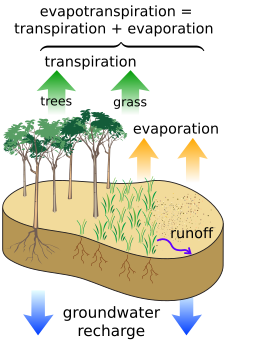
Washington, DC. — Scientists have long debated about the impact on global climate of water evaporated from vegetation. New research from Carnegie’s Global Ecology department concludes that evaporated water helps cool the earth as a whole, not just the local area of evaporation, demonstrating that evaporation of water from trees and lakes could have a cooling effect on the entire atmosphere. These findings, published September 14 in Environmental Research Letters, have major implications for land-use decision making.
Evaporative cooling is the process by which a local area is cooled by the energy used in the evaporation process, energy that would have otherwise heated the area’s surface. It is well known that the paving over of urban areas and the clearing of forests can contribute to local warming by decreasing local evaporative cooling, but it was not understood whether this decreased evaporation would also contribute to global warming.
The Earth has been getting warmer over at least the past several decades, primarily as a result of the emissions of carbon dioxide from the burning of coal, oil, and gas, as well as the clearing of forests. But because water vapor plays so many roles in the climate system, the global climate effects of changes in evaporation were not well understood.
The researchers even thought it was possible that evaporation could have a warming effect on global climate, because water vapor acts as a greenhouse gas in the atmosphere. Also, the energy taken up in evaporating water is released back into the environment when the water vapor condenses and returns to earth, mostly as rain. Globally, this cycle of evaporation and condensation moves energy around, but cannot create or destroy energy. So, evaporation cannot directly affect the global balance of energy on our planet.
The team led by George Ban-Weiss, formerly of Carnegie and currently at Lawrence Berkeley National Laboratory, included Carnegie’s Long Cao, Julia Pongratz and Ken Caldeira, as well as Govindasamy Bala of the Indian Institute of Science in Bangalore. Using a climate model, they found that increased evaporation actually had an overall cooling effect on the global climate.
Increased evaporation tends to cause clouds to form low in the atmosphere, which act to reflect the sun’s warming rays back out into space. This has a cooling influence.
“This shows us that the evaporation of water from trees and lakes in urban parks, like New York’s Central Park, not only help keep our cities cool, but also helps keep the whole planet cool,” Caldeira said. “Our research also shows that we need to improve our understanding of how our daily activities can drive changes in both local and global climate. That steam coming out of your tea-kettle may be helping to cool the Earth, but that cooling influence will be overwhelmed if that water was boiled by burning gas or coal.”
.
Doh!
.
.
Can’t think of any other reply as a) several others have already amply responded and b) I think the one-word ‘Doh” exclaimed puts the icing on it ..
.
Eureka! Vapor cools. More CO2 -> more vapor -> more cooling.
Or did I miss anything?
Stupidity of these propaganists is infinite.
If increased evaporation from tress cools the planet increased evaporation from the warming of c02 must also cool the planet. There you go we have our negative feed back.end of discussion the argument cannot be broken we all agree!
So, that’s why I feel cool air as I ride my bike past the grove! Evaporation cools. Who knew?
“Globally, this cycle of evaporation and condensation moves energy around, but cannot create or destroy energy. So, evaporation cannot directly affect the global balance of energy on our planet.”
Not quite true – the energy taken from the surface – or from the leaf – as the latent heat of evaporation is released as the water changes state as it condenses and/or freezes higher in the atmosphere where the air is less dense. This is _heat energy_ and it is easier for it to escape to space without being ‘absorbed’ by green house gases. This heat release will have no effect on atmospheric temperature unless it is absorbed.
Good thing there is less evaporation in winter or it would really get cold. /sarc
“Globally, this cycle of evaporation and condensation moves energy around, but cannot create or destroy energy. So, evaporation cannot directly affect the global balance of energy on our planet.”
——-
This statement in the paper is essentially true for water that is in equilibrium with the hydrological cycle, but is not true for water that is not in equilibrium. Water that is not in equilibrium with the hydrological cycle comes from two sources, 1) ground water produced from aquifers that are no or slow to recharge – so called fossil water and 2) water produced when hydrocarbons are burned using oxygen in the air. This new water releases heat into the troposphere for one cycle of the hydrological cycle then is in equilibrium and acts the same as the water in the oceans and other impoundments.
Produced fossil water is about 93% of the total new water added to the atmosphere each day. The large majority of the produced fossil water is used for irrigation of food & fodder and for makeup water for evaporative cooling towers. The production of fossil water is currently about 1000 cubic kilometers per year. The production of fossil water got started in earnest around 1950.
There seems to be a misunderstanding of how liquid water is evaporated into water vapor and the condensed back into liquid water. Liquid water is in a state of potential energy in its normal setting. Evaporation takes place at constant temperature and the contained potential energy is changed to kinetic energy as the liquid gives up 1000 btu/lb of latent heat. If we look at the effluent from evaporative cooling towers, it contains aerosols and essentially 100% saturated water vapor at about 120F. This mixture is lighter than air so rises until it cools enough to start condensing whereby the kinetic energy is changed back to potential energy and the absorbed latent heat is released as specific heat of 1 btu/lb/F. The specific heat raises the temperature of the atmosphere.
This evaporation/condensing process undoubtedly has some influence on cloud formation which could offset some of the temperature rise.
JFD
@Scottish Sceptic
BRILLIANT!
I think it is reasonable for them to confirm that more evapotranspiration from plants cools the climate GLOBALLY rather then just locally or regionally.
That point would previously have been denied by the AGW fraternity.
THey just need to think it through a bit 🙂
Will somebody PLEASE study climate!
That photosynthesis in plants has a cooling effect has been known for ages, can’t see anything new in this paper. The more CO2, the more photosynthesis, the more surface cooling. That is why CO2 is an overall coolant.
I lived in the desert for over 12 years and used evaporation cooling and the hotter it got, the more it cooled the house. I am no scientist, but it seems to me that the ‘system’ has been working long enough to understand at least part of the reason why our earth can ‘modulate’ and keep life going.
“It is well known that the paving over of urban areas and the clearing of forests can contribute to local warming by decreasing local evaporative cooling,…”
The urban forests in the middle of the prairies wooood like a word with you.
It would seem to me that the way this would work is that even though the same heat is released by condensation high in the atmosphere that was removed by evaporation at the surface, that heat now has fewer GHGs to work its way through to reach space. The net effect is cooling, via a reduced net GHG effect. Although the lower atmosphere has more H2O in it, the latent heat in the water vapor is in effect “taking the elevator” past the lower atmosphere via convection currents, so that the lower atmosphere GHG content becomes less relevant.
So, deforestion causes possible global warming, increased solar activity posiibly causes global warming, black soot, black roof-tops, land use changes all cause warming…. With 0.8 degrees C warming over the last 150 years, where is CO2’s slice of the pie?
“Increased evaporation tends to cause clouds to form low in the atmosphere, which act to reflect the sun’s warming rays back out into space. This has a cooling influence.”
So if the atmosphere is only clouds and no bleu sky we could start a new Ice-age. or would the heat generated by our planet be enough to keep us warm thanks to the greenhouse gas H2O ?
70% of the surface of this planet is water! Of the remaining 30% a lot of it is ice and snow. Then count rivers and lakes and FINALLY trees and grass. If that lot isn’t in the models then what is the point?
Having worked with air conditioning on marine vessels for over 30 years my first thought was….No Sh/ye Sherlock! Hells teeth! This was junior school stuff!
Ray sums it up with…..
September 16, 2011 at 7:51 am
“Good thing there is less evaporation in winter or it would really get cold. /sarc”
Now I am off to find the aspirin due to the headache caused by banging my head on the keyboard!
Two things about the statements in the article that I am amazed about.
One is the unsustained claim that CO2 has been making it warmer the last decades, in spite of the article mentioning water evaporated from trees as a coolant. The other is the lack of the natural connection that urban areas where many measurements now come from is in fact measuring a higher temperature than if the vegetation had remained, independent of any climate change.
— Mats —
In fiscal year 2010, Carnegie benefitted from continuing increases in federal support. Carnegie’s federal
support has grown from $24.5 million in 2006 to more than $36 million in new grants in 2010. This is a
testament to the high quality of Carnegie scientists and their ability to compete successfully for federal funds.
Very sorry. http://www.carnegiescience.edu
Here you go:
http://climaterealists.com/index.php?id=3735
“Our Saviour – The Hydrological Cycle”
which says amongst other things:
“Thus extra energy in the air from extra GHGs increases the evaporation rate which increases the speed of the hydrological cycle which prevents the extra energy in the air from warming the oceans whether via the ocean skin theory or otherwise.
AGW is thus falsified because the air cannot warm the oceans and the air circulation systems always adjust to bring surface air temperatures back towards sea surface temperatures.
Climate models do not reflect this obvious truth and the ideas of Tyndall et al whilst correct if taking the air in isolation cannot affect the global equilibrium temperature set by the constantly varying interplay of sun air and oceans.”
It is time the climate establishment caught up. They have been stuck in the CO2 merry-go-round for over 20 years whilst the real world went its own way.
Time for a re-evaluation and a fresh start.
I guess this also indicates that cutting down trees to grow biofuels is also counterproductive for “global warming” assuming that trees are better at evaporation than corn or other vegitation.
Mother Nature’s swamp coolers.
I actually cringed when I read this quote, as others seem to have as well: “Globally, this cycle of evaporation and condensation moves energy around, but cannot create or destroy energy. So, evaporation cannot directly affect the global balance of energy on our planet.”
This is part of the problem I found years ago when I decided to investigate the “science” behind global warming. How can any actual scientist be comfortable making that kind of statement? Energy cannot be created nor destroyed. Got it. It’s the Law of Conservation of Energy. Most people (in the U.S.) are taught that somewhere along the line before they graduate from high school. But how do you then make the gigantic leap of logic (or is it a leap of faith, since AGW is really a religion?) that there is no way for evaporation to affect the global energy balance? After all, we know that new energy comes in via sunlight. If the energy balance cannot be affected by evaporation due to the Law of Conservation of Energy, then, using that logic, it cannot be affected by incoming sunlight.
The problem with this pseudoscientific statement is that the law doesn’t actually apply to our atmosphere/climate system. Simply put, our planet is not an isolated system. There are external exchanges between the sun, top of the atmosphere, and space. Pretending it is isolated is great for creating models that might possibly help to undestand parts of how things may or may not work, but that falls apart when dealing with the reality of our atmosphere and energy balance. I won’t even get into the whole “energy does not equal temperature” discussion…
I will now sit back and wait for my check from Exxon…
/sarc