 *
*
Steve McIntyre reports (via commenter AMac) that Mann’s inverted Tiljander sediment data lives on in Kemp et al 2011 like some zombie that will not die. I feel for graduate student Kemp, who will forever have the stink of Mann’s inability to admit and correct this simple issue tied to his paper.
AMac: Upside Down Mann Lives on in Kemp et al 2011
AMac writes:
Yesterday, Kemp et al. 2011 was published in PNAS, relating sea-level variation to climate over the past 1,600 years (UPenn press release). Among the authors is Prof. Mann. (Kemp11 is downloadable from WUWT.) Figs. 2A and 4A are “Composite EIV global land plus ocean global temperature reconstruction, smoothed with a 30-year LOESS low-pass filter”. This is one of the multiproxy reconstructions in Mann et al. (2008, PNAS). The unsmoothed tracing appears as the black line labelled “Composite (with uncertainties)” in panel F of Fig. S6 of the “Supporting Information” supplement to Mann08 (dowonloadable from pnas.org).
This is one of the Mann08 reconstructions that made use of the four (actually three) uncalibratable Tiljander data series.
As scientist/blogger Gavin Schmidt has indicated, the early years of the EIV Global reconstruction rely heavily on Tiljander to pass its “validation” test: “…it’s worth pointing out that validation for the no-dendro/no-Tilj is quite sensitive to the required significance, for EIV NH Land+Ocean it goes back to 1500 for 95%, but 1300 for 94% and 1100 AD for 90%” (link). Also see RealClimate here (Gavin’s responses to comments 525, 529, and 531).
The dependence of the first two-thirds of the EIV recon on the inclusion of Tiljander’s data series isn’t mentioned in the text of Kemp11. Nor is it discussed in the SI, although it is an obvious and trivial explanation for the pre-1100 divergence noted in the SI’s Figures S3, S4, and S5.
Peer review appears to have been missing in action on this glaring shortcoming in Kemp11′s methodology.
More than anything, I am surprised by this zombie-like re-appearance of the Tiljander data series — nearly three years after the eruption of the controversy over their misuse as temperature proxies!
For those that don’t know this story, here’s some links to get yourself up to speed. In a nutshell, Mann took some sediment data, inverted it in sign, and even though the scientist (Tiljander) who gathered and published the data says it is inverted, Mann has done nothing about it, and it continues to find its way into peer reviewed literature.
AMac has more at his blog: The Tiljander Data Series Appear Again, This Time in a Sea-Level Study. Apparently, realclimate.org won’t allow him to comment on the issue.
Here’s a graph from an earlier CA post: More Upside-Down Mann
The difference is shown below:
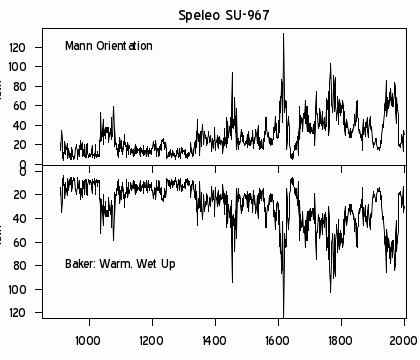
Imagine the caterwauling if we published the bottom graph regularly:

Here’s some links for background:
Upside-Side Down Mann and the ”peerreviewedliterature”
Upside Down Tiljander in Japan
IQ Test: Which of these is not upside down?
Here’s an interesting use of upside down graphs followed by a consensus insistence that the orientation of the data is correct:
* That’s an actual company http://www.zombiedata.com/
Michael Monce says:
June 22, 2011 at 12:28 pm
…
Nobody is trusted in these parts. Now, if you submit data with your paper and interpret it properly, it has a good chance of being trusted. In fact, if nobody can find fault with your paper, the veracity might just rub off on your reputation.
So please, sir, submit!
Michael Monce says:
June 22, 2011 at 12:28 pm
“James: I understand yours was a devil’s advocate response; you stated as such.
Wil and others: You assume my complicity. I was a signer of the original Oregon petition………”
==============================================================================
Thank you for understanding. It should go without stating that the others weren’t lashing out at you personally, but against this black eye climatology has given science. It is likely that, like me, we were taught and brought up in the pollyanna view of the altruistic scientist madly slaving away hoping to find something, anything that could be used for the benefit of humanity and doing it for no other purpose than that. And, perhaps it is a semi-accurate portrayal of many still today. But, our faith has been shaken, to some, perhaps beyond redemption. For many, healthy skepticism has been replaced by cynicism.
Michael, understand, no one likes this. No one wants this.
I’m sure Wil and the others join me in our personal thanks to your courageous stance that you’ve taken. Would that others would follow your example, not for the sake of the ideology, but for science itself.
And, as dbs has stated, by all means don’t let a few of us despair, nor discourage you from submitting an article. I’d look forward to reading it.
James Sexton
Richard Courtney, I see your point, and even anticipated it in my post. It’s not a matter of the computer program vs pencil and paper, but the algorithm used to average the proxies together. For example, if I just added together the proxies, then it would be easy to undo the damage, and enter the proxy correctly, right side up. However, it cannot be done for this proxy. Whichever way it is entered into the program, the result is wrong. It is more than a matter of Mann used data upside-down, which he did for CPS version of Mann et al 2008. It is flawed because the data for the recent period show ‘cold’ when in fact it was ‘warm’. My point is claiming that Mann used the data upside-down,which he did, is too simplistic. It is argument like that that let’s Mann get away with making claims like he did in his response to Steve McIntyre in PNAS:
The claim that ‘‘upside down’’ data were used is bizarre.
Multivariate regression methods are insensitive to the sign of
predictors.
For the case of EIV, the second statement is correct.
Michael Monce says:
June 22, 2011 at 12:28 pm
Right on Michael! fight the good fight and thank you for clarifying your real position.
What I’ve never understood about the ‘inverted’ controversy is this: If the data is sign insensitive, why bother inverting it in the first place?
“One cannot attribute to malice that which can be explained by incompetence”. Both are unacceptable IMHO.
Unfortunately neither he nor you know how to read the legend in the chart. HADCRUTv3 has been REBASELINED so that zero is for the period 1400-1800
Fig. 2. (A) Composite EIV global land plus ocean global temperature reconstruction (1), smoothed with a 30-year LOESS low-pass filter (blue). Data since AD 1850 (red) are HADCrutv3 instrumental temperatures. Values are relative to a preindustrial average for AD 1400–1800
The Y axis has been inverted in Manns graph but not in the example below?
@Rhoda
Inverting the sign to determine the fit and weighting of a dataset in this way is the correct operation of the statistical method used, but only if either:
1) You aren’t sure if there is a significant relationship of the proxy dataset to the value purportedly being measured by the proxy – you’re really looking for correlation in this way without expectation. It’s a *starting* point that tells you “dig here” to attempt to determine a genuine physical relationship, not an end point that lets you draw a conclusion
or
2) You know there’s a physical relationship and can stipulate *before* feeding the series into the method that flipping would be justified for one reason or another. One artificial example often used is measuring the position of the meniscus on a mercury thermometer, relative to a point below the thermometer. It doesn’t matter whether the thermometer hangs upside down – the displacement of the meniscus is a proxy for temperature. In this case, automatically flipping the sign would be a desirable outcome of the method.
However, if you examine how the proxy was actually employed to deliver a result, and find it was flipped in a way that makes no sense when it’s related to a physical process, use of that flipped proxy is questionable; it should not be used because it is not a suitable proxy, and any apparent significance it has because of the blind (but correct) processing of the method is deceptive.
MikeN:
I thank you for your patience in again trying to explain your view to me in your post at June 22, 2011 at 3:28 pm.
Yes, I ‘get it’ that the algorithm is sign insensitive. But I still fail to see how use of such an algorithm differs from ‘using the data upside down’ if that insensitivity indicates ‘cold is warm’.
The explanation from mrsean2k at June 23, 2011 at 2:01 am agrees with my understanding of the issue. I commend it to you and I thank him for it.
Richard
I am not a scientist, I have posted previously about Mann and after reading the E-Mails I was disgusted with the whole peer review process AND his ultimate goal of picking my pocket by getting my taxes raised over nonsense. If the justification for your work is solely government grants then get a shovel, Obama has a job for you. Mann promoted this Global Warming monstrosity for MONEY, personal enrichment. Those in authority either knew it or let it slide.If the peer review process is as shoddy as it is to promote global warming then science will progress no further.
I don’t know, nor do I care at this point what his credentials are, all he has done was call people like me and those in the sciences “Flat Earthers” BS, he did it for a BUCK. He should be forced to resign aqnd if charges are needed go to a nice “WARM” jail.
Richard, I agree with mrsean2k. The data was used upside-down. My objection is to the phrasing, between the chart and the comparison temperature charts, I don’t think the main post is explaining the issue correctly. The proxy cannot be used in this fashion. A comparison would be to the Kaufmann et al Arctic warming paper, in which the proxy was used upside-down, perhaps due to having a coauthor with Mann08, then when spotted they simply turned it right side up again. They used a simple average and cut off the modern portion that was flawed. They also fixed some of their other calculations as recommended by Hu McCullough.
“The justification relies on the fact that the statistical method used to determine the suitability of the series is insensitive the orientation of the series.”
Oh dear, where to start?
Well, the real issue with the use of the Tiljander sediment data as a climate proxy is not the numerical sign of the correlation coefficient, the real issue is the CALIBRATION of the proxy in the first place.
The identification of varves (banded layers) in the sediment record from arctic lakes produces a valid climate proxy as long as the attribution of the varve type is correctly applied. Varves form in lakes that experience annual freezing of the surface waters. The still conditions of winter allow fine sediment to settle out of the water column below the ice carapace. In contrast, the spring melt and summer run-off brings coarser sediments into the lake, from the surrounding barren landscape, leading to the formation of mineral rich varves under cold climate conditions.
Under mild climate conditions the same lake is likely to be surrounded by vegetated land. The formerly barren mineral soil is now overlain by organic peat and fixed by plant roots. While the annual winter freeze – summer thaw cycle still allows varves to form, the summer conditions now bring organic remains into the lake. The mineral subsoil, buried by peat, does not now get eroded to the same degree as previously occurred under the cold climate conditions.
Organic rich varves are a sign of an ameliorated climate; mineral rich varves indicate cold barren climate conditions. The is the Environmental Science I was taught almost 40 years ago and I see no reason to expect that modern knowledge says anything different. All would have been well with the Tiljander sediment data had the above correct science been applied. However the modern Tiljander sediment record is contaminated by human activity. Ground disturbance associated with land management, ditch clearance and bridge building has produced an influx of coarse sediments in the summer, swamping the natural organic sediment signal.
On the basis of finding coarse sediment varves occurring in the modern lake sediments, the false calibration of mineral rich varves equals warm climate was made. When applied to the historic record, this incorrect calibration falsely turned the cold-period natural mineral rich varves into a signal of a nonexistent warm paleoclimate.
Isn’t it the case that the data was “back to front” rather than “upside down”? If the actual sediments were inverted, this would mean the oldest sediments were interpreted as being the newest and vice versa. And, if that is the case, it is the data itself that has the problem, as noted by Tiljander herself.
Or am I missing something?
Philip Mulholland (June 23, 2011 at 10:24 am) —
Nice analysis.
I’d like to expand on your closing paragraph. Tiljander03 recorded the total thickness of each year’s varve (thicknessmm, millimeters), and then got the thickness that was due to mineral deposition (lightsum, millimeters)*. The authors then deduced the portion of the varve thickness that was due to the settling of organic matter by this formula:
darksum = thicknessmm – lightsum
All values are in millimeters (or in micrometers — thousandths of millimeters).
(There’s a fourth data series, X-Ray Density, that I won’t discuss here.)
Tiljander03 suggested that local human activities started contributing appreciably to varve characteristics around 1720**.
Prior to that point, the interpretations offered in Tiljander03 match the ones that you gave.
Higher lightsum values come about when cold, snowy winters lead to a more vigorous spring thaw, carrying more mineral silt into the lake.
Higher darksum values come about when warm, wet summers promote the growth of vegetation, leading to more organic matter being carried into the lake.
There’s no interpretation for thicknessmm.
According to Tiljander: Post-1720, progressively more silt settles to the lake bottom (farming, road-building). And over that time span, progressively more organic matter settles to the lake bottom (peat cutting, eutrophication).
As you say, this is where Mann08 was misled. For 1850-1995, they looked at the CRUTEM3v temperature anomaly record for the gridcell containing Lake Korttajarvi, and compared it with the varve data.
Overall, temperature goes up over time, and, overall:
— lightsum goes up over time.
— darksum goes up over time.
— thicknessmm goes up over time.
The resulting calibration of temperature to lightsum is without validity. For hindcasting, the spurious correlation is upside-down with respect to Tiljander’s interpretation.
The resulting calibration of temperature to darksum is equally invalid. This spurious correlation is rightside-up with respect to Tiljander’s interpretation.
The resulting calibration of temperature to thicknessmm also lacks merit. Since Tiljander offered no opinion, this spurious correlation can’t be upside-down, or rightside-up.
That seems to be a fair accounting of this piece of the puzzle. In my experience, supporters of Mann08’s validity neither challenge nor accept this description. Instead, the conversation moves towards assertions along the lines of, I don’t know, and it doesn’t matter.
– – – – – – – – – –
* I am not sure what method Tiljander used to do determine lightsum–do you know?
** Gazing at the data, the onset of large-scale contamination seems much later to me, perhaps 100 years or more.
Isn’t it generally regarded as poor methodology to splice signals due to the bandpass problem?
For example, take any noisy signal. Apply a low bandpass filter to the first portion of the signal and a high bandpass filter to the end portion. What you will end up with is a signal that looks quite flat in the first portion and quite spiky in the end portion.
Looking at the resulting signal you might then incorrectly conclude that the object generating the signal had changed, while in fact the observed change is simply an artifact of the bandpass problem.
Since it is unlikely that a tidal gauge has the same bandpass as ocean sediments, it would appear that any conclusions drawn from the signal might simply be an artifact of the signal processing. Unless and until the same bandpass filters are applied to both portions of the signal you cannot reliably splice the signals and achieve a significant result.
For example, it is likely that the ocean sediments are a low bandpass filter. There may well have been spikes in the low bandpass section of the signal similar to what is observed in the tidal gauge. However, these would no longer be visible due to the effects of the filter. Thus, it cannot be ruled out that such spikes are typical of the signal.