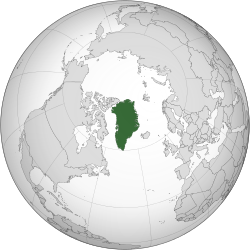
 Greenland’s early Viking settlers were subjected to rapidly changing climate. Temperatures plunged several degrees in a span of decades, according to research from Brown University. A reconstruction of 5,600 years of climate history from lakes near the Norse settlement in western Greenland also shows how climate affected the Dorset and Saqqaq cultures. Results appear in Proceedings of the National Academy of Sciences.
PROVIDENCE, R.I. [from Brown University] — The end of the Norse settlements on Greenland likely will remain shrouded in mystery. While there is scant written evidence of the colony’s demise in the 14th and early 15th centuries, archaeological remains can fill some of the blanks, but not all.
What climate scientists have been able to ascertain is that an extended cold snap, called the Little Ice Age, gripped Greenland beginning in the 1400s. This has been cited as a major cause of the Norse’s disappearance. Now researchers led by Brown University show the climate turned colder in an earlier span of several decades, setting in motion the end of the Greenland Norse. Their findings appear in Proceedings of the National Academy of Sciences.
The Brown scientists’ finding comes from the first reconstruction of 5,600 years of climate history from two lakes in Kangerlussuaq, near the Norse “Western Settlement.” Unlike ice cores taken from the Greenland ice sheet hundreds of miles inland, the new lake core measurements reflect air temperatures where the Vikings lived, as well as those experienced by the Saqqaq and the Dorset, Stone Age cultures that preceded them.
“This is the first quantitative temperature record from the area they were living in,” said William D’Andrea, the paper’s first author, who earned his doctorate in geological sciences at Brown and is now a postdoctoral researcher at the University of Massachusetts–Amherst. “So we can say there is a definite cooling trend in the region right before the Norse disappear.”
“The record shows how quickly temperature changed in the region and by how much,” said co-author Yongsong Huang, professor of geological sciences at Brown, principal investigator of the NSF-funded project, and D’Andrea’s Ph.D. adviser. “It is interesting to consider how rapid climate change may have impacted past societies, particularly in light of the rapid changes taking place today.”
D’Andrea points out that climate is not the only factor in the demise of the Norse Western Settlement. The Vikings’ sedentary lifestyle, reliance on agriculture and livestock for food, dependence on trade with Scandinavia and combative relations with the neighboring Inuit, are believed to be contributing factors.
Still, it appears that climate played a significant role. The Vikings arrived in Greenland in the 980s, establishing a string of small communities along Greenland’s west coast. (Another grouping of communities, called the “Eastern Settlement” also was located on the west coast but farther south on the island.) The arrival coincided with a time of relatively mild weather, similar to that in Greenland today. However, beginning around 1100, the climate began an 80-year period in which temperatures dropped 4 degrees Celsius (7 degrees Fahrenheit), the Brown scientists concluded from the lake readings. While that may not be considered precipitous, especially in the summer, the change could have ushered in a number of hazards, including shorter crop-growing seasons, less available food for livestock and more sea ice that may have blocked trade.
“You have an interval when the summers are long and balmy and you build up the size of your farm, and then suddenly year after year, you go into this cooling trend, and the summers are getting shorter and colder and you can’t make as much hay. You can imagine how that particular lifestyle may not be able to make it,” D’Andrea said.
Archaeological and written records show the Western Settlement persisted until sometime around the mid-1300s. The Eastern Settlement is believed to have vanished in the first two decades of the 1400s.
The researchers also examined how climate affected the Saqqaq and Dorset peoples. The Saqqaq arrived in Greenland around 2500 B.C. While there were warm and cold swings in temperature for centuries after their arrival, the climate took a turn for the bitter beginning roughly 850 B.C., the scientists found. “There is a major climate shift at this time,” D’Andrea said. “It seems that it’s not as much the speed of the cooling as the amplitude of the cooling. It gets much colder.”
The Saqqaq exit coincides with the arrival of the Dorset people, who were more accustomed to hunting from the sea ice that would have accumulated with the colder climate at the time. Yet by around 50 B.C., the Dorset culture was waning in western Greenland, despite its affinity for cold weather. “It is possible that it got so cold they left, but there has to be more to it than that,” D’Andrea said.
Contributing authors include Sherilyn Fritz from the University of Nebraska–Lincoln and N. John Anderson from Loughborough University in the United Kingdom. The National Science Foundation funded the work.
The Cooling and the Black Death are directly linked; such pandemics occur in Cool Eras, contrary to warm-monger propaganda. So the LIA caused both inclement farming weather and the setting for mass death by disease.
For those asking about the reconstruction.
It’s behind a paywall but you can get an idea of the shape of the temperature reconstruction from Fig S6 B in the Supplimentary Information.
http://www.pnas.org/content/suppl/2011/05/25/1101708108.DCSupplemental/Appendix.pdf
The temp reconstructions show a warmer period <2000years ago aswell as in earlier periods. I don't know the copyright issues of posting a screen grab of the actual reconstruction from the paper.
It looks like you can download the actual data of the reconstruction from here
ftp://ftp.ncdc.noaa.gov/pub/data/paleo/paleolimnology/greenland/kangerlussuaq2011.txt
Maybe Antony can draw a graph and add it to the post please???
vukcevic says:
June 1, 2011 at 1:01 am
Dr. Spencer, Dr. Svalgaard
And why would one assume that the current knowledge of the Sun – Earth interaction is the definitive one?
One always build on ‘current knowledge’ [which is never ‘definitive’]. Anything else is just [usually inadmissible] speculation.
Leif Svalgaard says: June 1, 2011 at 7:49 am
One always build on ‘current knowledge’ [which is never ‘definitive’]. Anything else is just [usually inadmissible] speculation.
Unless the experts (in this case the climate ones) ignore the basic ‘down to earth’ processes, and fly off into the ‘stratosphere’ looking for a few gone astray CO2 molecules.
vukcevic says:
June 1, 2011 at 8:32 am
Unless the experts (in this case the climate ones) ignore the basic ‘down to earth’ processes, and fly off into the ‘stratosphere’ looking for a few gone astray CO2 molecules.
Having a basic knowledge of physics and applying it correctly works. Every complex problems have simple, ‘down to earth’, explanations which are wrong.
HR says:
June 1, 2011 at 4:46 am
Maybe Antony can draw a graph and add it to the post please???
Here it is: http://www.leif.org/research/Greenland-Temp-DAndrea.png
Leif Svalgaard says:
June 1, 2011 at 8:59 am
Here it is: http://www.leif.org/research/Greenland-Temp-DAndrea.png
I added the [inverse] cosmic ray flux [brown curve] and the solar cycle modulation extracted from the cosmic ray flux [bottom curves]. It is clear that there [unfortunately] are no correlations with any of these solar parameters with the Greenland temperatures.
Leif Svalgaard says: June 1, 2011 at 9:31 am
It is clear that there [unfortunately] are no correlations with any of these solar parameters with the Greenland temperatures.
Precisely.
Greenland is not place to look for solar correlations. If the most recent period doesn’t correlate, there is no point looking for correlation in a more distant past.
My ‘down to earth’ approach concluded that more than a year ago, despite regular ridicule from the resident expert/s, as number of the past posts on this blog can confirm.
Here is the reminder
http://www.vukcevic.talktalk.net/CET&10Be.htm
vukcevic says:
June 1, 2011 at 12:21 pm
My ‘down to earth’ approach
Is pseudo-science of the worst kind, so doesn’t need to be commented on.
Very odd world.
Academic science comes to the same conclusion as the ‘pseudo-science of the worst kind’!
Case of an ‘Alice in Wonderland’?
vukcevic says:
June 1, 2011 at 1:22 pm
Academic science comes to the same conclusion as the ‘pseudo-science of the worst kind’
Conclusions arrived at by invalid analysis [and undisclosed] and not-understood physics still aren’t any good, no matter what they are compared with.
tty says:
June 1, 2011 at 12:50 am
I have a 14 year old who is interested in history, and i would like to know where i can get more info on the inuits and others in greenland, atleast for the last couple of millennia.
is there any easy reference i can pass on to an 8th grader
From the linked article:
“This is the first quantitative temperature record from the area they were living in,” said William D’Andrea, the paper’s first author, who earned his doctorate in geological sciences at Brown and is now a postdoctoral researcher at the University of Massachusetts–Amherst. “So we can say there is a definite cooling trend in the region right before the Norse disappear.”
“The record shows how quickly temperature changed in the region and by how much,” said co-author Yongsong Huang, professor of geological sciences at Brown, principal investigator of the NSF-funded project, and D’Andrea’s Ph.D. adviser. “It is interesting to consider how rapid climate change may have impacted past societies, particularly in light of the rapid changes taking place today.”
“In the light of the rapid changes taking place today”. Its unusual and refreshing to see scientists recognising the climate cooling currently underway, and comparing it to similar cooling periods which, like warming periods, have periodically occurred throughout measured history with no help from human influence.
They could have extended the inquiry further to speculate how long the current Greenland settlement will continue as climate cools.
BTW the historic cold periods identified in the linked article coincide with those cited by E.M. Smith in support of his “Bond Event” hypotheses of cold periods occurring every 1470 years corresponding to Dansgaard-Oeschger events:
http://chiefio.wordpress.com/2009/04/06/bond-event-zero/
i.e. at 850 BC. then during 500-800 AD (prior to the MWP). The next one in this sequence is, well, now.
phlogiston says:
June 1, 2011 at 4:43 pm
i.e. at 850 BC. then during 500-800 AD (prior to the MWP). The next one in this sequence is, well, now.
There really aren’t any such periodicity, e.g. none at 2320 BC.
http://www.leif.org/research/Greenland-Temp-DAndrea.png has this power spectrum [for mean of the three lakes]:
http://www.leif.org/research/Greenland-Temp-DAndrea-FFT.png
There are no cycles at any period [the time resolution is 20 years, so the curve starts at twice that, i.e. 40 years]
Leif Svalgaard says:
June 1, 2011 at 6:37 pm
http://www.leif.org/research/Greenland-Temp-DAndrea.png
What I plotted was the raw data, called Long-Chain Alkenones, e.g. see here:
http://chemoc.coas.oregonstate.edu/~fprahl/alkdesc.html
The Alkenone UK’37 data can be converted to temperature using T=29.4(A37-0.039).
P.S. I’m a bit puzzled by the negative sign of the UK’37 data given, because that would correspond to T ~ -20C, which doesn’t not sound reasonable, but, hey, I just present the data.
Thanks Leif,
The paper used a different formulae for converting UK37 to T than the one you found it goes T=40.8*UK37+31.8 which put’s the rnage of mid=june to mid=July temperature in the reconstruction at ~20-25oC which looks a little better. I’ll have a go at posting the reconstructions latter if you don’t beat me to it.
HR says:
June 1, 2011 at 8:15 pm
temperature in the reconstruction at ~20-25oC which looks a little better. I’ll have a go at posting the reconstructions latter if you don’t beat me to it.
That looks better, indeed [perhaps a bit high…]. The important thing for me was the relative variation. as long a that is linear with the temperature I’m happy. The point was to point out that there is no solar variation [nor cosmic ray] correlation, cyclical or otherwise in the Greenland data.
RE: (Halfway through 7th paragraph) “The (Viking) arrival coincided with a time of relatively mild weather, similar to that in Greenland today. ”
Come on; have some guts! It was much warmer, but the writer doesn’t want to ruffle feathers. If it was “similar,” then it would be possible to raise cattle and over 100,000 goats and sheep, right now. It isn’t.
The current “Warm Period” reduced ice in a valley on the cold east coast, exposing crushed branches of birches and conifers. This originally made headlines, as it seemed to support the idea of “unprecedented” warming. However, when it was pointed out birches and conifers still cannot grow in that area of the east coast, despite recent warming, and therefore the exposed branches are evidence that the MWP was warmer than today, this “news” quietly went away.
There are many other examples of scientists needing to tiptoe, concerning the MWP in Greenland, because politicians held the purse-strings, but now it is time to demonstrate guts and speak the truth.
The Plague hit the Western Settlement and wiped it out, according to the sagas.
Jared Diamond’s book (I have not read) seems to indicate 1) there were forested areas in SW Greeenland and 2) there was no native iron, upon which the settlers were dependent for tools and nails. There was only bushy scrub at best with perhaps a few very modest stands of spindly adventitious alders, birches and poplars, nothing more, and there was meteoritic iron, but a little further north it seems was a main source, the Norse settlers never found it.
The Taanit/Tuunit=Dorset connection isn’t proved, but makes sense. The “Thule” Inuit who moved into the former Norse areas also spoke of cannibals on the east coast of Greenland. The saga data about the child hostages the Norse took in North America indicate a somewhat different collection of cultures in the region at the time. The Dorset per se were a sort of more primitive Eskimo culture and had stone houses where they were first discovered. The Saqqaq are fairly unknown but an article in a science publication about 2 years ago had genetic studies of a sample of hair found at an archaeological site in Greenland that might have belonged to a member of the so-called Saqqaq culture and found there were connections with Siberian cultures but probably represented a group that was already in North America and distinct from Aleut/Inuit and other Native Americans.
Contrary to popular myth, most Vikings were farmers and very few were pirate raiders. The Greenland settlers brought crops and livestock, apparently sheep and cows did alright initially, pigs never did really well, and eventually Greenlandic cows became pygmies, the smallest cows known to Europeans. Viking farming in Greenland was based upon lessons in soil erosion learned in Iceland, which didn’t really apply, Iceland having lots of fine volcanic soils that tended to wash away, whereas Greenland had a lot of rocks and not much soil to speak of.
It is more less proved from what I’ve read over the years that the Greenlanders were forced to rely more and more on seafood and less on crops and livestock.
It seems rather obvious that they faced the problem of diminishing returns due to a cooling climate, and weren’t prepared to completely change their lifestyles, so they left and went back to Norway, Iceland, or to the Canadian maritimes, or tried to stick it out and failed. All of the above. There is some papal intrigue involving the sale of the eclesiastical province which wasn’t tithing anymore to Portuguese slavers, and there might have been Dutch and even English expeditions as well, because John Dee had maps of a sort and declared the Queen monarch there or somesuch.
A mission to check up on the Western Settlement sent from the Eastern found no survivors and livestock loose and grazing the coastal strip between the settlements. The last church record on file in Iceland of the wedding in Garde at Hvalsey Church I suppose probably isn’t the end of the story there. Most likely a few famine survivors were taken in by the Inuit and given a ration of seal meat, those who weren’t adverse to charity from the skraelings, probably children or young people. Relief from Norway was blocked because of icy seas as well as crises back in Europe: plague, famine, war.
A decent place to start for eighth graders would be the Catholic Encyclopedia article available on the internet. The wikipedia article is a bunch of ninth graders arguing the merits of Diamond’s thesis.