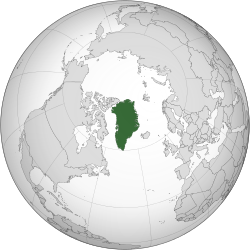
 Greenland’s early Viking settlers were subjected to rapidly changing climate. Temperatures plunged several degrees in a span of decades, according to research from Brown University. A reconstruction of 5,600 years of climate history from lakes near the Norse settlement in western Greenland also shows how climate affected the Dorset and Saqqaq cultures. Results appear in Proceedings of the National Academy of Sciences.
PROVIDENCE, R.I. [from Brown University] — The end of the Norse settlements on Greenland likely will remain shrouded in mystery. While there is scant written evidence of the colony’s demise in the 14th and early 15th centuries, archaeological remains can fill some of the blanks, but not all.
What climate scientists have been able to ascertain is that an extended cold snap, called the Little Ice Age, gripped Greenland beginning in the 1400s. This has been cited as a major cause of the Norse’s disappearance. Now researchers led by Brown University show the climate turned colder in an earlier span of several decades, setting in motion the end of the Greenland Norse. Their findings appear in Proceedings of the National Academy of Sciences.
The Brown scientists’ finding comes from the first reconstruction of 5,600 years of climate history from two lakes in Kangerlussuaq, near the Norse “Western Settlement.” Unlike ice cores taken from the Greenland ice sheet hundreds of miles inland, the new lake core measurements reflect air temperatures where the Vikings lived, as well as those experienced by the Saqqaq and the Dorset, Stone Age cultures that preceded them.
“This is the first quantitative temperature record from the area they were living in,” said William D’Andrea, the paper’s first author, who earned his doctorate in geological sciences at Brown and is now a postdoctoral researcher at the University of Massachusetts–Amherst. “So we can say there is a definite cooling trend in the region right before the Norse disappear.”
“The record shows how quickly temperature changed in the region and by how much,” said co-author Yongsong Huang, professor of geological sciences at Brown, principal investigator of the NSF-funded project, and D’Andrea’s Ph.D. adviser. “It is interesting to consider how rapid climate change may have impacted past societies, particularly in light of the rapid changes taking place today.”
D’Andrea points out that climate is not the only factor in the demise of the Norse Western Settlement. The Vikings’ sedentary lifestyle, reliance on agriculture and livestock for food, dependence on trade with Scandinavia and combative relations with the neighboring Inuit, are believed to be contributing factors.
Still, it appears that climate played a significant role. The Vikings arrived in Greenland in the 980s, establishing a string of small communities along Greenland’s west coast. (Another grouping of communities, called the “Eastern Settlement” also was located on the west coast but farther south on the island.) The arrival coincided with a time of relatively mild weather, similar to that in Greenland today. However, beginning around 1100, the climate began an 80-year period in which temperatures dropped 4 degrees Celsius (7 degrees Fahrenheit), the Brown scientists concluded from the lake readings. While that may not be considered precipitous, especially in the summer, the change could have ushered in a number of hazards, including shorter crop-growing seasons, less available food for livestock and more sea ice that may have blocked trade.
“You have an interval when the summers are long and balmy and you build up the size of your farm, and then suddenly year after year, you go into this cooling trend, and the summers are getting shorter and colder and you can’t make as much hay. You can imagine how that particular lifestyle may not be able to make it,” D’Andrea said.
Archaeological and written records show the Western Settlement persisted until sometime around the mid-1300s. The Eastern Settlement is believed to have vanished in the first two decades of the 1400s.
The researchers also examined how climate affected the Saqqaq and Dorset peoples. The Saqqaq arrived in Greenland around 2500 B.C. While there were warm and cold swings in temperature for centuries after their arrival, the climate took a turn for the bitter beginning roughly 850 B.C., the scientists found. “There is a major climate shift at this time,” D’Andrea said. “It seems that it’s not as much the speed of the cooling as the amplitude of the cooling. It gets much colder.”
The Saqqaq exit coincides with the arrival of the Dorset people, who were more accustomed to hunting from the sea ice that would have accumulated with the colder climate at the time. Yet by around 50 B.C., the Dorset culture was waning in western Greenland, despite its affinity for cold weather. “It is possible that it got so cold they left, but there has to be more to it than that,” D’Andrea said.
Contributing authors include Sherilyn Fritz from the University of Nebraska–Lincoln and N. John Anderson from Loughborough University in the United Kingdom. The National Science Foundation funded the work.
Leif, the estimated change in TSI in the paper you cite is only 0.9 W m-2 from the Maunder Minimum until present. This translates to about 0.2 W m-2 in terms of a change in total solar actually absorbed. Unless this is greatly magnified by an indirect effect like cosmic ray-induced changes in planetary albedo, it would suggest a very sensitive climate system…which would mean the 1.6 Watts or so from more CO2 so far will kill us all. (But probably not before we die of old age). 🙂
Brian H wrote:
“There are also UK and other MWP period castles with ports etc. now located up to a mile or more inland, from which we can reasonably deduce the water was rather deeper than now. Observing the obvious is difficult, but rewarding.”
You cannot deduce that the water was deeper then. Scotland and northern England have been rising since the end of the last ice age but southeast England has been sinking.
I just wanted to complement you on the excellent discussion that occurs on this site. It is one of the few blogs I read that has comments that I also read. The comments are interesting and add greatly to my understanding of the post. I never notice trolls here, so thank you for that. Decades ago I wanted to be a geophysicist, but was told that was not a job for girls so I never pursued it. However, my interest in science never waned. I now teach high school government and economics, so this site is an important source for my public policy discussions. I often refer my students to your posts for required reading. Keep up the good work.
Brian H says:
May 31, 2011 at 11:34 am
For example, York. It must have been at the head of a decent estuary when it had its second flowering. Today tidal waters are a bit downstream.
It will be interesting to see if it is a summer only reconstruction.
If that’s the case the 4C decrease may not be that great on an annual basis.
Summer temps are worse than winter temps for reconstructing an annual figure.
The other thing people need to be aware of is polar amplification.
Simply, if it gets 1C warmer at the equator, then the increase you see at high latitude
is greater. One could expect that a a rapid cooling in the northern latitudes would
not be matched at the equator. basically, a 4C change in greenland does not imply
a 4C change everywhere. Its important to remember this especially if you think that
7000 thermometers around the planet are not adequate to capture an average.
The study clearly shows that cold is far more disruptive for settlements than warmth. That’s why the heck they came then left Greenland in the first place. Global warming is good, cold is a killer.
Thank you for the link to this paper Dr. Svalgaard. Very much appreciated.
Dr. Spencer:
What the link that Dr. Svalgaard provided shows is that we are missing something in the climate models. The trillion dollar question is……….just what in the heck is it????????
I wish the fixation on co2 would diminish enough to allow scientists to think outside the box to find that missing item.
Maybe it is GCR…..I don’t know. But somewhere in ole Sol there is a missing link.
Roy Spencer says:
May 31, 2011 at 3:09 pm
Leif, the estimated change in TSI in the paper you cite is only 0.9 W m-2 from the Maunder Minimum until present.
I actually think it is only half that, at most.
it would suggest a very sensitive climate system
Or that the Sun simply does not vary enough to have any influence at all [on a time scale of 1000s of years]
Nah, it was the twin Evinrudes on the longboats. Vroom vroom!
To Bob Tisdale, Looks like NSF funding according to the article
“The record shows how quickly temperature changed in the region and by how much,” said co-author Yongsong Huang, professor of geological sciences at Brown, principal investigator of the NSF-funded project, and D’Andrea’s Ph.D. adviser.”
Tom T says:
May 31, 2011 at 10:33 am
[snip]
We better stop depending on agriculture and livestock for food then.
I can’t imagine the Vikings’ leading a sedentary lifestyle. What did they do, sit around playing Viking Hero on the PS3?
_________________________________________________________
Funny you mention that. I always thought they went in for the pillage and plunder thing.
Maybe it is far worse than we thought.
This may be the URL for two data sets for the study:
ftp://ftp.ncdc.noaa.gov/pub/data/paleo/paleolimnology/greenland/kangerlussuaq2011.txt
Leif,
I’m sure others have pointed the following out to you:
It is not fluctiations in the heat output from the sun that is under study, but fluctiations in the magnetic forces between sun and earth.
AusieDan says:
May 31, 2011 at 7:23 pm
It is not fluctiations in the heat output from the sun that is under study, but fluctuations in the magnetic forces between sun and earth.
The latter are a million times less enrgetic than the former, so are of little consequence.
The Black Death pandemic around 1350 may also have played a role in the settlements demise.
To make it more interesting, consider the sea level was 2 m higher than today, possibly more, about 3000 to 4000 years ago. There are studies of settlements on the Texas coast that support this idea. There is also some evidence of ports left high and dry in India from about the same period. The usual counter argument for North America is the gradual rise of the land following the Ice Age. The weight of ice removed allowed the land to rebound to high levation. However, this phenomenon is evident farther north around Maine, where ice actually once sat.
Thus, the sea level was higher in the past after the end of the Ice Age than it is now. And CO2 did whatever it did.
http://en.wikipedia.org/wiki/Post-glacial_rebound
http://geochemistry.usask.ca/bill/Courses/Climate/Coastal%20catastrophe%20prt.pdf
These are interesting, with much to explore:
http://www.stanford.edu/~meehan/donnellyr/summary.html
http://www.stanford.edu/~meehan/donnellyr/3000bc.html
Yngvar, correct, though perhaps not in the way you were thinking. The Black Death left a lot of abandoned farms in Iceland as the growing season was getting shorter in Greenland, and the Greenlendings had kinship inheritance rights to those farms, and many simply moved back to Iceland.
Stevefb says:
May 31, 2011 at 10:38 am
Pesky Norse chaps obviously had 4×4 chariots
If they were pulled by horses, yes they did. Just think, my (4×4) Land Rover has a driven wheel at each corner. A horse has a driven leg at each corner. Admittedly the Landie is more than one horsepower, but the analogy is sound, I think.
They seem to be remarkably uninformed about the archaeological and historical data about the norse on greenland.
“D’Andrea points out that climate is not the only factor in the demise of the Norse Western Settlement. The Vikings’ sedentary lifestyle, reliance on agriculture and livestock for food, dependence on trade with Scandinavia and combative relations with the neighboring Inuit, are believed to be contributing factors.”
Stable isotope data show that the norse shifted from mainly relying on livestock (not agriculture) to mainly living on maritime food (probably mostly seals) as climate deteriorated. There is no archaeological and very little historical evidence for violence between the norse and the inuits. Icelandic historic sources mention one single clash and inuit oral traditions one or two others.
“The Eastern Settlement is believed to have vanished in the first two decades of the 1400s.”
It is true that it is last mentioned in icelandic sources in 1406 (when a wedding in Herjolfsnes chuch is mentioned), but archaeological excavations at Herjolfsnes churchyard shows that it was in use until at least 1450.
“The arrival coincided with a time of relatively mild weather, similar to that in Greenland today. However, beginning around 1100, the climate began an 80-year period in which temperatures dropped 4 degrees Celsius (7 degrees Fahrenheit), the Brown scientists concluded from the lake readings.”
Historical sources (Konungs Skuggsjá) mention that barley could (just barely) be grown in the Eastern Settlement in the 1200’s. This is not possible under current conditions.
“The Saqqaq exit coincides with the arrival of the Dorset people, who were more accustomed to hunting from the sea ice that would have accumulated with the colder climate at the time. Yet by around 50 B.C., the Dorset culture was waning in western Greenland, despite its affinity for cold weather. “It is possible that it got so cold they left, but there has to be more to it than that,” D’Andrea said.”
The reason the Dorset people left (southern) Greenland was probably that it got too warm (Roman Warm Period, anybody?). The Dorsets did not have any kayaks but were dependent on hunting from the ice in winter. Southwestern Greenland does not have any reliable winter ice under current or equivalent climatic conditions. Isléndingabok (ca 1130) mentions that there were no people at all in SW Greenland when the Norse arrived, but traces of former settlement, and that the norse later recognized that these had been built by the people they came to call “Skraelings” when they encountered them further north and west. The Dorset did survive until much later in northern Greenland and the Parry Archipelago that are much colder than southern Greenland. A small remnant (the Sadlermiut) actually survived in the northern Hudson Bay area until wiperd out by an epidemic around 1900.
Somewhat lather the Thule inuits (ancestors of the modern inuit) arrived in northern Greenland from the west (Aleaska). These were maritime hunters relying on hunting from kayaks and took advantage of open water in the Parry archipelago and around Northern Greenland during the MWP. They mostly displaced the Dorset (which they called Tuniit). As the LIA progressed the Thule inuits were gradually forced south as sea-ice expanded, and the original settlements in northern and eastern Greenland ultimately went extinct.
The LIA impacted both norse and inuits.
Dr. Spencer
Dr. Svalgaard
And why would one assume that the current knowledge of the Sun – Earth interaction is the definitive one?
AusieDan says:
It is not fluctiations (fluctuations) in the heat output from the sun that is under study, but fluctuations in the magnetic forces between sun and earth.
Dr. L.S.
The latter are a million times less enrgetic (energetic)than the former, so are of little consequence.
AusieDan
Dr. Svalgaard is absolutely correct that the magnetic forces are a million times less energetic than the TSI input.
My simple curiosity led me to discover that the Arctic magnetic field (an unlikely cause of climate change by itself, but a parallel artefact) is a mirror image (in reverse) of the solar activity.
http://www.vukcevic.talktalk.net/LFC9.htm
The other half of the mentioned parallel is at the base of the natural climate change
http://www.vukcevic.talktalk.net/dBz.htm
I think I know why; it appears to be a very simple ‘down to earth’ process.
So, climates change. Who would have thought it? Certainly not those at the EPA or UK Met. Office.
Sigurdur says: May 31, 2011 at 6:04 pm
Maybe it is GCR…..I don’t know. But somewhere in ole Sol there is a missing link.
I don’t think link was ever missing, it was obvious for as long as the temperatures were recorded, but it has been ignored by scientists.
http://www.vukcevic.talktalk.net/CD2.htm
Anthony,
The more I read, the more mistakes that scientists have created to produce their own findings, hence their own science.
Statistical record of temperatures really ain’t science. Considering temperatures cannot predict events.