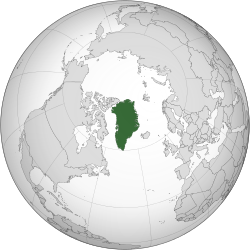
 Greenland’s early Viking settlers were subjected to rapidly changing climate. Temperatures plunged several degrees in a span of decades, according to research from Brown University. A reconstruction of 5,600 years of climate history from lakes near the Norse settlement in western Greenland also shows how climate affected the Dorset and Saqqaq cultures. Results appear in Proceedings of the National Academy of Sciences.
PROVIDENCE, R.I. [from Brown University] — The end of the Norse settlements on Greenland likely will remain shrouded in mystery. While there is scant written evidence of the colony’s demise in the 14th and early 15th centuries, archaeological remains can fill some of the blanks, but not all.
What climate scientists have been able to ascertain is that an extended cold snap, called the Little Ice Age, gripped Greenland beginning in the 1400s. This has been cited as a major cause of the Norse’s disappearance. Now researchers led by Brown University show the climate turned colder in an earlier span of several decades, setting in motion the end of the Greenland Norse. Their findings appear in Proceedings of the National Academy of Sciences.
The Brown scientists’ finding comes from the first reconstruction of 5,600 years of climate history from two lakes in Kangerlussuaq, near the Norse “Western Settlement.” Unlike ice cores taken from the Greenland ice sheet hundreds of miles inland, the new lake core measurements reflect air temperatures where the Vikings lived, as well as those experienced by the Saqqaq and the Dorset, Stone Age cultures that preceded them.
“This is the first quantitative temperature record from the area they were living in,” said William D’Andrea, the paper’s first author, who earned his doctorate in geological sciences at Brown and is now a postdoctoral researcher at the University of Massachusetts–Amherst. “So we can say there is a definite cooling trend in the region right before the Norse disappear.”
“The record shows how quickly temperature changed in the region and by how much,” said co-author Yongsong Huang, professor of geological sciences at Brown, principal investigator of the NSF-funded project, and D’Andrea’s Ph.D. adviser. “It is interesting to consider how rapid climate change may have impacted past societies, particularly in light of the rapid changes taking place today.”
D’Andrea points out that climate is not the only factor in the demise of the Norse Western Settlement. The Vikings’ sedentary lifestyle, reliance on agriculture and livestock for food, dependence on trade with Scandinavia and combative relations with the neighboring Inuit, are believed to be contributing factors.
Still, it appears that climate played a significant role. The Vikings arrived in Greenland in the 980s, establishing a string of small communities along Greenland’s west coast. (Another grouping of communities, called the “Eastern Settlement” also was located on the west coast but farther south on the island.) The arrival coincided with a time of relatively mild weather, similar to that in Greenland today. However, beginning around 1100, the climate began an 80-year period in which temperatures dropped 4 degrees Celsius (7 degrees Fahrenheit), the Brown scientists concluded from the lake readings. While that may not be considered precipitous, especially in the summer, the change could have ushered in a number of hazards, including shorter crop-growing seasons, less available food for livestock and more sea ice that may have blocked trade.
“You have an interval when the summers are long and balmy and you build up the size of your farm, and then suddenly year after year, you go into this cooling trend, and the summers are getting shorter and colder and you can’t make as much hay. You can imagine how that particular lifestyle may not be able to make it,” D’Andrea said.
Archaeological and written records show the Western Settlement persisted until sometime around the mid-1300s. The Eastern Settlement is believed to have vanished in the first two decades of the 1400s.
The researchers also examined how climate affected the Saqqaq and Dorset peoples. The Saqqaq arrived in Greenland around 2500 B.C. While there were warm and cold swings in temperature for centuries after their arrival, the climate took a turn for the bitter beginning roughly 850 B.C., the scientists found. “There is a major climate shift at this time,” D’Andrea said. “It seems that it’s not as much the speed of the cooling as the amplitude of the cooling. It gets much colder.”
The Saqqaq exit coincides with the arrival of the Dorset people, who were more accustomed to hunting from the sea ice that would have accumulated with the colder climate at the time. Yet by around 50 B.C., the Dorset culture was waning in western Greenland, despite its affinity for cold weather. “It is possible that it got so cold they left, but there has to be more to it than that,” D’Andrea said.
Contributing authors include Sherilyn Fritz from the University of Nebraska–Lincoln and N. John Anderson from Loughborough University in the United Kingdom. The National Science Foundation funded the work.
my reading of this when i read it in the newspaper was that they were trying to stress that climate can change suddenly, as shown in this study, and therefore the unspoken part is that we must do something now to avoid another sudden change. Or am I just so used to this now that I read more into it than was intended. But nowhere did they mention the elephant in the room…. Climate changed suddenly then… Was it the Vikings or the Inuit that caused it with their 15th century 4x 4 cars?
In a similar vein OXFAM are advertising on UK tv that if we dont do something fast then the climate will change and it will be poor peopel who will not be able to afford scarce food suppplies….. Yet they say carbon dioxide is the problem. Surely more CO2 leads to more crops not fewer! I just wish they could get some logic in their thinking! Is just like the Germans worried about their nuclear plants in case of a tsunami in Dusseldorf 🙂
“The record shows how quickly temperature changed in the region and by how much,” said co-author Yongsong Huang, professor of geological sciences at Brown, principal investigator of the NSF-funded project, and D’Andrea’s Ph.D. adviser. “It is interesting to consider how rapid climate change may have impacted past societies, particularly in light of the rapid changes taking place today.”
=========================================================
I’m positive that he didn’t mean to…..
…but he just said it’s business as usual.
Nothing new and that temperatures can fall faster than they can rise.
That the planet wants to be cold, not warm.
Do we have to beat them up to see their temperature reconstruction?
“It is interesting to consider how rapid climate change may have impacted past societies, particularly in light of the rapid changes taking place today.”
Seems to be noticable lack of mention of how it got so warm back then…and an interesting mention of climate change while failing to emphasize in which direction the change progressed.
that’ll be the Great Unknown Eruption of 1258 AD, signalled in the Greenland ice cores, one of the biggest in the Holocene. (Oppenheimer 2003; INTERNATIONAL JOURNAL OF CLIMATOLOGY; Int. J. Climatol.
ICE CORE AND PALAEOCLIMATIC EVIDENCE FOR THE TIMING AND
NATURE OF THE GREAT MID-13TH CENTURY VOLCANIC ERUPTION)
It’s either the sun or Mother Earth. Move along, nothing to see here…..
Is there a link to their reconstruction?
Sounds like an analysis of the past few years in the lives of Saskatchewan farmers.
‘in light of the rapid changes taking place today’
They just had to put that in didn’t they. What RAPID change? The slight cooling going on now?
John Gorter
Milan
[snip . . as you say OT . . please repost to Tips&Notes . . thanks . . kb]
Which “rapid changes taking place today” is the author alluding to?
No graph for the reconstruction?
Still interesting. This could mean that the current melting of the Greenland ice is a recovery from LIA, i.e a return to “normal”.
the area inhabited by the norse, where they had large farms, livestock, churches could support quite large communities at the time, where today it would be impossible, suggests that at least on Greenland it must have been much warmer than today.
Of course the Reuters repeat of the same article adds the following required paragraph:
“Scientists fear that the 21st century warming is caused by climate change, stoked by a build-up of greenhouse gases from human activities. An acceleration of warming could cause a meltdown of the Greenland ice sheet, raising world sea levels.”
Here is the link to Reuters:
http://www.reuters.com/article/2011/05/30/us-climate-greenland-idUSTRE74T52920110530
I just find it astounding but not surprising that Reuters felt compelled to take an article that shows clearly the climate goes up and down without man’s CO2 influence and spin it the AGW way.
denis hopkins says:
May 31, 2011 at 9:31 am
“In a similar vein OXFAM are advertising on UK tv that if we dont do something fast then the climate will change and it will be poor peopel who will not be able to afford scarce food suppplies….. Yet they say carbon dioxide is the problem. Surely more CO2 leads to more crops not fewer! I just wish they could get some logic in their thinking! ”
They wouldn’t be activists if they could.
Is there a source for sunspot cycles for these years? And other lake/ocean sediment data covering the years in this paper?
I remember screaming at some idiot reporter on TV recently when I was being shown some port on the coast of Greenland which was apparently ice-free for the first time ever!
It of course didn’t occur to the idiot reporter to wonder why a port, with landings and jetties and stuff, had been built in the first place if it was permanently frozen.
CONCLUSION… the climate changes, regardless of the CO2 concentration.
Jack Wedel says:
May 31, 2011 at 10:25 am
Is there a source for sunspot cycles for these years? And other lake/ocean sediment data covering the years in this paper?
It would have been nice for them to provide 18O and 10Be figures for the lake sediment
“D’Andrea points out that climate is not the only factor in the demise of the Norse Western Settlement. The Vikings’ sedentary lifestyle, reliance on agriculture and livestock for food………………..”
We better stop depending on agriculture and livestock for food then.
I can’t imagine the Vikings’ leading a sedentary lifestyle. What did they do, sit around playing Viking Hero on the PS3?
Please guys, follow the narrative.
This article proves that ‘the climate’ can shift around suddenly, like luggage in the overhead bin. The greenhouse theory proves that we are taking off in the plane. Between us and with a few more analogies like how vaccines are like nectar, how global warming is like living in a roach motel and other highway driving metaphors like ‘pedal to the metal’ and bathroom metaphors like the ‘filling bathtub of liquid nitrogen in the sea of dry ice’, I’m sure we can completely understand the climate system.
By the way, you might read this comment and think I’m drinking, but I am not.
Pesky Norse chaps obviously had 4×4 chariots
So… we have evidence that warming enabled growth of human range and habitation, and sudden cooling catastrophically (locally) reduced it.
We also have record of a .5C/decade temperature change without anthropogenic forcings.
Isn’t this a bit counter to the “narrative”?
I remember screaming at some idiot reporter on TV recently when I was being shown some port on the coast of Greenland which was apparently ice-free for the first time ever!
It of course didn’t occur to the idiot reporter to wonder why a port, with landings and jetties and stuff, had been built in the first place if it was permanently frozen.
===========================
Bonus points for asking the question of ….Why?
Climate changes, land rises and falls, but no one seems to ask why ports are built where they are. A lot of ports built early are landlocked, a lot of them are now underwater. They wern’t that way when they were built!
If Greenland had been inhabited when it was colder, it would have been named “Whiteland”. Do any of these AGW alarmist get how stupid their statements about Greenland are?
If the reconstruction follows the pattern of the ice-sheet cores, temperature at the present will be lower than it was 5600 years ago, even though CO2 concentration is much higher.
I am with batheswithwhales (see his post May 31, 2011 at 10:04 am). I consider that they very much underestimate how much warmer Greenland must have been than it is today for farming with primative means to have flourished for three or four hundred years.