
- Perigee Moon left, Apogee Moon, right. Picture Credit: Galileo Project, NASA

Thanks to WUWT regular “justthefacts” for assembling this story. – Anthony
There has been a lot in the news about, “Saturday’s full moon will be a super “perigee moon” — the biggest in almost 20 years. This celestial event is far rarer than the famed blue moon, which happens once about every two-and-a-half years.”
“The last full moon so big and close to Earth occurred in March of 1993,” said Geoff Chester with the U.S. Naval Observatory in Washington. “I’d say it’s worth a look.”
Full moons look different because of the elliptical shape of the moon’s orbit. When it’s at perigee, the moon is about 31,000 miles (50,000 km) closer to Earth than when it’s at the farthest point of its orbit, also known as apogee.
“Nearby perigee moons are about 14% bigger and 30% brighter than lesser moons that occur on the apogee side of the moon’s orbit,” the NASA website says.”
http://www.cnn.com/2011/US/03/18/nasa.moon/index.html?hpt=C2
Some of the reporting appears to be of questionable merit, e.g.;
“Nolle is responsible for coining the upcoming event, and he’s also responsible for the latest buzz sweeping the Internet about how the supermoon will affect the planet. On his website Astropro, Nolle warns Earth’s inhabitants to prepare themselves during the “supermoon risk window,” which ranges from March 16 – 22. During this time, Nolle claims there will be an increase in supreme tidal surges, magnitude 5 or higher earthquakes, and even volcanic activity.”
Read more: http://www.foxnews.com/scitech/2011/03/12/supermoon-cause-moonquakes-scientist-says/#ixzz1H43vFhS7 http://www.foxnews.com/scitech/2011/03/12/supermoon-cause-moonquakes-scientist-says/#ixzz1H43vFhS7
Some of it a bit more reasoned:
“On Saturday night, the moon will arrive at perigee at 19:09 UT (3:09 p.m. Eastern Time). Its distance from the Earth at that moment will be 221,565 miles. But just over three years ago, on Dec. 12, 2008, which was also the night of a full moon, the moon reached perigee at 21:39 UT (4:39 p.m. Eastern Time) at a distance of 221,559 miles, about 6 miles closer than Saturday night’s perigee distance.”
“In addition, the near coincidence of Saturday’s full moon with perigee will result in a dramatically large range of high and low ocean tides.
The highest tides will not, however, coincide with the perigee moon but will actually lag by up to a few days depending on the specific coastal location. For example, in Wilmington, N.C., the highest tide (5.3 feet) will be attained at 11:21 p.m. EDT on March 20.
In New York City, high water (5.9 feet) at The Battery comes at 10:49 p.m. EDT on March 21, while at Boston Harbor, a peak tide height of 12.2 feet comes at 1:31 a.m. EDT on March 22, almost 2 1/2 after perigee.
According to the Observer’s Handbook of the Royal Astronomical Society of Canada, residents of regions along the shores of the Bay of Fundy in eastern Canada, the 10- to 20-foot (3- to 6-meter) swell in the vertical tidal range makes it obvious when the moon lies near perigee, regardless of clear skies or cloudy.
Any coastal storm at sea around this time will almost certainly aggravate coastal flooding problems.
Such an extreme tide is known as a perigean spring tide, the word spring being derived from the German springen – to “spring up,” and is not, as is often mistaken, a reference to the spring season.
In contrast, later this year, on October 11, the full moon will closely coincide with apogee, its farthest point from the Earth. In fact, on that night the moon will appear 12.3 percent smaller than it will appear this weekend.”
http://www.space.com/11172-supermoon-full-moon-closest.html
The phenomenon in question appears to be a combination of Lunar Precession;
http://en.wikipedia.org/wiki/Lunar_precession
and Lunar Phases;
http://en.wikipedia.org/wiki/Lunar_phase
This is one of an array Lunar and Luni-Solar Cycles that result in Tidal Forces;
http://en.wikipedia.org/wiki/Tidal_force
that result in Earth’s Ocean Tide;
http://en.wikipedia.org/wiki/Tide
and Atmospheric Tide;
http://en.wikipedia.org/wiki/Atmospheric_tide
Other cycles including the Lunar Node;
“Every 27.5 days the Moon completes a ‘nodal’ cycle. The Sun, Moon, and planets have a similar background of stars in their cycles but the Moon’s trajectory is 5 degrees from that of the Sun. This means that there are two points at which these two apparent orbits seem to cross. These are known as the ascending, or North node (or the Dragon’s head) and the descending or South node (Dragon’s tail).””The lunar nodes precess rather quickly around the ecliptic, completing a revolution (called a draconitic or nodical period, the period of nutation) in 6793.5 days or 18.5996 years (note that this is not the saros eclipse cycle)”:
http://en.wikipedia.org/wiki/Lunar_node
Saros Cycles
“The Saros cycle of 6585.322 days is useful for predicting the times at which nearly identical eclipses will occur, and derives from three periodicities of the lunar orbit: the synodic month, the draconic month, and the anomalistic month. For an eclipse to occur, either the Moon must be located between the Earth and Sun (for a solar eclipse) or the Earth must be located between the Sun and Moon (for a lunar eclipse). This can happen only when the Moon is new or full, respectively, and repeat occurrences of these lunar phases are controlled by the Moon’s synodic period, which is about 29.53 days.”
http://en.wikipedia.org/wiki/Saros_cycle
and the Inex Cycle:
“The inex is an eclipse cycle of 10,571.95 days (about 29 years minus 20 days).”
“Unlike the saros cycle, the inex is not close to an integer number of anomalistic months so successive eclipses are not very similar in their appearance and characteristics. From the remainder of 0.67351, being near 2/3, every third eclipse will have a similar position in the moon’s elliptical orbit and apparent diameter, so the quality of the solar eclipse (total versus annular) will repeat in these groupings of 3 cycles (87 years minus 2 months).”
http://en.wikipedia.org/wiki/Inex
The combined cycles of the Saros and Inex Cycles can be visualized here:
http://eclipse.gsfc.nasa.gov/SEsaros/image/SEpanoramaGvdB-big.JPG
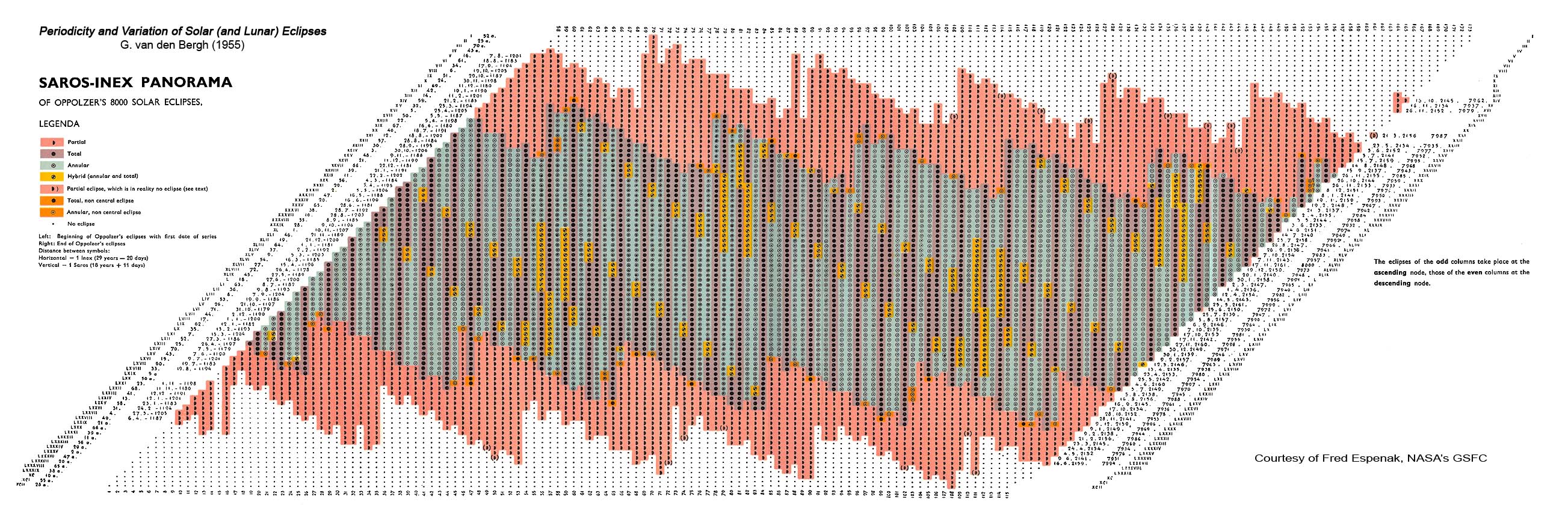
And it gets even more complex than that because “A Saros series doesn’t last indefinitely because the three lunar months are not perfectly commensurate with one another. In particular, the Moon’s node shifts eastward by about 0.5º with each cycle. A typical Saros series for a solar eclipse begins when new Moon occurs ~18° east of a node. If the first eclipse occurs at the Moon’s descending node, the Moon’s umbral shadow will pass ~3500 km below Earth and a partial eclipse will be visible from the south polar region. On the following return, the umbra will pass ~300 km closer to Earth and a partial eclipse of slightly larger magnitude will result. After ten or eleven Saros cycles (about 200 years), the first central eclipse will occur near the south pole of Earth. Over the course of the next 950 years, a central eclipse occurs every 18.031 years (= Saros) but will be displaced northward by an average of ~300 km. Halfway through this period, eclipses of long duration will occur near the equator. The last central eclipse of the series occurs near the north pole. The next approximately ten eclipses will be partial with successively smaller magnitudes. Finally, the Saros series will end a dozen or more centuries after it began at the opposite pole. Due to the ellipticity of the orbits of Earth and the Moon, the exact duration and number of eclipses in a complete Saros is not constant. A series may last 1226 to 1550 years and is comprised of 69 to 87 eclipses, of which about 40 to 60 are central (i.e., total, hybrid or annular).
http://eclipse.gsfc.nasa.gov/SEsaros/SEsaros.html
The point here being that Earth’s tidal forces are ridiculously complex, and their potential impacts on Earth’s Ocean Tides;
http://en.wikipedia.org/wiki/Tide
the Thermohaline Circulation;
http://en.wikipedia.org/wiki/Thermohaline_circulation
Oceanic Oscillations including El Nino/La Nina, the Pacific Decadal Oscillation (PDO) and Atlantic Multidecadal Oscillation (AMO)
http://en.wikipedia.org/wiki/El_Ni%C3%B1o-Southern_Oscillation
http://en.wikipedia.org/wiki/Pacific_decadal_oscillation
http://en.wikipedia.org/wiki/Atlantic_Multidecadal_Oscillation
Ocean currents;
http://en.wikipedia.org/wiki/Ocean_current
and Atmospheric Tide;
http://en.wikipedia.org/wiki/Atmospheric_tide
are essentially impossible to predict given our limited understanding of Earth’s climate system. Predictions of “Supermoon” make for good headlines, but what it really shows is how little we understand about Earth’s astounding complex climate system. Happy moon watching.
Atomic Hairdryer says: March 19, 2011 at 6:43 pm
“Some years ago, not as long ago as 1993 I nipped outside my office in London and saw a much larger moon than the one I was photographing tonight. Not sure why, but it was early evening, winter and the moon was rising over a church at the end of the road.”
========================================
Its an optical illusion called the “Moon Illusion.” The moon appears larger at the horizon that it does at zenith (high in the sky). The illusion is caused by the fact that objects in the visual field at the horizon make the moon appear closer to us than it does when it is high in the sky. Since the visual angle on the retina of the eye is identical in both positions, the construction generated by your visual cortex is that of a larger moon at the horizon. The creative mind at work. {smile}
Could this event have triggered the “monster” earthquake in Japan?
What else to expect? Volcanoes?
@ur momisugly Leif Svalgaard says:
March 20, 2011 at 8:01 pm
“The ‘cluster’ after 1975 is due to better reporting.”
There are more near full/new moon since 1975, I don`t think that the dates reported were wrong for great quakes since 1900. In terms of numbers, there were more 8.0+ events in the decades 1900-9 and 1910-20 than any other time since.
Ulric Lyons says:
March 21, 2011 at 2:06 am
In terms of numbers, there were more 8.0+ events in the decades 1900-9 and 1910-20 than any other time since.
so you deduce that there were more full/new moons back then? 🙂
Ulric Lyons says:
March 21, 2011 at 2:06 am
In terms of numbers, there were more 8.0+ events in the decades 1900-9 and 1910-20 than any other time since
According to the PAGER-CAT catalog:
1900-09 8
1910-19 5
1920-29 6
1930-39 7
1940-49 10
1950-59 7
1960-69 9
1970-79 7
1980-89 2
1990-99 6
2000-09 12
Saturday night (the only night void of obscuring snow ladened clouds) I was out with my binoculars. I saw the thing rise over the hill and then studied it for quite some time. You could see the navel end and striations that point to it. You could see craters and the other affects of its violent past. I was mesmerized and stunned silent by it. I wish I was an astronaut.
That said, the deeper tectonic energy forces intrinsic to Earth are far, far, far greater than the puny surfacy pull of the moon (and by the way, why do we not have a name for ours?) in terms of causing Earth quakes. The null hypothesis clearly stands.
That said, anyone spouting this kind of nonsense (the Sun did it, the moon did it, or Jupiter was aligned with Mars wut dun it) is ready fodder for my planned goddess cave dedicated to the worship of the gravity forces from outer space. I plan on making tons of money off you guys.
Pamela when you pull the trigger of your six shooter, it is not power of your finger but one of the gun-powder charge which is responsible for whatever damage you may cause.
fabron says:
March 21, 2011 at 7:50 am
Pamela when you pull the trigger of your six shooter, it is not power of your finger but one of the gun-powder charge which is responsible for whatever damage you may cause.
But a certain amount of force is still necessary. A flea jumping on the trigger will not causing the gun to fire. Regardless, careful analysis of the observational data shows that there is no more earthquakes near full/new moon near perigee, so there is nothing to debate or explain.
Who says the moon is at perigee?
Personally, I like to think that the earth is at perilune.
banjo says:
March 20, 2011 at 5:53 am
Prince George : Ah Blackadder. It has been a wild afternoon full of strange omens. I dreamt that a large eagle circled the room three times and then got into bed with me and took all the blankets. And then I saw that it wasn’t an eagle at all but a large black snake. And also Duncan’s horses did turn up and eat each other. As usual.
———————————
Banjo, I like the way you think.
The only comment I can provide to this esoteric debate is that for the last week, here (35 south) on a clear night it is like a spotlight has been pointed into the yard. I have been gardening by moonlight.
mojo says: March 21, 2011 at 10:30 am
Who says the moon is at perigee?
Personally, I like to think that the earth is at perilune.
You are welcome to think as you would like, but you’d be wrong, as the definition of Perilune is, “the point in the path of a body orbiting the moon that is nearest to the center of the moon.”
http://www.merriam-webster.com/dictionary/perilune
The event is named based on the object being orbited, i.e.:
“Body | Closest approach | Farthest approach
Earth | Perigee | Apogee
Moon | Periselene/Pericynthion/Perilune | Aposelene/Apocynthion/Apolune
Sun |Perihelion | Aphelion
General |Periapsis/Pericentre | Apoapsis
Galaxy | Perigalacticon | Apogalacticon
Star |Periastron | Apastron
Black hole| Perimelasma/Peribothra/Perinigricon | Apomelasma/Apobothra/Aponigricon
Mercury | Perihermion | Apohermion
Venus | Pericytherion/Pericytherean/Perikrition | Apocytherion/Apocytherean/Apokrition
Mars | Periareion | Apoareion
Jupiter | Perizene/Perijove | Apozene/Apojove
Saturn | Perikrone/Perisaturnium | Apokrone/Aposaturnium
Uranus | Periuranion | Apouranion
Neptune | Periposeidion | Apoposeidion
Pluto | Perihadion | Apohadion”
http://en.wikipedia.org/wiki/Apsis
@ur momisugly Leif Svalgaard says:
March 21, 2011 at 5:02 am
Ulric Lyons says:
March 21, 2011 at 2:06 am
In terms of numbers, there were more 8.0+ events in the decades 1900-9 and 1910-20 than any other time since.
http://neic.usgs.gov/cgi-bin/epic/epic.cgi?SEARCHMETHOD=1&FILEFORMAT=4&SEARCHRANGE=NO&SYEAR=1900&SMONTH=01&SDAY=01&EYEAR=1994&EMONTH=12&EDAY=31&LMAG=8.0&UMAG=9.9&NDEP1=&NDEP2=&IO1=&IO2=&CLAT=0.0&CLON=0.0&CRAD=0.0&SUBMIT=Submit+Search
http://neic.usgs.gov/cgi-bin/epic/epic.cgi?SEARCHMETHOD=1&FILEFORMAT=4&SEARCHRANGE=NO&SYEAR=1900&SMONTH=01&SDAY=01&EYEAR=1994&EMONTH=12&EDAY=31&LMAG=8.0&UMAG=9.9&NDEP1=&NDEP2=&IO1=&IO2=&CLAT=0.0&CLON=0.0&CRAD=0.0&SUBMIT=Submit+Search
Ulric Lyons says:
March 22, 2011 at 3:32 am
In terms of numbers, there were more 8.0+ events in the decades 1900-9 and 1910-20 than any other time since.
The best compilation of earthquakes is the modern PAGER-CAT
http://earthquake.usgs.gov/research/data/pager/
“PAGER-CAT combines high-quality source (i.e., hypocentral location and magnitude)”
Here are the PAGER values for 1906 [last column is magnitude]
1/21/1906 13:49 696173.5761 34 137 7.7
1/31/1906 15:36 696183.65 1 -81.5 8.6
4/18/1906 13:12 696260.55 38 -123 7.9
8/17/1906 0:40 696381.0278 -33 -72 8.5
8/17/1906 0:10 696381.0074 51 179 7.8
9/14/1906 16:04 696409.6697 -7 149 8.0
12/22/1906 18:21 696508.7646 43.5 85 7.2
Here are the NOAA numbers you quote:
1906 01 21 1349 34.00 138.00 340 8.3
1906 01 31 1536 1.00 -81.50 25 8.8
1906 04 18 1312 38.00 -123.00 25 8.3
1906 08 17 0010 51.00 179.00 25 8.3
1906 08 17 0040 -33.00 -72.00 25 8.6
1906 09 14 1604 -7.00 149.00 25 8.3
1906 12 22 1821 43.50 85.00 25 8.3
As you can see there have been a recalibration since 1994.
Well two minutes and Photoshop can make the moon any size you want.
Actually it is no big deal; the moon gets THAT BIG EVERY SINGLE MONTH.
So what’s the fuss; moon gets to perigee every month without incident; and it looks that big every month; so get used to it.
I am not sure yet, does the fact that the moon sometimes is nearer to earth affect the total energy budget and if so, what happens to the climate if it is nearer by or farther away?