
- Perigee Moon left, Apogee Moon, right. Picture Credit: Galileo Project, NASA

Thanks to WUWT regular “justthefacts” for assembling this story. – Anthony
There has been a lot in the news about, “Saturday’s full moon will be a super “perigee moon” — the biggest in almost 20 years. This celestial event is far rarer than the famed blue moon, which happens once about every two-and-a-half years.”
“The last full moon so big and close to Earth occurred in March of 1993,” said Geoff Chester with the U.S. Naval Observatory in Washington. “I’d say it’s worth a look.”
Full moons look different because of the elliptical shape of the moon’s orbit. When it’s at perigee, the moon is about 31,000 miles (50,000 km) closer to Earth than when it’s at the farthest point of its orbit, also known as apogee.
“Nearby perigee moons are about 14% bigger and 30% brighter than lesser moons that occur on the apogee side of the moon’s orbit,” the NASA website says.”
http://www.cnn.com/2011/US/03/18/nasa.moon/index.html?hpt=C2
Some of the reporting appears to be of questionable merit, e.g.;
“Nolle is responsible for coining the upcoming event, and he’s also responsible for the latest buzz sweeping the Internet about how the supermoon will affect the planet. On his website Astropro, Nolle warns Earth’s inhabitants to prepare themselves during the “supermoon risk window,” which ranges from March 16 – 22. During this time, Nolle claims there will be an increase in supreme tidal surges, magnitude 5 or higher earthquakes, and even volcanic activity.”
Read more: http://www.foxnews.com/scitech/2011/03/12/supermoon-cause-moonquakes-scientist-says/#ixzz1H43vFhS7 http://www.foxnews.com/scitech/2011/03/12/supermoon-cause-moonquakes-scientist-says/#ixzz1H43vFhS7
Some of it a bit more reasoned:
“On Saturday night, the moon will arrive at perigee at 19:09 UT (3:09 p.m. Eastern Time). Its distance from the Earth at that moment will be 221,565 miles. But just over three years ago, on Dec. 12, 2008, which was also the night of a full moon, the moon reached perigee at 21:39 UT (4:39 p.m. Eastern Time) at a distance of 221,559 miles, about 6 miles closer than Saturday night’s perigee distance.”
“In addition, the near coincidence of Saturday’s full moon with perigee will result in a dramatically large range of high and low ocean tides.
The highest tides will not, however, coincide with the perigee moon but will actually lag by up to a few days depending on the specific coastal location. For example, in Wilmington, N.C., the highest tide (5.3 feet) will be attained at 11:21 p.m. EDT on March 20.
In New York City, high water (5.9 feet) at The Battery comes at 10:49 p.m. EDT on March 21, while at Boston Harbor, a peak tide height of 12.2 feet comes at 1:31 a.m. EDT on March 22, almost 2 1/2 after perigee.
According to the Observer’s Handbook of the Royal Astronomical Society of Canada, residents of regions along the shores of the Bay of Fundy in eastern Canada, the 10- to 20-foot (3- to 6-meter) swell in the vertical tidal range makes it obvious when the moon lies near perigee, regardless of clear skies or cloudy.
Any coastal storm at sea around this time will almost certainly aggravate coastal flooding problems.
Such an extreme tide is known as a perigean spring tide, the word spring being derived from the German springen – to “spring up,” and is not, as is often mistaken, a reference to the spring season.
In contrast, later this year, on October 11, the full moon will closely coincide with apogee, its farthest point from the Earth. In fact, on that night the moon will appear 12.3 percent smaller than it will appear this weekend.”
http://www.space.com/11172-supermoon-full-moon-closest.html
The phenomenon in question appears to be a combination of Lunar Precession;
http://en.wikipedia.org/wiki/Lunar_precession
and Lunar Phases;
http://en.wikipedia.org/wiki/Lunar_phase
This is one of an array Lunar and Luni-Solar Cycles that result in Tidal Forces;
http://en.wikipedia.org/wiki/Tidal_force
that result in Earth’s Ocean Tide;
http://en.wikipedia.org/wiki/Tide
and Atmospheric Tide;
http://en.wikipedia.org/wiki/Atmospheric_tide
Other cycles including the Lunar Node;
“Every 27.5 days the Moon completes a ‘nodal’ cycle. The Sun, Moon, and planets have a similar background of stars in their cycles but the Moon’s trajectory is 5 degrees from that of the Sun. This means that there are two points at which these two apparent orbits seem to cross. These are known as the ascending, or North node (or the Dragon’s head) and the descending or South node (Dragon’s tail).””The lunar nodes precess rather quickly around the ecliptic, completing a revolution (called a draconitic or nodical period, the period of nutation) in 6793.5 days or 18.5996 years (note that this is not the saros eclipse cycle)”:
http://en.wikipedia.org/wiki/Lunar_node
Saros Cycles
“The Saros cycle of 6585.322 days is useful for predicting the times at which nearly identical eclipses will occur, and derives from three periodicities of the lunar orbit: the synodic month, the draconic month, and the anomalistic month. For an eclipse to occur, either the Moon must be located between the Earth and Sun (for a solar eclipse) or the Earth must be located between the Sun and Moon (for a lunar eclipse). This can happen only when the Moon is new or full, respectively, and repeat occurrences of these lunar phases are controlled by the Moon’s synodic period, which is about 29.53 days.”
http://en.wikipedia.org/wiki/Saros_cycle
and the Inex Cycle:
“The inex is an eclipse cycle of 10,571.95 days (about 29 years minus 20 days).”
“Unlike the saros cycle, the inex is not close to an integer number of anomalistic months so successive eclipses are not very similar in their appearance and characteristics. From the remainder of 0.67351, being near 2/3, every third eclipse will have a similar position in the moon’s elliptical orbit and apparent diameter, so the quality of the solar eclipse (total versus annular) will repeat in these groupings of 3 cycles (87 years minus 2 months).”
http://en.wikipedia.org/wiki/Inex
The combined cycles of the Saros and Inex Cycles can be visualized here:
http://eclipse.gsfc.nasa.gov/SEsaros/image/SEpanoramaGvdB-big.JPG
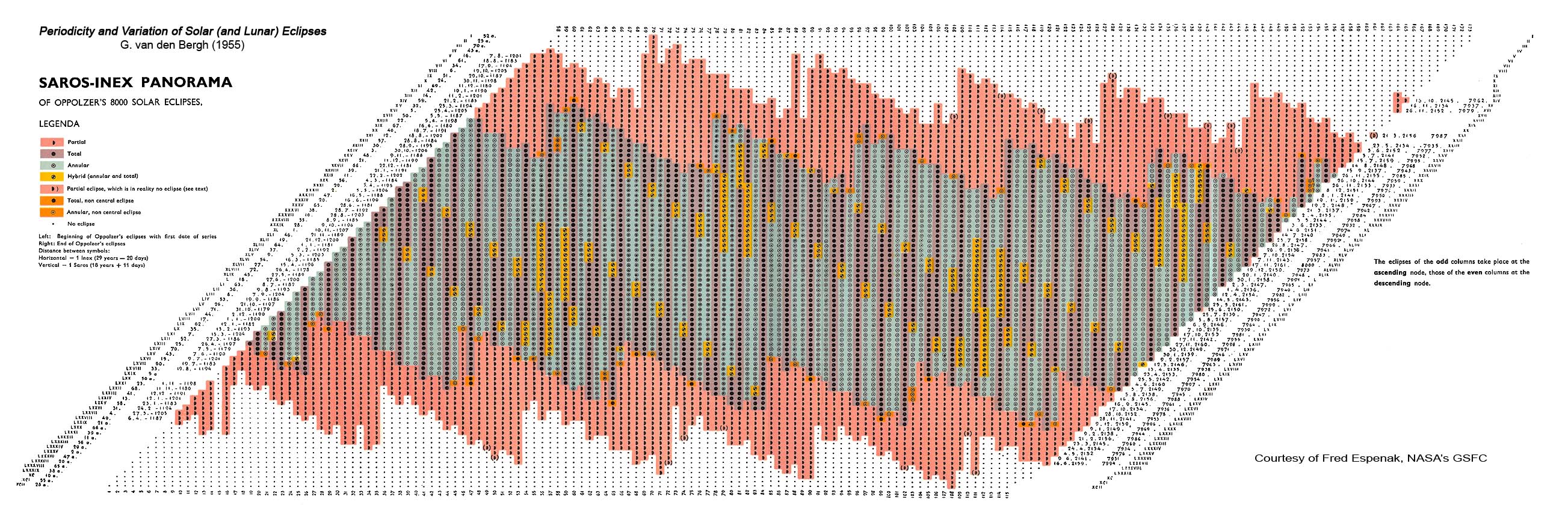
And it gets even more complex than that because “A Saros series doesn’t last indefinitely because the three lunar months are not perfectly commensurate with one another. In particular, the Moon’s node shifts eastward by about 0.5º with each cycle. A typical Saros series for a solar eclipse begins when new Moon occurs ~18° east of a node. If the first eclipse occurs at the Moon’s descending node, the Moon’s umbral shadow will pass ~3500 km below Earth and a partial eclipse will be visible from the south polar region. On the following return, the umbra will pass ~300 km closer to Earth and a partial eclipse of slightly larger magnitude will result. After ten or eleven Saros cycles (about 200 years), the first central eclipse will occur near the south pole of Earth. Over the course of the next 950 years, a central eclipse occurs every 18.031 years (= Saros) but will be displaced northward by an average of ~300 km. Halfway through this period, eclipses of long duration will occur near the equator. The last central eclipse of the series occurs near the north pole. The next approximately ten eclipses will be partial with successively smaller magnitudes. Finally, the Saros series will end a dozen or more centuries after it began at the opposite pole. Due to the ellipticity of the orbits of Earth and the Moon, the exact duration and number of eclipses in a complete Saros is not constant. A series may last 1226 to 1550 years and is comprised of 69 to 87 eclipses, of which about 40 to 60 are central (i.e., total, hybrid or annular).
http://eclipse.gsfc.nasa.gov/SEsaros/SEsaros.html
The point here being that Earth’s tidal forces are ridiculously complex, and their potential impacts on Earth’s Ocean Tides;
http://en.wikipedia.org/wiki/Tide
the Thermohaline Circulation;
http://en.wikipedia.org/wiki/Thermohaline_circulation
Oceanic Oscillations including El Nino/La Nina, the Pacific Decadal Oscillation (PDO) and Atlantic Multidecadal Oscillation (AMO)
http://en.wikipedia.org/wiki/El_Ni%C3%B1o-Southern_Oscillation
http://en.wikipedia.org/wiki/Pacific_decadal_oscillation
http://en.wikipedia.org/wiki/Atlantic_Multidecadal_Oscillation
Ocean currents;
http://en.wikipedia.org/wiki/Ocean_current
and Atmospheric Tide;
http://en.wikipedia.org/wiki/Atmospheric_tide
are essentially impossible to predict given our limited understanding of Earth’s climate system. Predictions of “Supermoon” make for good headlines, but what it really shows is how little we understand about Earth’s astounding complex climate system. Happy moon watching.
There appears to be an imbalance between the left and right cheek in this full moon display.
Wow! This was really interesting. Who knew? More intriguing to me is who took all the time and trouble to figure out all that cycling…makes me tired thinking about it. Thanks, Anthony, for working so hard to make WUWT so much fun to read.
REPLY: The credit goes to “justthefacts” a WUWT regular contributor who wrote this in addition to some of the reference pages. – Anthonyh
Well I’ll be jiggered….. Actually I don’t care… as long as the sun comes up in the morning it will be just fine… and all of the ‘end of the world’ enthusiasts can go on enjoying the fruits of their reality distortion field experiments…
I’m sure there will be those who still think people are affected mentally by the phases of the moon.
In German we also have the word Springflut for spring tide. Yes, it comes from springen = to jump.
Force of attraction between earth and moon (ignoring all other planets and the sun)
F = G(m1*m2)/r^2
The delta between the 2 values of r doesn’t make for a lot of difference.
Super-moon is having some effect, however no major Earthquakes as yet.
http://www.vukcevic.talktalk.net/gms.htm
It was already enormous last night, and it isn’t even full yet. And it’s coming right at us! Run for your life!!! I wonder if CNN etc will go wall to wall coverage? Nah, not with the new war ‘n stuff. 😉
Great article JTF.
Cheers!
Because of the AGW-induced winter snow storm ( ☺) headed into southern Alberta from Montana we will miss the super moon tonight.
Thanks for the interesting story justthefacts and WUWT.
Jeff Alberts says:
March 19, 2011 at 3:09 pm
I’m sure there will be those who still think people are affected mentally by the phases of the moon.
The mentally ill are affected by any phenomena which complicates thier already troubled view. As you examine the midrange of population between mentally ill and sane, you will find a group that does in fact exhibit behavioral problems in sync with the Full Moon. Into that mix toss chronic drug users and those who believe the MSM hype without thinking about the real world.
It’s all about behavior and paying attention.
At the time of writing it’s 23:00 GMT here in Southern England. The sky is gin-clear and the moon looks beautiful.
No earthquakes, though.
Disappointing, that.
vukcevic says:
March 19, 2011 at 3:24 pm
Super-moon is having some effect, however no major Earthquakes as yet.
http://www.vukcevic.talktalk.net/gms.htm
and there won’t be because of this, just as there is no effect from solar/geomagnetic storms, as we have already discussed.
ruh roh. was that a super werewolf?
Leif Svalgaard says:
March 19, 2011 at 4:13 pm
vukcevic says: Super-moon is having some effect, however no major Earthquakes as yet.
http://www.vukcevic.talktalk.net/gms.htm
and there won’t be because of this, just as there is no effect from solar/geomagnetic storms, as we have already discussed.
———————————————————————————–
Pythia has spoken !
“ew-3 says:
March 19, 2011 at 3:20 pm
Force of attraction between earth and moon (ignoring all other planets and the sun)
F = G(m1*m2)/r^2
The delta between the 2 values of r doesn’t make for a lot of difference.”
True, however as I learned from other WUWT contributors, the effect on tides is larger since it varies inversely as the cube of the radius. The tragedy a week ago was terrible, but if it happened today, it would have been much worse due to the additional influence of the sun during a full moon on the tides.
….and of course AGW made it worse than expected.
vukcevic says:
March 19, 2011 at 4:45 pm
“and there won’t be because of this, just as there is no effect from solar/geomagnetic storms, as we have already discussed.”
Pythia has spoken !
Just science: http://www.leif.org/research/Earthquakes-Perigee.png
See more proof of Global Warming!!!
Ha Ha Ha 🙂
“In addition, the near coincidence of Saturday’s full moon with perigee will result in a dramatically large range of high and low ocean tides.”
Sigh. We really shouldn’t talk like this. I causes people to think that the fact that the moon is full is making the difference.
The moon is full because it is at 180° to the sun. The large tides are because the moon is at 180° to the sun. The amount of light reflected back off the moon is totally irrelevant.
We would get exactly the same tidal effect if the moon was aligned with the sun and the moon was therefore new.
If we aren’t careful with this language the effect is people think the moon is actually closer during “full” moons, and therefore it has some magic effects. Like earthquakes and effecting crops. Sigh.
(Next we have to work on explaining that the sun is not closer during summer.)
“affecting” crops. Sorry.
Some years ago, not as long ago as 1993 I nipped outside my office in London and saw a much larger moon than the one I was photographing tonight. Not sure why, but it was early evening, winter and the moon was rising over a church at the end of the road. Sadly I didn’t have a camera with me but not seen the effect since. I’m assuming it was some weather effect that made it appear much larger, but would love to know what that was so I could shoot it if it happens again. Any ideas what might have caused that?
Leif Svalgaard says:
March 19, 2011 at 4:13 pm
“just as there is no effect from solar/geomagnetic storms, as we have already discussed.”
While you are here, could you briefly explain the likelihood of a Carrington Event and the likely damages caused by a Carrington Event?
This is sure one loony article.
So, SuperMoon is a full Moon at perigee.
What’s a full Moon at apogee?
Atomic Hairdryer says:
March 19, 2011 at 6:43 pm
The moon close to the horizon always appears much larger than when high in the sky. It is a well known optical illusion due to the way the brain interprets what it thinks it is seeing: were you to measure it you would find it the same size in both cases.
Kindest Regards