By Joseph D’Aleo, CCM
The North Atlantic undergoes a multidecadal oscillation appropriately called the Atlantic Multidecadal Oscillation or AMO. It is officially the mean sea surface temperature anomaly from the equator to 70 degrees North. It went above the longer term mean in 1995. The AMO has a long term cycle of about 60-70 years.
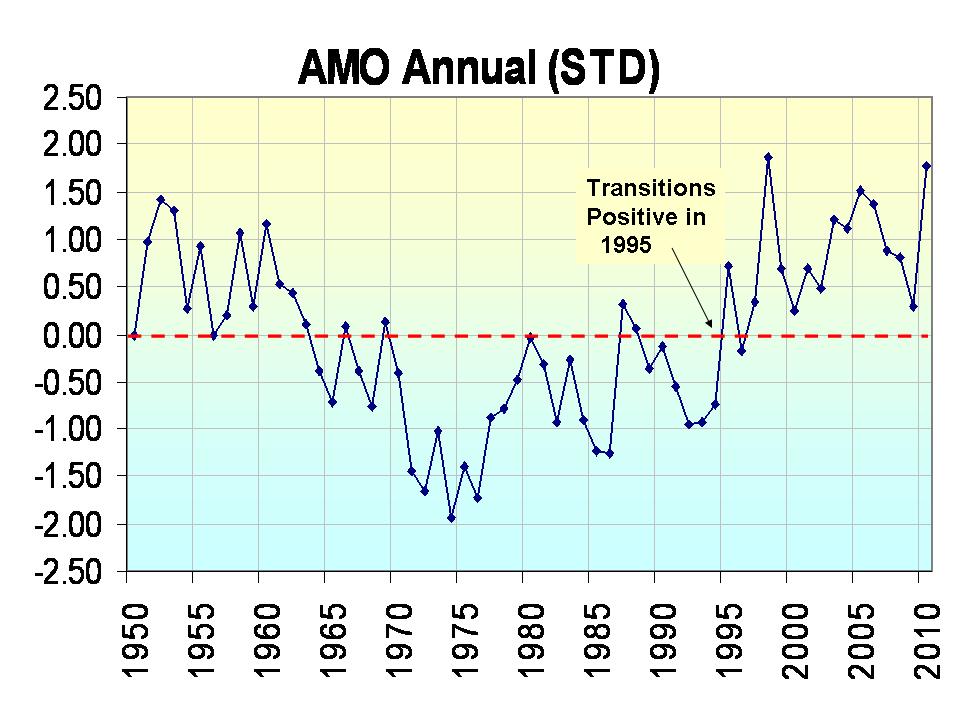
Enlarged here

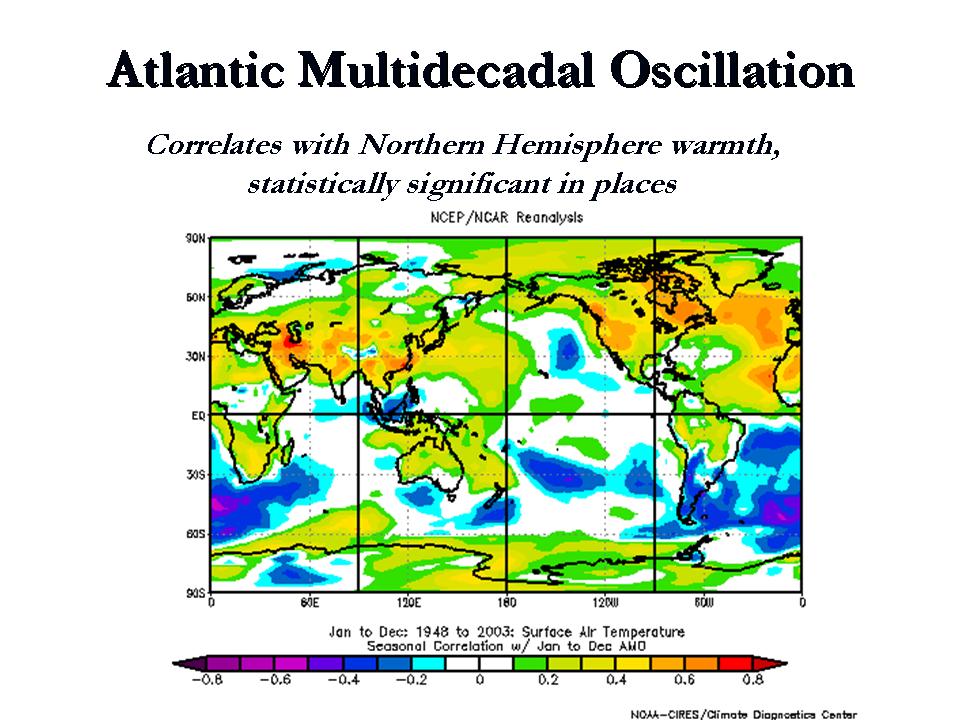
When the AMO is positive (warm) the Northern Hemisphere is warmer than normal on an annual basis across the continents. When it is cold, it is colder. The positive state is associated with a warmer arctic and Greenland and more summer hurricanes in the Atlantic Basin.

Correlation of annual temperatures with the AMO. Yellows to reds are positive and blues negative correlations with the AMO state. Enlarged here.
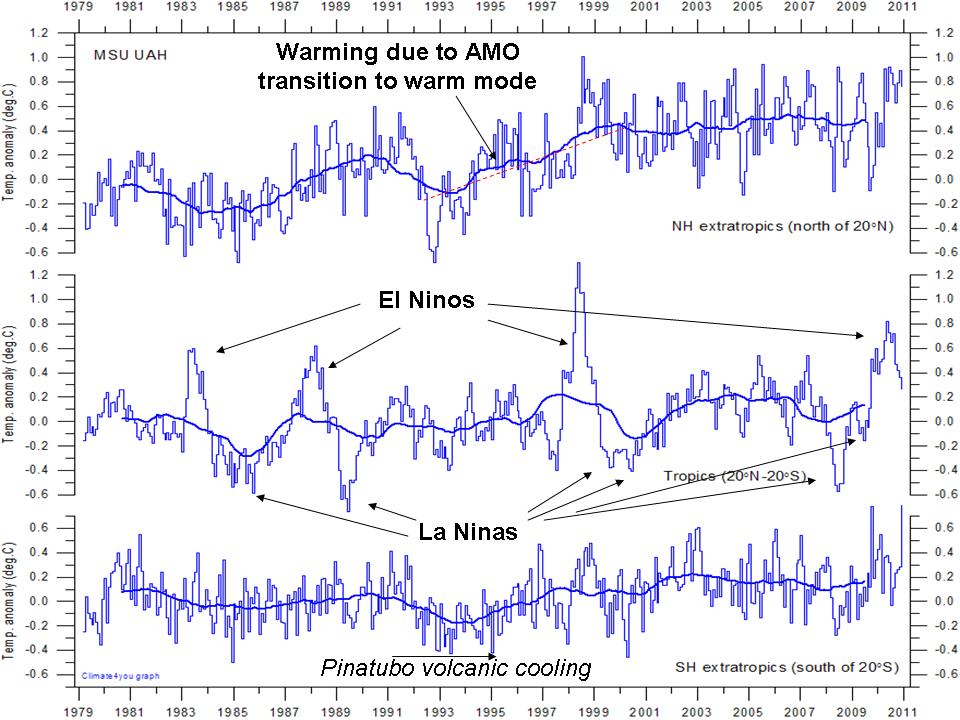
This can be also seen in the satellite derived temperatures for the Northern Hemisphere (north of 20N). There is little continuous trend since 1979. Most of the warming is in the 1995 transition from AMO negative to positive. Note the temperatures in the tropics reflect the ENSO state but has no perceived trend. There is also no trend in the Southern Hemisphere. The only significant departure was with the volcanic cooling also seen in the Northern Hemisphere after Pinatubo in 1991-1994.

UAH Satellite temperatures by latitude zone – Northern Hemisphere poleward of 20N, tropics, 20N to 20S, Southern Hemisphere poleward of 20S. Enlarged here.
The AMO tracks to the solar irradiance with a lag of about 8-9 years. This suggests the current warm AMO state will end by around 2015. Northern Hemispheric temperature will take a leg down. With the cooling of the Pacific now and more La Ninas, look for net cooling especially in the tropics until then.
See more here.
Stephen Wilde says:
November 4, 2010 at 5:55 am
” Shortwave tends to penetrate clouds more as the energy of the photons increases and LWIR does not get into the oceans at all because it doesn’t get past the region involved in evaporation so I don’t think your proposal constitutes a significant factor as compared to the natural cloudiness and albedo changes.”
?? That to some degree is my proposal; from George E Smith, “then the actual ground level (air Mass once) spectrum; that shows the amounts of that energy taken out by primarily O2, O3, and H2O, in the case of H2O which absorbs in the visible and near IR perhaps 20% of the total solar energy is capture by water VAPOR (clear sky) clouds are an additionqal loss over and above that…So your (referring to a comment Tim made) characterization of the H2O vapor “blockage” as being “tiny”; is simply not an accurate depiction; it is one of the largest solar spectrum modifications caused by the atmosphere. Solar spectrum energy mostly goes deep into the oceans which reflect only2-3% of sunlight; and the part of the earth which is mostly oceans is in the tropics where most of the solar energy arrives…True; that absorption by the the H2O in the atmosphere does warm the atmosphere; in fact it is one of the major warming influences; and that results in long wave Ir radiation in an isotropic pattern so only half of that radiative LWIR energy comes down to the surface. The other half goes upwards to space; so there is a net energy loss to the surface of about 1/2 of the amount that H2O vapor absorbs from the solar input. Reducing the total amount of solar energy that reaches the earth surface ALWAYS results in it getting cooler”
So, trying to reword my statement I am postulating that as some of the incoming TSI is converted to LWIR by increased CO2, and 1/2 of that continues downward resulting in evarporative cooling, not entering the ocean, and as this additional evaporation results in increasing water vapor and possibly clouds there is then less SWR at the surface, as some of the incoming TSI was converted to LWIR and therefore the amount of SWR entering the oceans is decreased, which works in harmony with the LWIR in that both cool the ocean, one at the surface, one to depths of up to 300m, the reduced SWR results in less energy into the oceans where the residence time is far longer then the LWIR , so the one works to cool the surface, and at the same time there is less photons entering the ocean where the residence time is far longer.
Once more to be clear and then I will give up until my ability to communicate is increased. More water vapor and CO2 must increase the residence time of TSI in the atmosphere, this must result in a spectral change of less SWR entering the ocean below the surface and increased LWIR at the surface. The reduced SWR results in a small but, cumultive over time, cooling of the ocean below the surface, the increased LWIR does not warm the ocean at all do to the evaporative cooling at the surface, thus the conversion of incoming TSI to less SWR and more LWIR increases the time each photon of energy spends in the atmosphere, but dereases the number of SWR photons entering the ocean where the residence time in the earths heat budget is far longer.
Thank you for your time, if this does not make sense tell me why so I can evaluate it.
>the more evaporation the more cooling.
Let me expand on this, because this get to the crux of the matter (as I see it).
1) The more net energy into the surface layer of the ocean, the higher the temperature of the surface layer.
2) The higher the temperature of the surface layer, the more evaporation.
3) The more evaporation, the more
coolingenergy that leaves the surface layer.Line 1 is a simple statement of conservation and I really don’t see any way to argue against that. Line 3 is your statement is a refinement of your statement, so I don’t expect you will argue with it too much. If evaporation removes more energy that is being added in other ways, then the surface layer will cool. If other energy inputs are larger than evaporation, then evaporation can slow the warming that would otherwise occur if there were no evaporation.
Perhaps you can find a flaw with line 2 …
Now consider my “control” square meter of ocean. Suppose for simplicity assume it is mid-afternoon and the temperature of the surface is steady at 15 C (so net energy flow into the layer is zero) . Evaporation rates are steady and depend on this temperature (and on other factors like humidity and wind). Lets suppose this number is 80 W/m^2. That means that other factors must be adding a net 80 W/m^2 to the surface layer.
My “test” square meter is identical — 80 W/m^ of evaporative cooling and 80 W/m^2 of other heating. Then I increase the energy into the top layer of the water – say 1 W/m^2. Following the steps 1-3 above, the increasing temperature will increase the evaporation. The temperature will continue rising until at some surface temperature higher than we started, the evaporation will have increased enough to counteract the extra energy – evaporation would provide 81 W/m^2 of energy transfer out. This “prevents any further warming” from the extra energy but (step 2) the water must be warmer than it started. So the extra evaporation is providing a cooling effect against further increases but it does not cool the water below the point it started.
ANY source of energy into that top layer – LWIR, contact with warm air, a heater under the surface — will lead to steps 1-3 above. Evaporation can limit the warming from extra LWIR, but it won’t actually reduce the temperature below where it started.
P.S. I actually over-simplified a bit – the warming of the surface layer will not only increase the evaporative cooling, it will also increase LWIR cooling and conductive cooling. I should really have said “The temperature will continue rising slowly until at some surface temperature higher than we started, the evaporation and LWIR and conduction and convection will have increased enough to counteract the extra energy.” This will limit the rise in temperature even more — but it is still definitely a rise.
Sorry for the long post Steve, are you simply saying that there is very little, or no change in the amount of SWR hitting the ocean surface regardless of water vapor or CO2 changes, but what I am saying would be true with increased cloud cover and albedo changes?
Tim Folkerts says:
November 4, 2010 at 12:28 pm
P.S. I actually over-simplified a bit – the warming of the surface layer will not only increase the evaporative cooling, it will also increase LWIR cooling and conductive cooling. I should really have said “The temperature will continue rising slowly until at some surface temperature higher than we started, the evaporation and LWIR and conduction and convection will have increased enough to counteract the extra energy.” This will limit the rise in temperature even more — but it is still definitely a rise.
I was about to pitch in until I saw the PS! Exactly right, you have to do a total energy balance on the surface layer taking into account all modes of energy transfer (as I posted a few posts up). If the layer doesn’t get warmer there will be no additional evaporation.
Phil,
I only saw your post after I had entered mine — it seems we are both on the same track.
Hopefully those on the side of the counter-arguments are starting to see our simple main point. Their argument seems to have some variation of Maxwell’s Demon whereby LWIR energy ONLY goes into molecules that will evaporate. In fact, the demon would have to be perverse enough that when LWIR comes in, that energy AND MORE is given to evaporating water molecules!
Evaporation has a net cooling effect.
The latent energy taken out of the local environment to achieve the change of state from liquid to vapour exceeds the sensible energy required to achieve the change of state.
It is quite true that the affected molecules briefly get warmer but all that achieves is an acceleration of the timing of the change of state and as soon as the change of state occurs that sensible energy (and more) disappears into latent energy.
How then can there be any energy left to achieve warming of anything ?
The LWIR must only be absorbed by molecules that will evaporate because it never gets past the evaporative layer and so does not encounter any molecules that do not eventually evaporate. Every molecule impacted by those LWIR photons has the timing of its evaporation brought forward.
Can you show that ANY molecules acquiring extra LWIR fail to evaporate ?
I am open to evidence on the issue but my logic is not faulty.
David, I see the point but am not convinced as regards the scale of the effect as compared to the effect of shifting all the globe’s climate bands and therefore cloud bands bodily poleward or equatorward.
Such latitudinal shifting has a significant effect on albedo and albedo changes have a large effect on WM2 entering the oceans from solar shortwave.
Two things happen when the clouds are shifted latitudinally:
i) If the cloud bands shift equatorward then the increasing circumference of the globe stretches out all the air mass boundaries over longer distances with increased opportunity for air mass mixing and generation of more clouds.
ii) As clouds move equatorward they protect the surfaces below from more intense insolation so more reflection occurs.
Thus do latitudinal shifts affect albedo significantly and the Earthshine project confirms that global albedo and cloud quantities both started to rise in the late 90s when I aver that the jets began to shift more equatorward.
If you can put your proposed effect into that context I can consider it further. Is your effect significant in the face of those other forcing effects ?
Thanks Stephen,
I definetly do not have the numbers to quantify the effect I am considering. My thought is rather simple in that all clouds have an albedo effect. The pro AGW thought is that some clouds warm, some cool, some are neutral, depending I suppose on the relative changes in LWIR and SW which reach the surface.
My thought is that not all photons are equall due to their relative residence time in earth’s system, both ocean and amotsphere. So a cloud that blocks 5 W/m’2 of SWR through albedo, but has a 15 W/m’2 warming effect through the GHG effect will warm the atmosphere, but do to the far longer residence time of SWR photons entering the ocean the reduction of those 5 W/m’2 reduced SWR will have a stronger long term effect which is cumlitive depending on the duration of the change in cloud cover and certainly as you say their laditude, which as they shift poleward obviously effects an evergreater % of the TSI.
I definetly do not have the numbers to quantify the effect I am considering, primarily because I do not know the residence time of SWR photons entering the ocean vs the residence time of LWIR in the atmosphere.
Tim, may I ask why you are certain the extra energy is not used in simply speeding the hydrolic cycle? Is it possible for this to be tested by an actual experiment?
David, the additional LWIR photons do not hang around for long at all as you say. They are soon absorbed by water when it changes to latent heat in water vapour and are whisked away upward by convection and wind.
The additional SW stays in the ocean possibly throughout the length of the thermohaline circulation (up to 1500 years) so on balance I’d say that anything that restricts SW uptake by the oceans is going to have a far bigger long term effect than anything that alters IR quantities.
The biggest effect on SW entering the oceans appears to be albedo changes. Changes in CO2 or GHGs generally only affect IR and so are largely irrelevant as far as I can tell. The sea surfaces will not allow the air temperaure to diverge from those SSTs . As soon as the air temperaure does try to diverge all that happens is a change in the speed of the hydrological cycle for little or no change in surface air temperature because the excess energy in the air just gets converted to latent heat and is whisked away faster by convection and wind.
I’ve not found any convincing mechanism whereby significant amounts of extra IR in the air could ever get into the oceans. If it doesn’t get into the oceans it cannot affect the Earth’s equilibrium temperature because the oceans are in absolute control.
david says:
November 4, 2010 at 5:22 am
phlogiston says:
November 4, 2010 at 1:40 am
“… By contrast, effects of insolation and cloud etc. affect the sea surface in real time.”
Please see my questions above and respond if you wish. Would not any relative increase in LWIR and decrease in SW have, over time, a cooling effect on these large downwelling and upwelling currents?
Indeed yes. I regret I haven’t had time to study the whole thread and your earlier comments. But the changes you describe in LWIR and SW, under the influence of atmospheric / solar parameters, can indeed exert an effect on downwelling. Since downwelling is the impetus behind the THC with a cycle timescale of centuries, this scenario provides a mechanism by which climatic variations can leave an oceanic-THC “legacy” which can re-surface later as ocean driven climate variation on a decadal-century timescale.
Also as I have mentioned before in conversation with Stephen Wilde, it is not (in my view) a question of the temperature of water that is downwelled. Water downwells to the ocean floor due to low temperature and high salinity from ice formation in places like the Norwegian sea (although there may be limited scope for temperature variation). But volume of downwelling and variations thereof is likely the key factor. But the mechanism by which this might manifest itself in the long term is unknown – it might represent periodic forcing of a non-equilibrium quasi-chaotic system that could result in emergent periodicities generated by the system.
Stephen Wilde says:
November 4, 2010 at 11:40 pm
I am open to evidence on the issue but my logic is not faulty.
It certainly is, but it’s clear that it’s a waste of time explaining the science to you.
Stephen Wilde says:
November 4, 2010 at 4:22 am
Agreed, phlogiston which is why another part of my hypothesis involves the subduction and re emergence of extra energy into and out of the thermohaline circulation during periods of a more active or less active sun.
In fact that is the best explanation I currently have for a relatively monotonic CO2 change despite all the other variations in climate that seem to have little or no effect on short timescales.
It should be possible to observe bubbles of CO2 escaping from cold deep ocean water when it moves to the surface and warms – I wonder if anyone has looked for these?
Steven,
Three last points …
1) “The LWIR must only be absorbed by molecules that will evaporate because it never gets past the evaporative layer …”
The LWIR penetrates tens of micrometers. Water molecules are tenths of nanometers –> LWIR penetrates ten of thousands of molecules deep. That means that the water molecules that absorb the LWIR will run into MANY other molecules before then might evaporate. The extra energy will be redistributed by collisions with other molecules, so the extra energy is distributed pretty much evenly to all the water in the top layer pretty quickly. This provides a distributed energy to the top layer, not some specialized energy to select molecules.
2) in the end, you are saying “by adding more energy to the water, the water is getting cooler”. This is a pretty extraordinary claim that on the face of it seem to contradict conservation of energy
3) This website is all about skepticism. As far as I can tell, you are about the only one really pushing this idea. From the perspective of a neutral skeptic, I tend to doubt that you are right and generations of climate scientists, physicist, chemists, and chemical engineers are wrong. Can you convince me that you have a new, correct perspective on a branch of science that dates back over a century?
I can’t resist one more set of thought experiments. You have three identical, perfectly insulated tanks of water at 20C. Part of the water in each tank (1 mole = 18 g) evaporates, which would remove approximately 44,000 J of energy (http://en.wikipedia.org/wiki/Enthalpy_of_vaporization).
Tank 1: Nothing else is done. The water left in the tank will be cooler than 20 C. I would use Q = mc(deltaT) to calculate the temperature drop of the remaining water, where Q = 44,000 J, m is the mass of the remaining water, and c is the heat capacity of water. Do you agree?
Tank 2: I add an electric heater to the water which adds 44,000 J of energy to the water as the 1 mole evaporates. The final temperature will be 20 C because the net energy is zero. Do you agree?
Tank 3: I add a heat lamp shining LWIR into the water which adds 44,000 J of energy to the water as the 1 mole evaporates. The temperature will remain at 20 C because the net energy is zero. Do you agree?
P.S. Please don’t come back with “evaporation is a net cooling effect” unless you are ready to explain what you mean in terms of energy, enthalpy, and temperature in any of the examples I have given.
david says: November 5, 2010 at 4:42 am
Tim, may I ask why you are certain the extra energy is not used in simply speeding the hydrolic cycle? Is it possible for this to be tested by an actual experiment?
Actually, I suspect much of the extra energy would indeed go into speeding up the evaporation from the ocean. But how do you increase evaporation? You warm the surface (or change the humidity and/or wind).
The one thing I am sure of is that a given square meter of ocean will be WARMER (not colder) if extra energy in any form (including LWIR) is added to the water compared to a similar square meter without that extra energy input.
Tim, I’ll have a go at your further questions but then we must give it a rest 🙂
i) All those tens of thousands of molecules are within the layer involved in evaporation. Each molecule acquiring energy from incoming IR does warm but in doing so moves closer to the moment of evaporation. Every such molecule does indeed redistribute energy by the means you say before it evaporates but then every one of those other molecules moves closer to the moment of evaporation. Eventually ALL those molecules DO evaporate and furthermore they do so earlier than they otherwise would have done and every time one does evaporate it converts more energy into latent form than the amount of sensible energy required to provoke the evaporation. Thus your description does not overcome the problem. There is no IR left to propogate downwards.
ii) No. I am saying that there is a net cooling process in the local environment. The evaporation takes the energy from where it is most readily available. When the water gets down to the temperature of the air above any shortfall is just as likely to come from the air or from some of the IR not yet absorbed by water molecules. The entire local environment cools, not just the water surface. I already explained that that is why a huge amount of IR cannot result in a bizarre outcome such as freezing the water surface.
iii) My account used to be well known when I was educated. The knowledge has been lost or ignored over the past 50 years in climatology. I am saying nothing new. The characteristics of evaporation and the other phase changes of water are indeed remarkable and surprising. It has always been thus. It is not I who is out of line.
If you apply the above properly you can sort out the consequences for your own thought experiment.
LWIR does not warm a body of water significantly if at all.
“The one thing I am sure of is that a given square meter of ocean will be WARMER (not colder) if extra energy in any form (including LWIR) is added to the water compared to a similar square meter without that extra energy input.”
Only the molecules in the evaporative layer become any warmer and that is only temporary for each molecule because the timing of the moment of evaporation is brought forward for a subsequent net excess of cooling in the local environment for the reason I explained. Nothing propogates downward but there may be an increase in energy pulled upward towards that warmed layer. Otherwise we could not observe that 0.3C cooler layer above the ocean bulk. The presence of that thin cooled layer is the proof.
I think we may have to agree to disagree.
We both agree that evaporation is a cooling process. The principle of “swamp coolers” is well known and well used in many hot, dry climates; sweating does cool us down.
We seem to agree that adding more LWIR will accelerate the evaporation and hence increase the rate that energy is removed.
* I conclude the elevated evaporation (and elevated upward LWIR and elevated conduction to air and water) reduces the warming, but that there is still a net warming from the net increase in energy.
* You conclude … that the evaporative cooling takes away ALL the extra LWIR energy AND then some extra energy on top of that to make the water even cooler than it would be with less energy input? So that the water on the surface has gotten cooler AND evaporates more?
There doesn’t seem to be much point in further discussion — we seem set in our respective views. For my own edification, I may have to run this whole idea past some learned friends and see what they think (but I suspect I know their response).
http://www.physlink.com/education/askexperts/ae93.cfm
“The energy required to completely separate the molecules, moving from liquid to gas, is much greater that if you were just to reduce their separation, solid to liquid. Hence the reason why the latent heat of vaporization is greater that the latent heat of fusion.”
and:
http://daphne.palomar.edu/jthorngren/latent.htm
“Evaporation is the change of state from liquid to vapor. In the process of evaporation, the molecule absorbs energy. This energy is latent heat. Latent means hidden, so latent heat is “hidden” in the water molecule–we can’t feel it, but it is there. Wherever that individual molecule of water vapor goes, it takes that latent heat with it. ”
The science of the phase changes of water is long settled but climatology chooses to ignore it.
“The science of the phase changes of water is long settled but climatology chooses to ignore it.”
Or, just maybe, you choose to ignore that the combined knowledge of 1000’s of scientist might be greater than your knowledge.
For instance, the iconic energy balance diagram (seen many places on the web like here http://stephenschneider.stanford.edu/Graphics/EarthsEnergyBalance.png) includes evaporation. A 10 minute “back of the envelope” exercise by me confirmed that 78 W/m^2 is a reasonable number. (You can do it yourself – google the # of cm of water that evaporate from the oceans, the surface area of the ocean, and the enthalpy of vaporization for water. ) Clearly evaporation was included there, and I doubt that climate scientists have forgotten either the science of evaporation or the importance of evaporation since Kiehl and Trenberth published this graphic in 1997.
P.S. I don’t disagree with anything you cited November 6, 2010 at 1:40 am. I just don’t think either of those points supports your conclusion that heating water with extra LWIR makes the water cooler rather than warmer.
” Clearly evaporation was included there,”
Of course it is but there is no provision for variability over time.
“I just don’t think either of those points supports your conclusion that heating water with extra LWIR makes the water cooler rather than warmer.”
It doesn’t make the water cooler than the air above because energy is taken from where it is most readily available. However it does try to extract energy from the water faster and in doing so it will increase the depth or intensity of that 0.3C cooler layer on the ocean surface.