By Joseph D’Aleo, CCM
The North Atlantic undergoes a multidecadal oscillation appropriately called the Atlantic Multidecadal Oscillation or AMO. It is officially the mean sea surface temperature anomaly from the equator to 70 degrees North. It went above the longer term mean in 1995. The AMO has a long term cycle of about 60-70 years.
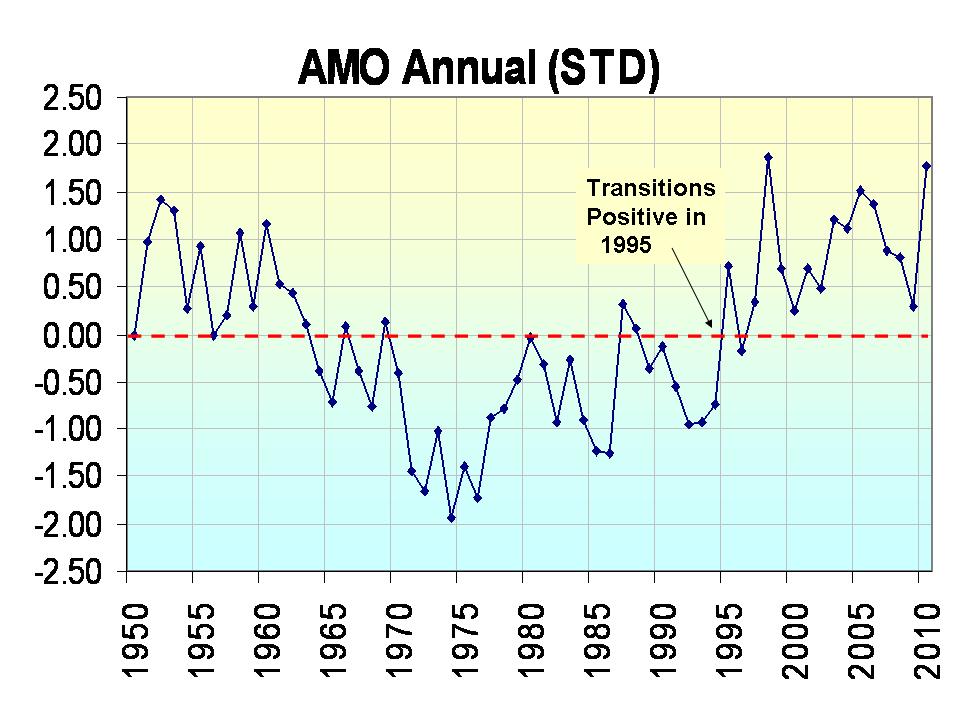
Enlarged here

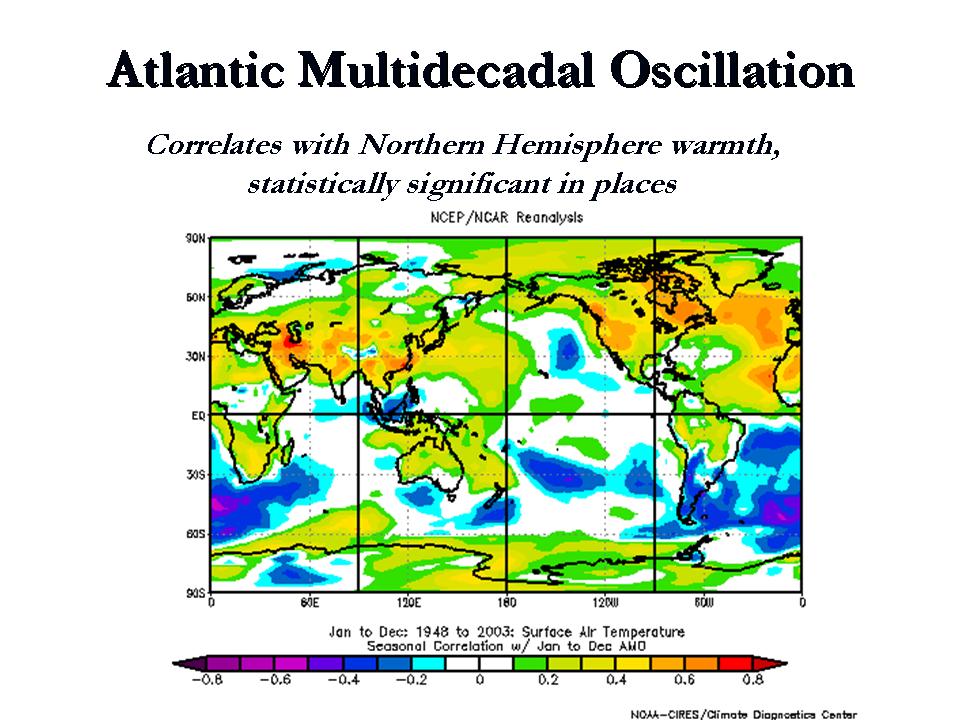
When the AMO is positive (warm) the Northern Hemisphere is warmer than normal on an annual basis across the continents. When it is cold, it is colder. The positive state is associated with a warmer arctic and Greenland and more summer hurricanes in the Atlantic Basin.

Correlation of annual temperatures with the AMO. Yellows to reds are positive and blues negative correlations with the AMO state. Enlarged here.
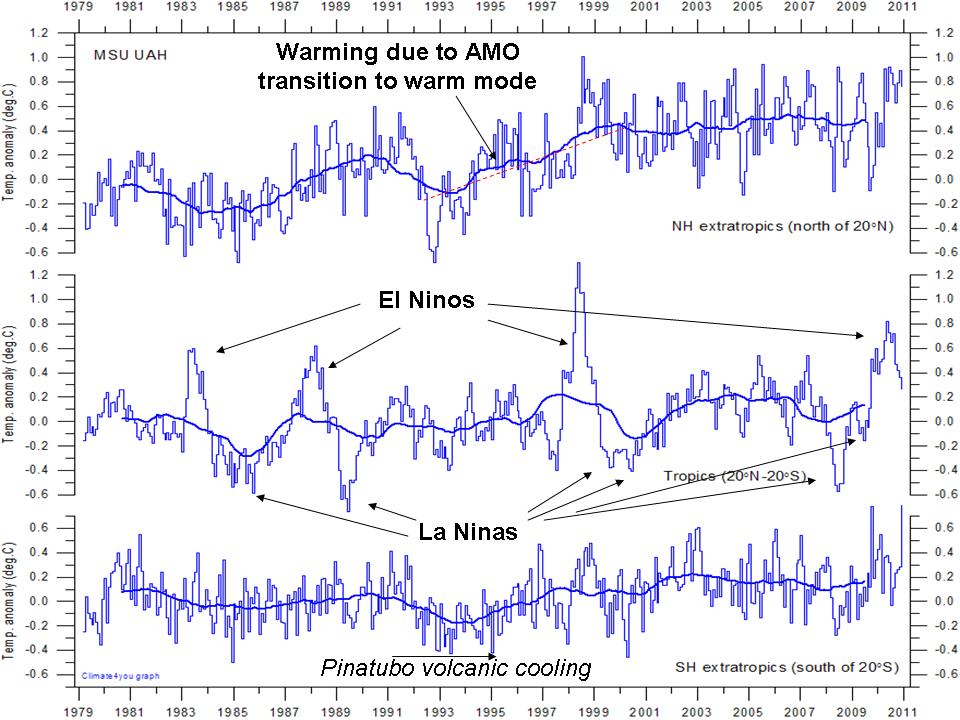
This can be also seen in the satellite derived temperatures for the Northern Hemisphere (north of 20N). There is little continuous trend since 1979. Most of the warming is in the 1995 transition from AMO negative to positive. Note the temperatures in the tropics reflect the ENSO state but has no perceived trend. There is also no trend in the Southern Hemisphere. The only significant departure was with the volcanic cooling also seen in the Northern Hemisphere after Pinatubo in 1991-1994.

UAH Satellite temperatures by latitude zone – Northern Hemisphere poleward of 20N, tropics, 20N to 20S, Southern Hemisphere poleward of 20S. Enlarged here.
The AMO tracks to the solar irradiance with a lag of about 8-9 years. This suggests the current warm AMO state will end by around 2015. Northern Hemispheric temperature will take a leg down. With the cooling of the Pacific now and more La Ninas, look for net cooling especially in the tropics until then.
See more here.
>Stephen Wilde says: November 3, 2010 at 11:16 am
>Tim, my query is limited exclusively to longwave IR because it is only
>longwave IR that increases as a result of more CO2 in the air.
OK – I agree with that.
>The only effect on a water surface that longwave IR can have
>is to increase evaporation because it never gets in deeper than
>the region involved in evaporation.
Why do you a priori rule out conduction of heat to the atmosphere or to lower layers of water? Some “back of the envelope” calculations suggest that thermal conductivity could whisk the increased energy (we are only talking about a few W/m^2) to lower layers almost as fast as the extra LWIR arrives. Yes, some increase in evaporation will occur, but it seems much of the energy will get absorbed into the water.
My background in in physics — we need a good chemical engineer to tell us about heat from thru water. My intuition is that the bulk will get heated; your intuition is that only the surface will get heated. Intuition doesn’t count for a lot unless it is an area someone specializes in.
“Why do you a priori rule out conduction of heat to the atmosphere or to lower layers of water?”
Evaporation being a net cooling process it follows that it removes more energy (in latent form) than the amount of energy (in sensible form) required to provoke it.
“Yes, some increase in evaporation will occur, but it seems much of the energy will get absorbed into the water.”
Why ? The extra energy in IR form doesn’t get past the evaporating layer so all it does is increase the rate of evaporation for a net cooling effect before it can be conducted downward.
There is physical evidence for that in the presence of ‘skin’ of cooler water above the ocean bulk which is about 0.3C cooler than the ocean bulk below.
That skin is created because the effects of evaporation and upward radiation remove energy from the water faster than it comes up from below.
Thus logically if one increases evaporation or upward radiation that skin layer must either get colder or deeper or more likely both as the two processes try to draw energy out of the water even faster.
That fact being potentially fatal to AGW theory (because you can’t warm the air without warming the oceans first) there has been a cockeyed attempt to debunk it by means of a so called ocean skin effect (promulgated at Realclimate) due to increased CO2 but I don’t accept that speculation for a moment and it has never been adequately demonstrated
And so I post this again: david says:
November 3, 2010 at 11:47 am
has anyone ever seen an experiment that compared the warming capacity of LWIR verses SWUV?
I know an experiment cannot exactly reflect real world conditions, but it appears logical that it can put the physics on paper to a real world experiment and somewhat isolate the various spectrum and their different warming affect on H2o.
I am also very intrested in the residence time of various TSI in all spectrum once it reaches the ocean, as this must be critical in determing net warming of the ocean over time verses short term atmosphere changes. Atmosphere warming can still mean global cooling is taking place.
Any help is appreciated.
Tim, Pamela, Stephen, Bueler, anyone
Thanks (-:
AMO correlates to global temperature shifts fairly well over the long term (back to 1860), but is by no means perfect. For instance, 1910 – 1920 was the coolest part of the AMO phase, but global temperatures were rising. For a more recent example (better data), AMO took a precipitous drop from 1960 to 1975, but the globe warmed.
If one posits lags and weather effects, you could make a better fit, but what you can’t do is turn an oscillation into a trend. Over the long-term (from 1860), AMO has oscillated around a mean, while global temperatures have gone up by ~1C. As with ENSO and PDO, oscillating patterns may correlate to temperature shifts, but none of them account for the long-term warming. The nomenclature common to all these patterns (oscillating) should give a clue. They don’t cause global warming so much as move the heat around in-system.
Joe, if you have convincing proof that this is the case you should publish your work in a peer reviewed paper. Hold your paper to the same standard that you would hold any Mann or Schmidt or Hansen. Until you can do that you are publishing an opinion piece.
Tim Folkerts says:
November 3, 2010 at 1:15 pm
Just try preparing your breakfast with a hairdryer 🙂
@Stephen Fisher
Let me reduce this to the core issue (as I see it). Imagine two sections of ocean – each one square meter and located near each other. Thus they are essentially identical.
Are you arguing that if I shine an extra 10 W of LWIR on one of those square meters, that section will be COOLER than the unchanged one? Cooler at ANY level in the water? If so, by what mechanism?
@Enneagram
I’m fine using a frying pan or microwave to cook my breakfast. By what does that have to do with anything I said?
Will Crump says: “I am not suggesting that CO2 in the water causes any warming, only that the anthroprogenic effects on the atmosphere cause it to warm and this in turn can cause the ocean to be warmer than it would be without the atmosphere warming.”
I also was not suggesting that the CO2 in the water causes any warming. Let me rephrase my statement. There is no evidence that downward longwave radiation from anthropogenic greenhouse gases has any impact on sea surface temperatures, or on ocean heat content.
You continued, “If there is no warming effect, why are the numbers adjusted for ‘detrending’…
The reason the North Atlantic SST anomalies are detrended for the AMO is to better show the frequency and magnitude of the variations in The North Atlantic SST anomalies.
You asked, “What is your analysis of the statement ‘The Atlantic Ocean via the AMO drives the apparent “Global Warming’ and the information provided by Joseph D’Aleo above?”
I disagree. I’ve left two comments on this thread about the post:
http://wattsupwiththat.com/2010/11/02/the-atlantic-ocean-via-the-amo-drives-the-apparent-%e2%80%9cglobal-warming%e2%80%9d/#comment-521702
http://wattsupwiththat.com/2010/11/02/the-atlantic-ocean-via-the-amo-drives-the-apparent-%e2%80%9cglobal-warming%e2%80%9d/#comment-521715
“Tim Folkerts says:
November 3, 2010 at 4:47 pm
@Stephen Fisher
Let me reduce this to the core issue (as I see it). Imagine two sections of ocean – each one square meter and located near each other. Thus they are essentially identical.
Are you arguing that if I shine an extra 10 W of LWIR on one of those square meters, that section will be COOLER than the unchanged one? Cooler at ANY level in the water? If so, by what mechanism?”
I’m arguing that logically that should be so unless there is another way of getting the energy from downward IR deeper into the water.
I went into it in extensive detail here:
http://climaterealists.com/index.php?id=4245
“Greenhouse Gases Can Cause Cooling !”
“”””” Tim Folkerts says:
November 3, 2010 at 1:15 pm
>Stephen Wilde says: November 3, 2010 at 11:16 am
>Tim, my query is limited exclusively to longwave IR because it is only
>longwave IR that increases as a result of more CO2 in the air.
………………………..
My background in in physics — we need a good chemical engineer to tell us about heat from thru water. My intuition is that the bulk will get heated; your intuition is that only the surface will get heated. Intuition doesn’t count for a lot unless it is an area someone specializes in. “””””
Tim, standard absorption coefficients for LWIR in H2O are well documented, and suggest that something like 99% of downward LWIR that reaches the ocean surface gets absorbed in about 50 microns pathlength, so you have a heated source that is 50 microns thick, on top of a heat sink, that already has a natural Temperature gradient from surface to deeper waters, and a totally huge thermal mass compared ot that thin surface layer (I refuse to call it a skin).
You can do the math, and figure out just how much that LWIR caused heat source could change the surface Temeprature gradient, and calculate the rate of heat conduction from the surface. To the extent that the surface Temperature increases at all, the high energy tail of the MB distribution of molecular energies would increase and those more energetic molecules could leave in evaporation; leaving the mean energy lowered and so the Temperature; and you’d have to factor in the Latent heat lost to the atmosphere at the same time.
I’ve never done the calculation but I imgine it would be done sometime in “Heat 101” in a freshman Physics course; if not in High School. Since I did HL&S, E&M from my first day in High school, I have no recollection of exactly when we would have done it; or when they teach it in school these days. I have a son doing an “engineering degree” at SF State U, and so far, I am confident that he can spell “heat”; but after that I think his eyes just glaze over.
But SF State does have a World Class School of Racism; well I think they officially call it “Ethnic Studies.”
I have no idea what all the elements of Stephen’s New Theory of Climate are; so I can’t comment further on that.
I would think that Trenberth in his earth energy budget would have done all of those calculations so they should be in his papers somewhere.
George E. Smith says:
George, thank you for post. What can you tell me about the residence time of various solar spectrem as it enters the ocean besides LWIR.
Also would not any LWIR that mmanages not to quickly revert back to the atmosphere be very near the surface and have a short residence time, although it does not sound like this small residue of heat would have any real net effect?
Thanks
Does a warm atmosphere immediately above water result in that water warming up?
Obviously yes.
The molecules immediately above the water’s surface are colliding with other molecules at a rate of 8 billion per second. In other words, words cannot even describe how much energy is being transferred around at speeds we cannot even imagine.
Let’s look at what really happens with water temperatures.
The Ocean surface temperatures lag behind the solar radiation cycle by about 40 days to 90 days. The peak of solar radiation is around June 21st but shallow surface lake waters peak around the end of July, deeper lake surface waters peak around mid-August and Ocean waters peak around September 10th (there is some differential depending on the latitude as well).
Atmospheric temperatures peak about 35 days after the solar radiation peak so there
are certainly lags in the climate system and even longer ones for water.
How do these lags happen? Does that help answer any questions with respect to how water absorbs energy?
I still come back to basic conservation of energy considerations applied to the top 0.01 mm = 100 microns of water in the ocean.
In the “control” square meter, the energy flow into that layer must be very nearly balanced — if it wasn’t then even a small positive imbalance would quickly lead to a rise in temperature. That would cause the layer to evaporate more and to radiate more and conduct more to the air and conduct more to the water below.
In the “test” square meter, I intentionally add extra energy — more LWIR coming down from GHG’s. This will raise the temperature of the surface. Much of this energy will result in more evaporation. Much of it will result in more LWIR emitted back upward. But at least SOME of the energy will go to the air and some to the water below.
Tim did George E Smith ‘s comment help you as it was a direct response to your comment / question :
Tim, standard absorption coefficients for LWIR in H2O are well documented, and suggest that something like 99% of downward LWIR that reaches the ocean surface gets absorbed in about 50 microns pathlength, so you have a heated source that is 50 microns thick, on top of a heat sink, that already has a natural Temperature gradient from surface to deeper waters, and a totally huge thermal mass compared ot that thin surface layer…Temperature increases at all, the high energy tail of the MB distribution of molecular energies would increase and those more energetic molecules could leave in evaporation; leaving the mean energy lowered and so the Temperature; and you’d have to factor in the Latent heat lost to the atmosphere at the same time.
Bill Illis, thank you and it helps. but does not quantify how much of the LWIR is responible for the warmth verses the SWR and refers to the warming of bodies of water, not the cooling. Any more information is recieved with gratitude.
“But at least SOME of the energy will go to the air and some to the water below.”
Not necessarily because evaporation is a NET COOLING process. That means more energy is removed from the local environment in latent form than is required in sensible form to provoke it. If one proposes that any energy is added to the environment then one must show that to be the case and not just assume it.
“Does a warm atmosphere immediately above water result in that water warming up?
Obviously yes. ”
Actually it is yes AND no.
The heat in the warm atmosphere is in the form of sensible heat which shows up on sensors. That gets absorbed by the top few microns of the water surface. That then brings forward the timing of evaporation for all the molecules that accept such extra sensible heat. Then when evaporation takes place more energy is taken from the local environment in latent form (which does not show up on sensors) than was required in the form of sensible heat to bring forward the evapoporative event and that sequence of events results in a net cooling effect as far as any available sensors are concerned.
The energy is conserved but is changed from sensible to latent form then whisked away by convection and wind.
Thus nothing left over for downward conduction. There should in fact be an acceleration of cooling. The more wind and convection the faster the process and the greater the net cooling of the water surface.
There is much discussion of ocean heat and sea temperatures, surface or otherwise, which apparently assumes that the only factors at play are surface solar heating and evaporation.
However there is another factor – downwelling of very cold water at the far north Atlantic and Southern Ocean east of Australia, drives the thermohaline deep global circulation by pumping cold water to the ocean bottom. There is scope for variations in solar, cloud, Arctic / Antarctic temperatures and other climatic variations to influence this downwelling and thus ultimately the oceans thermal budget.
This downwelling – and its converse, deep water upwelling, are a system that can provide variation over decadal and century timescales in ocean heat and temperatures. By contrast, effects of insolation and cloud etc. affect the sea surface in real time.
Agreed, phlogiston which is why another part of my hypothesis involves the subduction and re emergence of extra energy into and out of the thermohaline circulation during periods of a more active or less active sun.
In fact that is the best explanation I currently have for a relatively monotonic CO2 change despite all the other variations in climate that seem to have little or no effect on short timescales.
Steve is it not logical that in addition to any slight speed up of the hydrologic cycle through phase change evaporative process, the fact is that when CO2 or water vapor increases in the atmosphere, the spectrem of TSI which reaches the ocean surface changes to an increased quantity of IR, and a decreased quantity of SW? Does it not then follows that the residence time of energy entering the ocean is reduced greatly compared to periods of more SW radiation and less IR during periods of decreased CO2 and or water vapor? Is not the residence time of all spectrems of TSI in earths budget far greater in the oceans, thus any change in TSI wavelength the ocean effect over time will overwhelm what happens in the atmosphere?
phlogiston says:
November 4, 2010 at 1:40 am
“… By contrast, effects of insolation and cloud etc. affect the sea surface in real time.”
Please see my questions above and respond if you wish. Would not any relative increase in LWIR and decrease in SW have, over time, a cooling effect on these large downwelling and upwelling currents?
Another example of the seasonal cycle.
In the centre of North America, the climate is coldest around January 25th. Effectively, the climate contains an average 240 Watts/m2 of energy in it (which results in a mean temperature of -18C).
Starting the next day, the climate begins to accumulate about 1.0 Watt/m2/day and is slowly warming up. By July 25th, the climate has reached an average 410 Watts/m2 (+19C).
Starting the next day, the climate begins to cycle down again and loses about the same 1.0 Watt/m2/day.
This seasonal change represents a huge change in the energy levels existing in the climate system (+/- 170 W/m2).
Water is not going to swing so much but it is also going to exhibit these huge swings in the level of energy contained in it. Its seasonal cycle will lag behind the atmosphere and even further off-cycle from the solar radiation cycle (almost one-quarter).
So, water is accumulating huge amounts of energy for six months and then dissipating huge amounts of energy for six months. For 70 days after the solar radiation peak, water is absorbing something like 0.5 watts/m2/day from somewhere.
It is obviously absorbing both short-wave solar radiation and long-wave thermal radiation (either directly or through collision with atmospheric molecules). And the numbers are really big.
David:
Humidity and optical depth do not seem to change much. Only cloud quantities and albedo seem to change and small albedo changes have a large effect on the Wm2 coming into the system.
Shortwave tends to penetrate clouds more as the energy of the photons increases and LWIR does not get into the oceans at all because it doesn’t get past the region involved in evaporation so I don’t think your proposal constitutes a significant factor as compared to the natural cloudiness and albedo changes.
What matters is the total amount of solar shortwave getting past the evaporative layer and that varies according to the level of solar activity due to changes both in the spectrum of solar output and the movement of the clouds latitudinally.
If increasing the downward LWIR radiant energy creates a net cooling of the oceans through increased evaporation, then the reverse must also be true — decreasing downward LWIR would warm the oceans.
Suppose I could temporarily reduce GHG’s so that the downward LWIR decreased by 80 W/m^2 (approximately a 25% reduction in energy). For this to warm the oceans, I would have to reduce the evaporation energy loss by more than 80 W/m^2. But 80 W/m^2 happens to be (approximately) the total energy carried away by evaporation, so I would have to stop (approximately) all evaporation. To stop all evaporation, I would pretty much have to freeze the surface. So following your logic, I have come to the conclusion that decreased LWIR will warm the surface of the ocean all the way down to freezing!
*************************************
Increasing the LWIR will increase the evaporation and increase the cooling – we agree on that. I simply disagree that the increased cooling due to increased evaporation will be greater than the change in LWIR energy that drives the change in evaporation. if the water actually cooled, then the evaporation would decrease and the water would rewarm.
Or put another way, I believe that adding extra LWIR energy to the surface at some rate Q leads to a (slightly smaller) increased evaporative cooling of (Q – Δ), for a net increase of Δ in total power to the surface. This small net increase in power will slowly warm the surface — which will then warm the water below, warm the air above, and/or increase the LWIR up from the surface until that extra Δ of energy can be balanced but other outflows of energy).
Tim,
Why should the evaporative process leave any ‘unused’ energy in the local environment after the net cooling effect has taken place.
Do you deny that evaporation is a net cooling effect ?
Bizarre outcomes such as a huge input of IR freezing the ocean surface do not happen because the evaporative process takes the energy it needs from the most readily available source which means both air and water combined but nonethelss evaporation gives a net cooling in the local environment and the more evaporation the more cooling.
Stephen Wilde says:
November 4, 2010 at 8:10 am
Tim,
Why should the evaporative process leave any ‘unused’ energy in the local environment after the net cooling effect has taken place.
Do you deny that evaporation is a net cooling effect ?
It’s an illogical statement. Additional LWIR hitting the surface of the ocean which is already in equilibrium will raise the temperature of the surface to a new value at which all the following are balanced with the increased flux: additional conduction and convection to the air above the surface and to the water below, latent heat loss accompanying evaporation (exp(∆T)) and LWIR radiation from the surface (∆T^4). The temperature of the surface must increase.