By Joseph D’Aleo, CCM
The North Atlantic undergoes a multidecadal oscillation appropriately called the Atlantic Multidecadal Oscillation or AMO. It is officially the mean sea surface temperature anomaly from the equator to 70 degrees North. It went above the longer term mean in 1995. The AMO has a long term cycle of about 60-70 years.
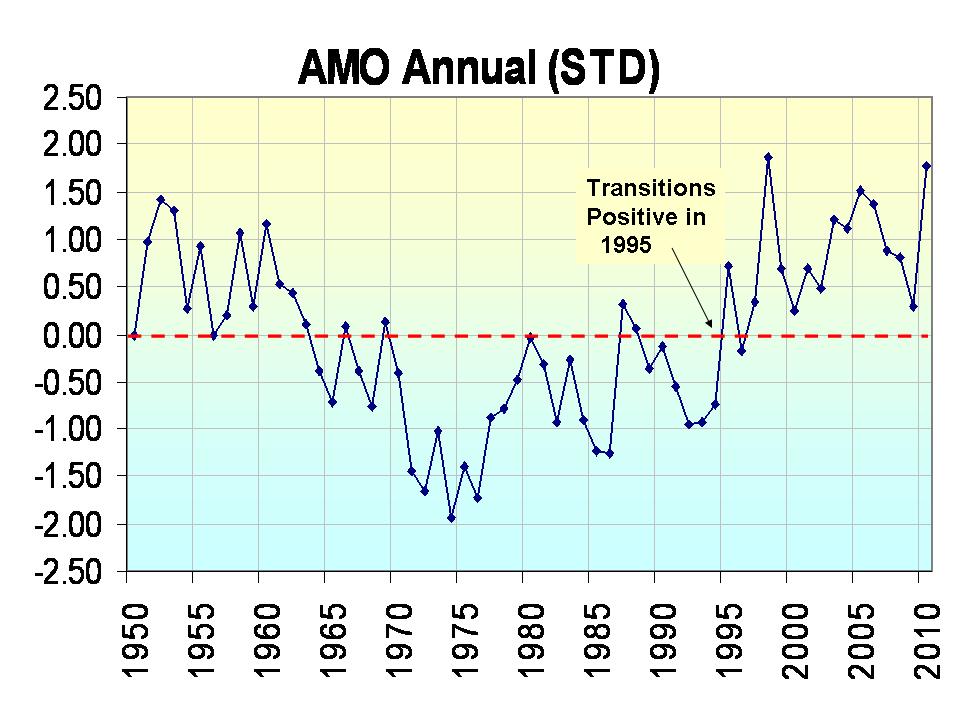
Enlarged here

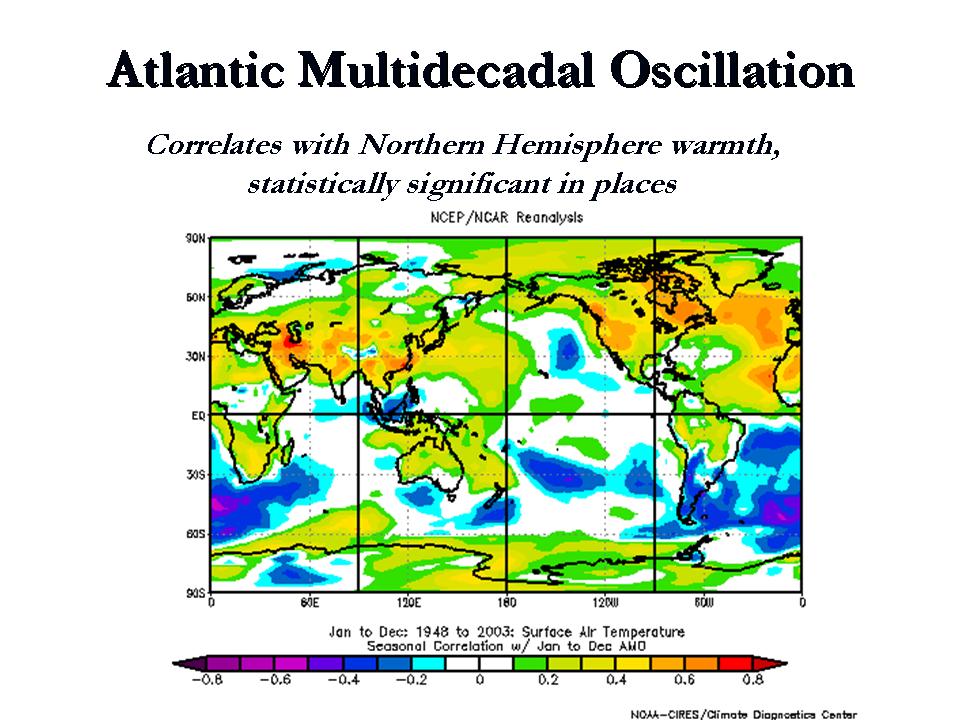
When the AMO is positive (warm) the Northern Hemisphere is warmer than normal on an annual basis across the continents. When it is cold, it is colder. The positive state is associated with a warmer arctic and Greenland and more summer hurricanes in the Atlantic Basin.

Correlation of annual temperatures with the AMO. Yellows to reds are positive and blues negative correlations with the AMO state. Enlarged here.
This can be also seen in the satellite derived temperatures for the Northern Hemisphere (north of 20N). There is little continuous trend since 1979. Most of the warming is in the 1995 transition from AMO negative to positive. Note the temperatures in the tropics reflect the ENSO state but has no perceived trend. There is also no trend in the Southern Hemisphere. The only significant departure was with the volcanic cooling also seen in the Northern Hemisphere after Pinatubo in 1991-1994.

UAH Satellite temperatures by latitude zone – Northern Hemisphere poleward of 20N, tropics, 20N to 20S, Southern Hemisphere poleward of 20S. Enlarged here.
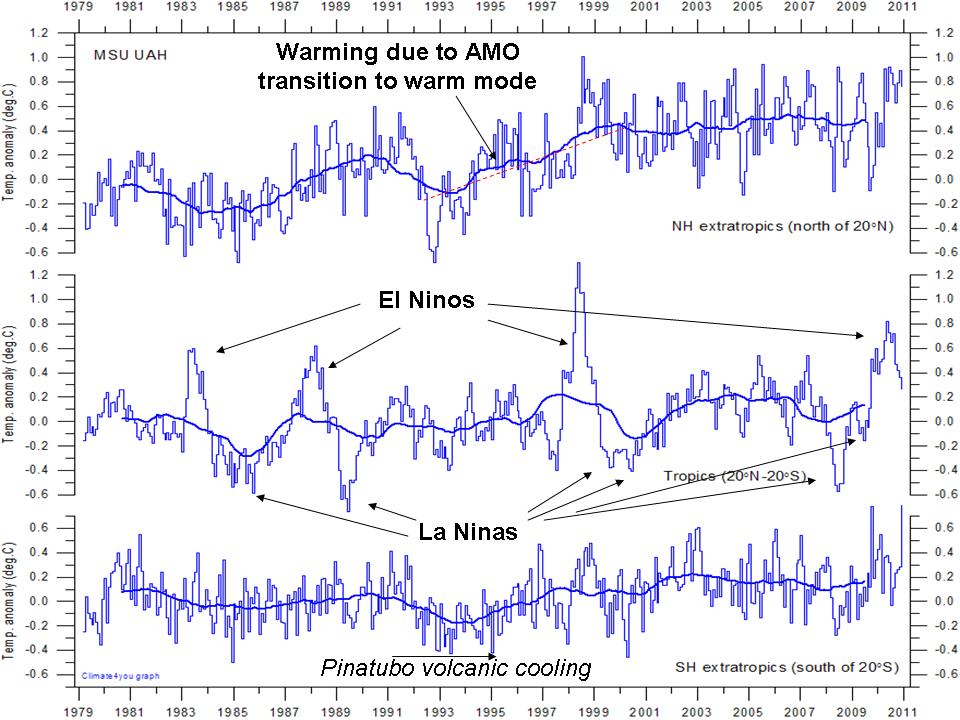
The AMO tracks to the solar irradiance with a lag of about 8-9 years. This suggests the current warm AMO state will end by around 2015. Northern Hemispheric temperature will take a leg down. With the cooling of the Pacific now and more La Ninas, look for net cooling especially in the tropics until then.
See more here.
How would one go about warming the Atlantic? Are some posters here really saying that humans are warming it up? How? If you say increased greenhouse gas and specifically mention CO2, you’ve got some physics to explain related to long wave radiation’s inability to warm a large, deep body of water to any degree measurable below the mm surface and that is outside of the normal natural variation.
@Will Crump, since the warming trend between 1910-1940 and 1975-2005 is essentially the same, there seems not be much space left for alleged “anthropogenic footprint”, even you are trying hard. Looking at NA SST record, the difference between 1910 and 1975 minimums and 1940 and 2005 maximum is the same – some 0.3 C. First, the underlying warming trend is by order less than IPCC “best estimate”, second it does not seem to be strengthening to the end of the record, it is linear. Twist the facts which ever way, after removing PDO or AMO, there is nothing left for alleged anthropogenic effect. IPCC wrongly attributes all post-1975 warming to CO2. The whole AGW pseudoscience runs on 30-year natural trend, exactly of the same size and magnitude as occurred in 1900-1940 period.
David A. Evans says:
November 2, 2010 at 2:44 pm
I would like you to visit the link at “Enneagram”, a kind you will like it.
Arno Arrak says: “And ENSO has nothing whatsoever to do with AMO.”
All SST datasets are impacted by ENSO, including the AMO, which is simply North Atlantic SST anomaly data that’s been detrended.
Give me some time and I’ll eventually show the the AMO is actually the North Atlantic integrating the effects of ENSO. I gave a hint toward it with this animation of the monthly (lag) correlations with ENSO in the Atlantic:
http://i52.tinypic.com/2gtai6d.jpg
From this post:
http://bobtisdale.blogspot.com/2010/10/on-differences-between-surface-and-tlt.html
“Transitions positive”??????
Does that mean “becomes postive”?
If so, a few English lessons might help to make things clearer.
I note from the graph that the world did not end in 1953 or 1998. . . .
Fred N. says: “Bob, I think the AMO/solar link is discussed here”
Thanks for the links, but Joe D’Aleo states “solar irradiance” implying Total Solar Irradiance or TSI, which is not discussed in the two posts your linked. Solar cycle length and TSI are two separate discussions.
Will Crump says: “Your article failed to note that the AMO is so interconnected with human induced warming that the data supporting the ‘natural’ element has to be altered to remove the influence of greenhouse global warming and there are concerns that this removal still contains an element of global warming.”
There is no evidence that Sea Surface Temperatures are impacted in any way by Anthropogenc Greenhouse Gases. None whatsoever. The rise in global SST anomalies over the 20th century can be explained as the oceans integrating the lingering effects of ENSO. Are you aware that about 25% of the global oceans (the East Indian and West Pacific Oceans, from 80E to 180 longitude) warm in response to El Nino AND La Nina events? Your packaged AGW replies don’t stand up here at WUWT.
Regards
“When the AMO is positive (warm) the Northern Hemisphere is warmer than normal on an annual basis across the continents. When it is cold, it is colder.”
So what went wrong in 1975/6 then ?
http://icecap.us/images/uploads/AMOSANNUAL.jpg
Did two people just ask how CO2 could affect ocean temps? Now I’m not really qualified to discuss climate science but if co2 is a GHG, and it warms the atmosphere ( fact, right?), wouldn’t that heat transfer into the oceans? Also I’m confused on why this article discusses An apparent “global warming”.. I thought we had already decided the earth was cooling??
It all depends if one accepts that the AMO has a cycle (any cycle at all that is) [which should be quite clear for anyone with eyes and anyone without graphic dyslexia] …
… or whether one thinks the AMO just reflects the global temperature and is not a natural cycle then.
But the second explanation results in the conclusion that global temperatures have some kind of cycle (AMO influenced or not).
In other words, it does not matter. The AMO either contributes to a global temperature cycle or it is caused by a global temperature cycle.
This issue should be therefore DONE in my opinion.
Secondly, how does the ENSO impact the AMO (there are various physical explanations for how it could do so especially when considers how the actual atmosphere circulates around the planet).
Here is a chart which shows there is a lag of approximately 8 months in the AMO reacting to the Nino 3.4. Not a really, really clear correlation but certainly there.
http://img215.imageshack.us/img215/8791/weeklyensoamooct27.png
So how does the combination of the ENSO and the AMO impact global sea surface temperatures. Very strong correlation on the way up, but global SSTs look a little sticky on the way down.
http://img249.imageshack.us/img249/4264/weeklyensoamoglobalssts.png
If one wants to see how the ENSO and AMO influence the UAH global temperatures since 1979 or the Hadcrut3 global temperatures since 1871 (along with my forecast out a few months), here one is. Should be clear enough for anyone with eyes and without graphic dyslexia.
http://img138.imageshack.us/img138/6597/uahmodeloct10.png
http://img828.imageshack.us/img828/1048/hadcrut3modelsept10.png
Will Crump says:
November 2, 2010 at 4:14 pm
In any event, the presentation failed to inform the reader of the links between the AMO and anthropogenic forcing.
==================================
Uh huh.
And “in any event”, YOUR presentation…failed to scientifically prove any significant link between the AMO and anthropogenic forcing.
Chris
Norfolk, Va, USA
Pamela Gray says: November 2, 2010 at 4:25 pm
How would one go about warming the Atlantic? Are some posters here really saying that humans are warming it up? How? If you say increased greenhouse gas and specifically mention CO2, you’ve got some physics to explain related to long wave radiation’s inability to warm a large, deep body of water to any degree measurable below the mm surface and that is outside of the normal natural variation.
Of course, the ocean is huge and the heat capacity is large, but how could increased radiant energy into the oceans do anything but warm up the water at least a little bit? (OK, there are some possible negative feedback mechanisms like warmer –> more humidity –> more clouds –> more reflected energy, but the 1st order effect is to warm the waters.)
As to the “mm penetration depth”, that is a red herring. Indeed, LWIR from ~300 K objects will penetrate 0.1 mm or less (see http://www.physics.umd.edu/grt/taj/104a/watopt.gif). Still, increased LWIR from CO2 can have a net warming effect on several meters of water, and I can explain the physics.
The simple fact is that there is more LWIR LEAVING that top 0.1 mm than ENTERING — the warm water radiates more LWIR up than the cool atmosphere radiates down. So the top mm will on average be COOLED by LWIR. An increase in GHG’s and a subsequent increase in the temperature of the atmosphere will reduce the cooling of the top 0.1 mm by radiating more LWIR downward.
Meanwhile, SWIR from the sun heats a layer on the order of 10 cm deep. Visible light from the sun heats a layer on the order of 10 m deep.
* Top layer cools less when more LWIR is radiated down by the atmosphere.
* Deeper layers get heated as much by SWIR and visible light radiated down by the sun.
Sounds like a recipe for increased warming of several meters of ocean.
Of course, there are other affects like evaporation and convection, but that is more than I have time (or expertise) to address at the moment. I’d be happy to hear criticisms of the radiative part of my arguments.
” Still, increased LWIR from CO2 can have a net warming effect on several meters of water, and I can explain the physics.”
Please do. If I’ve been under a misapprehension then I’d like to know. However you need to take evaporation and convection into account too because evaporation is a net cooling process so somehow the LWIR from CO2 needs to overcome that obstacle yet you admit that you have not considered it:
“Of course, there are other affects like evaporation and convection, but that is more than I have time (or expertise) to address at the moment.”
HenryP we have the ability to do pretty much anything we want to the climate – by lifting enormous mirrors into space – and we can reach any resources we need. The question is do we have the will?
The Manhattan Scientists gave us the ability. http://en.wikipedia.org/wiki/Project_Orion_(nuclear_propulsion)
Re Pamela Gray says:
November 2, 2010 at 4:25 pm
How would one go about warming the Atlantic? Are some posters here really saying that humans are warming it up? How? If you say increased greenhouse gas and specifically mention CO2, you’ve got some physics to explain related to long wave radiation’s inability to warm a large, deep body of water to any degree measurable below the mm surface and that is outside of the normal natural variation.
Pamela, do you or anyone know of actual studies (experiments) done on this and have the results to reflect the difference in ocean heating capacity between LW and SW radiation? It appears obvious to me that an increase in sunshine over the tropics would do far more to heat the oceans then any GHG, as well as increasing the residence time of each unit of energy in the planets budget, but I have not seen any numbers to quantify either the ocean warming capability or residence times of various spectrem of radiant energy.
Jurajv:
Bob Tisdale:
savethesharks:
Relationship of AMO and greenhouse gas is not a matter of my opinion, it is what the studies report.
“Analysis of recent literature finds weaknesses in arguments to the effect that the Atlantic multidecadal oscillation (AMO)—roughly 50–90 year fluctuations in North Atlantic sea surface temperatures—is externally forced by anthropogenic aerosols and greenhouse gases rather than an internal climate mode, plus indications from other sources that the contrary may be true. We are led to the conclusion that the AMO is probably comprised of both natural and anthropogenic forcing in ways that preclude a physically based separation of the two, using the limited historical data sets.”
Enfield, David B.; Cid-Serrano, Luis (2010), “Secular and multidecadal warmings in the North Atlantic and their relationships with major hurricane activity”, International Journal of Climatology 30 (2): 174–184, doi:10.1002/joc.1881
I would have thought you would have focused on the language above, which takes the position that there are weaknesses in studies which attribute all of the AMO effect to anthropogenic forces and studies which attempt to attribute all of the AMO effect to forces other than anthropogenic forces.
This 2010 study concluded that the AMO consisted of both natural forces and anthropogenic forces and did not assign a value to which factor was of higher importance as it stated: “This places a high premium on understanding to what extent the AMO is a man-made or a natural phenomenon.”
I do not think this is the standard AGW view as the AGW crowd would want to attribute all of the AMO to human causes.
I welcome references to studies that take different positions and look forward to future studies that take up the challenge from this study of determining the relative contribution of the various forces affecting the AMO.
My primary issue is with Joseph D’Aleo’s article not presenting the existence of differences of opinion about the AMO.
Have you ever wondered..?.., see:
1)The induction coil (Nasa):
http://www.nasa.gov/centers/goddard/images/content/154188main_plasma_bands_lgweb.jpg
2) Plus the magnetic core: Fe3O4 (magnetite ore)
3)Induction heating.
Now, do you understand?:
http://www.vukcevic.talktalk.net/AT-GMF.gif
Entiende? 🙂
The aerosol theory is similar to Einstein’ s cosmological constant; to bent theory to agree with observations.
Had the aerosols did the 1950-1990 cooling, industrial areas like Ruhr area would be much colder than other areas. They were not.
Aerosols (except the volcanic ones, shot up high) have short lifetime (until the next rain). But distant Arctic cooled much more than industrial Europe; it does not add.
There are no measurements of aerosols from that times. SATO index shows nothing, except volcanic events. The aerosol theory is a fig leaf, covering the deficiences of GCM, governed by only CO2.
Had the aerosol theory been correct, we should still live under thick cloud of black smoke, which decreases the clean air temperature by whole two degrees. Just extrapolate the 1900-1940 warming trend until today. Pure nonsense.
http://climexp.knmi.nl/data/ihadsst2_280-360E_0-70N_na.png
I have read this very interesting paper from Dan Pangburn, P. E. (Licensed Mechanical Engineer)
http://www.climaterealists.com/attachments/database/corroborationofnaturalclimatechange.pdf
One of the most inteligent approach I ever read on the subject. If there is a path to follow this one could be it.
>> Still, increased LWIR from CO2 can have a net warming effect
>>on several meters of water, and I can explain the physics.”
>Please do.
I thought I had. 🙂
> … you need to take evaporation and convection into account too …
I know from conservation of energy that if the NET energy flow into a system exceeds the net energy flow out, then the system will warm. And vice versa.
If “the system” = “the oceans as a whole”, then we could consider many ways to transfer energy in and out:
* visible light (energy in to the oceans)
* SWIR (mostly in)
* LWIR (some in, more out)
* Evaporation (energy out)
* contact with air (depends on relative temperature of air and water)
* geothermal heat (a small amount in from ocean floors)
* convection (which simply moves energy around within the ocean, so it doesn’t really change the overall energy).
Even if I don’t know the specific contributions of each mechanism (heck, even if I have not listed some specific energy transfer mechanisms), I still know that the net flow of energy is all that matters. The net result of all the mechanisms tells me what happens If I increase any energy flow in — including LWIR — the then systems has to respond. If it was stable, then it will warm. If it was warming, it will warm more. If it was cooling, it will cool less. All of these could be considered a “warming effect”.
Tim Folkerts says:
November 3, 2010 at 9:37 am
The missing links, the fields we have chosen to ignore, by fear of being considered not so intelligent, by denying the simple laws of the universe. Unless we free ourselves of that self indulging fantastic epistemological load we won’t be able to see things analogically: The simple laws of the cosmos has been transmitted generation after generation however our self conceit has impeded us of approaching to them:
http://www.scribd.com/doc/40514613/Unified-Field-Explained-8
Tim, my query is limited exclusively to longwave IR because it is only longwave IR that increases as a result of more CO2 in the air.
The only effect on a water surface that longwave IR can have is to increase evaporation because it never gets in deeper than the region involved in evaporation.
Evaporation being a net cooling process how can you show that ANY of the energy from that extra IR is left in the body of the water ?
has anyone ever seen an experiment that compared the warming capacity of LWIR verses SWUV?
Bob Tisdale:
I have visited your web site and appreciate the information and analysis that you provide.
I am not certain I follow what you mean by this:
“There is no evidence that Sea Surface Temperatures are impacted in any way by Anthropogenc Greenhouse Gases.”
I am not suggesting that CO2 in the water causes any warming, only that the anthroprogenic effects on the atmosphere cause it to warm and this in turn can cause the ocean to be warmer than it would be without the atmosphere warming.
If there is no warming effect, why are the numbers adjusted for “detrending”:
“The AMO signal is usually defined from the patterns of SST variability in the North Atlantic once a linear trend has been removed. This detrending is intended to remove the influence of greenhouse gas-induced global warming from the analysis, leaving a purely natural variation.”
Your website phrases this differently:
“The Atlantic Multidecadal Oscillation (AMO) is an expression of the natural quasi-periodic cycle in North Atlantic SST anomalies. The AMO is created by detrending the North Atlantic SST anomalies; that is, the monthly values of the linear trend line are subtracted from the monthly SST anomaly data. ”
http://bobtisdale.blogspot.com/2009/03/recent-drop-in-amo.html
http://bobtisdale.blogspot.com/2009/04/atlantic-multidecadal-oscillation.html
Is the description of detrending in the quote I originally left in error? If yes, please bash this description and lets get the right information out.
Saw your comment concerning a previous post concerning information provided by Joe D’Aleo and Don Easterbrook at: http://wattsupwiththat.com/2010/11/02/the-atlantic-ocean-via-the-amo-drives-the-apparent-%E2%80%9Cglobal-warming%E2%80%9D/
What is your analysis of the statement “The Atlantic Ocean via the AMO drives the apparent “Global Warming” ” and the information provided by Joseph D’Aleo above?