
Geoff Sharp writes in comments:
NASA releases their new estimate for SC24. The new number is 64 but not allowing for any 13 month smoothing is noted.
The text is quite comical, they have no idea. By Xmas I predict they will be inline with my prediction made in 2008.
Perhaps. This blink comparator that I made (see below), tells the story pretty well.
Back in October of 2007, the SC24 smoothed SSN prediction was for 150. Now it is 64. But, let us not be too critical of Dr. Hathaway, unlike some scientists we know, he has the integrity and courage to admit when his forecasts and models don’t work, and to revise them in the face of reality. Speaking from experience, Nature can be a bitch to forecast.
Here’s the current prediction below:
Solar Cycle Prediction
(Updated 2010/10/05)

Current prediction for the next sunspot cycle maximum gives a smoothed sunspot number maximum of about 64 in July of 2013.
Predicting the behavior of a sunspot cycle is fairly reliable once the cycle is well underway (about 3 years after the minimum in sunspot number occurs [see Hathaway, Wilson, and Reichmann Solar Physics; 151, 177 (1994)]). Prior to that time the predictions are less reliable but nonetheless equally as important. Planning for satellite orbits and space missions often require knowledge of solar activity levels years in advance.
A number of techniques are used to predict the amplitude of a cycle during the time near and before sunspot minimum. Relationships have been found between the size of the next cycle maximum and the length of the previous cycle, the level of activity at sunspot minimum, and the size of the previous cycle. Among the most reliable techniques are those that use the measurements of changes in the Earth’s magnetic field at, and before, sunspot minimum. These changes in the Earth’s magnetic field are known to be caused by solar storms but the precise connections between them and future solar activity levels is still uncertain.
Of these “geomagnetic precursor” techniques three stand out. The earliest is from Ohl and Ohl [Solar-Terrestrial Predictions Proceedings, Vol. II. 258 (1979)] They found that the value of the geomagnetic aa index at its minimum was related to the sunspot number during the ensuing maximum. The primary disadvantage of this technique is that the minimum in the geomagnetic aa index often occurs slightly after sunspot minimum so the prediction isn’t available until the sunspot cycle has started.
An alternative method is due to a process suggested by Joan Feynman. She separates the geomagnetic aa index into two components: one in phase with and proportional to the sunspot number, the other component is then the remaining signal. This remaining signal has, in the past, given good estimates of the sunspot numbers several years in advance. The maximum in this signal occurs near sunspot minimum and is proportional to the sunspot number during the following maximum. This method does allow for a prediction of the next sunspot maximum at the time of sunspot minimum.
A third method is due to Richard Thompson [Solar Physics 148, 383 (1993)]. He found a relationship between the number of days during a sunspot cycle in which the geomagnetic field was “disturbed” and the amplitude of the next sunspot maximum. His method has the advantage of giving a prediction for the size of the next sunspot maximum well before sunspot minimum.
We have suggested using the average of the predictions given by the Feynman-based method and by Thompson’s method. [See Hathaway, Wilson, and Reichmann J. Geophys. Res. 104, 22,375 (1999)] However, both of these methods were impacted by the “Halloween Events” of October/November 2003 which were not reflected in the sunspot numbers. Both methods give larger than average amplitude to Cycle 24 while its delayed start and low minimum strongly suggest a much smaller cycle. The smoothed aa index reached its minimum (a record low) of 8.4 in September of 2009. Using Ohl’s method now indicates a maximum sunspot number of 70 ± 18 for cycle 24. We then use the shape of the sunspot cycle as described by Hathaway, Wilson, and Reichmann [Solar Physics 151, 177 (1994)] and determine a starting time for the cycle by fitting the data to produce a prediction of the monthly sunspot numbers through the next cycle. We find a starting time of August 2008 with minimum occurring in November or December 2008 and maximum of about 66 in June of 2013. The predicted numbers are available in a text file, as a GIF image, and as a pdf-file. As the cycle progresses, the prediction process switches over to giving more weight to the fitting of the monthly values to the cycle shape function. At this phase of cycle 24 we now give 22% weight to the curve-fitting technique of Hathaway, Wilson, and Reichmann Solar Physics 151, 177 (1994). That technique currently gives highly uncertain (but smaller) values.
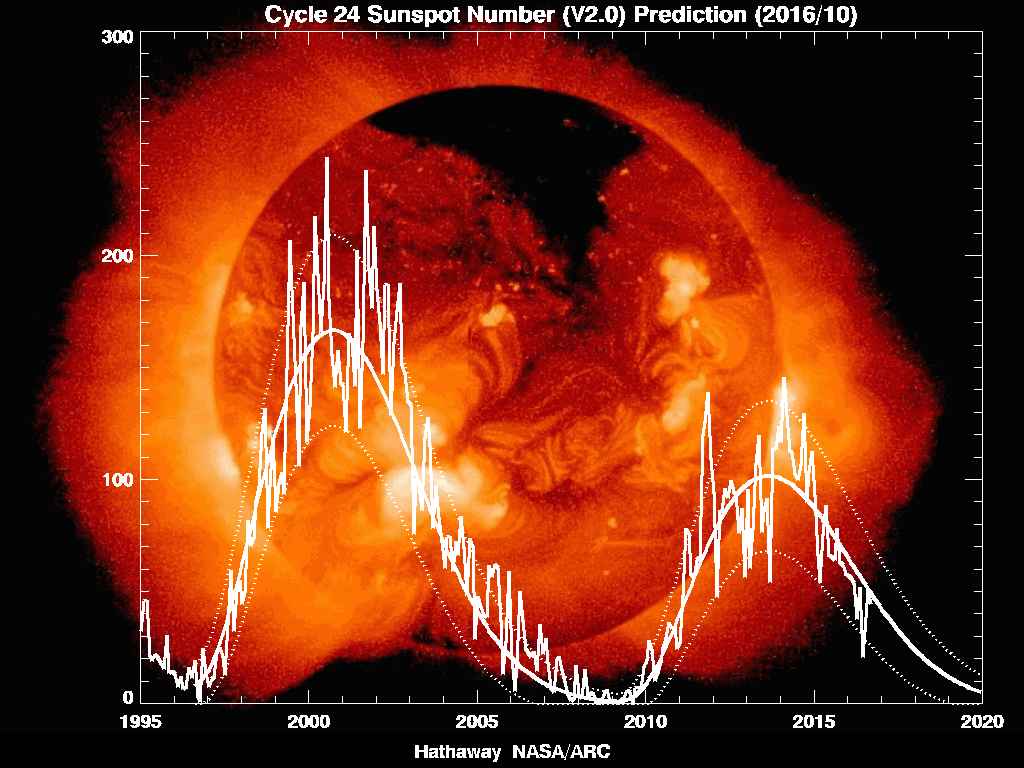
Note: These predictions are for “smoothed” International Sunspot Numbers. The smoothing is usually over time periods of about a year or more so both the daily and the monthly values for the International Sunspot Number should fluctuate about our predicted numbers. The dotted lines on the prediction plots indicate the expected range of the monthly sunspot numbers. Also note that the “Boulder” numbers reported daily at www.spaceweather.com are typically about 35% higher than the International sunspot number.
Another indicator of the level of solar activity is the flux of radio emission from the Sun at a wavelength of 10.7 cm (2.8 GHz frequency). This flux has been measured daily since 1947. It is an important indicator of solar activity because it tends to follow the changes in the solar ultraviolet that influence the Earth’s upper atmosphere and ionosphere. Many models of the upper atmosphere use the 10.7 cm flux (F10.7) as input to determine atmospheric densities and satellite drag. F10.7 has been shown to follow the sunspot number quite closely and similar prediction techniques can be used. Our predictions for F10.7 are available in a text file, as a GIF image, and as a pdf-file. Current values for F10.7 can be found at: http://www.spaceweather.ca/sx-4-eng.php.

Here’s my blink comparator:

I’m making a prediction that’s virtually a dead cinch: all the predictions will be appreciably WRONG.
has someone a link to a blink image showing hathaway’s series of failed predictions? Whats he up to now? 10 fails in a row?
Vuk, minimum impact speed for an asteroid is around 10 -11 km/s (1100 m/s).
(also military jets hit 330 m/s when at or near Mach 1 at sea level. Usually they are flying at 200 to 550 mph most of the time. That’s about 90 m/s to about 250 m/s, depending on the mission profile and the where they are on it)
this site: Mad Sci Network calculates the average speed for an asteroid at 47,000 mph. That’s really close to 21 km/s. So allowing for the velocity attenuation in the atmosphere, you are going to get the 11 km/s that I posted (or higher) depending on angle of entry.
Vuk etc says:
October 6, 2010 at 3:18 pm
Given:
Projectile diameter: 1.30 km ( = 0.81 miles )
Projectile Density: 1500 kg/m3
Assume a sphere (close enough) volume is 4/3 * pi * r^3
4/3 * 3 * 650^3 = 1 million m^3, 1 Mm^3. Mass is 1.5 Tgrams (T for Tera, 10^12).
Force averaged over the cross section of sphere is mg/(pi * r^2), where g is 9.8 newtons, call it 10.
15 Tn/ 1.3 Mm^2 = 10 Mnewtons/meter^2. A newton is about 0.2 lb, a m^2 is about 10 ft^2, so to maintain the object’s speed, the atmosphere needs to push back with 200,000 lb/ft^2, 1,400 lb/in^2, or about 100 bar.
So, if the asteroid compresses the air ahead of it by a factor of 100 (less since the air will heat up to well into incandesence), its acceleration will drop to zero just before impact. (Speed will still be 10 Km/sec.)
Meteors are around altitude 60 Km, I think? You used an entry angle of 45°, so the trajectory will be 84 Km. At 10 Km/sec, that’s all of 8.4 seconds to slow down to.
The Tunguska event was estimated to be an object a few tens of meters across, this object is 50X on a dimension, 125,000X the volume, hence mass, hence energy. Impact would be cataclysmic.
Why even bother predicting: Just let the thing generate itself, since this is already SC24.
http://www.robertb.darkhorizons.org/TempGr/uSC24vs13_14.GIF
Water drippin’ up the spout
Made Galileo look like a Boy Scout
Nobody knows what its all about
Keep an open mind, let it all hang out
rbateman says:
October 6, 2010 at 9:22 pm
Why even bother predicting: Just let the thing generate itself, since this is already SC24.
As Hathaway points out the data is not homogeneous with time:
“Careful inspection of the data indicates that quantities such as sunspot area are not uniform across datasets or even within a given dataset. For example, the ratio of the umbral areas (the darker part of the sunspot) to total spot area (including the lighter penumbra) changes abruptly in 1941/1942 and the ratio of the total sunspot area to the sunspot number changes dramatically with the start of the USAF/NOAA data. “
Leif Svalgaard says
October 6, 2010 at 1:24 pm
NOAA reports area in increments of 10 millionth of the Hemisphere. If the area is less it is counted as zero. The sunspot was at the very limb and its projected area was too small to be counted [at the limb the area becomes zero].
The Layman’s count is misconceived to ‘support’ the sunspot number around 1800-1820, before Wolf was even born. In the 150 years since Wolf we have learned how to count sunspots and what the count means. The Layman’s count is junk.
—–
There was (and still is) a problem with SWPC sunspot data for October 5. On one hand they report an SSN of 11, on the other hand their solar region summary (http://www.swpc.noaa.gov/ftpdir/forecasts/SRS/1006SRS.txt) states that there are no sunspots. Normally the SRS is the most reliable as that data is used as a basis for the SSN. I don’t know what happened in this case, perhaps the forecaster responsible for updating the SSN was given the wrong information. So based on the SRS SSN should have been zero. Another problem is that there were actually two active regions with tiny spots on October 5, both AR 11111 and an unnumbered region which was located at N21E01 by the end of the UTC day. The spots were visible in both SOHO and SDO images.
Leif, I would have to agree that the Layman’s count is junk.
Leif Svalgaard says:
October 6, 2010 at 12:23 pm
“I maintain a monthly ‘Active Region count’ which essentially is the number of active regions per day summed over a month.”
In the top panel, the “humps” are becoming smaller with each cycle.
Is there a link which sheds light on this?
Brownedoff says:
October 7, 2010 at 3:05 am
In the top panel, the “humps” are becoming smaller with each cycle.
Is there a link which sheds light on this?
Yes, solar cycles have become smaller and smaller.
You can find some discussion of that here: http://www.leif.org/research/Predicting%20the%20Solar%20Cycle%20(SORCE%202010).pdf
The Sun’s polar fields are getting weaker, which might account for the decrease of active regions. See http://www.leif.org/research/Cycle%2024%20Smallest%20100%20years.pdf
Peaks 22 and 23 look like bimodal peaks. If there are two slightly superimosed peaks, perhapst the cycle troughs are reinforced at some negative value.
What about de temperatures on 2020?