
Geoff Sharp writes in comments:
NASA releases their new estimate for SC24. The new number is 64 but not allowing for any 13 month smoothing is noted.
The text is quite comical, they have no idea. By Xmas I predict they will be inline with my prediction made in 2008.
Perhaps. This blink comparator that I made (see below), tells the story pretty well.
Back in October of 2007, the SC24 smoothed SSN prediction was for 150. Now it is 64. But, let us not be too critical of Dr. Hathaway, unlike some scientists we know, he has the integrity and courage to admit when his forecasts and models don’t work, and to revise them in the face of reality. Speaking from experience, Nature can be a bitch to forecast.
Here’s the current prediction below:
Solar Cycle Prediction
(Updated 2010/10/05)

Current prediction for the next sunspot cycle maximum gives a smoothed sunspot number maximum of about 64 in July of 2013.
Predicting the behavior of a sunspot cycle is fairly reliable once the cycle is well underway (about 3 years after the minimum in sunspot number occurs [see Hathaway, Wilson, and Reichmann Solar Physics; 151, 177 (1994)]). Prior to that time the predictions are less reliable but nonetheless equally as important. Planning for satellite orbits and space missions often require knowledge of solar activity levels years in advance.
A number of techniques are used to predict the amplitude of a cycle during the time near and before sunspot minimum. Relationships have been found between the size of the next cycle maximum and the length of the previous cycle, the level of activity at sunspot minimum, and the size of the previous cycle. Among the most reliable techniques are those that use the measurements of changes in the Earth’s magnetic field at, and before, sunspot minimum. These changes in the Earth’s magnetic field are known to be caused by solar storms but the precise connections between them and future solar activity levels is still uncertain.
Of these “geomagnetic precursor” techniques three stand out. The earliest is from Ohl and Ohl [Solar-Terrestrial Predictions Proceedings, Vol. II. 258 (1979)] They found that the value of the geomagnetic aa index at its minimum was related to the sunspot number during the ensuing maximum. The primary disadvantage of this technique is that the minimum in the geomagnetic aa index often occurs slightly after sunspot minimum so the prediction isn’t available until the sunspot cycle has started.
An alternative method is due to a process suggested by Joan Feynman. She separates the geomagnetic aa index into two components: one in phase with and proportional to the sunspot number, the other component is then the remaining signal. This remaining signal has, in the past, given good estimates of the sunspot numbers several years in advance. The maximum in this signal occurs near sunspot minimum and is proportional to the sunspot number during the following maximum. This method does allow for a prediction of the next sunspot maximum at the time of sunspot minimum.
A third method is due to Richard Thompson [Solar Physics 148, 383 (1993)]. He found a relationship between the number of days during a sunspot cycle in which the geomagnetic field was “disturbed” and the amplitude of the next sunspot maximum. His method has the advantage of giving a prediction for the size of the next sunspot maximum well before sunspot minimum.
We have suggested using the average of the predictions given by the Feynman-based method and by Thompson’s method. [See Hathaway, Wilson, and Reichmann J. Geophys. Res. 104, 22,375 (1999)] However, both of these methods were impacted by the “Halloween Events” of October/November 2003 which were not reflected in the sunspot numbers. Both methods give larger than average amplitude to Cycle 24 while its delayed start and low minimum strongly suggest a much smaller cycle. The smoothed aa index reached its minimum (a record low) of 8.4 in September of 2009. Using Ohl’s method now indicates a maximum sunspot number of 70 ± 18 for cycle 24. We then use the shape of the sunspot cycle as described by Hathaway, Wilson, and Reichmann [Solar Physics 151, 177 (1994)] and determine a starting time for the cycle by fitting the data to produce a prediction of the monthly sunspot numbers through the next cycle. We find a starting time of August 2008 with minimum occurring in November or December 2008 and maximum of about 66 in June of 2013. The predicted numbers are available in a text file, as a GIF image, and as a pdf-file. As the cycle progresses, the prediction process switches over to giving more weight to the fitting of the monthly values to the cycle shape function. At this phase of cycle 24 we now give 22% weight to the curve-fitting technique of Hathaway, Wilson, and Reichmann Solar Physics 151, 177 (1994). That technique currently gives highly uncertain (but smaller) values.
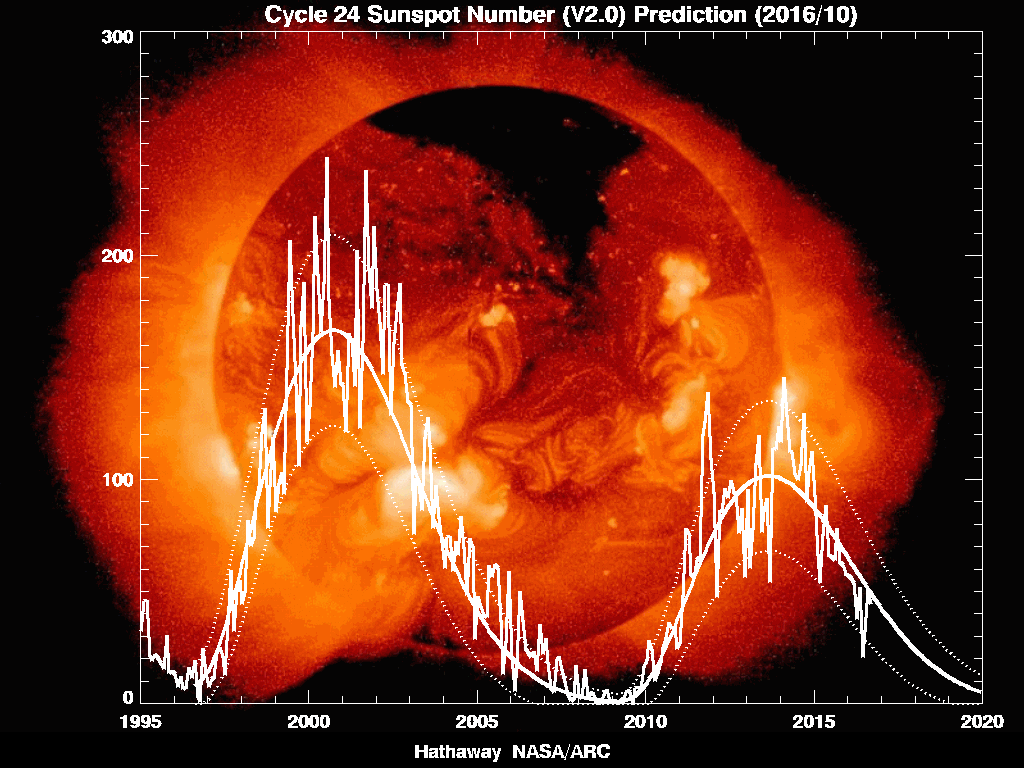
Note: These predictions are for “smoothed” International Sunspot Numbers. The smoothing is usually over time periods of about a year or more so both the daily and the monthly values for the International Sunspot Number should fluctuate about our predicted numbers. The dotted lines on the prediction plots indicate the expected range of the monthly sunspot numbers. Also note that the “Boulder” numbers reported daily at www.spaceweather.com are typically about 35% higher than the International sunspot number.
Another indicator of the level of solar activity is the flux of radio emission from the Sun at a wavelength of 10.7 cm (2.8 GHz frequency). This flux has been measured daily since 1947. It is an important indicator of solar activity because it tends to follow the changes in the solar ultraviolet that influence the Earth’s upper atmosphere and ionosphere. Many models of the upper atmosphere use the 10.7 cm flux (F10.7) as input to determine atmospheric densities and satellite drag. F10.7 has been shown to follow the sunspot number quite closely and similar prediction techniques can be used. Our predictions for F10.7 are available in a text file, as a GIF image, and as a pdf-file. Current values for F10.7 can be found at: http://www.spaceweather.ca/sx-4-eng.php.

Here’s my blink comparator:

Sun’s activity flies in face of climate expectations
http://www.newscientist.com/article/mg20827813.700-suns-activity-flies-in-face-of-climate-expectations.html
Now New Scientist is whinging that ‘their proxies’ are failing.
Richard Altstatt says that 2014 is too late for predicted minimum (but anyway Hathaway predicts mid-2013). Well, though 4 years is a good average for min-to-max, weaker cycles tend to build more slowly, and it would only need to be 5.5 years to make it peak in mid-2014. That can’t be ruled out yet.
Mr. Alex notes the spotless sun with a count of 11. In fact NOAA’s data for October 5th say SSN=11 but sunspot area = 0! How bizarre is that? Give me the Layman’s count any day, it’s far more likely to be like the way Wolf assessed things, which is rather important for comparative purposes dontchathink?
Rich.
@ur momisugly Billy Liar says:
October 6, 2010 at 10:42 am
@ur momisugly Enneagram says:
October 6, 2010 at 9:25 am
We ought to trust in that “double layer” EM shield called “atmosphere” (& all its “spheres”), where its effect usually called “friction” by some, will vaporize it.
It’s 1300 meters in diameter!
Plug in that dia. here, along with other parameters as indicated, to see what the estimated impact effects will be at a specific distance from ground zero. http://impact.ese.ic.ac.uk/ImpactEffects/
It varies greatly depending on the composition of the body, etc. But it would be a significant hit in any case.
Leif Svalgaard says:
October 6, 2010 at 11:48 am
If Livingston and Penn are correct, it is possible that the visible sunspots no longer is a good proxy.
Has anyone come up with any theories on how Livingston and Penn might be correct?
AFAIK, no one – not even – they have put forward any mechanism for their prediction.
I maintain a monthly ‘Active Region count’ which essentially is the number of active regions per day summed over a month:
http://www.leif.org/research/Active%20Region%20Count.png
The dashed line in the bottom panel is the prediction and it looks good up to now.
If my memory serves me well, Hathaway always said that his predictions were not well founded until 3 years after the following cycle had begun (minimum). Badly worded by me. So none of his “predictions” were anything more than approximations or guesses. What really anoyed me was when he kept saying that there was nothing unusual about what was happening when it was blatantly obvious that there was. Blind arrogance? In the past “the panels” predictions after the start of the cycle have been good within the calculated confidence limits. There were many predictions other than DrH’s which were patently absurd. So, Thanks DrH for your time and to Leif for his incredible patience over several years on this blog.
Lockwood demonstrates link between low sun and low temps
Posted on April 14, 2010 by Anthony Watts
NOW,
A stronger Sun actually cools the Earth,
An increase in solar activity from the Sun actually cools the Earth, suggests new research that will renew the debate over the science behind climate change.
Focused on a three-year snapshot of time between 2004 and 2007.
As solar activity waned at the end of one of the Sun’s 11-year cycles, the new data shows the amount of light and heat reaching the Earth rose rather than fell. Its impact on melting polar ice caps, and drying up rivers could therefore have been exaggerated by conventional climate models during the period.
http://www.telegraph.co.uk/earth/environment/climatechange/8046586/A-stronger-Sun-actually-cools-the-Earth.html
Mr. Alex says:
October 6, 2010 at 10:53 am
“Anything is possible says:
October 6, 2010 at 8:59 am
A maximum of 64 would make Solar Cycle 24 the quietest for nearly 200 years. It will be interesting to see what effect that will have on Global Temperatures……”
Not quite. Solar Cycle 14 peaked at 64.2 in 1906.
Having watched this solar event for some years now I have little confidence that we can realistically compare current sunspot numbers with those counted back at the turn of the last century. Sadly.
A stronger Sun actually cools the Earth
Over the past century, overall solar activity has been increasing and should therefore cool the Earth, yet global temperatures have increased.
There you have it, IT`S CO2.
Re Hathaway.
My prediction is a test of the polar field method. Hathaway’s has a different aim, namely to reflect operationally what the current [based on all data up to now] outlook is. So his prediction SHOULD change with time, just like a regular weather prediction for next week would change from day to day, getting better and better [we hope] the closer we get to next week,
Leif Svalgaard says:
just like a regular weather prediction for next week would change from day to day, getting better and better [we hope] the closer we get to next week,
======================================================
Is this still called weekly prediction? 🙂
See – owe to Rich says:
October 6, 2010 at 12:19 pm
In fact NOAA’s data for October 5th say SSN=11 but sunspot area = 0! How bizarre is that? Give me the Layman’s count any day, it’s far more likely to be like the way Wolf assessed things, which is rather important for comparative purposes dontchathink?
NOAA reports area in increments of 10 millionth of the Hemisphere. If the area is less it is counted as zero. The sunspot was at the very limb and its projected area was too small to be counted [at the limb the area becomes zero].
The Layman’s count is misconceived to ‘support’ the sunspot number around 1800-1820, before Wolf was even born. In the 150 years since Wolf we have learned how to count sunspots and what the count means. The Layman’s count is junk.
Curiousgeorge says:
………….
parameters:
Distance from Impact: 1000 meters ( = 3280.00 feet )
Projectile diameter: 1.30 km ( = 0.81 miles )
Projectile Density: 1500 kg/m3
Impact Velocity: 330.00 meters per second ( speed of a military jet )
Impact Angle: 45 degrees
Target Density: 2500 kg/m3, Target Type: Sedimentary Rock
Results
22.4 MegaTons TNT
Transient Crater Diameter: 1.81 km ( = 1.13 miles )
Transient Crater Depth: 641 meters ( = 2100 feet )
Final Crater Diameter: 2.26 km ( = 1.41 miles )
Final Crater Depth: 482 meters ( = 1580 feet )
The crater formed is a simple crater
-little vaporization occurs; no fireball is created, therefore, there is no thermal radiation damage.
At distance from Impact: 1000 meters
-The major seismic shaking will arrive approximately 200 milliseconds after impact.
Richter Scale Magnitude: 5.5
Air Blast:
The air blast will arrive approximately 3.03 seconds after impact.
Multistory wall-bearing buildings will collapse.
Wood frame buildings will almost completely collapse.
Multistory steel-framed office-type buildings will suffer extreme frame distortion, incipient collapse.
Highway truss bridges will collapse.
Highway girder bridges will collapse.
Glass windows will shatter.
Cars and trucks will be largely displaced and grossly distorted and will require rebuilding before use.
Up to 90 percent of trees blown down; remainder stripped of branches and leaves.
Vuk etc says:
October 6, 2010 at 1:27 pm
“Death and destruction”
Got a hemisphere ?
I’m sorry but this isn’t a prediction or forecast IMO, it’s another guess. And history has proved that his previous guesses were incorrect. So regardless of what the new and improved model forecasts we know for a fact that the model can’t be deemed to have any skill.
Thanks, Leif, for reminding us of geometry (or heliometry we should say!). However, am I correct in thinking that there is a rule whereby spots are not to be counted if they are too close to the limb, and so if they’re not too close they should have some area? I expect you might know the details of that. Are you convinced that NOAA adhered to the (assumed) rule on October 5th? I looked at the solarcycle24.com image and I wouldn’t have counted a spot.
Rich.
See – owe to Rich says:
October 6, 2010 at 2:20 pm
there is a rule whereby spots are not to be counted if they are too close to the limb,
No such rule
that NOAA adhered to the (assumed) rule on October 5th? I looked at the solarcycle24.com image and I wouldn’t have counted a spot.
What NOAA counted shows what they adhered to. There is also the issue when to count. The classical Wolf/Wolfer rule says to count only once, e.g. in the morning when seeing is usually the best. So the counts from NOAA and Brussels are sometimes different because of different times.
The point is that there is nothing ‘bizarre’ or ‘conspiratorial’ or ‘nefarious’ in all of this. The observers do their best to deal subjectively with a messy phenomenon.
Vuk etc says:
October 6, 2010 at 1:27 pm
That’s got to be off by a couple orders of magnitude. Try escape velocity, which is 41% greater than Low Earth Orbit speed. Lessee, I can never remember those. 24,000 miles (40,000 Km) in 90 minutes (5400 seconds), is 7.4 Km/sec, times sqrt(2) is over 10 Km/sec.
So 1.5 orders of magnitude. Kinetic energy about 1000X what that calculation came up with.
I’ll rely on the estimated visual magnitude of 17 – that’s about as bright as Pluto, IIRC.
Can we go back to sun spots?
So now the establishment is finally starting to see that the sun is slumbering when will any of this affect government policy – as in the threat of a cooling world!
Solar surprise for climate issueBy Richard Black
Environment correspondent, BBC News
“It is possible, contended Mike Lockwood of Reading University, that there was something special about the last solar cycle – that it could mark the end of an extended phase of relatively high output, and the transition into a less active phase.
“If you look back… 9-10,000 years, you find oscillations of the Sun between ‘grand maxima’ and ‘grand minima’,” he said.
“It’s now emerging that the ‘space age’ has been a grand maximum; so my view is that the Sun is due to fall out of this and into a ‘grand minimum’, so I would not be surprised if in 50 years’ time we find ourselves in conditions like the ‘Maunder Minimum’ [of the late 17th and early 18th Centuries] associated with the ‘Little Ice Age’.”
http://www.bbc.co.uk/news/science-environment-11480916
So how long before the National Enquirer-type rags start screaming: “Sun to go SUPERNOVA in Dec. 2012!!!”
😉
In this forum, the word ‘prediction’ is being used the way the man in the street uses it. In that usage, the claim that the Jets will win by 35 on Sunday is a prediction. But that is not scientific prediction. In science, prediction and explanation go hand-in-hand and are symmetric. I can predict an event “A” only if I have physical hypotheses and some statement of initial conditions that imply the future occurrence of “A.” The hypotheses will describe the mechanism that brings about “A.” Explanation of event “A” is by reference to the hypotheses used to predict it. Also, hypotheses must be reasonably confirmed. Folks, what we are doing here is extrapolating from recent and not so recent graphs. Extrapolation should not be glorified with the name “scientific prediction.”
Ric Werme
Asteroid would be coming down through atmosphere and not being aerodynamically shaped, I thought I would downgrade its velocity to the lowest within reason, speed of sound. Kinetic energy increases with velocitys quared , hence I did not whish to be too cataclysmic.
Ah., sunspots, whatever happened to those?
If Dr.S’s hypothesis on polar fields is correct than next 20 years are going to be rather lacklustre.
http://www.vukcevic.talktalk.net/LFC2.htm
But we see these graphics all the time, and every one turns out not to be a prediction, but a historic update, in which we simply move the goal posts over. Hence it is really no more than an intelligent guess.
Anyway, I’m off to study the chicken entrails, might get a better answer.