
Geoff Sharp writes in comments:
NASA releases their new estimate for SC24. The new number is 64 but not allowing for any 13 month smoothing is noted.
The text is quite comical, they have no idea. By Xmas I predict they will be inline with my prediction made in 2008.
Perhaps. This blink comparator that I made (see below), tells the story pretty well.
Back in October of 2007, the SC24 smoothed SSN prediction was for 150. Now it is 64. But, let us not be too critical of Dr. Hathaway, unlike some scientists we know, he has the integrity and courage to admit when his forecasts and models don’t work, and to revise them in the face of reality. Speaking from experience, Nature can be a bitch to forecast.
Here’s the current prediction below:
Solar Cycle Prediction
(Updated 2010/10/05)

Current prediction for the next sunspot cycle maximum gives a smoothed sunspot number maximum of about 64 in July of 2013.
Predicting the behavior of a sunspot cycle is fairly reliable once the cycle is well underway (about 3 years after the minimum in sunspot number occurs [see Hathaway, Wilson, and Reichmann Solar Physics; 151, 177 (1994)]). Prior to that time the predictions are less reliable but nonetheless equally as important. Planning for satellite orbits and space missions often require knowledge of solar activity levels years in advance.
A number of techniques are used to predict the amplitude of a cycle during the time near and before sunspot minimum. Relationships have been found between the size of the next cycle maximum and the length of the previous cycle, the level of activity at sunspot minimum, and the size of the previous cycle. Among the most reliable techniques are those that use the measurements of changes in the Earth’s magnetic field at, and before, sunspot minimum. These changes in the Earth’s magnetic field are known to be caused by solar storms but the precise connections between them and future solar activity levels is still uncertain.
Of these “geomagnetic precursor” techniques three stand out. The earliest is from Ohl and Ohl [Solar-Terrestrial Predictions Proceedings, Vol. II. 258 (1979)] They found that the value of the geomagnetic aa index at its minimum was related to the sunspot number during the ensuing maximum. The primary disadvantage of this technique is that the minimum in the geomagnetic aa index often occurs slightly after sunspot minimum so the prediction isn’t available until the sunspot cycle has started.
An alternative method is due to a process suggested by Joan Feynman. She separates the geomagnetic aa index into two components: one in phase with and proportional to the sunspot number, the other component is then the remaining signal. This remaining signal has, in the past, given good estimates of the sunspot numbers several years in advance. The maximum in this signal occurs near sunspot minimum and is proportional to the sunspot number during the following maximum. This method does allow for a prediction of the next sunspot maximum at the time of sunspot minimum.
A third method is due to Richard Thompson [Solar Physics 148, 383 (1993)]. He found a relationship between the number of days during a sunspot cycle in which the geomagnetic field was “disturbed” and the amplitude of the next sunspot maximum. His method has the advantage of giving a prediction for the size of the next sunspot maximum well before sunspot minimum.
We have suggested using the average of the predictions given by the Feynman-based method and by Thompson’s method. [See Hathaway, Wilson, and Reichmann J. Geophys. Res. 104, 22,375 (1999)] However, both of these methods were impacted by the “Halloween Events” of October/November 2003 which were not reflected in the sunspot numbers. Both methods give larger than average amplitude to Cycle 24 while its delayed start and low minimum strongly suggest a much smaller cycle. The smoothed aa index reached its minimum (a record low) of 8.4 in September of 2009. Using Ohl’s method now indicates a maximum sunspot number of 70 ± 18 for cycle 24. We then use the shape of the sunspot cycle as described by Hathaway, Wilson, and Reichmann [Solar Physics 151, 177 (1994)] and determine a starting time for the cycle by fitting the data to produce a prediction of the monthly sunspot numbers through the next cycle. We find a starting time of August 2008 with minimum occurring in November or December 2008 and maximum of about 66 in June of 2013. The predicted numbers are available in a text file, as a GIF image, and as a pdf-file. As the cycle progresses, the prediction process switches over to giving more weight to the fitting of the monthly values to the cycle shape function. At this phase of cycle 24 we now give 22% weight to the curve-fitting technique of Hathaway, Wilson, and Reichmann Solar Physics 151, 177 (1994). That technique currently gives highly uncertain (but smaller) values.
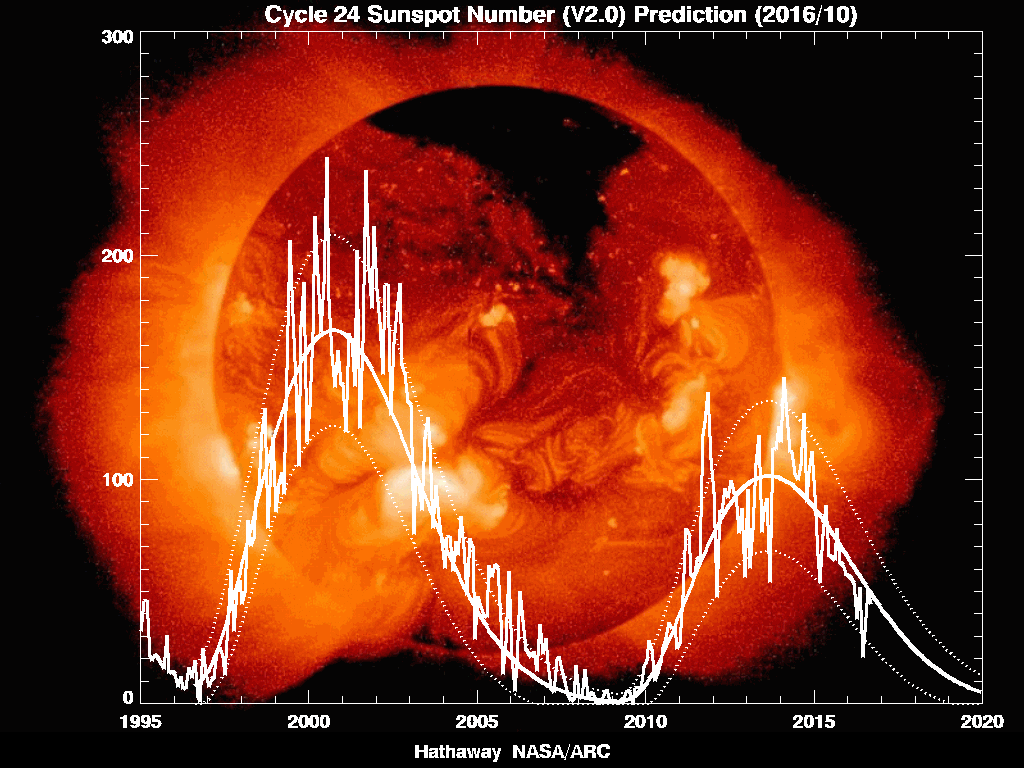
Note: These predictions are for “smoothed” International Sunspot Numbers. The smoothing is usually over time periods of about a year or more so both the daily and the monthly values for the International Sunspot Number should fluctuate about our predicted numbers. The dotted lines on the prediction plots indicate the expected range of the monthly sunspot numbers. Also note that the “Boulder” numbers reported daily at www.spaceweather.com are typically about 35% higher than the International sunspot number.
Another indicator of the level of solar activity is the flux of radio emission from the Sun at a wavelength of 10.7 cm (2.8 GHz frequency). This flux has been measured daily since 1947. It is an important indicator of solar activity because it tends to follow the changes in the solar ultraviolet that influence the Earth’s upper atmosphere and ionosphere. Many models of the upper atmosphere use the 10.7 cm flux (F10.7) as input to determine atmospheric densities and satellite drag. F10.7 has been shown to follow the sunspot number quite closely and similar prediction techniques can be used. Our predictions for F10.7 are available in a text file, as a GIF image, and as a pdf-file. Current values for F10.7 can be found at: http://www.spaceweather.ca/sx-4-eng.php.

Here’s my blink comparator:

Jeremy says:
………..
I just hope that the orbit prediction is far more accurate than one for the sunspot number.
amicus curiae says:
……………..
Asteroid encounter. (copy and paste entire line)
Over a year and a half ago, I guessed SC#24 would peak at 80 around July 2013. At the time I made my guess, back in January 2009, Hathaway had revised his original guesses a couple times to lower and later. He has gone from 150/early 2012, to 134/early 2012, to 104/mid 2012. Now Hathaway’s guess is 64/July 2013.
At least I had the courtesy to round my guess to a multiple of 10! Perhaps that is because I know I have no special expertise in this area, no models, and am not on the government payroll.
For now, I’m sticking with my prediction of 80/July 2013. I’m hoping I’m high and Hathaway’s 64/July 2013 turns out to be the case. It would be better if the peak is even lower and later, because that could help reduce the warming trends and perhaps give us a bit of cooling.
Mr Hathaway is a science man of integrity, I wish one could say the same about other scientists. Myself I am no climate nor solar scientist but I bet that a situation similar to the early 1800s will happen.
The AGW Titanic is sinking as inexorably as the original Titanic sunk. The laws of physics are inexorable, period.
David Archibald predicted 40 way before any of these dudes LOL
Mr Hathaway is a science man of integrity, I wish one could say the same about some other scientists that we know. Myself I am no climate nor solar scientist but I bet that a situation similar to the early 1800s will happen.
The AGW Titanic is sinking as inexorably as the original Titanic sunk. The laws of physics are inexorable.
Hey, that’s funny. Back in 2007 I took part in a sweepstake for the next solar maximum. My guess was 65! So I’m hoping that Hathaway is right this time. Unfortunately he is usually wrong!
This is huge
http://www.climateconversation.wordshine.co.nz/2010/10/observations-on-niwas-statement-of-defence/
REPLY: Yes, I was reading it this morning, but I have to say that blog post of theirs is a train wreck communications wise – too much insider banter, it needs to be explained better, and that is what I’m going to try to do. – Anthony
Perhaps Goldman Sachs, Pachauri et al, could set up a sunspot number futures market? Those with particularly good models and conviction could then become wealthy, in a similar manner to those with models and conviction relating to CO2 levels. I am sure only a few laws would need to be changed.
This is the 3rd? New prediction.
Joseph D’Aleo had it right two years ago.
50 to 60 in peak year. Total sunspot mean for cycle around 200.
Unlike twin to follow.
Jeremy says:
October 6, 2010 at 9:32 am
In layman’s terms:
Asteroid: 2010 JL33
Closest approach: Dec 9
Miss distance: 16.6 Lunar Distances (1 LD = 384,401 km)
Visual magnitude at closest approach: 17.6
Asteroid size: 1.3 km
…from spaceweather.com (last object in table)
One might think that the solar guys have some integrity *at least in part* (I do not intend to neglect the inherent integrity of given individuals) because they deal in timeframes and observations that are verifiable/falsifiable in the mid-term. That tends to reenforce whatever natural integrity they have.
Enneagram says:
October 6, 2010 at 9:25 am
We ought to trust in that “double layer” EM shield called “atmosphere” (& all its “spheres”), where its effect usually called “friction” by some, will vaporize it.
It’s 1300 meters in diameter!
Stephan,
Its a scandal to equal climategate, they are disowning a record they created and defended and used to advise government, they are publicly funded and have pimped their construction as first rate when in fact they knew all along it was rubbish. The NZ government will be left swinging in the wind by this because their whole energy policy was based on the NIWA record.
Governments do not like to be made to look stupid by underlings on the payroll and they do not on the whole enjoy taking flak, a big ooops.
“Anything is possible says:
October 6, 2010 at 8:59 am
A maximum of 64 would make Solar Cycle 24 the quietest for nearly 200 years. It will be interesting to see what effect that will have on Global Temperatures……”
Not quite. Solar Cycle 14 peaked at 64.2 in 1906.
I’m still sticking to max of 50. Today the visible disk is blank but officially we have a sunspot number of 11… nothing has changed, the numbers will continue to be inflated.
The Flux 10.7 is very interesting to watch… it has dipped back to near minimum levels (75) and has yet to reach 100!
Billy Liar says:
October 6, 2010 at 10:42 am
Just peanuts!
Predictions are only valid if derived from a statistically stable system, wherein all of the significant variables are known. As for the several billion year old Sun, I doubt we have a good handle on that. Wheels within wheels. We should be amused by our ignorance, yet we pronounce as if we are Lords of the Universe.
Mr. Alex says:
October 6, 2010 at 10:53 am
I’m still sticking to max of 50.
I’m right there with you, mine was homed in at an average of 47 or lower but 50’s close enough for a nice round number. ☺
With all the solar research going on at NASA and this is the best that they can model on a relatively short term prediction? Kind of demonstrates how good models aren’t with a pointer aimed at all those AGW models.
They are still increasing the base cycle to generate a higher peak. I wouldn’t increase the cycle length without further evidence. I expect we will peak Christmas 2012 at 50. (yeah, +/- 10 points and 6 months) But 2014 is too late for peak.
In Webster’s under “clueless predictions” you’ll see NASA’s Hathaway. These guys have been wrong, wrong, wrong every step along the way since 2006…
Interesting timing, todays sunspot number is zero.
Dennis Wingo says:
October 6, 2010 at 8:50 am
Is Leif still holding to his 72 prediction? Leif has there been anything that indicates to you that you would reduce your own prediction number? Also, even Hathaway and others from the NASA team had previously predicted a very low cycle 25, is this still the case?
Since my prediction is based on the polar fields prior to and at solar minimum, the prediction will not change once minimum is past. So 72 it is. There is one thing to take into account: the prediction is based on magnetic field and thus predicts magnetic field. There are various proxies for the solar magnetic field: sunspot number, number of active regions, F10.7 microwave flux, Heliospheric magnetic field, cosmic ray modulation, etc. If the relationships between the proxies and the magnetic field do not change, it matters not which one you predict as one can simply convert from one to the other. If Livingston and Penn are correct, it is possible that the visible sunspots no longer is a good proxy. If so, the prediction must be expressed in terms of other proxies. E.g. F10.7, where it would stand at ~125 sfu, or number of active regions [72/12=6].
I see the peak is pushed back about 3 years.
Hi doc. Nice to see you are not budging, only if proxies are right, naturally.
Once I caught a fish alive,
Then I let go again.
Why did you let it go?
Because it bit my proxy so.
Which proxy did it bite?
The one I thought it was right.
Can Leif send me my winning lotto numbers as well!.