Guest post by David Archibald

We return to Dr Svalgaard’s plot of four solar parameters, updated daily at: http://www.leif.org/research/TSI-SORCE-2008-now.png
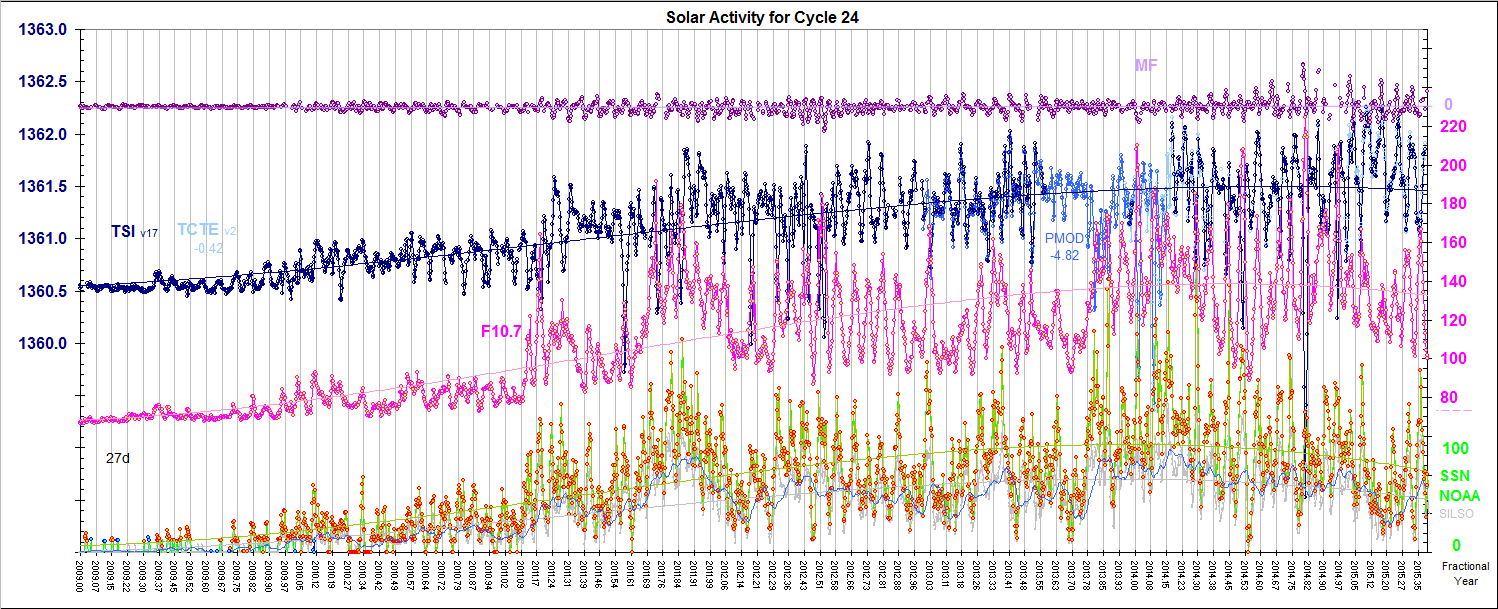
There are a couple of things to note. Firstly, the solar Mean Field, which is the top line, went into the Solar Cycle 23/24 transition being neat and regular like a heartbeat, and has come out choppy and arrhythmic. Secondly, the F10.7 ramp up continues to be very flat indeed. The line of best fit of the F10.7 flux, currently at 82, equates to a sunspot number of 24. In terms of sunspot number, the rate of ramp up over the last year is 11 per annum. At two years into the cycle, this will be the maximum rate of increase we will get.
One of the accepted solar cycle prediction methodologies is a curve fitting exercise two years after the month of solar minimum, which was December 2008. Inspired by the fact that NOAA et al called 2010 the hottest year ever when it was only half over, we have decided to go early and curve fit now. The green corona brightness tells us that solar maximum will be in 2015. Combined with that constraint, the graphic below is the result:

F10.7 flux at solar maximum will be 105, equating to a sunspot number of 50. It will be the weakest solar cycle since Solar Cycle 6, the second half of the Dalton Minimum (1810 to 1823). Solar Cycle 5 had a maximum amplitude of 49.2 and Solar Cycle 6 of 48.7.
The evidence for a Dalton Minimum repeat continues to build. As a 210 year de Vries cycle event, it has come along right on schedule.
John Finn:
I think that one temperature from a single location is a not a particularly good representation of global temps. I think we can agree on that.
Prof. Easterbrook has an extremely good paper where he outlines the evidence for the effect of solar variations on climate, from evidence such as receeding and advancing glaciers, and analysis of the ice cores in Greenland and Antarctica. In this paper Prof. Easterbrook presents compelling evidence for the period of the Dalton minimum being cooler.
http://myweb.wwu.edu/dbunny/research/global/glopubs.htm
Bob from the UK says:
August 31, 2010 at 3:15 am
In this paper Prof. Easterbrook presents compelling evidence for the period of the Dalton minimum being cooler.
Check Figure 33 in your link. Note the warm spike in the middle of the Dalton. Check Loehle’s reconstruction http://www.leif.org/research/Loehle-Temp.png and note the warm spike during the Dalton.
Gentlemen here are some numbers that might help.
These are averages for two selected periods:
year ——–winter—–spring——summer—-autumn
1750-1850–3.407—-8.165——15.319—9.458—-9.087
1800-1830–3.324—-8.261——15.170—9.596—-9.089
as you can see winters and summers were fractionaly cooler, springs and autumns fractionaly warmer, yearly averages are virtualy same.
Or if you are so inclined you can count dots on:
http://www.vukcevic.talktalk.net/CET-D.htm
(second graph for 1750-1850)
Leif:
There are still warm and cold PDO modes during the solar maximum and solar minimums. If you notice during the maunder minimum and dalton minimum the cold periods are longer and deeper. On average the temp is cooler during the Dalton minimum than the periods before and after.
Bob from the UK says:
August 31, 2010 at 9:39 am
On average the temp is cooler during the Dalton minimum than the periods before and after.
Define your periods: e.g. DM 1800-1830, Before 1770-1800, After 1830-1860
Or tell us which periods you would prefer, then we do the math.
This unresolved debate is exactly why I found it necessary to propose independently varying solar and oceanic influences sometimes supplementing and sometimes offsetting one another.
Depending on the interplay the air circulation systems move latitudinally to create the observed climate responses.
Bob from the UK,
Thank you for posting the Easterbrook link. Our friend John Finn is still arguing with everyone because he can not admit that the planet’s temperature fluctuated significantly over the Holocene, causing plant- animal- and human-friendly warm optimums, alternating with cold cycles marked by mass starvation and misery. If CO2 has anything at all to do with temperature, its effect is so insignificant that it can be completely disregarded, as Prof Easterbrook conclusively shows.
As I stated to Mr Finn up-thread: …if you — or Mann — admitted that the MWP, the LIA, the Dalton Minimum, the Minoan Optimum, the Roman Warm Period, etc. occurred, then all your wild-eyed alarmism gets flushed, because if the climate naturally warmed and cooled so much prior to the industrial revolution, then it’s pretty much impossible to hang your hat on CO2 as the driver of the climate… So you have to pretend that the planet’s temperature has always been just like it is now: the straight handle of the Hokey Stick.
Dr Easterbrook provides volumes of evidence to support the fact that the temperature naturally fluctuates by many degrees, and that CO2 is a non-player in planetary climate dynamics. Others also show the Dalton Minimum centered around 1800. With the planet emerging from the LIA, it is to be expected that temperatures will be higher than for the past several hundred years. CO2 has nothing measurable to do with it, as Easterbrook shows.
The politically inspired runaway global warming scare is actually the reverse of what we should be concerned about. Global freezing is much more likely — and truly scary.
Bob from the UK says:
August 31, 2010 at 3:15 am
John Finn:
I think that one temperature from a single location is a not a particularly good representation of global temps. I think we can agree on that.
Well -yes – but it was you who linked to the source and, as I pointed out, it’s not just that station that shows the Dalton was not unusually cold.
Prof. Easterbrook has an extremely good paper where he outlines the evidence for the effect of solar variations on climate, from evidence such as receeding and advancing glaciers, and analysis of the ice cores in Greenland and Antarctica. In this paper Prof. Easterbrook presents compelling evidence for the period of the Dalton minimum being cooler.
http://myweb.wwu.edu/dbunny/research/global/glopubs.htm
A few years ago I might have found the Easterbrook paper(s) highly persuasive but I suspect not now. I’m already put off by a statement in one which states that the world has cooled since 1998. This is not correct – regardless of which temeprature record is used. This leads me to think Easterbrook will include anything that supports his ideas and ignore everything that contradicts them.
Smokey says:
August 31, 2010 at 11:04 am
Others also show the Dalton Minimum centered around 1800.
Not quite, the cycle that ended in 1798 was one of the highest recorded, so it is stretching it to claim that the DM is centered on 1800. If you count the two or three low cycles that followed as the DM, then the center would be something like 1815 commensurate with the ‘official’ duration 1800-1830. See, e.g. http://sidc.oma.be/html/wolfaml.html
Smokey says: August 31, 2010 at 11:04 am
Others also show the Dalton Minimum centered around 1800.
Above is a misleading use of my graph.
http://www.vukcevic.talktalk.net/CET-Dec.gif
You will see in my previous posts I have used for Dalton 1800-1830.
However, I would like to state following: I think CO2 and TSI have a little (if anything) to do with large temperature oscillations.
There is only one indicator which in main correctly signals in advance those oscillations (N. Atlantic precursor)
http://www.vukcevic.talktalk.net/CETnd.htm
More importunately it suggests significant cooling in decade to come. Variable delay is well within parameters of the precursor.
Any serious researcher should scrutinise it in detail. 10 year period 1695-1705 is odd one out, but this may possibly be something to do with data reliability from the period, 1895-1900 there is break in the data compatibility.
For those ignoring its significance today, may render their views worthless tomorrow.
There is something wrong with solar cycle 24
http://www.landscheidt.info/?q=node/196
R. de Haan says:
August 31, 2010 at 1:09 pm
There is something wrong with solar cycle 24
Not that, see the discussion at
http://wattsupwiththat.com/2010/08/31/cooler-times-ahead-indicators-show-deepening-la-nina/#comment-471395
John Finn
A few years ago I might have found the Easterbrook paper(s) highly persuasive but I suspect not now. I’m already put off by a statement in one which states that the world has cooled since 1998. This is not correct – regardless of which temeprature record is used. This leads me to think Easterbrook will include anything that supports his ideas and ignore everything that contradicts them.
With regard to cooling I recall what Phil Jones said with respect to 2002 – 2009, “The trend this time is negative (-0.12C per decade), but this trend is not statistically significant”. Now 1998 was warmer than 2002. Phil Jones and Don Easterbrook don’t really contradict one another, Phil Jones simply qualifies the trend from 2002-2009 as not statistically significant. I wonder if the trend from 1998 – 2009 was.
use different
Smokey says:
August 31, 2010 at 11:04 am
Bob from the UK,
Thank you for posting the Easterbrook link. Our friend John Finn is still arguing with everyone because he can not admit that the planet’s temperature fluctuated significantly over the Holocene
Why do you keep repeating something that’s clearly not true. Do you not understand the issue or are you just deliberately avoiding it .
I’m not arguing about climate fluctuation “over the Holocene” I’m arguing against the assertion that the Dalton Minimum was “unusually cold”. All the evidence presented in this thread indicates that I’m correct. The Uppsala temperature record actually shows the 1860s were more than half a degree cooler than the Daltomn minimum period. It is you who appears to have a problem with the facts.
Bob from the UK (August 30, 2010 at 10:04 am) cited the Uppsala record as evidence that the Dalton Minimum was an unusually cold period but when it was pointed out to him that the data had been very deliberately presented to mislead the casual reader he complained that using ” a single location is a not a particularly good representation of global temps”. Clearly it depends if it supports your personal viewpoint or not. I haven’t see too many people criticise David Archibald’s analyses, for example.
Bob from the UK says:
August 31, 2010 at 11:47 pm
With regard to cooling I recall what Phil Jones said with respect to 2002 – 2009, “The trend this time is negative (-0.12C per decade), but this trend is not statistically significant”. Now 1998 was warmer than 2002. Phil Jones and Don Easterbrook don’t really contradict one another, Phil Jones simply qualifies the trend from 2002-2009 as not statistically significant. I wonder if the trend from 1998 – 2009 was.
use different
The trends since 1998 to date – significant or not – are positive. Easterbrook is wrong. The world has not cooled soince 1998 and he shouldn’t have said that it had even if, at the time of writing, the trend was negative. The time scale was too short and he should know that there are often short term falls due, for example, to ENSO fluctuations.
Leif Svalgaard (August 31, 2010 at 11:17 am) says: “If you count the two or three low cycles that followed as the DM, then the center would be something like 1815 commensurate with the ‘official’ duration 1800-1830.”
vukcevic (August 31, 2010 at 12:36 pm) says: “You will see in my previous posts I have used for Dalton 1800-1830″.
The period 1800-1830 would seem to be right – as far as solar cycles are concerned. But any cooling began before then so, in what appears to be an attempt to tie the cooling in with the Dalton minimum, periods such as 1790-1820 are often specified.
Smokey says:
August 31, 2010 at 11:04 am
Bob from the UK,
…… Our friend John Finn is still arguing with everyone…..
Smokey
I’ve just checked back over the last fwe posts and it appears more people are arguing with you than they are with me. Even vukcevic (August 31, 2010 at 12:36 pm) criticises you about “misleading use of my graph”
I’d give up if I were you. Even your natural allies are debunking your arguments
Smokey, Bob from the UK
I’ve just started reading this Easterbrook paper
http://myweb.wwu.edu/dbunny/research/global/easterbrook_climate-cycle-evidence.pdf
I’m a bit puzzled by his first graph (Figure 1), i .e. NASA GISS global temperatures 1895-2007 – or so it says. The problem is the graph seems to show several years in the 1920s/1930s when temperatures were higher than in the 1990s/2000s. I have looked at GISS global data and cannot find a single year before 1990 which is warmer than any year after 2000.
Can either of you tell me what I could be doing wrong?