Guest post by David Archibald

We return to Dr Svalgaard’s plot of four solar parameters, updated daily at: http://www.leif.org/research/TSI-SORCE-2008-now.png
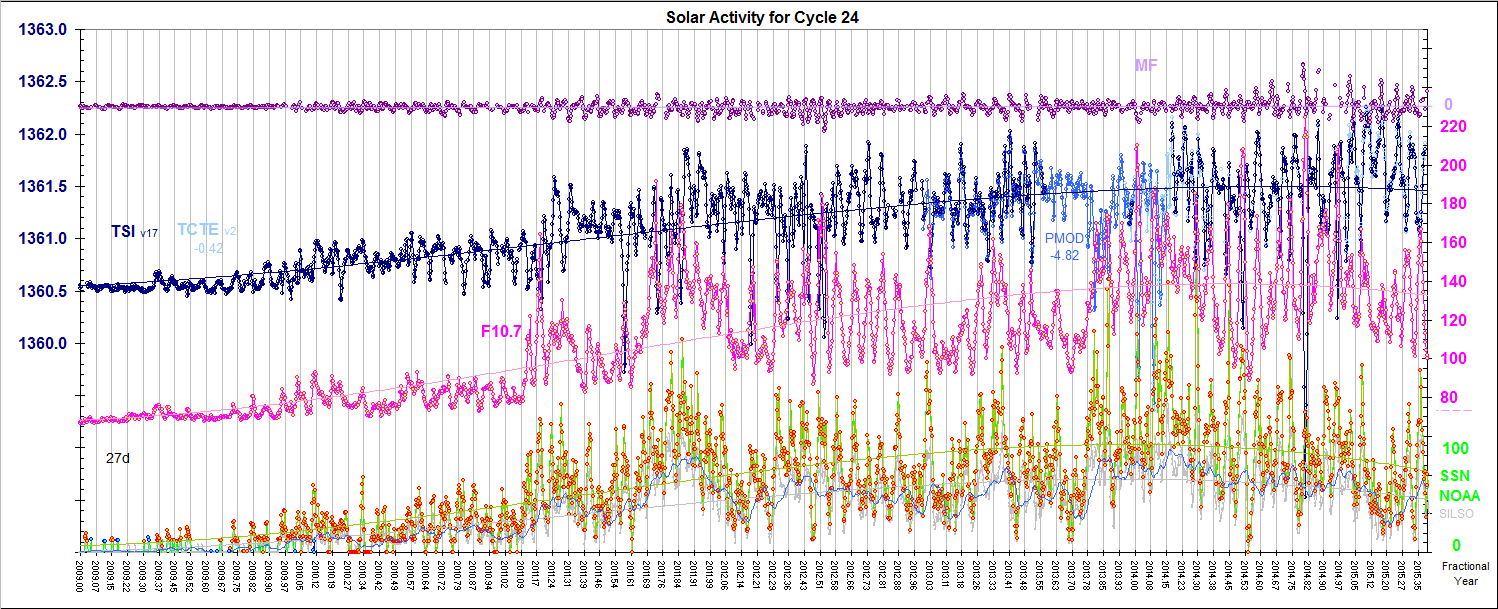
There are a couple of things to note. Firstly, the solar Mean Field, which is the top line, went into the Solar Cycle 23/24 transition being neat and regular like a heartbeat, and has come out choppy and arrhythmic. Secondly, the F10.7 ramp up continues to be very flat indeed. The line of best fit of the F10.7 flux, currently at 82, equates to a sunspot number of 24. In terms of sunspot number, the rate of ramp up over the last year is 11 per annum. At two years into the cycle, this will be the maximum rate of increase we will get.
One of the accepted solar cycle prediction methodologies is a curve fitting exercise two years after the month of solar minimum, which was December 2008. Inspired by the fact that NOAA et al called 2010 the hottest year ever when it was only half over, we have decided to go early and curve fit now. The green corona brightness tells us that solar maximum will be in 2015. Combined with that constraint, the graphic below is the result:

F10.7 flux at solar maximum will be 105, equating to a sunspot number of 50. It will be the weakest solar cycle since Solar Cycle 6, the second half of the Dalton Minimum (1810 to 1823). Solar Cycle 5 had a maximum amplitude of 49.2 and Solar Cycle 6 of 48.7.
The evidence for a Dalton Minimum repeat continues to build. As a 210 year de Vries cycle event, it has come along right on schedule.
Eye witness account of crossing the river that night.
“[Our] army passed through Bethleham and Moravian town and so on to the Delaware which we crossed 9 miles north of Trenton and encamped on the Pennsylvania side and there remained to the 24th December. [O]ur whole army was then set on motion and toward evening began to re-cross the Delaware but by obstructions of ice in the river did not all get across till quite late in the evening, and all the time a constant fall of snow with some rain, and finally our march began with the torches of our field pieces stuck in the, exhalters. [They] sparkled and blazed in the storm all night and about day light a halt was made at which time his Excellency and aids came near to the front on the side of the path where soldiers stood.
When crossing the Delaware with the prisoners in flat bottom boats the ice continually stuck to the boats, driving them down stream; the boatmen endeavoring to clear off the ice pounded the boat, and stamping with their feet, beckoned to the prisoners to do the same, and they all set to jumping at once with their cues flying up and down, soon shook off the ice from the boats, and the next day recrossed the Delaware again and returned back to Trenton.
Brave men.
John Finn,
You asked some questions, and I’m here to assist. You’re never too old to learn!
These charts should help regarding the various time lines:
click1
click2
click3 [interactive chart]
click4
click5
click6
click7
click8
click9
click10
click11
click12
You also asked what caused the cool climate the rest of the time. There are plenty of hypotheses, but no clear answers to that question. What we do know is that empirical observations show that nothing unusual is happening, no matter how fervently some folks wish it would be so.
The climate is well within its past parameters, a Goldilocks climate at present — and no one has falsified the null hypothesis that the observed temperature changes are a consequence of natural variability. That is the simplest, most elegant answer; no need to throw in an extraneous variable like CO2. Look at the charts, CO2 changes follow temperature changes.
What we are observing are natural, regional climate fluctuations. Only those who listen to Michael Mann believe that the climate never fluctuated before the SUV was invented. Skeptics, being realists, know better. The climate has always fluctuated, often much more severely than now, as is shown in the links above.
vukcevic says:
August 28, 2010 at 2:00 pm
….
Perhaps you should quote him correctly: “Schatten’s work on percolation theory and the dynamo is not in my view worth following up”
In any event, this has no bearing on the prediction, neither Schatten’s nor mine.
vukcevic says:
August 28, 2010 at 2:00 pm
Author of those words is well known in the field of the solar science
Perhaps you should ask him for his assessment of your ideas and report back with his response.
Leif Svalgaard says:
August 28, 2010 at 11:14 am
If you don’t like the few data points before SC23, just ignore them, they make no difference.
My plot is up-to-date through August 1st, 2010.
Yes the pre SC23 max records should be dropped, it is bad science to include them. But that will cause a problem with their paper which states the magnetic record does not follow the sunspot cycle.
Rather than supplying a graph can we see the original data as you used to post?
John Finn says:
August 28, 2010 at 5:25 pm
A single river does not prove the Dalton as a zero-sum game, nor does it magically divorce it from the LIA. And so what if it has frozen in every century.
How many times it froze in any given century is more worthy of note.
Try the Nile freezing over if you really want to talk about rare events disassociated from recorded history.
Geoff Sharp says:
August 28, 2010 at 9:43 pm
Yes the pre SC23 max records should be dropped, it is bad science to include them. But that will cause a problem with their paper which states the magnetic record does not follow the sunspot cycle.
Their paper only discusses data from 1998 and later. It is not bad science to include them as they show the upper envelope of the data points. Since they are so few they have no influence on the trend lines. So stop whining.
Rather than supplying a graph can we see the original data as you used to post?
The data has always been at http://www.leif.org/research/Livingston.txt
Matt Penn has been looking at this using the ordinary synoptic data going way back before SC23 . At a recent [last Tuesday] IAU symposium #273 he reported:
Matthew Penn, William Livingston
National Solar Observatory, Tucson, AZ, United States
Independent of the normal solar cycle, a linear decrease in the sunspot magnetic field strength has been observed in synoptic infrared observations taken by Livingston at the NSO Kitt Peak McMath Pierce telescope. This trend was seen to continue in observations of the first sunspots of the new solar cycle 24, and extrapolating this pattern would lead to only half the number of spots in Cycle 24 compared to Cycle 23, and to virtually no sunspots in Cycle 25.
We examined synoptic observations from the NSO Kitt Peak Vacuum Telescope and found a change in sunspot intensity and magnetic flux which roughly agreed with the infrared observations. A more detailed examination of both data sets reveals that the relationship of the sunspot magnetic fields with intensities, or with sunspot size, remain constant during the period of observation. While the observations show a lot of scatter, at a barely significant level we see that smaller, brighter and magnetically weaker spots have appeared more frequently as time passes.
Leif Svalgaard says: August 28, 2010 at 7:57 pm
As an independent minded intellectual, when the philosophy of science is concerned, I take my views as the reference point to be judged against, not the other way around. The fact that you or Hathaway find it infuriating to be unable to overturn the correlation of my equations, it only strengthens the independence of my thought process.
“ Cogito ergo sum “
Leif Svalgaard says:
August 28, 2010 at 10:48 pm
Their paper only discusses data from 1998 and later. It is not bad science to include them as they show the upper envelope of the data points. Since they are so few they have no influence on the trend lines. So stop whining.
Rather than supplying a graph can we see the original data as you used to post?
The data has always been at http://www.leif.org/research/Livingston.txt
No, both their graphs and yours show the data starting from 1990. Pre 1998 only the large spots were measured as per Solanki (as they should), the measurements are also VERY sparse. No real data is recorded during the SC22/23 minimum. Pointing out a deficit in the data is not whining.
Their graph here.
http://www.landscheidt.info/images/l&p_graph.png
L&P and yourself are making the same mistake as the official sunspot records, all are showing an increase in the speck ratio which is skewing the records as I have said many times. The 24th of July is a good example, L&P measuring 16 spots where around 10 of these are pores. This artificially drags the record down.
But even with the pores counted it can be seen that SC24 is growing in magnetic strength. Discard the pore records and the clear trend is on the up, sunspots will not disappear around 2015 due to reducing magnetic field strength. All L&P are showing us is the increase in specks during SC24.
http://www.landscheidt.info/images/livingston.png
The recent gauss readings aligning very nicely with my darkness ratio measurement. Glad to see the online data back ( L&P not measuring for more than 2 months after April explaining the non update)
rbateman says:
August 28, 2010 at 10:07 pm
John Finn says:
August 28, 2010 at 5:25 pm
A single river does not prove the Dalton as a zero-sum game, nor does it magically divorce it from the LIA. And so what if it has frozen in every century.
Are you not following the dicussion. I didn’t bring up the issue of the Thames river – Smokey did. It was one of his attempts to show that the Dalton Minimum was an “unusually cold” period. I agree it’s a pretty pathetic attempt. He also supported Yonb’s use of the CET record. I used the CET record to show that TonyB’s assertions were not valid.
In a nutshell: I’ve been using the very same evidence used by Smokey and TonyB to show that their conclusions about the Dalton Minimum are questionable. Smokey, in typical fashion, has now moved the discussion on to the LIA which has nothing to do with the supposed relationship between low solar activity and an “unusually cold” climate during the Dalton Minimum.
Moderator: Any chance you could post this rather than the first effort, i.e. John Finn says:
(August 29, 2010 at 4:04 am)
thanks and sorry
Smokey says:
August 28, 2010 at 6:43 pm
John Finn,
You asked some questions, and I’m here to assist. You’re never too old to learn!
I’d drop the patronising tone if I were you. You are some way below the mark required to get away with it. My questions that you refer to were rhetorical. I am very familiar with the various temperature records you linked to – particularly the CET record. However, I’m also aware that the LIA, like the MWP, has a tendency to move around to suit the argument of whoever is using it. None of your links is of any use in providing a precise definition for the LIA period. The Wiki article ( http://en.wikipedia.org/wiki/Little_ice_age ) on the LIA states
Which is more or less what I’ve found. In other words, you can pretty much take your pick.
This, though, has nothing to do with the original argument which you now seem keen to avoid, i.e. that the Dalton Minimum was an “unusually cold” period. The implication here being:
Dalton minimum -> low solar activity -> cooler climate
“cooler” than what, though? I’ve shown that the Dalton Minimum wasn’t appreciably cooler than the periods immediately preceding and following the Dalton Minimum. The coldest decade of the Dalton Minimum (which included the massive Tambora eruption in 1815, btw) was only a few hundredths of a degree cooler than 1780-89 and 1880-89. In fact, there were only two decades in the 19th century which might be considered “significantly” warmer than 1810-19 and one of those is 1820-29 which, according vukcevic (August 28, 2010 at 12:10 pm), was part of the Dalton Minimum period anyway.
Also, in 1817 (during the coldest decade of the Dalton Minimum), William Scoresby (jnr) “noted a remarkable diminution of the polar ice” (See http://www.whitby-yorkshire.co.uk/scoresby/scoresby.htm ). This is one of the reasons for the investigation by the Royal Navy into arctic warming.
The “unusual cold” in the Dalton Minimum is a myth. Of course, it was cold at times but no more so than many other priods in the 18th and 19th centuries.
John Finn,
You’re arguing with just about everyone here. And using Wikipedia as your source… *Tsk, tsk*. On climate matters, Wikipedia, as they say, lies even when it says “a” and “the.” Even when they’re right, it’s on the broken clock principle. Please use a credible reference in future, thanx in advance.
Since you’ve posted wikipedia to back up your opinion, let me refer you again to Vukcevic’s chart showing a clearly defined cold period during the time in question: click. See? it really was cold around the Dalton [≈1790 – 1830]. Where’s your chart?☺
While disparaging all the work Tony Brown has put into digging up the historical record, you picked a John Daly excerpt. You should really read that entire article, it will help your understanding. Pay particular attention to the Conclusion.
To claim, against all evidence, that the Dalton was a “myth” paints you into a corner. My advice: stop trying to fool yourself into carrying Michael Mann’s torch, by claiming there was no significant climate change before the advent of the motor home. Arguing against the historical record is fighting a losing battle. Most of the alarmist crowd now grudgingly accepts that the climate has changed far more in the past than recently. But I guess there will always be holdouts.
Well said Smokey, John has been harping the same old line here for years.
The CET as most long term temperature series when taken in isolation, appears reasonably flat. The world temperature data very rarely follow the individual stations.
Vuk’s trend line shows that the Dalton Minimum certainly did not set any high temp world records…get over it John.
vukcevic says:
August 29, 2010 at 12:18 am
to be unable to overturn the correlation of my equations
Correlations are just that, do not imply causation. Read Yule’s classic paper: “Why do we Sometimes get Nonsense-Correlations between Time-Series?–A Study
in Sampling and the Nature of Time-Series” it also applies to you.
http://www.leif.org/EOS/Yule.pdf
To prove that you [at least] have looked at it tell us what the last word on page 5 is.
Don’t forget to report back with your famous solar physicist’s assessment of your correlation.
Geoff Sharp says:
August 29, 2010 at 12:48 am
both their graphs and yours show the data starting from 1990.
http://www.leif.org/EOS/20946-web.pdf
Pre 1998 only the large spots were measured as per Solanki
Not quite correct. Per Livingston no attempt was made to measure all spots, but there was no special selection of only large spots. Anyway, since there are so few they do not change the trend lines, so it is whining as it is irrelevant for the trend.
L&P and yourself are making the same mistake as the official sunspot records, all are showing an increase in the speck ratio […] All L&P are showing us is the increase in specks during SC24.
The L&P effect is an increase of specks as spots turn into specks, then specks becoming invisible.
We’ll know soon enough, by 2016, whether the Maunder was real. Either temps turn down or they don’t.
gary gulrud says:
August 29, 2010 at 12:13 pm
We’ll know soon enough, by 2016, whether the Maunder was real. Either temps turn down or they don’t.
Gary, what have temps to do with the Maunder Minimum? Are you not being presumptive here, Gary? We’ll know from the lack of sunspots whether the Maunder was real, Gary.
Geoff Sharp says:
August 29, 2010 at 5:52 am
Well said Smokey, John has been harping the same old line here for years.
The CET as most long term temperature series when taken in isolation, appears reasonably flat. The world temperature data very rarely follow the individual stations.
Another one who hasn’t followed the discussion. This all statrted when TonyB used the CET to show that the Daltomn Minimum was unusually cold. I used the CET to show him it was no colder than several other periods in the 18th and 19th centuries. Secondly , what do you mean by “world temperature data”? The world temperature data in the early 19th centurt consisted og the CET, Uppsala and about 6 other records. The CET WAS the world temperature data during the DM.
Vuk’s trend line shows that the Dalton Minimum certainly did not set any high temp world records…get over it John.
Brilliant. The evidence for the cold Dalton Minimum is that it didn’t set any high temperature records. Well – that’s me convinced.
Smokey says:
August 29, 2010 at 5:11 am
John Finn,
You’re arguing with just about everyone here.
No I’m not I’m arguing with you – and Geoff Sharp.
And using Wikipedia as your source… *Tsk, tsk*. On climate matters, Wikipedia, as they say, lies even when it says “a” and “the.” Even when they’re right, it’s on the broken clock principle. Please use a credible reference in future, thanx in advance.
The wikipedia reference summed up the situation perfectly. The LIA period is not clearly defined. The start ranges from the 14th century to the 16th century. The end can be any time during the 19th century. Why don’t you tell me what period the LIA covers and let’s see if I can find a “credible reference” which contradicts you. Not that this as anything to do with the Dalton Minimum, of course.
Since you’ve posted wikipedia to back up your opinion, let me refer you again to Vukcevic’s chart showing a clearly defined cold period during the time in question: click. See? it really was cold around the Dalton [≈1790 – 1830]. Where’s your chart?
You have posted a chart for December. It just gets worse. Did the low solar activity only affect December? Even using your cherry-picked month, it’s not appreciably colder. I also note that the temperature decline occurred in around 1770 (red line) which if I’m not mistaken was at least 25 years before the onset of the Dalton Minimum cycles. How did this happen? Did the Central England climate somehow anticipate the weak solar cycles that were due?
Perhaps Geoff Sharp can help us. Any ideas, Geoff.? Vukcevic doesn’t offer an explanation. In this post
vukcevic says:
August 28, 2010 at 12:10 pm
he says
He doesn’t actually tell us that it warmed for 10 years before that nor does he tell us if there was anywhere where it cooled over a longer period. That might be because he can’t find anywhere. He does go on to say
Analysing the temperature response to solar activity is clearly a complicated business. Sometimes summers were warm – sometimes cold – sometimes they were hot. However it does seem as though most of the winters were generally below average though not as cold as 1963, 1740 or 1695. Make of that what you will.
While disparaging all the work Tony Brown has put into digging up the historical record, you picked a John Daly excerpt. You should really read that entire article, it will help your understanding. Pay particular attention to the Conclusion.
Tony Brown (TonyB) cherry-picked his data. I used the same source that he used to show this. As for John Daly’s site – I’ve read pretty much everything on it. I’m particularly interested in anything written by Jack Barrett or Doug Hoyt.
To claim, against all evidence, that the Dalton was a “myth” paints you into a corner.
There isn’t any evidence. The “myth” relates to the fact that the Dalton was unusually cold. It clearly wasn’t.since you are reduced to referring to paintings and the temperature record from a single month to provide the “evidence”.
My advice: stop trying to fool yourself into carrying Michael Mann’s torch, by claiming there was no significant climate change before the advent of the motor home. Arguing against the historical record is fighting a losing battle. Most of the alarmist crowd now grudgingly accepts that the climate has changed far more in the past than recently. But I guess there will always be holdouts.
This is the second time you’ve mentioned Michael Mann and I’m puzzeld to know why. Why do you think I support the views of Michael Mann? Is it because you have no idea about the separate issues of climate change and think that just because someone argues against some crackpot nonsense which just happens to oppose AGW doctrine they are automatically in the AGW camp?
Would you like me to provide of evidence where I’ve argued against Michael Mann?
John Finn,
I haven’t read your entire post above, but as I scrolled thru I noticed your complaint about comparing you & Michael Mann. So state your position: Do you support Mann’s version of reality, or not? It seems you must, since both you & Mann argue against climate fluctuations such as the Dalton and the MWP. In which case, you’re both wrong.
I’ve provided numerous charts and graphs here showing that the climate fluctuates constantly, and has fluctuated much more in the past than currently. I have more if you need them.
But of course, if you — or Mann — admitted that the MWP, the LIA, the Dalton Minimum, the Minoan Optimum, the Roman Warm Period, etc. occurred, then all your wild-eyed alarmism gets flushed, because if the climate naturally warmed and cooled so much prior to the industrial revolution, then it’s pretty much impossible to hang your hat on CO2 as the driver of the climate. And CO2 is the reason for all the shouting. So you have to pretend that the planet’s temperature has always been just like it is now: the straight handle of the Hokey Stick.
Sorry, John, that’s just wrong. But I’m willing to be corrected — if Dr Mann opens the books on his methodology, data and metadata. Fat chance, huh? Charlatans never expose their secrets, even after they’ve been debunked.
John Finn says:
August 29, 2010 at 5:48 pm
I thought we were the ones with the “Denialist” tag.
Perhaps Geoff Sharp can help us. Any ideas, Geoff.? Vukcevic doesn’t offer an explanation. In this post
You need to keep up John. The TSI argument is dead, low solar activity during grand minima correlates with cold winters as we are seeing now. This years winter and the last 2 before have been colder than usual in many parts of the world, the record snowfalls speak for themselves . We are in new territory and are seeing the changing weather patterns for the first time, but current opinion is leading towards pressure differentials and jet stream changes that occur at the winter pole. Some are suggesting this is because of the down stream effects of a shrinking thermosphere. This shrinking thermosphere is a result of greatly reduced EUV which varies substantially more than TSI over the solar cycle.
So taking the December values for CET makes absolute sense.
Brent Hargreaves now:
Brent Hargreaves then:
Beliefs, eh?
John Finn:
The 2 degree drop is described in the Wiki entry.
http://en.wikipedia.org/wiki/Dalton_Minimum
Bob from the UK says:
August 29, 2010 at 11:59 pm
John Finn:
The 2 degree drop is described in the Wiki entry.
http://en.wikipedia.org/wiki/Dalton_Minimum
Bob from the UK
The Wiki entry (which, according to Smokey, we shouldn’t use, by the way) describes a 2 deg decline at one station, i.e. Oberlach in Germany. The source for this information appears to rely on David Archibald (I see what smokety means) who has never cited the source for his data. Does anyone have a link to the Oberlach record? I also seem to recall that the temperature decline at Oberlach began before the weak Dalton cycles started. Another location, it seems, which is able to anticipate the sun’s activity.
In any case, stations in the UK , Sweden and Holland show nothing remarkable about the Dalton Minimum. Yes it was on the cold side but no more so than other periods in the records.
Here is MET office CET data for the 1750-1850 .
http://www.vukcevic.talktalk.net/CET-D.htm
Geoff Sharp says:
August 29, 2010 at 7:17 pm
You need to keep up John.
No, Geoff, you need to think your argument through properly. If, as you seem to be implying, solar activity influences weather patterns then we will, as vukcevic says, have a “zero sum” game. Some places will have colder winters – some will have warmer winters. But the overall energy in the system will be unchanged. If some other factor exists which means that there is an energy imbalance (e.g. incoming > outgoing) then that may/will still continue.
The fact that northern europe and the US has a few years of colder winters is largely irrelevant. Despite the cold winter (in *some* part of the world) last winter, UAH still recorded some of the highest Jan-Mar temperatures on record.
The TSI argument is dead, low solar activity
Of course it is. It was never really alive. Your argument rests with a possible solar influence on weather patterns – but no significant change in the amount of energy entering the system. You might – just might – be able to explain why UK winters may become colder but you cannot, for example, explain the global trend over the past 30+ years. You need to appreciate the difference.