2007: Impassable Northwest Passage Open For First Time In History
2010: Ship find shows Arctic Sea Ice conditions similar to 1853
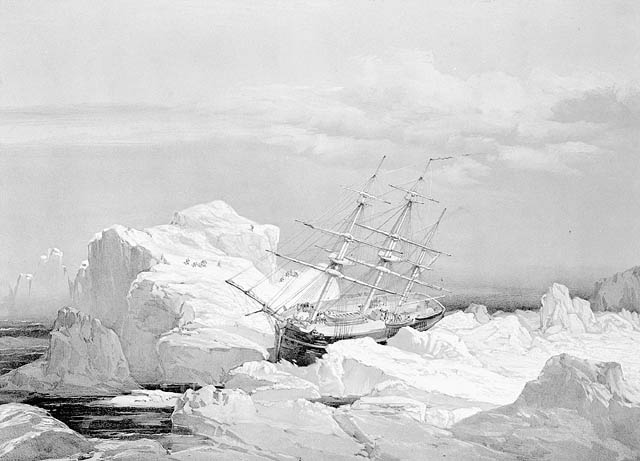
The international news media are hailing the archaeological find of a British naval ship the HMS Investigator on July 25 in an area far north (600 km) of the Arctic Circle that was previously unreachable due to sea ice. The HMS Investigator was abandoned in 1853, but not before sailing the last leg of the elusive Northwest Passage.
From AP/MSNBC:
Captained by Robert McClure, the Investigator sailed in 1850. That year, McClure sailed the Investigator into the strait that now bears his name and realized that he was in the final leg of the Northwest Passage, the sea route across North America.
But before he could sail into the Beaufort Sea, the ship was blocked by pack ice and forced to winter-over in Prince of Wales Strait along the east coast of Banks Island.
From the Hockey Schtick: The ship had been sent on a rescue mission for 2 other ships mapping the Northwest Passage. Now, thanks to “climate change,” archaeologists working for Parks Canada were finally able to plot a small window of time this summer to allow passage to the ship’s location:
Parks Canada had been plotting the discovery of the three ships for more than a year, trying to figure out how to get the crews so far north. Once they arrived and got their bearings, the task seemed easier than originally thought. It took little more than 15 minutes to uncover the Investigator, officials told The Globe and Mail last week. “For a long time the area wasn’t open, but now it is because of climate change,” said Marc-André Bernier, chief of the Underwater Archaeology Service at Parks Canada.
Interesting that the ship was lost in 1853, right at the end of the Little Ice Age, and coincidentally just 3 years after the start of the HADCRU global temperature record, from which we are led to believe the earth has warmed about 0.7C. If we are seeing “unprecedented” global temperatures and changes in Arctic sea ice, how did the HMS Investigator get this far north at the end of the Little Ice Age?
Here’s the location:

Video of the find:
As Steve Goddard pointed out temps have gone down in the Canadian side recently but it is still going to be a nice weekend up there
http://www.weatheroffice.gc.ca/city/pages/nu-25_metric_e.html
http://www.weatheroffice.gc.ca/city/pages/nu-10_metric_e.html
http://www.weatheroffice.gc.ca/city/pages/nu-27_metric_e.html
I definitelty think the northern route of the NW passage might be possible this year, a first as far as I can tell.
Andy
Amundsen’s northwest passage is a bit of history taught in grammar school.
Not everyone is as smart as a fifth grader, evidently.
Copied straight from Bear Grylls website for his up coming Northwest Passage journey.
“1906, Roald Amundsen – First Successful Transit
Norwegian explorer Roald Amundsen raised money, acquired equipment, and bought and outfitted a former 47-ton herring-boat named Gjöa, casting off from Oslo (called Christiania at the time) to the Arctic Sea on June 1903.
The little sailing ship boasted a 13-hp engine, stowed enough food and supplies for five years, and carried an experienced Arctic crew of seven. He completed a three-year voyage, excluding three winters simply trapped in ice.
1906 onwards – Later expeditions
1921 – 1924: Greenlander Knud Rasmussen and two Greenland Inuit completed the first traversal of the Northwest Passage, travelling from the Atlantic to the Pacific, via dog sled.
1940: Canadian officer Henry Larsen was the second to sail the passage, crossing west to east, from Vancouver to Halifax.
1969: the SS Manhattan, a reinforced supertanker sent to test the viability of the passage for the transport of oil, made the passage. The route was deemed not to be cost effective.
1977: sailor Willy de Roos left Belgium and crossed the Northwest Passage in his 13.8 m (45 ft) steel yacht Williwaw, reaching the Bering Strait in September.
1984: the commercial passenger vessel MS Explorer became the first cruise ship to navigate the Northwest Passage.
July 1986: Jeff MacInnis and Wade Rowland set out on 18-foot catamaran Perception on a 100-day sail, west to east, across the Northwest Passage.
July 1986: David Scott Cowper set out from England in a 12.8 m (42 ft) lifeboat, the Mabel El Holland, and survived three Arctic winters in the Northwest Passage before reaching the Bering Strait in August 1989.
July 2003: a father and son team, Richard and Andrew Wood, sailed the yacht Norwegian Blue into the Bering Strait. She became the first British yacht to transit the Northwest Passage from west to east.
May 2007: a French sailor, Sébastien Roubinet, and one other crew member left Anchorage, Alaska, in Babouche, a 7.5 m (25 ft) ice catamaran designed to sail on water and slide over ice. They navigated west to east through the Northwest Passage by sail only.”
So I find it a little mystifying of talk the Northwest Passage could be opening up for the first time. Unless I’m missing something?
Rational Debate says:
August 6, 2010 at 1:21 pm
This is probably the ignorance question of the week… so have mercy folks! :o) Hopefully someone with a better understanding of the geography, currents and ice flows will be willing to address this one and save some of us from having to research it ourselves – but is it possible that rather than managing to sail to where it was found, the ship was trapped in the ice and moved by ice flow a significant distance, to the position in which it was found?
It could have done, indeed this did happen to HMS Resolute, one of the other ships of the expedition which was abandoned to the east. It was salvaged by american whalers as it floated free of the ice about a year or so later, wood from it was used to make a desk which was presented to the President of the US and resides in the Oval Office as I recall.
In this case the ship was abandoned in a bay rather than in the open and we know the exact location, that is where the expedition looked first and is why it only took 20mins to find, it hadn’t moved!
15 Minutes?? to find a sunken ship? It would take that long to climb up to the bridge or down to the sonar room. Obviously the ship got there before human emissions were a concern. How? The Arctic has been solid ice forever until 30 years ago. Excuse my sarcasm.
Phil. says:
August 6, 2010 at 5:34 pm
===============================
Per Wikipedia:
“Three ships of the Royal Navy have borne the name HMS Resolute. A fourth was planned but never completed.”
I doubt President Obama sits behind a desk made from a salvaged wreck.
Check your history.
Concerning the lore about the Chinese fleets of exploration that may have gone all about the world, including to the North Pole, back before China, for some odd reason, withdrew into isolation:
There is Puritan lore which states that, when the Puritans first arrived, there were the hulks of large ships, much larger than the Puritan’s, on the shores of Boston Harbor. They were of little use, (much like the hulks of old schooners you can still see in salt marshes up in Maine,) because the wood was so rotten, but they were a curiosity that made Puritan’s wonder.
Not long before the Puritans arrived a terrible pandemic had wiped out a sort of Pre-Boston, numbering several thousand people, who are described as members of the Massachusetts tribe. They were ruled by a king, and later a queen. We know next to nothing about them, and likely never will learn if China influenced the local Algonquin clans. However there is a slight chance that, buried in the landfill of Boston neighborhoods, the keel of a huge Chinese junk still awaits discovery.
(I wouldn’t try to raise funds to dig up Boston neighborhoods any time soon. People are still in a bit of a bad mood about the last Big Dig.)
Intellectual academics, who have trouble hoisting themselves from the plush, leather armchairs of the Harvard Club, have doubts about whether other people can hoist sails and go on crazy voyages. However I am fortunate, because rather than going to Harvard I went on crazy voyages, and therefore I have no doubts crazy voyages are possible, and crazy weather is possible, including even an ice-free Arctic Ocean in the 1400’s.
Of course “possible” is a very different thing from “established fact.” But it’s a Friday night after a long, hard week, and facts bore me. Therefore I will entertain myself by dreaming up a scene from the ice-free Arctic Ocean in the 1400’s.
Two ships round a point from opposite directions, and spot each other at the same time. One is a huge Chinese Junk, big enough to hold over a hundred sailors. The other is a longboat holding eight Greenland Vikings. As they pass each other the Chinese look down and the Vikings look up, with equally dumbfounded expressions.
I would suggest that you all read The Man Who Ate His Boots a fine history of the search for the NW Passage.
Shorter version: the HMS Investigator was sailing *east* and got entrapped in heavy pack before being abandoned at the *western* entrance to the the NW Passage (well, one of them). It is interesting to read the account of journey of the Investigator in this book. The ship was entombed at Mercy Bay for two winters, in the intervening summer it was unable to move being a captive of the ice. They were saved because of a sledge journey which McClure took in the spring of 1852 in search of a cache (which did not exist) at a place called “Winter Harbor”. The cache did not exist. He did leave a note there and the subsequent year a sledge party found the note left at Winter Harbor and came looking for him.
It is interesting to compare McClure’s experience with the experience of the party which found the wreck of the Investigator this summer. Get your history straight.
Two ships round a point from opposite directions, and spot each other at the same time. One is a huge Chinese Junk, big enough to hold over a hundred sailors. The other is a longboat holding eight Greenland Vikings. As they pass each other the Chinese look down and the Vikings look up, with equally dumbfounded expressions.
——-
My money is on the Vikings!!
http://users.wolfcrews.com/toys/vikings/
When are these people going to run out of straws to grasp?
This report does not say where the ship floundered. When it became ice fast it would have been carried by the moveing ice pack and released when the ice melted to sink where it was found. The time from ice fastness to sinking is not known neither is the position of ice fastness or ice movement between the two events.
Apart from that an interesting report though biased to the AGW theory.
John Marshall : August 7, 2010 at 2:21 am
This report does not say where the ship floundered. When it became ice fast it would have been carried by the moveing ice pack and released when the ice melted to sink where it was found. The time from ice fastness to sinking is not known neither is the position of ice fastness or ice movement between the two events.
It wasn’t frozen into the pack ice in open water — it was trapped in bay ice, which is largely attached to the shore. Bay ice will break into smaller pieces than sea ice due to tidal stresses, so it won’t support a large, heavy object long enough to carry it anywhere.
1853 would have also been during the peak of the AMO.
u.k.(us) says:
August 6, 2010 at 6:30 pm
Phil. says:
August 6, 2010 at 5:34 pm
===============================
Per Wikipedia:
“Three ships of the Royal Navy have borne the name HMS Resolute. A fourth was planned but never completed.”
I doubt President Obama sits behind a desk made from a salvaged wreck.
Check your history.
Perhaps you should, here’s a photo (not photoshopped) of President Obama sitting at the eponymous desk.
http://en.wikipedia.org/wiki/File:Barack_Obama_sitting_at_the_Resolute_desk_2009.jpg
A map & info on known traverses of the northwest passage (and other arctic info) is at
http://www.athropolis.com/map9.htm
Phil. says:
August 7, 2010 at 7:54 am
=========
Thanks for the gracious reply. I realized my error before my hasty (stupid) comment cleared moderation.
I’m still betting the NW northern route will be open this year
http://ice-glaces.ec.gc.ca/prods/WIS56CT/20100802180000_WIS56CT_0005118933.gif
http://ice-glaces.ec.gc.ca/prods/WIS35CT/20100807180000_WIS35CT_0005124008.gif
That will be quite remarkable.
Andy
Well, if you like stories of badass ships crossing the Artic sea, I introduce you to Fridtjof Nansen and his 1893 attempt to reach the north pole in the Fram, a wooden ship he himself designed. Notice how close the ship drifted to the north pole, it’s a pity that they had missed it due to sea conditions:
http://en.wikipedia.org/wiki/Fridtjof_Nansen#Into_the_ice
it is also remarkable that a 19th century wooden ship (not an ice-breaker for clear) had reached that far just drifting through what nowadays is called by some a “50 million year old, one kilometer thick ice block”.
So… the artic ice caps are supposed to be 50 million year old, but a guy in 1893 crossed it in a wooden ship…
AndyW says:
August 7, 2010 at 3:13 pm
I’m still betting the NW northern route will be open this year
http://ice-glaces.ec.gc.ca/prods/WIS56CT/20100802180000_WIS56CT_0005118933.gif
http://ice-glaces.ec.gc.ca/prods/WIS35CT/20100807180000_WIS35CT_0005124008.gif
That will be quite remarkable.
Andy
It looks like it is already.
T Gough says:
August 6, 2010 at 4:02 pm
A few comments – mainly adding to what Peter Walsh has to say (11.52 a.m.)
Amundsen chose voluntarily to spend an extra year at Gjoa Haven in order to learn dog/ sledge handling from the Inuit. There is no apparent reason that the voyage could not have been completed in 2 instead of 3 years.
Except if you read his own account published in 1908 (which I have), where you’ll find that he had no chance of leaving before he actually did. Also he wasn’t there to learn how to handle dogs from the Inuit, if you read the book you’ll see that he spent the time making scientific measurements.