2007: Impassable Northwest Passage Open For First Time In History
2010: Ship find shows Arctic Sea Ice conditions similar to 1853
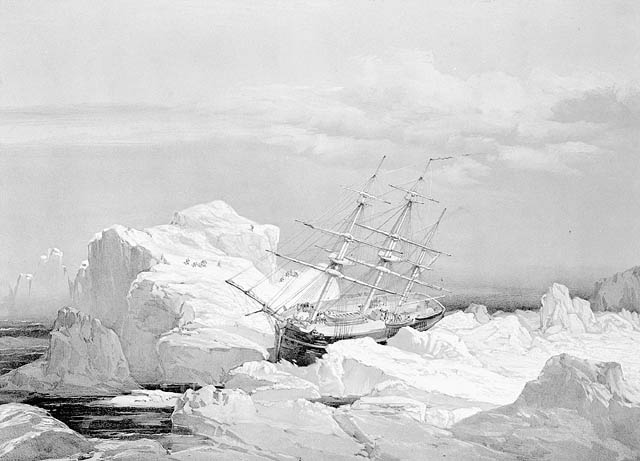
The international news media are hailing the archaeological find of a British naval ship the HMS Investigator on July 25 in an area far north (600 km) of the Arctic Circle that was previously unreachable due to sea ice. The HMS Investigator was abandoned in 1853, but not before sailing the last leg of the elusive Northwest Passage.
From AP/MSNBC:
Captained by Robert McClure, the Investigator sailed in 1850. That year, McClure sailed the Investigator into the strait that now bears his name and realized that he was in the final leg of the Northwest Passage, the sea route across North America.
But before he could sail into the Beaufort Sea, the ship was blocked by pack ice and forced to winter-over in Prince of Wales Strait along the east coast of Banks Island.
From the Hockey Schtick: The ship had been sent on a rescue mission for 2 other ships mapping the Northwest Passage. Now, thanks to “climate change,” archaeologists working for Parks Canada were finally able to plot a small window of time this summer to allow passage to the ship’s location:
Parks Canada had been plotting the discovery of the three ships for more than a year, trying to figure out how to get the crews so far north. Once they arrived and got their bearings, the task seemed easier than originally thought. It took little more than 15 minutes to uncover the Investigator, officials told The Globe and Mail last week. “For a long time the area wasn’t open, but now it is because of climate change,” said Marc-André Bernier, chief of the Underwater Archaeology Service at Parks Canada.
Interesting that the ship was lost in 1853, right at the end of the Little Ice Age, and coincidentally just 3 years after the start of the HADCRU global temperature record, from which we are led to believe the earth has warmed about 0.7C. If we are seeing “unprecedented” global temperatures and changes in Arctic sea ice, how did the HMS Investigator get this far north at the end of the Little Ice Age?
Here’s the location:

Video of the find:
Pablo an Ex Pat may have something, Fed Ex. The ship got there by 10 AM in one day.
That wrecked UK ship is symbolic….she and the UK still waiting for sailing through free waters. Why not trying the good old ways?, those paths only lead to nowhere:
He’s a real nowhere Man,
Sitting in his Nowhere Land,
Making all his nowhere plans
for nobody.
Doesn’t kave a point of view,
Knows not where he’s going to,
Isn’t he a bit like you and me?
Nowhere Man, please listen,
You don’t know what you’re missing,
Nowhere Man, the world is at your command.
He’s as blind as he can be,
Just sees what he wants to see,
Nowhere Man can you see me at all?
Doesn’t kave a point of view,
Knows not where he’s going to,
Isn’t he a bit like you and me?
Nowhere Man, don’t worry,
Take your time, don’t hurry,
Leave it all till somebody else
lend you a hand.
(The Beatles)
A shame its taken WUWT to run this story, as its contradictions make a laughing stock of the warmist agenda.
But hey, perhaps I’m the only one bored with daily Steve Goddard ice stories….
We often see articles citing the “warmest temperatures in 70 years” as proof of “global warming.”
It appears that the inability to think rationally is a key component of belief in AGW.
“Gary Pearse says: August 6, 2010 at 8:32 am
I’m disappointed that my alerting WUWT to this story a week or two ago (?), I believe in Tips and Notes, wasn’t followed up on – you could have scooped the Globe and Mail and others. I made the point that it was found at the western end of the NWP.”
You are the WUWT Investigator. ;~P
Gary Pearse says:
August 6, 2010 at 8:32 am
I’m disappointed that my alerting WUWT to this story a week or two ago (?), I believe in Tips and Notes, wasn’t followed up on – you could have scooped the Globe and Mail and others. I made the point that it was found at the western end of the NWP.
—-
I also posted the story about then to Tips & Notes, but “Fearless Leader” Anthony has, no doubt, been busy maintaining the #1 Science Blog (and, BTW, spending time with his family!) Thanks, Anthony, we know WUWT is quite a time consuming project!
And, we don’t need no stinking Globe and Mail!
Theo Goodwin says:
August 6, 2010 at 8:34 am
From the introduction above:
“If we are seeing “unprecedented” global temperatures and changes in Arctic sea ice, how did the HMS Investigator get this far north at the end of the Little Ice Age?”
They sailed there via the Pacific and the Bering Strait, so they barely entered the passage through the Archipelago at the time of the wreck. A point that doesn’t come through in the account above. McClure and his crew were the first to circumnavigate the Americas following their rescue by sled from the Resolute (the Eastern party) and return to England. Of the combined expeditions only one of the 6 ships survived the Arctic, the crews of the 5 trapped ships returned to England by a supply ship. As I recall there was a controversy arising about the claim of a prize by McClure for traversing the NW Passage.
Isn’t it possible that a ship trapped in floating/moving ice could have been taken northward from there? Just because the wreck is at a location doesn’t mean the event that trapped it began above that spot. If this is the case, then I don’t see the contradiction.
Pugh, Pugh, Barney McGrew, Cuthbert, Dibble and Grub – they have all been that way haven’t they? [Google ‘ Trumpton; if confused]
Or was it Lewis Pugh and Pen Hadow ?
Friday afternoon irony has engulfed me…….
Didn’t a Chinese Admiral [+ massive fleet] pass through the North West Passage in the mid 1400’s?
A lot of the attempts this year seem to have misguided aspirations over reporting the effects of climate change and there are some high profile publicity-seeking attempts as well as adventurous amateurs (often with blogs). I had fun looking many of them up last week for a blog post (here). Interestingly I also found that the minimum ice coverage in the NW passage was 1998 (max. 1978) and the graph 2007 looks to be ranked 5th lowest.
http://vinubuzz.com/hms-investigator-ship-discovered-at-mercy-bay-banks-island-150-years-old-hms-investigator-ship-found-hms-investigator-recovered-ship-pics/
For those wondering whether or not the Investigator has been swept a significant distance northwards in the interim, it was abandoned in Mercy Bay, Banks Island 1853, and found close to the same spot apparently, in Mercy Bay, Banks Island in July 2010.
To put this in clearer perspective could do with some further precise information on whether or not any substantial craft have managed to get through the NW Passage this summer . . – without the use of ice-breaking gear not possess by the Investigator.
Ric Werme (August 6, 2010 at 8:31 am) – it might be Explorers Web (link)
THE INTERNATIONAL BATHYMETRIC CHART OF THE ARCTIC OCEAN (IBCAO)
http://www.ipy.noaa.gov/education/4-Posters/ibcaoposter.pdf
The strait is named M’Clure Strait on this International map.
Look at the floor of the Arctic Basin — a number of the formations look like volcanoes. Maybe it was the Northwest hot tub in 1850.
Usual typos . . here’s that missing “we” . . and also the missing “ed” . . . apologies . . age or something – surfeit of Co2 impairs mental functioning . .!
Just a quibble: “HMS” means “His (or Her) Majesty’s Ship”.
Therefore, when it is written “the HMS Investigator “, it really means “the Her Majesty’s Ship”…makes no sense.
Sorry to be pedantic, but the ghost of my old English teachers won’t let this pass: it is either “HMS Investigator”, or “the Investigator”, but never, never, ever, “the HMS Investigator”.
Its ok, though, the BBC gets this wrong on a regular basis. I tells ya, checking grammar ain’t what it used to be…
Vuk etc. says:
August 6, 2010 at 8:56 am
Greenland becoming green again, though the UK and Europe will not follow the same trend, is this so?
BTW, don’t be mistaken by the current warm temperatures in the northern hemisphere, prepare for harsher winters every passing year.
They forgot the Norse not to mention the Romans. The Norse were seafarers and they hunted on the Arctic Seas, so they were aware of the sea ice. Here are the Greenland temperatures from Ice Core data The temperature at that time was 2C warmer than today. http://jonova.s3.amazonaws.com/graphs/lappi/gisp-last-10000-new.png
Late 16th century world map of the Arctic based on old Icelandic writings shows details of the Arctic including islands. http://www.heritage.nf.ca/exploration/vmap.html
The warm clime enticed Eric the Red:
http://ngm.nationalgeographic.com/2010/06/viking-weather/folger-text
The Norse in Vinland (Canada) http://www.heritage.nf.ca/exploration/norse.html
This article claims soil fertility loss as part of the demise of the Norse in Greenland http://www.archaeology.org/online/features/greenland/
But this scientific paper that actually LOOKED at the soil found it was not true (so what else is new in science by political agenda) The Norse did not leave because of soil erosion or loss of soil fertility. http://pubs.aina.ucalgary.ca/arctic/arctic48-4-324.pdf
Here is information about where the Norse were found:
“..In 1875, members of the British Arctic Expedition under the command of George S. Nares discovered two ancient-looking stone cairns on Washington Irving Island at the entrance to Dobbin Bay, eastern Ellesmere Island, Nunavut, Canada. At least one of these cairns was destroyed by the expedition members to construct their own cairn. The possibility that these cairns were built by Norse voyagers to Kane Basin is supported by the large number of Norse artifacts recovered from Thule culture Inuit sites …” http://journals.cambridge.org/action/displayAbstract;jsessionid=AC7B2F3425B6C9BB79C8C1B9493B2201.tomcat1?fromPage=online&aid=5421640
“…The settlers found that the area to the north of the Western Settlement, called the Nordseta, was good for hunting, fishing and gathering driftwood. A stone inscribed with runes has been found telling that in 1333, three Greenlanders wintered on the island of Kingigtorssuaq just below 73 degrees north. There is also evidence of voyages to the Canadian arctic. Two cairns have been discovered in Jones Sound above 76 degrees North and two more have been found on Washington Irving Island at 79 degrees north….” http://www.mnsu.edu/emuseum/prehistory/vikings/Greenland.html
Rewriting history à la George Orwell’s 1984… so he was a half century off.
Don B says:
August 6, 2010 at 8:16 am
If they want to change history they will need to destroy the Vancouver Maritime Museum where the St-Rock is sitting. They actually built the museum around the boat.
http://www.athropolis.com/arctic-facts/fact-st-roch.htm
“Between 1940 – 1942 the Canadian RCMP (Royal Canadian Mounted Police) vessel St. Roch sailed through the Northwest Passage (Map). It left Vancouver in June 1940, and after spending two winters frozen in the ice, finally docked at Halifax on October 11, 1942. It was the second ship to navigate the passage, and the first to go from west to east.
In 1944, St. Roch returned to Vancouver by way of a more northerly Northwest Passage route – cutting the time down to just 86 days.”
It would seem that the original mission of the St-Rock was to scout for possibly invading and occupying Greenland… http://pubs.aina.ucalgary.ca/arctic/Arctic46-1-82.pdf
What if the Southern Passage froze up?
http://www.bloomberg.com/news/2010-08-03/argentina-colder-than-antarctica-spurs-record-power-imports-shuts-plants.html
Argentina is importing record amounts of energy as the coldest winter in 40 years drives up demand and causes natural-gas shortages, prompting Dow Chemical Co. and steelmaker Siderar SAIC to scale back production.
Frozen Cape horn? 56 degrees south?
If they start finding WWII planes near that site, I’m going back to church.
With all due respect to HockeySchtick, McClure and the “Investigator” never sailed “the last leg” of the Northwest Passage. He is credited with discovering it, but was unable to traverse it himself after being thwarted by pack ice for four summers. Why, then is he credited with discovering it? Because after getting iced in in the fall of 1850, he took a sledge party north to the north end of Banks Island, climbed a mountain, and was able to fill in the unexplored gaps in the map of that part of the Canadian Arctic. He ultimately did traverse the Northwest Passage over the next three years, but not without traveling over land and being forced to abandon not just his own ship, but two ships that came to rescue him. By no means did he sail it on his own.
Amundsen’s trip in the early 20th century took three years, similarly beset by pack ice, which forced him to spend a couple winters trapped in pack ice. Even then, he was unable to traverse the northerly deep-water route we traditional think of as the Northwest Passage, but rather took some shallower routes to the south.
The difference between those expeditions and the summer of 2007 was that in 2007, all of the ice in the northern deep-water passage melted out completely, as did all the ice to the south, and stayed that way for about a month. This year the ice will probably not melt quite to that extent, but already this year the Northwest Passage is almost free of ice. If Amundsen or McClure or Franklin were to sail their expeditions again today, there would be no need to mount any recovery efforts, and they would not get stuck in pack ice for two or three winters.
For more on Robert McClure:
http://biography.yourdictionary.com/sir-robert-mc-clure
I guess we should assume that amplitudes of temps differ across the globe therefore it could be warmish up there but cooler at Dallas???
Pamela Gray says:
August 6, 2010 at 10:12 am
If they start finding WWII planes near that site, I’m going back to church.
http://en.wikipedia.org/wiki/Kee_Bird
Yachts going through the Northwest passage unaided
From:
http://www.norwegianblue.co.uk/history.htm
In 1977 the Belgian sailor Willy de Roos and his steel ketch ‘Willywaw’ became the 3rd yacht to go through, largely single handed.
To date (2003), only 20 yachts have ever completed the NWP, of these 14 made it through in one season, and fewer than 10 (including ‘Norwegian Blue’), without ice breaker assistance.
The first and until now, only British yacht to have completed the Passage was Rick Thomas’ ‘Northanger’. He sailed her East to West, overwintering in Inuvik in 1988. He was closely followed by David Scott Cowper in his converted British lifeboat ‘Mabel E Holland’. It took David 4 seasons to complete his transit, having suffered three consecutive bad ice years.
On 18 July 2003, father and son team, Richard & Andrew Wood with Zoe Birchenough sailed ‘Norwegian Blue’ into the Bering Strait which marks the entrance to the NWP. Exactly two months later, in what proved to be a very difficult ice year and without ice breaker assistance, she sailed into the Davis Strait to become the first British yacht to transit the Northwest Passage from West to East. She also became the only British vessel to have completed the Northwest Passage in one season.
The ‘Norwegian Blue’ crew were happy to have spent the last few weeks of their time on ice in the company of Eric Brossier’s ‘Vagabond
‘ and his fantastic crew. Of a record seven attempts at the NWP in 2003, ‘Vagabond’ & ‘Norwegian Blue’ were the only two yachts to successfully complete their transit. Both were fortunate enough to have been in the right place for the one day of the year the ice opened in Larsen Sound & Franklin Strait, traditionally the most difficult part of the NWP.
On 10 October 2003, having set out from New Zealand only five months earlier, Zoe & Andrew sailed ‘Norwegian Blue’ into St Mary’s Harbour in the Isles of Scilly, having covered over half the globe via one of the world’s most challenging and difficult sea routes… The Northwest Passage.