2007: Impassable Northwest Passage Open For First Time In History
2010: Ship find shows Arctic Sea Ice conditions similar to 1853
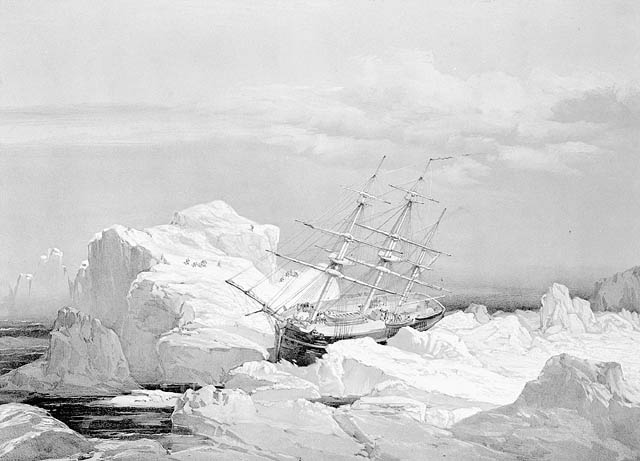
The international news media are hailing the archaeological find of a British naval ship the HMS Investigator on July 25 in an area far north (600 km) of the Arctic Circle that was previously unreachable due to sea ice. The HMS Investigator was abandoned in 1853, but not before sailing the last leg of the elusive Northwest Passage.
From AP/MSNBC:
Captained by Robert McClure, the Investigator sailed in 1850. That year, McClure sailed the Investigator into the strait that now bears his name and realized that he was in the final leg of the Northwest Passage, the sea route across North America.
But before he could sail into the Beaufort Sea, the ship was blocked by pack ice and forced to winter-over in Prince of Wales Strait along the east coast of Banks Island.
From the Hockey Schtick: The ship had been sent on a rescue mission for 2 other ships mapping the Northwest Passage. Now, thanks to “climate change,” archaeologists working for Parks Canada were finally able to plot a small window of time this summer to allow passage to the ship’s location:
Parks Canada had been plotting the discovery of the three ships for more than a year, trying to figure out how to get the crews so far north. Once they arrived and got their bearings, the task seemed easier than originally thought. It took little more than 15 minutes to uncover the Investigator, officials told The Globe and Mail last week. “For a long time the area wasn’t open, but now it is because of climate change,” said Marc-André Bernier, chief of the Underwater Archaeology Service at Parks Canada.
Interesting that the ship was lost in 1853, right at the end of the Little Ice Age, and coincidentally just 3 years after the start of the HADCRU global temperature record, from which we are led to believe the earth has warmed about 0.7C. If we are seeing “unprecedented” global temperatures and changes in Arctic sea ice, how did the HMS Investigator get this far north at the end of the Little Ice Age?
Here’s the location:

Video of the find:
NSIDC implied in their recent newsletter that multi-year ice didn’t used to melt.
If that were true, McClure would have run into ice many thousands of years old and many hundreds of feet thick.
History is short nowadays. It’s just a ‘shtory’.
Parks Canada must justify its grant… and the ever green propagandist Globe and Mail to oblige in the PR…
So, even though open water in the Arctic is unprecedented,
1. The British sailed there in 1853
2. Norwegians sailed the Northwest Passage in 1903.
http://en.wikipedia.org/wiki/Roald_Amundsen#Northwest_Passage
3. Canadians crossed the Northwest Passage both ways in 1940-42 and 1944.
http://www.ucalgary.ca/arcticexpedition/larsenexpeditions
How did they get there in 1853 ?
Fed – Ex ?
“…and in the foreground rope and canvas…”
Rope and canvas from a ship which sank in 1853 – extraordinary. The rest of the ship’s timbers and fittings look like they are in amazing condition too, especially the copper sheeting.
I guess it was teletransported from a teleconnected site further south.
so increase in CO2 that supposedly has warmed the globe since 1853 when the last ship was there. The fact that a ship made it that far in 1853, and then couldn’t until now means that it has to be natural cycles at work.
False claims again?
And what made them want to try? It couldn’t have been a single year of low ice; it would have taken many years to convince people to make an attempt. It’s quite possible that it would have been more successful had they sailed the year before. They may not have gotten ready until the ice was getting worse again.
I am at a loss for words. BIG AGW and its propagandists are never at a loss for words. I paraphrase: “Vessels fitted for the Arctic reached the location of a sailing ship that was lost to the ice in 1853. They were able to do this only because of global warming.” Embracing glaring self-contradiction is one way to never be at a loss for words.
Also in the news from Slashdot for 2007:
“Recently released evidence is showing the North Pole ice is melting at the highest rate ever recorded. As a result, the Pole may be completely ice-free at the surface and composed of nothing but open water by September. ”
http://science.slashdot.org/article.pl?sid=07/09/15/2023212
Why am I not surprised that so many people seem to think the world was completely unchanging until after they were born?
It took little more than 15 minutes to uncover the Investigator, officials told The Globe and Mail last week.
I don’t understand the significance of this. I once saw the crew of the F/V Northwestern fabricate a drag hook and find an anchor they lost on the first try, with no buoy attached. What is the significance of how long it took to find it? It seems as though it is being linked to climate change, but like the Northwestern’s situation, I would be more inclined to call it luck.
As to the HMS Investigator, that is an interesting story. I am pretty sure Dr. Evil’s big oil submarine towed it there from Bermuda.
Hey Antony,
it looks like this time I got you!
http://www.climatemonitor.it/?p=11973
🙂
I can’t find a site that last year kept track of some of the NW passage crossing last season.
I did come across a report saying about 50 boats are going to attempt the passage, not all of them up to the hazards. From http://www.nationalpost.com/news/Thrills+chills+rescue+bills+Northwest+Passage+luring+poorly+equipped/3364836/story.html :
Freshly navigable after confounding sailors for centuries, the Northwest Passage has suddenly become a tourism draw for the inexperienced, creating a dangerous and expensive burden for the Canadian Coast Guard.
“Last year, which we thought was a big season, at this time of the year we had something like 30 ships in the Arctic waters. This year we have something like 50 vessels, which is a lot. This doesn’t even include the adventurers from the pleasure crafts and we expect a lot of calls from those guys,” said Jean-Pierre Lehnert, the officer-in-charge of marine communications and traffic services in Iqaluit.
…
The mounting number of inexperienced adventurers navigating through Arctic ice and water will lead to a rise in public funds used to rescue them considering an icebreaker dispatch can range upward of $25,000, Mr. Lehnert said. He recalled one of several rescue missions last year that required the combined efforts of a Coast Guard station, Environment Canada and an icebreaker to help free a Seattle man’s pleasure craft from an ice jam.
“He was really panicking because the ice was putting pressure on his boat and he was getting really scared,” said Mr. Lehnert. The man and his two friends were freed soon after; a weather specialist helped steer them through ice that had coincidentally broken due to high winds.
Shouldn’t things like this be causing cognitive dissonance among the CAGW crowd? Warming is unprecedented and the opening of the Northwest Passage is proof, except that we found a ship from 150 years ago where it could only have been if the Northwest Passage was open which must mean that it was warmer then….
To paraphrase Lewis Carroll:
When I use a fact… it means just what I choose it to mean—neither more nor less.’
‘The question is,’ said Alice, ‘whether you CAN make facts mean so many different things.’
‘The question is,’ said Humpty Dumpty, ‘which is to be master—that’s all.’
I’m disappointed that my alerting WUWT to this story a week or two ago (?), I believe in Tips and Notes, wasn’t followed up on – you could have scooped the Globe and Mail and others. I made the point that it was found at the western end of the NWP.
From the introduction above:
“If we are seeing “unprecedented” global temperatures and changes in Arctic sea ice, how did the HMS Investigator get this far north at the end of the Little Ice Age?”
OK, I’ll bite. In 1853, the ship had wheels and travelled on water, land, or ice. It was sailing along nicely on the smooth and thick Arctic Ice of Ancient Age when it fell in a hole in the ice. The crew was found to be permanently pickled.
Notice the amount of seamoss and other plants that have enveloped the ship. This would not happen if temperatures were too cold and ice was blocking sunlight all year round. Therefore a lot of ice must have thawed many times in the last 157 years.
The true believers in IPCC CAGW will have no problem dealing with this blasphemous paradox. After all, if they can believe that a small amount of CO2 can cause the world to become an hot house, believing that a ship somehow found itself stuck in the middle of solid ice in 1853, is easy!
It got stuck hundreds of miles away from that point in ice that moved further and further North?
Later in 1848, she accompanied Enterprise on James Clark Ross’s expedition to find the missing Sir John Franklin. Also aboard Investigator on this expedition was the naturalist Edward Adams. She was commanded for the return voyage by Robert McClure,[5] but became trapped in the ice, and was abandoned on 3 June 1853[1] in Mercy Bay, where she had been held for nearly three years. The following year, she was inspected by crews of the Resolute, still frozen in, and reported to be in fair condition despite having taken on some water during the summer thaw.
http://en.wikipedia.org/wiki/HMS_Investigator
Words fail me.
Dorlomin, I would suggest that you might wish to stop referring to me as an “astrologer” in places like CIF.
Your childish behavior is not appreciated. – Anthony Watts
Greenland’s Farmers Welcome Global Warming
Sky News visited a sheep farm in Qassiarsuk, where the Vikings first set foot when they colonised this land. The business is run by young Greenlandic farmer Joorut Knudsen, 29, who took over from his father four years ago. He told us he had more than doubled the size of the farm since then, and if the weather conditions continue to improve he planned to do at least the same again.
“It is warmer,” he said. “It would help us if it (got) warmer and warmer in South Greenland so we could have more farming.
http://news.sky.com/skynews/Home/World-News/Greenland-Climate-Change-Offers-Hope-For-Farmers-Rising-Temperatures-Helps-Grow-Local-Produce/Article/201008115678015?f=rss
http://news.sky.com/skynews/Home/World-News/Greenland-Climate-Change-Offers-Hope-For-Farmers-Rising-Temperatures-Helps-Grow-Local-Produce/Article/201008115678015?f=rss
Try reading the account of the Investigator’s voyage into the Arctic and comparing that description with today before assuming the conditions were comparable. There’s a potted account on Wikipedia.
Ah, but you see… this time the melt cannot be explained by solar, volcanic or aerosol forcings, so this time it must be CO2. This is precisely what the pro-AGW crowd will conclude.