Supposedly Mark Twain once asserted: “The coldest winter I ever spent was a summer in San Francisco.” This July was cold, and Twain’s quote? Well, read on.
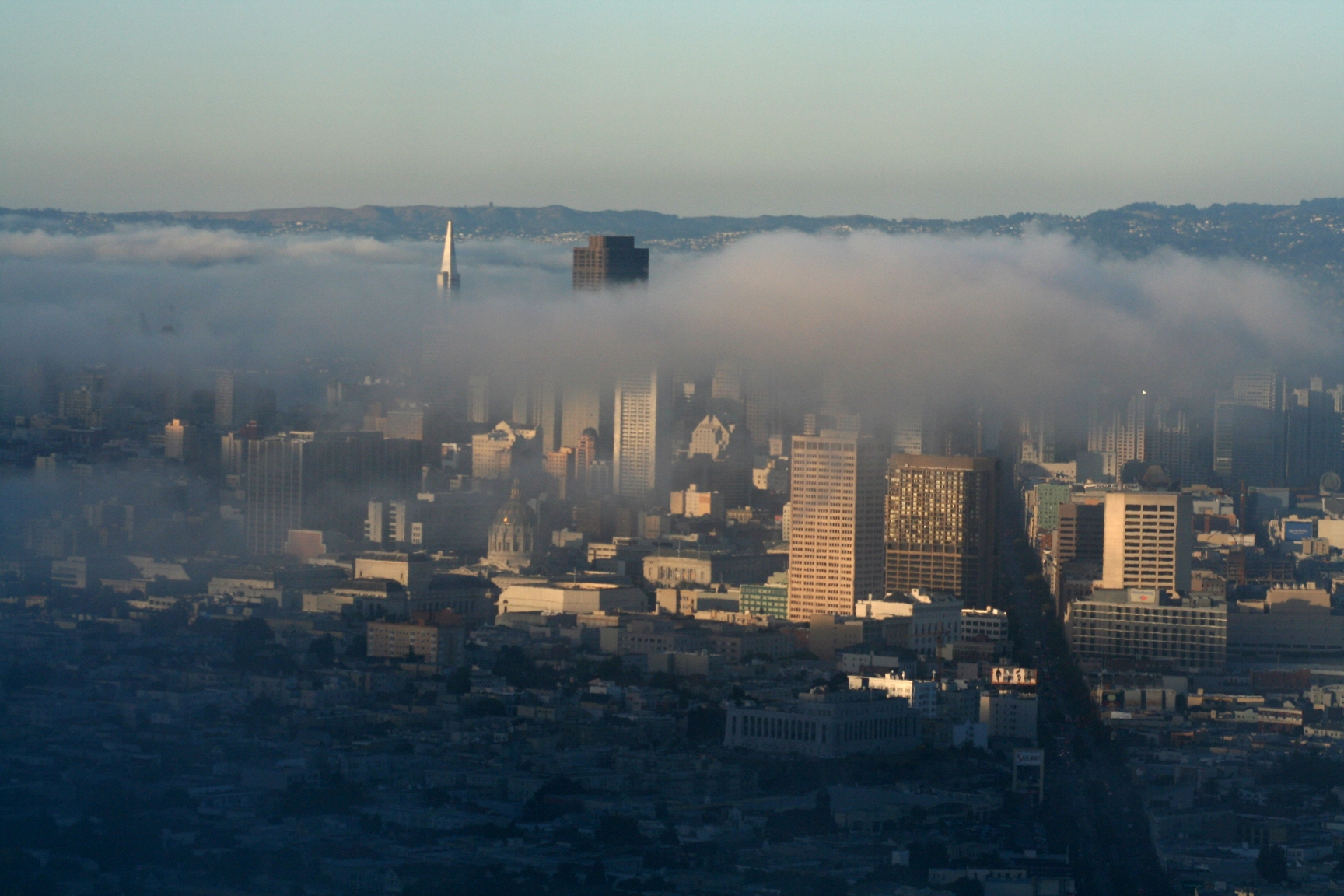
My friend Jan Null, former lead forecaster for the NWS in California, is now runs a private forecasting and forensic weather services business. He sends out regular emails with note of interest. Here is one of them:
With an average monthly maximum July temperature of just 63.1 degrees, San Francisco had its coolest July since 1971 and the 13th coolest in the past 97 years. Only one day reached the 70 degree mark (72 degrees on 7/3 and no day after the 17th exceeded 64 degrees.
Downtown San Francisco, CA
Average July monthly maximum temperatures
(See table below)
| Rank | Year | Avg. Max (°F) |
| 1 | 1962 | 60.52 |
| 2 | 1951 | 61.13 |
| 3 | 1944 | 61.55 |
| 4 | 1956 | 61.90 |
| 5 | 1965 | 61.94 |
| 6 | 1914 | 62.06 |
| 7 | 1955 | 62.52 |
| 8 | 1971 | 62.68 |
| 9 | 1919 | 62.90 |
| 10 | 1949 | 63.00 |
| 11 | 1968 | 63.00 |
| 12 | 1950 | 63.03 |
| 13 | 2010 | 63.10 |
| 14 | 1970 | 63.13 |
| 15 | 1969 | 63.29 |
| 16 | 1938 | 63.32 |
| 17 | 1982 | 63.32 |
| 18 | 1960 | 63.39 |
| 19 | 1958 | 63.55 |
| 20 | 1981 | 63.71 |
| 21 | 1966 | 63.81 |
| 22 | 2000 | 63.84 |
| 23 | 1953 | 63.87 |
| 24 | 1943 | 63.90 |
| 25 | 1952 | 63.94 |
| 26 | 1967 | 63.94 |
| 27 | 1978 | 64.06 |
| 28 | 1920 | 64.10 |
| 29 | 1945 | 64.13 |
| 30 | 1976 | 64.23 |
| 31 | 1973 | 64.32 |
| 32 | 1937 | 64.39 |
| 33 | 1928 | 64.42 |
| 34 | 1939 | 64.42 |
| 35 | 1975 | 64.52 |
| 36 | 1999 | 64.55 |
| 37 | 1964 | 64.61 |
| 38 | 1942 | 64.68 |
| 39 | 1924 | 64.71 |
| 40 | 1927 | 64.77 |
| 41 | 1948 | 64.87 |
| 42 | 1980 | 64.87 |
| 43 | 1941 | 64.94 |
| 44 | 1977 | 64.94 |
| 45 | 1930 | 65.06 |
Jan Null
Certified Consulting Meteorologist
Golden Gate Weather Services
Webpage: http://ggweather.com
===================================
About the Twain quote: Snopes.com reports that he never said it.
Something in the Bee this last Sunday related to this;
Mild weather, summer breezes keep ozone low
How do you like “Spare the Air” days as climate marker?
See the graphic Fewer Bad-Air Days for Sacramento. Annual total bad air days by year from 2001-2010.
I hate it when reports of the “Hottest Year In The History Of The Planet” are interrupted by reality.
GM says:
August 2, 2010 at 9:54 pm
Now let’s rank the values you posted by year (I would love to have the full dataset, but this is more than enough):
…So out of the 45 coldest years (which is probably 1/3 of the dataset) only 5 (1/9th of them) are in the last 30 years….
______________________________________________________________________-
It is a coastal city , influenced by the ocean so what is the pacific ocean doing?
SEE Graphs
Prediction:
graph 2
However the San Francisco temperature record seems to exhibit a heat island effect when compared to the records of less populated areas.
Yosemite Park headquarters
Independence
Electra
You should lead off with “NOAA once again shows that this year is not breaking the trend of lower global average temperatures” then give the anecdote “for example, in SF, it’s been an unusually cold July.” Go from the broad data set to the sample, so as not to appear to be cherry-picking. I mean, unless the larger data set stands in your way.
Over here in Perth, Western Australia, the month of July had average minimum daily temperatures of 5.9C as against the long term average minimum for July of 7.8C, almost 2 whole degrees less! Mean maximums were “normal” with the July just gone averaging 18.2C compared to long term average of 18.3C.
Similar for June 2010 – average min of 7.1C compared to long term average of 8.4C but average maximum was 19.0C compared to long term average of 19.3C.
Hang on just a minute, those temperatures haven’t been homogenized yet !! Im sure once they are properly processed they will be the 3rd hottest on record.
What would the real temperature be if a correction was made for the UHI?
The weather in SF is mainly a function of wind direction. When the winds blow onshore, it is cool and gloomy. When the winds blow offshore, it can get hot. San Francisco’s hottest days are generally September and October when we get the wind from the East and the downslope winds from the Sierra warm things up.
That said, I live a ways South (about 50 miles) from SF and have a coastal range of mountains between me and the coast (Santa Cruz mountains). We are generally warmer than SF and not as influenced by the coastal marine layer. Not this year. It has been cool and gloomy in the mornings with a late burnoff of marine layer of clouds/fog in the mornings. Temperatures have been below normal even here. But again, we haven’t had any strong Easterly winds to push the temperatures up either.
We will see how it goes in the fall.
Don E: that sounds like west of Scotland weather. Or do I mean climate?
Anthony: Brits read this and don’t assume anything, least of all units of measurement. Please specify your units, °F in this case. We’d like it even better if you could summon the energy to be ‘global’ about this and use °C (maybe as well rather than instead of). More work, I know. Just asking.
Gail Combs:
You can not compare SF with Electra or Yosemite or especially Independence. Those cities are in completely different climactic regions. Yosemite Park HQ is in a valley in the Sierra Nevada mountains. Electra is in “gold country” also in the Sierra foothills. Independence is on the other side of the Sierras near the Nevada border.
One would have to compare San Francisco with places like Half Moon Bay, Santa Cruz, and Bodega Bay. You will want to compare other coastal areas to make sure you get apples to apples.
Dang spellcheck, meant climatic … jeez.
I’ve been saying it was cold here…
Today I ripped out one of my tomato plants. Type name was “San Francisco Fog” and was supposed to be cold tolerant. The Siberian was making tomatoes, but not the SF Fog. Guess we are “Siberia” cold now 😉 That’s what I’ll be growing from here on out (along with the similar “Siberia” variaety). Of interest, the Roma planted next to the Siberian is also making fruit, but with only a few seeds. I think the Siberian is acting as a cold pollinator. (It’s pollen grain growth that’s limiting in the cold…)
@GM: If you had a point, a long list of numbers showing this year was cold, and about as cold as other Way Cold years, didn’t seem to say much other than: Its COLD.
Oh, and I’m sure we’ll have LOTS more cold years going forward now that the PDO is flipped back to ’70s mode’ and the sun is on vacation.
@Tom: SFO has water on three sides and frequent winds. It’s the odd day that has smog build up at all. (It generally all gets blown down the peninsula to where I live 🙁 or gets sent over to Oakland… ) So most of the time SF temps match the water temps plus solar heating minus wind speed… Smog need not apply.
@crosspatch: We’re probably not too far apart. I’ve had it be 103 F down here and 55 F under the fog in SF. Shocking when you leave here for there and forget to take a coat. Now anytime we head to SF, we put a coat in the car. And this year I’ve had overcast until late morning, then back again at near sundown. Dank and cold.
To those folks kvetching about the use of F: It’s what we do here. To convert it to C Anthony would have to change the published data and take precision errors. F is more precise than C, so something would be lost in the conversion. How about you learn to be multi-lingual in temperatures? We are… I use C, F, K, and even R sometimes. Depends on what works best. And F works just fine. BTW, the “traditional” units were not as slap-dash has legend leads you to think.
Take the planetary circumference in feet at the equator (131479724.6). Divide by (360 x 1000).
Recognize the number?…
http://chiefio.wordpress.com/2009/06/06/chasing-the-greek-foot/
Mark a circle on the ground and put a stick in the ground at the perimeter aligned with a star rising at the horizon. Put another stick 15 degrees away (you can do that without advanced tools…). Time the transit of a star from the first stick to the second with a pendulum. Count 3600 beats. Lengthen or shorten until it is exactly 3600. Congratulations. You have a 1 Rod measure. You can create this length standard anywhere with 2 sticks and a bit of string…
http://chiefio.wordpress.com/2009/06/13/making-an-english-foot/
The old units are Just Fine. And I’ll be able to recreate them anytime I want without any government body and without doing a survey of France… and getting it a bit off (the M is a bit off, but you knew that already…)
The point of the post was to show that the original post was dishonest, which should be obvious to
[snip — behave politely or take it elsewhere ~ ctm]
because I have figured our a long time ago that there is nothing to gain from that as the only weapon I as a scientist have are facts and logic and it is impossible to argue with facts and logic with people who do not see any value in those. And I am not a climatologist myself but I happened to come here by chance and I was about to scream in horror when I saw that post, so obvious is the hole in the argument. I can imagine how a climatologist would feel…
Anyway, yes, that’s the current temperatures in San Francisco maybe relatively cold. And what this means is precisely that – it’s cold in San Francisco and it hasn’t been very hot in Southern California where I am either . Which is only relevant to the argument about global climate change as far as the contribution of California to the global annual temperatures goes. Which is very small.
The same is true for the US as a whole. Another recent post was showing the map of the US and the how “cold” it is in the southern parts – that the northern part of the US are hotter than usual and that the whole of Canada is much hotter than usual was left out. Not that those on their own prove that there is warming, but this blog seems to only focus on the colder than usual regions, I wonder why.
The worst thing is that these same tactics have been beaten down to death repeatedly, yet nobody seems to listen…
That’s why Al Gore bought his apartment there by the sea, it’s safe from that terrible global warming and the 100ft sea rise
The only logical explanation is that the State of California’s efforts to reduce CO2 emissions are working! NOT.
[Snip again. Not remotely comparable, and your screed was for worse than the use of single word. If you are unable to engage in courteous discourse you do not belong here. If you do not grasp the complete context, give yourself a few months to catch up. And please, spare us links to realclimate. You’ll notice the factual points of your comment were left intact, which is something you are unlikely to find elsewhere. It is also unlikely to continue here as editing your posts to conform to blog policy (and writing responses, such as this) is far more work than the moderators would like. So, in the future, if you continue with your lack of decorum, it is likely your comments will be deleted in their entirety. ~ ctm]
“The whole of Canada” was most certainly not “hotter” than usual. Unless, as some Torontonians seem to believe, Toronto is suddenly the whole of Canada.
It’s COLD in the west. Stupidly cold. We’ve had a few days with high peak temps that are rapidly cooled in the late afternoon. We’re a month late on our usual weather patterns. We are missing summer, and this bodes ill for the winter to come.
Whatever you’re yapping about (GM) that’s getting you snipped, your accuracy certainly seems to be lacking as well. I’m not hearing anyone in BC, Alberta, Saskatchewan or Manitoba talking about “hot”, and that’s half the country.
At a latitude of 46°37’30.000″ N, Sudbury Ontario had an average max of 27.1 C, which is around 80.8 F, for July 2010. We have had a nice warm dry summer here unlike last July which was cold and wet. Our July 2009 average max was 21.5 C (70.7) which is closer to San Francisco’s temperature this July. — John M Reynolds
Codetech: We in Toronto do not believe we are the whole of Canada—we are the centre of Canada!
Here we’re having an average summer, and much better than last year. A few hot days, some humidity, generally just the way I remembered them. If NOAA or GISS shows that it was abnormally high in July, I’ll know the fix is definitely in.
Huth
Are you based in Scotland?
Eddie
I think that the most accurate thing that can be said from the (partial) dataset is that the average July temperature for San Francisco is in the range of 60-65 deg. F and has been in that range for a century.
Can we really believe these numbers?? I thought in order to get an accurate temp reading for any location, your supposed to 1200 miles away! I’m so confused!
eddieo 5.25am
Scotland, yes.
How did u guess?
Been wondering why global warming wasn’t noticeable here. With WUWT now I understand.
Huth
The local meteorologist for Redding was heard to remark that it is ‘very unusual’ to have a delta breeze in the forecast for 2 weeks straight. He normally gets the charts for that phenomenon out a couple of times per year.
So, the Delta Breeze coming in through SF is stuck in the ‘ON’ position.
Just like the last 3 years, where weather patterns get stuck. Same story with the recalcitrant Sun.
Yes, I do blame these stuck phenomena on the Sun.
GM,
you are new here. so, i understand your consternation.
everyone here DO believe weather is not climate. you will find that out, as you read the posts here for a while.
this post does not stand on it’s own. It is part of a complaint about the MSM. MSM has been talking up “hot Moscow”, and ignoring “Cold Siberia”. and MSM did not talk about “cold South America”, where there were snow on the beaches of Northern Argentina, which generally does not see snow.
MSM has been making a big deal out of Hot NY/Wash.DC/Phila,PA etc. but ignoring cold SanFran etc. That is what this post was about.
Context , my friend, is quite important