By Steve Goddard
The Arctic is proud to have been listed as one of many “fastest warming places on earth.”
The GISS 250km Arctic image below shows temperature trends from 1880-2009. Areas in black represent regions with no data.

In most fields of science, data is considered an essential element of historical analysis. But climate science gets a pass, because it involves “saving the planet.” Antarctic coverage is equally as impressive. The image below looks right through the earth to the Arctic hole.

Temperatures in the high Arctic have been running well below normal and have started their annual decline. There are only about 30 days left of possible melt above 80N.

http://ocean.dmi.dk/arctic/meant80n.uk.php
This can be seen in North Pole webcams which show the ice frozen solid.

http://psc.apl.washington.edu/northpole/webphotos/noaa2.jpg

As forecast in last week’s sea ice news, ice loss accelerated during the past week over the East Siberian Sea due to above normal temperatures.

http://ocean.dmi.dk/arctic/icecover.uk.php
The modified NSIDC map below shows (in red) regions of the Arctic that have lost ice over the past week.

The modified NSIDC map below shows (in red) ice loss since early April.

The modified NSIDC map below shows (in red) ice loss since July 1. The Beaufort Sea has actually gained ice (green.) Looks like a Northwest Passage traverse is quite possible (by helicopter.)

Ice loss from July 1 through July 23 has been the slowest on record in the JAXA database. Ice loss during July has been about one half that of 2007.

The graph below shows the difference between 2010 and 2007 melt. 2010 started the month half a million km² behind 2007, and is now half a million km² ahead of 2007.

The modified NSIDC image below shows the difference between 2007 ice and 2010 ice. Green indicates more ice in 2010, red indicates less.

“Climate expert” Joe Romm reported in May
Arctic sea ice shrinks faster than 2007, NSIDC director Serreze says, “I think it’s quite possible” we could “break another record this year.” Watts and Goddard seem in denial
Average ice thickness continues to follow a track below 2006 and above 2009, hinting that my prediction of a 5.5 million km² minimum continues to be correct.

During July, ice movement has been quite different from 2007 – which had strong winds compressing the ice towards the pole. By contrast, July 2010 has seen winds generally pushing away from the pole. Thus the ice edge on the Pacific side is further from the pole. No rocket science there, and a pretty strong indication that the alleged 2007 record summer melt was primarily due to wind.
Cryosphere Today showed two days ago that Arctic Basin ice is nearly identical to 20 years ago, but unfortunately their web site is down and I can’t generate any images.
NCEP forecasts warm temperatures in the East Siberian, Chukchi and Beaufort Seas for the next week, so I expect that melt will continue around the edges of the Arctic Basin.
Meanwhile, Antarctic ice continues well above normal. Antarctica is also the fastest warming place on the planet.
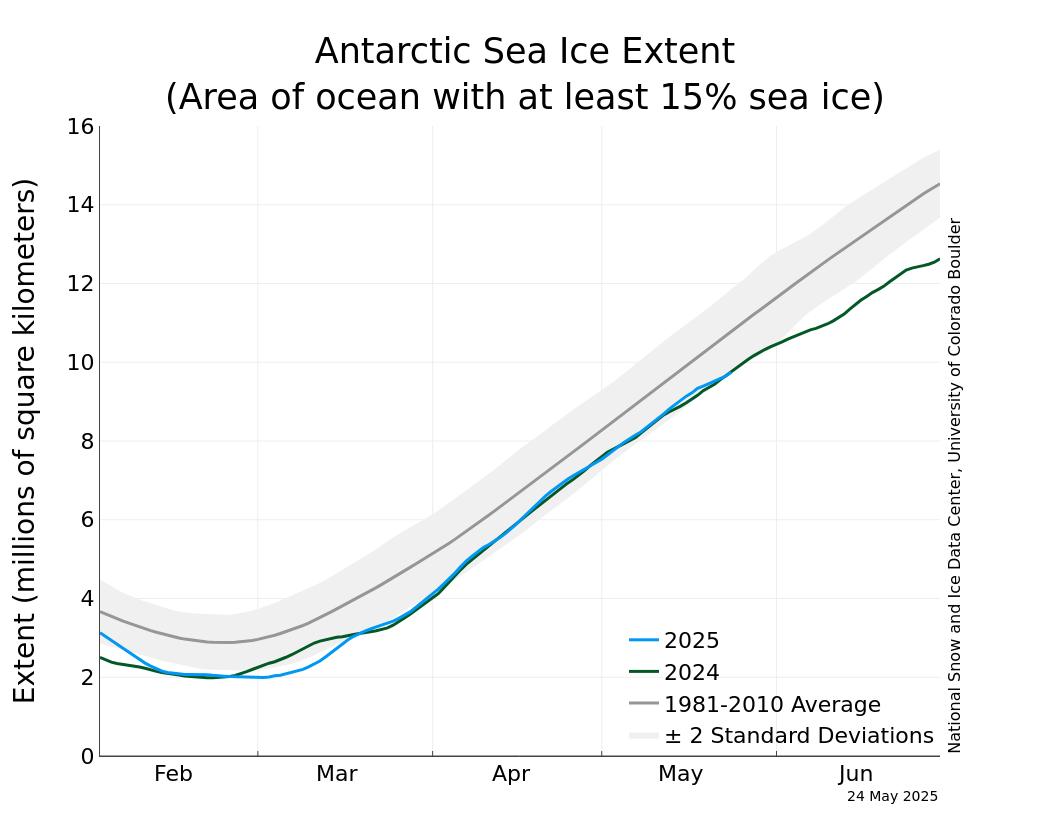

Conclusion: There is no polar meltdown at either pole.
Next week we start comparing PIOMASS forecasts vs. reality. PIOMASS claims that Arctic ice is the thinnest on record.

============================================
Don’t forget to bookmark WUWT’s new Sea Ice Page
Sponsored IT training links:
Subscribe for 350-030 training and get up to date 70-649 materials with 100% success guarantee plus get free demos for 220-701 exam.
steveW says:
July 25, 2010 at 5:45 pm
R. Gates says:
July 25, 2010 at 4:35 pm
This is very funny. The summer Arctic Sea ice has been melting faster in the past few years then GCM’s projected it would based on AGW, and so if, and this is a huge IF, but if it somehow returns to melting as fast as GCM’s said it should based on AGW (i.e. disappearing by 2070 to 2100), then this somehow disproves the AGW hypothesis. Now, that’s funny stuff…
———————————————————————————
The “increased” melting rate does not disprove the AGW theory. But it does point out the unreliability of the results of the GCM’s. It shows that the natural processes are not well modeled.
___________
Indeed, and those natural processes include feedback loops, both positive and negative. With continued forcing from CO2, it is possible that tipping points, quite natural and deterministic but unpredictable shifts in Arctic Sea ice behavior, could be reached where the system seeks a new equilibrium point. These are indeed the great unknowns. GCM’s cannot possibly predict tipping points as the Arctic system is a chaotic and complex system.
Billy Liar says:
July 25, 2010 at 5:09 pm
http://ice-glaces.ec.gc.ca/prods/WIS38CT/20100725180000_WIS38CT_0005101570.gif
Hmm, your map is showing areas BELOW where most people consider the NWP;
Billy Liar says:
July 25, 2010 at 5:09 pm
Rob Vermeulen says:
July 25, 2010 at 2:40 pm
‘Yes, the NW passage is almost open and should be within a few weeks. Same for NE passage. See This detailed map
http://arctic.atmos.uiuc.edu/cryosphere/NEWIMAGES/arctic.seaice.color.000.png‘
Not very detailed map! I think you need this one:
http://ice-glaces.ec.gc.ca/prods/WIS38CT/20100725180000_WIS38CT_0005101570.gif
The last fast ice in this section broke up about two weeks ago.
where you will see that the NWP is far from open; there is a large gray area of fast ice.
Oops, bad cut and paste above, here’s the NWP via MODIS imagery;
http://rapidfire.sci.gsfc.nasa.gov/realtime/single.php?2010205/crefl1_143.A2010205192000-2010205192500.250m.jpg
The last fast ice in this section broke up about two weeks ago.
JJB says:
July 25, 2010 at 5:46 pm
R. Gates, you are completely right that Steve is focusing on weather rather than climate. I should have caught on sooner that’s what he’s doing here, and trying to pass it off as climate. Looking at the many open water areas that have developed the last couple of weeks under the central Arctic low sea level pressure, and now the upcoming shift back towards a more dipole pattern, I bet the September 2010 ice extent will drop far below his predicted 5.5 million sq-km.
__________
I’m not so sure Steve is trying to pass anything off. He’s gives an excellent weekly analysis of the Arctic Sea ice conditions and I credit him for the time he takes to look at every angle, crack, and melt pool. But he’ll be the first to admit that one season does not a climate make. No proof of anything will come out of this season, no matter what happens, as we certainly aren’t seeing any great recovery. I personally am looking at the next few years, between now and 2015 as being watershed years for the Arctic, and am forecasting a new record low by 2015 of around 2.5 million sq. km. We’ve just passed through the longest and deepest solar minimum in a century since the Arctic sea ice record minimum in 2007, and just as with global temps flattening during that period, so too, the Arctic Sea ice only made an essentially sideways move in 2008 and 2009. But the next solar max is out in 2013 and my guess is we’ll have a good El Nino in 2012-2013 as well, and this will cause global temps to hit record highs. The last 12 months have been the warmest globally. It is these longer term natural fluctuations riding on top of the overall upward trend in temperatures in the last 30 years that can begin to hint at the bigger climate picture.
Generally though, the most important graph (that we know the data is valid) to look at Arctic Sea ice is this one:
http://arctic.atmos.uiuc.edu/cryosphere/IMAGES/seaice.anomaly.arctic.png
Steve, 15% is actually a good indicator of the REAL ice edge. That is why institutions use it. Certainly for navigational purposes, your 30% would be of no value.
What I am wondering, and what you didn’t yet answer, is what is the station coverage of your beloved graph of temperatures above 80N. Your plot is based on reanalysis data, but it assimilates station data into the numerical model. You constantly rip on the GISS data set, yet you rely on a numerical model for your 80N and above temperature plot.
Wayne Delbeke says:
“Good Grief! The Russians have been regularly navigating the North East Passage for close to 100 years. Explorers have been going through for about 450 years. What is new about this? Just Google it, lots of references.:”
I did as you suggested and immediately found this article from Sept 2009:
http://www.time.com/time/world/article/0,8599,1924410,00.html
Excerpt: “Shunning conventional shipping routes between Asia and Europe in what appears to be the first commercial navigation via the treacherous Arctic sea-lane, Beluga, the shipping company behind the voyage, said in a statement that “we are all very proud” to have “successfully transited the legendary Northeast Passage.
Plenty have tried. For centuries, sailors have searched for a shortcut between the Atlantic and Pacific oceans through the icy waters off Russia’s northern coast.”
Eric, my prediction is 4.6 million sq-km +/- 0.1 million sq-km. This is based on an assessment of the ice concentrations/ice area, typical rates of ice loss for July and August, the distribution of the ice age and the summer circulation pattern.
R. Gates says:
July 25, 2010 at 7:16 pm
GCM’s cannot possibly predict tipping points as the Arctic system is a chaotic and complex system.
===========================================================
Would you know a tipping point if one slapped you?
The computer games certainly do not.
Tipping points is just another scare tactic meant to scare the feeble minded.
Gates, the computer games have not been right about anything, except to say that temps will go up. That’s a pretty good high school guess, don’t you think?
There’s no hot spot in the tropics, temps have not behaved the way the computer games said they had to, and it’s a travesty.
You said so yourself, those computer games are worthless:
“”R. Gates says:
This is very funny. The summer Arctic Sea ice has been melting faster in the past few years then GCM’s projected it would based on AGW””
R. Gates, while Steve is giving a blow-by-blow account, it is biased and he purposefully doesn’t include a lot of information that would counter what outcome he would like to see happen. A true blow- by-blow account would be unbiased and include all relevant data/studies/links known to influence the ice cover.
R. Gates says:
July 25, 2010 at 7:16 pm
Indeed, and those natural processes include feedback loops, both positive and negative. With continued forcing from CO2, it is possible that tipping points, quite natural and deterministic but unpredictable shifts in Arctic Sea ice behavior, could be reached where the system seeks a new equilibrium point. These are indeed the great unknowns. GCM’s cannot possibly predict tipping points as the Arctic system is a chaotic and complex system.
———————————————————————————
If one can not model the natural processes correctly then how can one say anything about tipping points? The idea of a tipping point based on CO2 and “various and sundry” feedback loops is pure speculation.
Caleb says:
July 25, 2010 at 7:15 pm
I got a chuckle out of R Gates stating that the increase was a decrease, because the current increases were only “getting back” to the decrease which models predicted.
I suppose I’m having trouble keeping track of all the Alarmist predictions. I can only deal with them one at a time. The first ones to deal with are the really dire ones, which stated the arctic sea ice may-might-could be gone this summer.
It looks like that one is dealt with.
R Gates is wise to retreat to a safer prediction of an ice-free arctic summer in 2030.
I hope R Gates sticks with us to the bitter end, for I like seeing how his mind justifies evidence that would deeply depress most Alarmists. I can’t help but like a man who remains optimistic and isn’t quick to lose faith, even if he’s wrong.
If you are listening, Mr. Gates, I would be interested in hearing how you justify GISS portraying the arctic as a red blob, even as DMI shows temperatures below normal.
Do you find the GISS maps comforting? Are they a cozy refuge, where Alarmists can retreat and lick their wounds? And do you deem DMI a bunch of Big Oil liars?
__________
The general trends of 20th and 21st century warming, factoring in the natural oscillations from solar cycles, ENSO, etc. are in line with GCM’s prediction of the effects of increased CO2– which has increased 40% since the 1700’s. My strong “hunch” is that had we not had the long and deep solar minimum, where total solar irradiance fell to very low levels and GCR’s rose to very high levels, that the flattening of both the global temps would not have happened to the same degree. But the solar minimum is passed us now, and the last 12 months have been the warmest 12 months period on record. AGW skeptics would like to chalk this all up to the El Nino we had last year, but that is a short term fluctuation riding on top of a longer term rise in temps.
I will be here to the “bitter end” and then some and I’ve got no reason to abandon my prediction of 4.5 million sq. km. minimum as there is a lot of melt to be done. But as Steve has pointed out, quite accurately so many times, the behavior of sea ice in any one season is a matter of weather to a large extent. The rapid melt up to the end of June shows how vulnerable the sea ice is, and any talk of a recovery could only come after years of the minimum rising to 6.0, then 7.0 and up to 8.0 million sq. km., back to its longer term average minimum. A simple glance at this chart shows why this is true:
http://www.wunderground.com/hurricane/2009/stroeve.png
steveW says:
July 25, 2010 at 7:49 pm
R. Gates says:
July 25, 2010 at 7:16 pm
Indeed, and those natural processes include feedback loops, both positive and negative. With continued forcing from CO2, it is possible that tipping points, quite natural and deterministic but unpredictable shifts in Arctic Sea ice behavior, could be reached where the system seeks a new equilibrium point. These are indeed the great unknowns. GCM’s cannot possibly predict tipping points as the Arctic system is a chaotic and complex system.
———————————————————————————
If one can not model the natural processes correctly then how can one say anything about tipping points? The idea of a tipping point based on CO2 and “various and sundry” feedback loops is pure speculation.
________
In regards to chaotic systems, try this experiment. Put a pot of cold water on a hot burner and turn the heat to high. Immediately when the water is cold write down where you think the first bubble will form before boiling starts. Good luck with that. Yet you can predict that the water will boil eventually, and if you knew the exact temperature of the burner, the exact temp of he water when you started, the exact purity of the water, the exact atmospheric pressure, and the exact thermodynamic properties of the pan, etc. you could predict reasonably well when the water would start to boil. The formation of any single bubble is chaotic yet deterministic (as all chaotic but non-random systems are) and this is akin to predicting the weather. The knowledge that the pot will eventually boil is akin to knowing the climate. We still don’t know all the variables and feedbacks that would be similar to the thermodynamic properties of the pot or the purity of the water, but I think the GCM’s have enough in them to know enough to know the general direction, if not the exact point where the water starts to boil. But indeed, there may be chaotic “bubbles” that form in unpredictable places along the way.
latitude says:
July 25, 2010 at 7:44 pm
===========================================================
Would you know a tipping point if one slapped you?
You only know them when they’re actually happening. If you’ve been in an earthquake you know exactly what I’m talking about. Tipping points are unpredictable, but deterministic. There will be a next big earthquake that rocks LA someday, but no one can predict the exact moment, yet the forces that will cause it are even now working toward that exact outcome.
“Tipping points is just another scare tactic meant to scare the feeble minded.”
Tipping points are real events and among the most important in nature. You would do well to pick up a book on chaos theory. Human life, and all life only exists because of tipping points during our development.
JJB
You must be looking for talk about a “death spiral” or “ice free North Pole.”
No, you won’t find that here.
To compare navagating the NWP in modern boats with fast engines,gps,radar,satmaps and all aspects of modern nav equipment is just stupid.I think the NWP must have been wide open 100yrs.ago to tack a heavely laden squarerigged sailing ship through.
Meanwhile, the Jaxa data for 26th July is out and the ice extent at 7.23 million sq km is now ahead of 2009 which was 7.18 million sq km at 26th July.
It will be interesting to see how the remainder of the melt season progresses. The rate of loss during July has been well below that of any other season that JAXA has measured. Although we’ve seen an increase over the past week it has been interlaced with days of less ice loss.
2006 saw the lowest rate of ice loss from late July onwards for previous seasons. It would not surprise me to see 2010 come in even lower which should put the September minimum in the 5.6-6.0 million sq km range. I would be very surprised to see a result over 6 million though.
Regarding the fellows sailing the Northwest Passage:
I spent a lot of my youth by the sea, and went for some sails that make me shudder to recall, back when I didn’t know better. I accomplished some amazing things, simply because I was naive. If I could have had any idea of the risks I was taking, I’d’ve stayed safe at home.
Now I’m a grizzled survivor, quite content to stay safe at home, and bore people to tears by recounting adventures I experienced when I was young. However there is a part of me that wishes I still was a complete idiot, and could go on the adventures only the naive undertake.
It is for this reason I was gratified to closely watch, via the web, the progress of the various boats that made the Northwest Passage last year. In my humble opinion, the good angel who watched over me, when I sailed as a teenager, also watched over them. Quite a number of the craft went through touch-and-go situations, where the vague idea of “60% extent ice” became the abrupt and vivid reality of a huge mass of grinding ice, shifting on the whims of the wind from Asia towards North America, threatening to trap and crunch their ships. The good angel shifted the ice back towards Asia, at the last minute, (after giving them a good scare to remind them who was really in charge.)
Now, as I understand it, some numbskull, safe back at home, is saying it “proves Global Warming is occurring” that “pleasure craft” can so easily “make the passage.”
First, it wasn’t easy. Second, they had all sorts of satellite information that Vikings lacked. Third, they were lucky. Lastly, it doesn’t prove Global Warming is happening.
There is plenty of evidence, if you bother to look, which suggests the Arctic waters can open, and then suddenly shut, and that Arctic waters have done so many times in the recent and not-so-recent past. In fact, the Franklin expedition set out (in part) because there were reports the arctic was thawing, but the Franklin Expedition had the misfortune to set out after the thaw was over.
The same thing could happen again, as history repeats itself. If you encourage pleasure craft to make the Northwest Passage, you may wind up with a bunch of mini-Franklins.
Fortunately, it won’t be teenagers who risk death. Instead it will be a bunch of old men of my age who wish they were teenagers. Unlike me, and teenagers, they have millions of dollars and can afford pleasure craft. However their lives are so empty and devoid of meaning, despite all their hard-earned wealth, that they attempt an absurd stunt and mouth inane platitudes about Global Warming, seeking the meaning they remember they had as teenagers, but have lost.
After all, if you had several million dollars, and really did care for “humanity,” would you spend your millions on a “pleasure craft” and sail the Northwest Passage? Or would you spend it on people with very real needs, in your own home town?
2010 passes 2009. Indeed the ice melt of today was less then 60k sq km So 2010 now has more ice than 2009. Of all the talk of death spirals, 2010 now needs a greater melt then 2009 had from this point forward to go lower.
Hello Steve Goddard
I really got a very useful information of Sea Ice News #15. specially that sea ice melt graph it’s really useful..and i also like your “Faster than everyplace else” article.thanks for shearing such a good information.
To R. Gates,
Thank you for responding.
I appreciate your whole-hearted sincerity. The next six months will give the two of us some mind-boggling data to think about, I suspect, especially as the warm AMO is so out of sync with other cooling trends.
I’m still curious: What do you make of the huge difference between the GISS data about the North Pole and the DMI data?
It’s difficult to debate when the data disagrees.
GISS has a secret weapon for taking Arctic Temperatures:
It’s called an Anomalymometer.
It contains a singularity which is HOT.
Gail Combs says:
July 25, 2010 at 5:42 pm
http://www.ngu.no/en-gb/Aktuelt/2008/Less-ice-in-the-Arctic-Ocean-6000-7000-years-ago/
…………………………………………………………………………………………………………………….
Warmer on earth 6000 years ago, during the time of “The Wet Sahara”
gman says:
July 25, 2010 at 8:23 pm
To compare navagating the NWP in modern boats with fast engines,gps,radar,satmaps and all aspects of modern nav equipment is just stupid.I think the NWP must have been wide open 100yrs.ago to tack a heavely laden squarerigged sailing ship through.
Most of the boats going through over the last few years have been yachts not powerboats. If by 100 years ago you’re thinking of Amundsen, his ship the Gjoa was certainly not a squarerigged sailing ship! This yacht was a converted herring boat and had a 13 HP ‘petroleum’ engine and to quote Amundsen: “I may say that our successful negotiation of the North West Passage was very largely due to our excellent little engine.” I have Amundsen’s account of that voyage and the NWP was anything but wide open!
http://2.bp.blogspot.com/_0xunZaL7PCo/SNpRN64aeoI/AAAAAAAAAYE/fR0hkTMf_Yg/s400/Gjoa.jpg
JJB says:
July 25, 2010 at 5:46 pm
I bet the September 2010 ice extent will drop far below his predicted 5.5 million sq-km.
Hey, it’s your lucky day! There is a place taking bets!!!!
But if you are wrong will you come back to this blog and say so?
Phil,
You did not provide proof that the NW Passage has never been open 4 years in succession before. So you cannot claim this is unprecedented.