UPDATE: Easy come, easy go, the sharp decline has popped back up to near normal in the space of a couple days. See the end of the story for update.
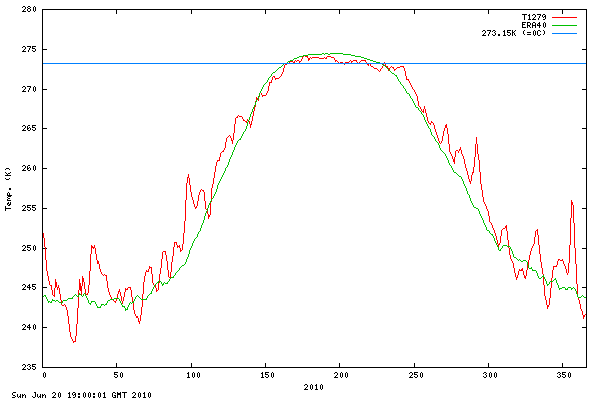
According to the Danish Meteorological Institute, Arctic temperatures are currently below 238K (-35.15 degrees Celsius or -31.27 degrees Fahrenheit)
That is more than five degrees below normal (the green line) and the lowest reading since 2004. The slope of decline has also recently been quite sharp, dropping from 252K on January 1, a drop of 14 degrees in 22 days.

Source: http://ocean.dmi.dk/arctic/plots/meanTarchive/meanT_2010.png
For an interactive view, showing historical data see:
http://ocean.dmi.dk/arctic/meant80n.uk.php
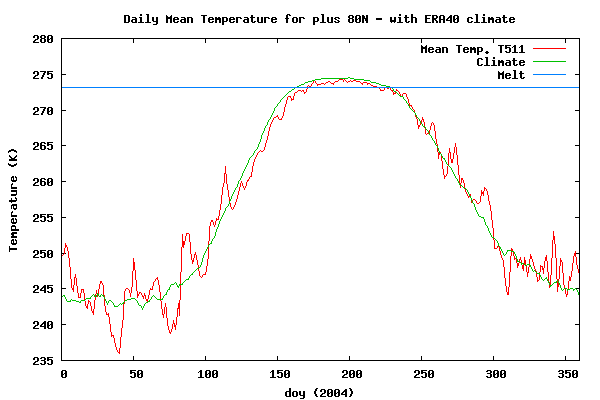
The last time temperatures were this low in the Arctic was in February, 2004, where the 80N temperature reached 236K.

Source: http://ocean.dmi.dk/arctic/plots/meanTarchive/meanT_2004.png
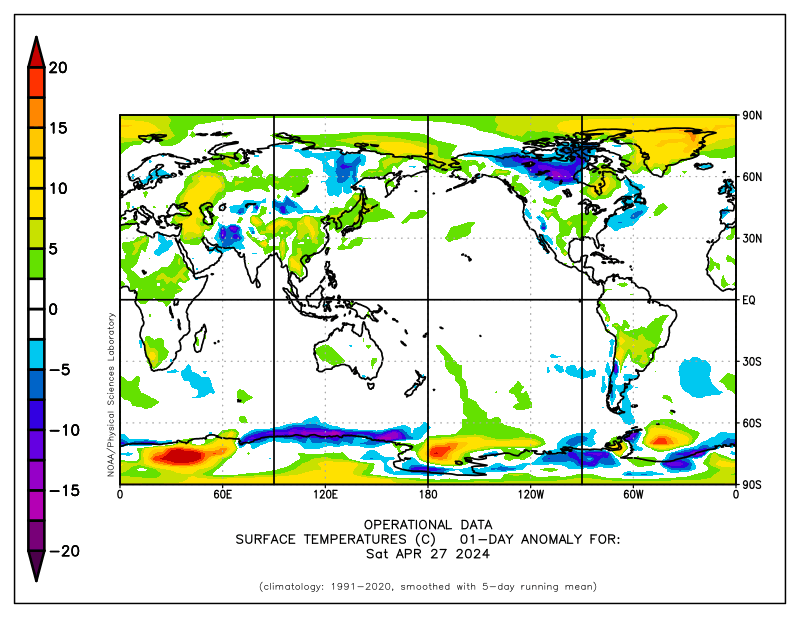
In other news, temperatures in both the Arctic and Antarctic are well below normal.

Source: http://www.esrl.noaa.gov/psd/map/ANIM/sfctmpmer_01a.fnl.30.gif
h/t to Steve Goddard
UPDATE: Quick rebound from the coldest temperature since 2004, will it oscillate back?

Phil,
I propose a different title. “Hansen’s Arctic amplification not happening.”
Ralph (00:20:54) :
Another reason for the recent cooling is extra albedo.
The N hemisphere has been covered in snow for four weeks, reflecting all incoming solar energy.
I have been reading Tim Flannery’s essay ‘Now or Never’ for the sake of balance (balance ?, a mangled term like ‘robust’) and he carries on about Arctic albedo. I can see how cloud in the Tropics and mid-latitudes can reflect light/heat before it reaches the Earth, but is Arctic albedo all that it is made out to be ?. I mean how much does light (really UV) have an measurable effect above 75degN ?
I mean (really IR)
Keith,
The Arctic ice minimum comes in September, when the sun is just above the horizon. So the albedo argument is a ruse.
I wrote about this last year.
http://wattsupwiththat.com/2009/01/10/polar-sea-ice-changes-are-having-a-net-cooling-effect-on-the-climate/
Keith when the day lasts for 6 months quite a lot!
Summer at the North Pole 2008 the measured solar at the surface was ~300W/m^2, that’s worth 600W/m^2 at the equator because it’s 24hrs not 12. As for IR there’s a measured ~300W/m^2 of that there too!
Phil,
There may be lots of sun at the North Pole in May, June and July, but there is very little year to year variation in ice extent during those months.
http://www.ijis.iarc.uaf.edu/seaice/extent/AMSRE_Sea_Ice_Extent.png
The 2007 minimum occurred in late September, after the sun had already set.
>>The Arctic ice minimum comes in September, when the
>>sun is just above the horizon. So the albedo argument
>>is a ruse.
I was not talking about Arctic albedo, it was the N hemisphere I was concerned about.
Many areas from latitude 45° north and above have been carpeted with snow and low stratus for weeks (more dumped on E Europe yesterday), and that must affect the amount of incident energy being absorbed in the N hemisphere. That must, in turn, affect the amount of energy available to migrate towards the poles.
.
What the heck is going on with Arctic ice coverage the last few days? Another satellite problem? It’s gone *down* (not just rate of increase flattened) according to NSIDC. That can’t be right at this time of year can it?
Steve, Keith’s question was “I mean how much does light (really IR) sic have an measurable effect above 75degN ?”, which my post was in answer to. Just because the extent minimum occurs in september doesn’t mean that the previous 6 months of sunlight have nothing to do with the melting. In fact the minimum will always occur after the refreezing has started. In further response to Keith as can be seen from the DMI plot the average temperature increases 30ºC in the 60 days following sunrise. Also while the sunsets in late September at the pole, at 80ºN there is plenty of sun through mid October (7 – 10 hours).
geo (06:38:39) :
What the heck is going on with Arctic ice coverage the last few days? Another satellite problem? It’s gone *down* (not just rate of increase flattened) according to NSIDC. That can’t be right at this time of year can it?
It happens all the time, just minor fluctuations at the margins at a time when the growth in extent is rather low, i.e. ‘weather’.
See below for evidence of such fluctuations in previous years.
http://www.ijis.iarc.uaf.edu/en/home/seaice_extent.htm
Phil,
At 80N, the sun’s elevation above the horizon in October ranges from 7 degrees to 0 degrees. The amount of solar radiation received is very small.
No one is disputing that the sun melts ice during the summer, the question was about albedo and reflected light.
geo,
Nothing wrong with the NSIDC plot, Winds are compacting ice in the Eastern Arctic.
http://nsidc.org/data/seaice_index/images/daily_images/N_daily_extent.png
I still think the temp shooting up 8 degrees centigrade in a single day is a bit much for such a large area. Smooth the plot with a two-week moving average and you’ve got a better view of the arctic temp.
http://www.bloomberg.com/apps/news?pid=20601088&sid=aSEEa_iSCC7Y
What about the Bears???
Running out of food, eating each other, no where to play, their world turning into shyte. I think i need a cup of Mogadon.
relax. relax.
regards