by Steve McIntyre
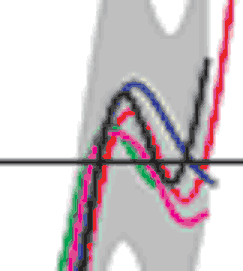
For the benefit of new readers, we discussed some aspects of the “trick” at Climate Audit in the past. Obviously, the Climategate Letters clarify many things that were murky in the past. On the left is a blowup of IPCC 2001 Fig 2.21 showing where the Briffa reconstruction (green) ends. More on this below.
Figure 1 below is the original graphic showing the MBH98-99, Jones et al 1998 and Briffa 2000 temperature reconstructions. I think that it’s fair to say that this graphic gives a strong rhetorical impression of the proxy reconstructions all going up throughout the 20th century, lending credibility to the idea that the “proxy” reconstructions would also be responsive to past warm periods – and obviously not giving any “fodder to the skeptics” by revealing the divergence between the Briffa reconstruction and temperatures.

Figure 1. IPCC 2001 Comparison of warm-season (Jones et al., 1998) and annual mean (Mann et al., 1998, 1999) multi-proxy-based and warm season tree-ring-based (Briffa, 2000) millennial Northern Hemisphere temperature reconstructions. The recent instrumental annual mean Northern Hemisphere temperature record to 1999 is shown for comparison.
While the digital version of the Briffa reconstruction has only become available in the past few days, Briffa 2000 (cited in the caption to IPCC Fig 2.21) did show the decline as shown in Briffa 2000 Figure 5 shown below (with its original caption). This series obviously goes down at the end (as does a related series in Briffa et al 1998, referred to by Gavin Schmidt.) What Gavin didn’t discuss is how you get from the version below to the IPCC version.

Figure 2. Briffa 2000 Figure 5 An indication of growing season temperature changes across the whole of the northern boreal forest. The histogram indicates yearly averages of maximum ring density at nearly 400 sites around the globe, with the upper curve highlighting multidecadal temperature changes… The LFD curve indicates low-frequency density changes produced by processing the original data in a manner designed to preserve long-timescale temperature signals (Briffa et al., 1998c). Note the recent disparity in density and measured temperatures discussed in Briffa et al., 1998a, 1999b). Note that the right hand axis scale refers only to the high-frequency density data.
Gavin Schmidt stated that everything was “in plain sight”. Regular CA readers are used to watching the pea under the thimble. There is no mention in the IPCC report of the deletion of Briffa reconstruction data after 1960. Nor is there any mention of the deletion in the IPCC reference (Briffa 2000) nor, for that matter, in the article cited by Gavin Schmidt (Briffa et al 1998). These articles report the divergence, but do not delete it. (Briffa et al 2001 does delete the post-1960 values.)
Not only was the deletion of post-1960 values not reported by IPCC, as Gavin Schmidt implies, it is not all that easy to notice that the Briffa reconstruction ends around 1960. As the figure is drawn, the 1960 endpoint of the Briffa reconstruction is located underneath other series; even an attentive reader easily missed the fact that no values are shown after 1960. The decline is not “hidden in plain view”; it is “hidden” plain and simple.
Figure 3. Blowup of IPCC Figure 2-21.
Previous discussion of these issues is at Climate Audit here here here and more recently by Jean S here. Jean S and UC report at CA that the puzzling end point properties can be replicated by replacing actual proxy data after 1960 with instrumental data and then smoothing (truncating back to 1960) – exacerbating the problem. (I haven’t personally confirmed this, but Jean S and UC are extraordinarily skilled analysts and know this material as well as I do.) Jean S:
In order to smooth those time series one needs to “pad” the series beyond the end time, and no matter what method one uses, this leads to a smoothed graph pointing downwards in the end whereas the smoothed instrumental series is pointing upwards — a divergence. So Mann’s solution was to use the instrumental record for padding, which changes the smoothed series to point upwards as clearly seen in UC’s figure (violet original, green without “Mike’s Nature trick”).
Jean S then drolly quoted Mann:
No researchers in this field have ever, to our knowledge, “grafted the thermometer record onto” any reconstruction. It is somewhat disappointing to find this specious claim (which we usually find originating from industry-funded climate disinformation websites) appearing in this forum.
The Climategate Letters contain a very interesting discussion between Mann, Jones, Briffa, Karl and Folland worrying that showing the discrepancy would provide “fodder to the skeptics”. More on this tomorrow.
Discover more from Watts Up With That?
Subscribe to get the latest posts sent to your email.

enough (18:37:56) :
Josh
“A disturbing thing is Obama’s Energy “Czar” Carol “Brownshirt” Browner doesn’t care about anything but her radical agenda: http://bit.ly”
She was under court order not to destroy data as she left the EPA as director. The EPA was caught funneling money to non-profits for obvious political gain. She ordered all the hard drives be reformatted. Their is no way she was going to be appointed to something needing congressional approval. So now she is a bama CZAR
This sort of thing is not mentioned by indignant warmists in their moralistic frenzies. Why not? They’re hypocrites. And it doesn’t appear in MSM articles in which it is OK to quote alarmists impugning the bona fides of critical scientists. Why not?
An Anonymous Coward at Slashdot just submitted an article with a link to a blog on blogspot, whose first post is today, that analyzes portions of the code in the CRU files. Maybe the info or the blogger could be useful.
http://codeincontext.blogspot.com/
Gene, Thank you for responding, but what was the different data they inserted in place of the proxy data ? — and what is “proxy” data? Sorry to be a bother, but I would like to understand well enough to explain it to friends and family.
Brenda (13:01:51) :
Here’s a quote from the emails that shows what they used :
“I’ve just completed Mike’s Nature trick of adding in the real temps to each series for the last 20 years (ie from 1981 onwards) amd from 1961 for Keith’s to hide the decline. Mike’s series got the annual land and marine values while the other two got April-Sept for NH land
N of 20N. The latter two are real for 1999, while the estimate for 1999
for NH combined is +0.44C wrt 61-90. The Global estimate for 1999 with
data through Oct is +0.35C cf. 0.57 for 1998.
Thanks for the comments, Ray.”
You might not understand what they are saying. But, simply put, they took portions of actual thermometer readings (not proxies, ‘the real temps’), portions that would show continued warming. They were careful to use the portions of the temperature data set that would work for them—i.e., they cherry picked—to show continued warming.
————————–
the quote from the email is from here :
http://wattsupwiththat.com/2009/11/20/mikes-nature-trick/
—————-
p.s. I hope I don’t sound redundant. I’m a bit punchy from all the long days of reading since this story broke.
Brenda (13:01:51) :
Here’s the Briffa graph with the red showing when the decline that was hidden began. The red is the part what was taken out and replaced with cherry picked temperature data.
http://www.climateaudit.org/wp-content/uploads/2009/11/briffa_recon.gif
Brenda (13:01:51) :
A definition of ‘proxy’ found online from The Exploratorium
Proxy Data.—Because climate involves long-term patterns, climate researchers often seek data about what the climate was like thousands or millions of years ago. But such data are difficult to find (ice cores provide one source of actual prehistoric climate data). Researchers may therefore use other kinds of data that tell them about something related to climate. Non-climate data analyzed for clues to climate is called proxy data. For example, information about the past strength of ocean currents might be gained by studying fossil microorganisms deposited in sediments—the ages, types, and distributions of these organisms could reflect the nature of the currents that existed at the time they were deposited.
Brenda (13:01:51) :
more on “proxies” at this link, not perfect but you’ll get the idea
http://serc.carleton.edu/microbelife/topics/proxies/paleoclimate.html
Brenda (13:01:51) :
If you have any friends that know computer code, even if just a little, you might get a lot out of going to this link with them and reading.
http://wattsupwiththat.com/2009/11/25/climategate-hide-the-decline-codified/
What was done by the scientists is revealed in the computer code. The computer code verifies that what was communicated between the scientists in their emails was the reality of what they did and not, as they are now claiming, ‘robust discussion’ between scientists that is now being ‘taken out of context’.
Brenda (13:01:51) :
One last thing,
anyone can go to this link and get a beginners handle on things :
http://wattsupwiththat.com/2009/11/25/climategate-men-bahaving-badly-a-short-summary-for-laymen/
Gene, Thanks so much. You cleared it up for me. I went to all the articles you linked. I’ve been sending articles to friends and family, but “men behaving badly” (love the title) is the simplest to understand, so I’ll use it a lot from now on. Regarding computer code, I read someone’s explanation of the code notations and understood a lot of it, but I don’t know anyone who does that kind of work — probably because of my age and pre-computer era education. However, there’s so much commentary out there that even someone like me can pick up quite a bit of understandable information. Again, thanks for helping me out — I appreciate it.
Brenda:
I don’t know if it’s been made clear to you that the “trick” SteveM is pointing out is that the blow-up shows the green ‘proxy’ curve ending significanly prior to where the other curves end, while in the graph just a little below it’s hard to see the green curve ending where it really ends. It instead look like it goes on to ascend, because it merges with another strand of spagetti curve which is actually what is going up and leaving the green curve behind. To me it even looks a little green, probably due to some feature of our/my sight apparatus.
I think the “padding” of the green tree ring proxy curve data with “real”, instrumental data only made the end of the green curve flatten around 1960, whereas in the lowest graph shown the curve is still heading downward in 1960, as it continues to “diverge” from the temperature curve.
J. Peden, Thanks. I had read something along that line somewhere else, but you explained it better. I just can’t get over this whole story. How did they get away with this for so long? When I think of all the school kids being brainwashed and frightened with this nonsense, all the corrupted text books, the college kids who have spent years working to get useless degrees to study “climate change”, the billions of tax dollars wasted . . . no matter how much we wish otherwise, real science will suffer from this scandal, and clearly has already suffered.
Climate change does not happen because of humans! BBC docu:
http://www.garagetv.nl/video-galerij/blancostemrecht/The_Great_Global_Warming_Swindle_Documentary
The next election.. we have to clean house and enact laws to protect the public from such fraud..
I’m a denier, a skeptic, a non-believer but I found a NASA reference to “trick” that may soften the e-mail criticism. Of course NASA’s use may also be to hide the decline…
“The trick was to find the anomalies first and then compute the absolute values from the anomalies: Whereas the absolute monthly and seasonal temperatures may have a definite seasonal cycle, the monthly and seasonal anomalies do not; hence whereas a seasonal mean may be totally distorted if we leave out the warmest or coldest month, seasonal anomalies are less impacted by dropping any monthly anomaly.”
http://data.giss.nasa.gov/gistemp/station_data/seas_ann_means.html
Steve