Sorry no graphics, no abstract or paper (not published yet, due Friday the 27th, I hate it when they do this) the Penn State press release was rather spartan. So I’ll provide this one showing Mann’s previous work where the Medieval Warm Period doesn’t much show up at all:
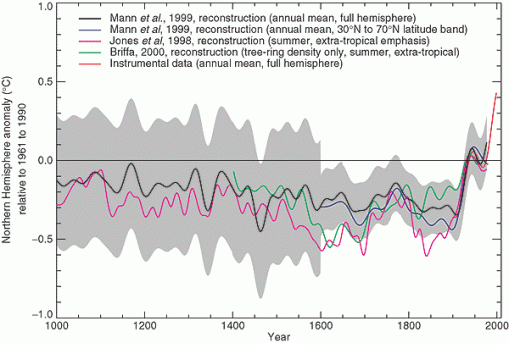
So here’s the question, the press release below mentions sediments. Place your bets now on whether the Tiljander sediment series remains inverted or not. (h/t to Leif Svalgaard) – Anthony
Past regional cold and warm periods linked to natural climate drivers
Intervals of regional warmth and cold in the past are linked to the El Niño phenomenon and the so-called “North Atlantic Oscillation” in the Northern hemisphere’s jet stream, according to a team of climate scientists. These linkages may be important in assessing the regional effects of future climate change.
“Studying the past can potentially inform our understanding of what the future may hold,” said Michael Mann, Professor of meteorology, Penn State.
Mann stresses that an understanding of how past natural changes have influenced phenomena such as El Niño, can perhaps help to resolve current disparities between state-of the-art climate models regarding how human-caused climate change may impact this key climate pattern.
Mann and his team used a network of diverse climate proxies such as tree ring samples, ice cores, coral and sediments to reconstruct spatial patterns of ocean and land surface temperature over the past 1500 years. They found that the patterns of temperature change show dynamic connections to natural phenomena such as El Niño. They report their findings in today’s issue (Nov. 27) of Science.
Mann and his colleagues reproduced the relatively cool interval from the 1400s to the 1800s known as the “Little Ice Age” and the relatively mild conditions of the 900s to 1300s sometimes termed the “Medieval Warm Period.”
“However, these terms can be misleading,” said Mann. “Though the medieval period appears modestly warmer globally in comparison with the later centuries of the Little Ice Age, some key regions were in fact colder. For this reason, we prefer to use ‘Medieval Climate Anomaly’ to underscore that, while there were significant climate anomalies at the time, they were highly variable from region to region.”
The researchers found that 1,000 years ago, regions such as southern Greenland may have been as warm as today. However, a very large area covering much of the tropical Pacific was unusually cold at the same time, suggesting the cold La Niña phase of the El Niño phenomenon.
This regional cooling offset relative warmth in other locations, helping to explain previous observations that the globe and Northern hemisphere on average were not as warm as they are today.
Comparisons between the reconstructed temperature patterns and the results of theoretical climate model simulations suggest an important role for natural drivers of climate such as volcanoes and changes in solar output in explaining the past changes. The warmer conditions of the medieval era were tied to higher solar output and few volcanic eruptions, while the cooler conditions of the Little Ice Age resulted from lower solar output and frequent explosive volcanic eruptions.
These drivers had an even more important, though subtle, influence on regional temperature patterns through their impact on climate phenomena such as El Niño and the North Atlantic Oscillation. The modest increase in solar output during medieval times appears to have favored the tendency for the positive phase of the NAO associated with a more northerly jet stream over the North Atlantic. This brought greater warmth in winter to the North Atlantic and Eurasia. A tendency toward the opposite negative NAO phase helps to explain the enhanced winter cooling over a large part of Eurasia during the later Little Ice Age period.
The researchers also found that the model simulations failed to reproduce the medieval La Nina pattern seen in the temperature reconstructions. Other climate models focused more specifically on the mechanisms of El Niño do however reproduce that pattern. Those models favor the “Thermostat” mechanism, where the tropical Pacific counter-intuitively tends to the cold La Niña phase during periods of increased heating, such as provided by the increase in solar output and quiescent volcanism of the medieval era.
The researchers note that, if the thermostat response holds for the future human-caused climate change, it could have profound impacts on particular regions. It would, for example, make the projected tendency for increased drought in the Southwestern U.S. worse.
Other researchers on the project were Zhihua Zhang, former postdoctoral fellow in meteorology now at the National Oceanic and Atmospheric Administration; Scott Rutherford, Roger Williams University; Raymond S. Bradley, University of Massachusetts; Malcolm K. Hughes and Fenbiao Ni, University of Arizona; Drew Shindell and Greg Faluvegi, NASA Goddard Institute for Space Studies, and Caspar Ammann, National Center for Atmospheric Research.
The National Science Foundation, the U.S. Department of Energy, NOAA, and NASA supported this work.
Discover more from Watts Up With That?
Subscribe to get the latest posts sent to your email.

Here’s a real hockey-stick for you: Google Trends data on ‘Climategate’:
http://www.google.com/trends?q=climategate&date=mtd&geo=all&ctab=0&sort=0&sa=N
Interesting that Sweden tops the US in searches for it…
It as if he is saying that climate change is caused by nature…who would have guessed it!?
For a slightly different take on this;
http://network.nationalpost.com/np/blogs/fullcomment/archive/2009/11/26/skewed-science.aspx
I won’t say that word.
Is it just me, but doesn’t reporting on work by discredited scientist Michael (what’s he lying about this time?) Mann demean a serious science blog like Watts Up With That? Shame on you Anthony, you’ll get your Best Science Blog award withdrawn if you’re not careful.
Hahahahaha. Ask “Harry” about that.
I believe that this paper was the team’s opening gambit to explain the current flat temperatures: “Natural variation is large enough to explain current temperatures, but not large enough to damage our AGW therories.”
Jeff Alberts (21:31:58):
The problem then for Mann is, as Dr Svaalgard says, if the sun was a major player then, it’s a major player now, so they can’t say the sun isn’t having as much influence in modern times.
The sun is as much of an influence as it always was, and no-one has said anything different. It’s precisely *because* solar irradiation has been declining slightly in recent decades, while the world has warmed significantly, that climate scientists know it’s not the sun causing the warming this time.
I would just like to say is it really necesary to employ people to adjust and distort the temperature data in favour of global warming happening.Can we have the original data to work out ourselves if it is happening? The answer seems to be no but we are expected to accept without question the outcome of their latest model runs.The Arctic ice is growing rapidly ,the snow is coming down all over the northern hemisphere and it is cold. If the present trend of of increasing arctic ice extent continues in September 2010 then the national snow and ice data centre will have to start using the word recovery,they have made no secret of distorting their graphs and using false means to compare the present data with in order promote the man made global warming hypothesis.The latest graphs produced by the national snow and ice centre at Colorado look nothing like either the ssmi ice extents produced by Nansen arctic roos Norway or the amsr-e sea ice extent produced by iarc-jaxa ,the cryosphere today agrees with the latter two.
” Gregg E. (01:15:53) :
Regarding the software, my suggestion for checking the compiled programs is to create three artificial data sets to run through them. If the programs are legit, they’ll reproduce the input pretty much exactly as a line graph. If they spit out hockey sticks…”
I offered three similar data sets to Gavin over at RC three years ago, offering to deposit the algorithms used to generate them with a lawyer. I was told that such a test would take too much time, then told it had been done and was then deleted.
“Now my high priest is telling me the science isn’t settled. What is a poor acolyte to do?”
Follow your leader over the cliff?
Get thee to a psychiatric hospital?
Drink beer not Kool-aid?
Why do you ask such troublesome questions? 😉
Sadly enough, this is what I believe will happen: The global warming religion has gone too far now to stop. But in a few years time it will become obvious that the climate will start cooling and then the shysters will turn coat and say, we succeeded, we managed to cut emissions enough to stop the heating, yeah, now salute us for this as well. They will never accept the fact that they were wrong all along.
How is many using the data if they lost it? Did he give the journal raw data and code. Why do the journals keep publishing this garbage? How can we pressure the journals to raise or merely enforce existing standards?
Stephen Wilde,
The warmer surface does conduct and convect downward as well as evaporate and conduct and convect upward. The continual input of energy is absorbed Solar energy driving both directions. The Solar increases do increase the atmospheric temperature, and then the atmosphere radiates more to get back into balance. The net is a heating followed by a cooling, not one or the other. In the long term, the total input matches the total output for equilibrium. The actual cases are never in equilibrium, but are lagging and always moving toward equilibrium due to ocean and land storage and currents and wind movement of the energy.
Breaking news from Bishophill – awaiting confirmation
http://bishophill.squarespace.com/blog/2009/11/27/whitewash-starting.html
“1) Lord Rees (Royal Society) to be asked by UEA to investigate CRU leak.
2) Foreign Office and government leaning heavily on UEA to keep a lid on everything lest it destabilises Copenhagen.
3) CRU asked to prepare data for a pre-emptive release in past couple of days but trouble reconciling issues between data bases has stopped this.”
A few observaton –
UEA and CRU are beng hung out to dry.
Mann has got one foot in the lifeboat.
Climate is a non-linear chaotc system so trends mean nothing, as the average temperature of the globe is always going up down as it tracks around each of it’s strange attractors (as can be seen on the graph). However, what is meaningful is that over the 2000 years shown, the difference between max and min temperature, taken to the limits of the error bars, is only 1.3 degrees Celcius.
Seems the Earth is pretty good at regulatng it’s temperature. No run-away global warming to be seen here – please move along…
Has anyone noticed the growth in the Artic ice-extent over the past month?
http://www.ijis.iarc.uaf.edu/en/home/seaice_extent.htm
Is that a record?
**************
Bob Tisdale (02:23:56) :
The title of Mann et al (2009) is “Global Signatures and Dynamical Origins of the Little Ice Age and Medieval Climate Anomaly.
http://www.sciencemag.org/content/vol326/issue5957/images/data/1256/DC1/multiproxySpatial09.zip
***************
Hmmmm … look like many of the links don’t work. Was he expecting no one would look at this?
file:///home/family/.cache/.fr-cskhfJ/multiproxySpatial09/index.html
I think RaCook has a good point. Mann’s charts don’t really rule out the MWP. Actually, if you look at most statements by warmist scientists, they pretty much always leave themselves wiggle room. In fact, if you look at the IPCC reports carefully, they never flat out predict catastrophic warming.
Anyway, I think what’s going on is that the Team, faced with evidence that undermines their hypothesis, is just trying to muddy the waters a bit to rehabilitate CAGW. Mann’s talk about El Ninos, volcanos, and regional effects are (for his purposes) epicycles.
Global Signatures and Dynamical Origins of the Little Ice Age and Medieval Climate Anomaly
Michael E. Mann, Zhihua Zhang, Scott Rutherford, Raymond S. Bradley, Malcolm K. Hughes, Drew Shindell, Caspar Ammann, Greg Faluvegi, Fenbiao Ni
Supporting Online Material
This supplement contains:
Materials and Methods
SOM Text
Figs. S1 to S11
Tables S1 to S5
References
http://www.sciencemag.org/cgi/content/full/sci;326/5957/1256/DC1
As has been stated many times in these blogs, science moves on from further study and peer review, even if the review is conciously trying to be blocked.
For the historical perspecitve II highly recommend the Brian Fagan books available on http://www.amazon.com/ , all for <$10 used including shipping.
The Little Ice Age
The Great Warming
The Long Summer
Interesting, in that in the introduction Fagan states he completely agrees with the IPCC, then after writing that, he writes hundreds of pages with thousands of references, all proving that there have been dramatic swings in climate for the past 1,000 years, not just since man began creating significant CO2 in about 1940. He ignores his own voluminous EVIDENCE. Highly recommended, skip the foreward, or take it in context of ClimateGate.
*****************
TitiXXXX (03:29:26) :
After a quick look at the paper:
good point: seems to provide all (at least a bunch) data and code and method (22 Meg of compressed data and stuff as supplementary info). Even if it may contain errors or so, I think it is a progress.
Bad point: hide the decline… more … (figure 1) proxies reconstruction stops in 1850 (about) then go to only instrumental record. I don’t know yet if there is a reason why explained in the paper. To be checked further.
****************
It still uses the “S1” reconstruction. No one has the code and data for that, do they?
Meanwhile, back in the real world where actual measurements exist, we are getting more of that “projected US Southwest drought” tonight and this weekend. About 4 to 7 inches of white “drought” plus rain (oops, can’t say that word, can we?) are forecast to fall across Kern County (Bakersfield and surrounding areas) in Southern California. Seems a cold weather front is pushing through.
Hmmm…and northern California, Oregon, and Washington just got pounded with rain and snow.
(Say, Anthony – how about we change the label for the Mann et al team to “liars?”) We’re the skeptics, they’re the liars. Just a thought. (I know, I know…Liars is too inflammatory and combative…need something softer but accurate)
Hmmmm … the vid still seems to be available on Youtube:
Direct link
“Hide the decline” search on youtube. (Search performed just moments ago 10:40 AM EST)
AND –
It appears under Science & TechnologyScience & Technology on the Youtube home page. (Performed at 10:47 EST)
Beef? Where’s the beef?
.
.
May one assume that Mann’s paper is both robust and peer reviewed? [ /snark off]
No.
We can’t trust his numbers
We can’t trust his calculations
Can’t trust his “peer review”
Why is he pushing out a new report and can’t even release numbers from any of his past reports?
I realize it is “publ;ish or perish”
New reports from him won’t salvage his previous vindictive actions and defective claims.