Sorry no graphics, no abstract or paper (not published yet, due Friday the 27th, I hate it when they do this) the Penn State press release was rather spartan. So I’ll provide this one showing Mann’s previous work where the Medieval Warm Period doesn’t much show up at all:
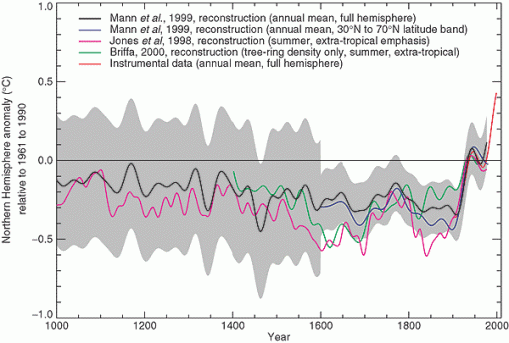
So here’s the question, the press release below mentions sediments. Place your bets now on whether the Tiljander sediment series remains inverted or not. (h/t to Leif Svalgaard) – Anthony
Past regional cold and warm periods linked to natural climate drivers
Intervals of regional warmth and cold in the past are linked to the El Niño phenomenon and the so-called “North Atlantic Oscillation” in the Northern hemisphere’s jet stream, according to a team of climate scientists. These linkages may be important in assessing the regional effects of future climate change.
“Studying the past can potentially inform our understanding of what the future may hold,” said Michael Mann, Professor of meteorology, Penn State.
Mann stresses that an understanding of how past natural changes have influenced phenomena such as El Niño, can perhaps help to resolve current disparities between state-of the-art climate models regarding how human-caused climate change may impact this key climate pattern.
Mann and his team used a network of diverse climate proxies such as tree ring samples, ice cores, coral and sediments to reconstruct spatial patterns of ocean and land surface temperature over the past 1500 years. They found that the patterns of temperature change show dynamic connections to natural phenomena such as El Niño. They report their findings in today’s issue (Nov. 27) of Science.
Mann and his colleagues reproduced the relatively cool interval from the 1400s to the 1800s known as the “Little Ice Age” and the relatively mild conditions of the 900s to 1300s sometimes termed the “Medieval Warm Period.”
“However, these terms can be misleading,” said Mann. “Though the medieval period appears modestly warmer globally in comparison with the later centuries of the Little Ice Age, some key regions were in fact colder. For this reason, we prefer to use ‘Medieval Climate Anomaly’ to underscore that, while there were significant climate anomalies at the time, they were highly variable from region to region.”
The researchers found that 1,000 years ago, regions such as southern Greenland may have been as warm as today. However, a very large area covering much of the tropical Pacific was unusually cold at the same time, suggesting the cold La Niña phase of the El Niño phenomenon.
This regional cooling offset relative warmth in other locations, helping to explain previous observations that the globe and Northern hemisphere on average were not as warm as they are today.
Comparisons between the reconstructed temperature patterns and the results of theoretical climate model simulations suggest an important role for natural drivers of climate such as volcanoes and changes in solar output in explaining the past changes. The warmer conditions of the medieval era were tied to higher solar output and few volcanic eruptions, while the cooler conditions of the Little Ice Age resulted from lower solar output and frequent explosive volcanic eruptions.
These drivers had an even more important, though subtle, influence on regional temperature patterns through their impact on climate phenomena such as El Niño and the North Atlantic Oscillation. The modest increase in solar output during medieval times appears to have favored the tendency for the positive phase of the NAO associated with a more northerly jet stream over the North Atlantic. This brought greater warmth in winter to the North Atlantic and Eurasia. A tendency toward the opposite negative NAO phase helps to explain the enhanced winter cooling over a large part of Eurasia during the later Little Ice Age period.
The researchers also found that the model simulations failed to reproduce the medieval La Nina pattern seen in the temperature reconstructions. Other climate models focused more specifically on the mechanisms of El Niño do however reproduce that pattern. Those models favor the “Thermostat” mechanism, where the tropical Pacific counter-intuitively tends to the cold La Niña phase during periods of increased heating, such as provided by the increase in solar output and quiescent volcanism of the medieval era.
The researchers note that, if the thermostat response holds for the future human-caused climate change, it could have profound impacts on particular regions. It would, for example, make the projected tendency for increased drought in the Southwestern U.S. worse.
Other researchers on the project were Zhihua Zhang, former postdoctoral fellow in meteorology now at the National Oceanic and Atmospheric Administration; Scott Rutherford, Roger Williams University; Raymond S. Bradley, University of Massachusetts; Malcolm K. Hughes and Fenbiao Ni, University of Arizona; Drew Shindell and Greg Faluvegi, NASA Goddard Institute for Space Studies, and Caspar Ammann, National Center for Atmospheric Research.
The National Science Foundation, the U.S. Department of Energy, NOAA, and NASA supported this work.
Discover more from Watts Up With That?
Subscribe to get the latest posts sent to your email.

“current disparities between state-of the-art climate models”
I’m sorry, didn’t somebody tell us that the science was “settled”?
(Me, I’m still wondering about the CG email where McCracken is saying that sulphates may be the cause of current lack of warming but they have no idea just how much China is emitting – “so to poor emissions data in mid 20th century we’ll add poor data this century” [quoting from memory so probably not exact wording, but that was the gist]. So how can the model outputs be remotely fit for purpose if one of the (accepted) major inputs is highly inferred speculation?
It’s an interesting observation that none of the team actually ever go out and collect data. Too far from Starbucks? They either take pre-existing data sets from the literature, buy data sets and then torture them so that apples become pears, and pears become apples.
What I’d like to see is the use of a model to make a retrodiction about the past and then to test it by looking at the proxy data. Unfortunately the proxies are not of sufficient accuracy and precision to carry out such tests.
Happy Thanksgiving and Thanks for your efforts at WUWT.
Wonder what Phil Jones is having for Thanksgiving? Oh, I forgot, he’s the turkey.
As for the question if the MWP is local or worldwide, the following recent paper may be an answer: D. W. Oppo et al., “2,000-year-long temperature and hydrology reconstructions from the Indo-Pacific warm pool,” Nature, Vol 460 (27 August 2009) 1113-1116.
I think this paper was already introduced somewhere, but its results are too important to forget, so I want to mention it once again here.
Most importantly, their method can directly compare paleoclimate and present climate because they used a sophisticated core sampling technique, which does not disturb the surface layer of the sea floor. Thus they succeeded to estimate sea surface temperature (SST) for the period 300 BC – 2000 AD based on the Mg/Ca ratio method, which is a much more reliable thermometer than the tree-ring method.
Figure 2 of the paper clearly shows the MWP as well as the LIA. The result is very impressive and convincing. Thus, the claim that the ENSO cancelled the MWP in the tropical regions is incorrect. The MWP and the LIA should have been worldwide, anyway.
The same figure tells us that the SST for the MWP compares well with or is even higher than the present values. According to the authors, the region they tested can represent the mean global temperature. This may mean that the MWP in other regions also did not have lower temperature than the present.
Interestingly, the shape of the curve for the SST change is very similar to that for the precipitation in China: P. Zhang et al., “A Test of Climate, Sun, and Culture Relationships from an 1810-Year Chinese Cave Record,” Science, 7 NOVEMBER 2008 VOL 322, 940-942.
This paper shows that the precipitation change nicely follows the solar activity change throughout the period they examined (200 AD – 2000 AD, see their supporting material). Then, naturally, the SST for the Into-Pacific also follows the solar activity changes, and hence …. Quite interesting, isn’t it?
Debate!! Yes, on the BBC!
Has Mann archived his method in full and his data and his metadata in full?
Have the reviewers insisted that he does so?
Have the reviewers checked that his method and data yield the results he claims?
If so then his paper might be worth reading.
But I also agree with previous posters on the unjustifiable un-naming of the Medieval Warm Period (so they did grow grapes in Yorkshire after all…) and the alleged cooling of the patently warm Pacific (The Incas farmed higher terraces than we can today…).
Did the peer reviewers pick up these flaws? Did the journal editor submit the proof to an archaeologist? If not, why not?
Clymit Seance maybe?
Re: Will, 20:50:38 – “What goes on?”
I don’t know if the creators would have or have had it removed or not… but it can be found at their website. Just google Minnesotans For Global Warming. Might even be minnesotansforglobalwarming.com but I’m not certain. Shame its not still on youtube where its easy for so many to find, but hopefully folk’ll start posting the link to the original website and it will still be seen quite a bit. That christmas tree is fun-ky!
Antonio San
Ramstorf says:
“…only very large scale averages can be expected to reflect the global forcings (GHG, solar) over the past millennium.”
Ramstorf acknowledges the sun as a factor here, yet he dismisses it as a factor in today’s warming in order to pin all the blame on CO2.
Is 30 years, 100 years enough to be large-scale? Surely Ramstorf cannot dismiss that warming has actually been occurring since the LIA. They make themselves look like charlatans by selecting time frames that are convenient for their hypothesis, among other shenanigans.
From a forensic point a view, Ramstorf’s e-mail could not possibly be a fabricated one. His starting the letter without capitalising the first word, which is standard in German lcorrespondence, is a dead give away. I point this out, just in case there are still doubts about authenticity.
For the past few weeks I have, before the CRUgate revelations, I have been wondering what these scientists thought they were doing. For sure if they keep up the pretence they might get away with it for another 10 -20 years but if they are wrong, and there is every reason to believe they are, there will be an almighty blowback for science from the politicians. They will discredit science for a generation. I assumed they were involved in a sort of folie a pleusier, which is a phsycotic disorder where many people have the same delusional beliefs which themselves are reinforced for each individual be the fact that all the others share the belief. Mann et al must know they’ve manipulated data and public opinion, in their own hearts they must know that what they’re saying need not necessarily be true, yet they persist, primarily because there’s no way back. What seemed a good idea in 1998 was perpetrated without the knowledge that it would snowball into an international debate and there would be lots of people with enough scientific knowledge demanding higher standards of proof before believing them.
I believe it is beginning to dawn on Dr. Mann that eventually this enterprise will come crashing to the ground and when it does he, and his acolytes and co-conspirators will have a place in history as the perpetrators of a huge scientific hoax. His recent utterances (“No scientist would ever splice instrumental data onto proxy datar.” ” I have never deleted any e-mails” “I have never said there was no MWp”) have all the characteristics of a man trying to pull himself back from the abyss of historical infamy.
In other news, a new hatchet job on “climate contrarians” has appeared in The Telegraph. It has all the look and feel of a press release. Amazing!
These claims by Mann are puzzling to an Australian like me. He says the MWP coincided with a La Nina mode. La Nina in the Pacific (cools globe, not warms it) typically alternates with El Nino (warms globe) on a time scale of only a few years – much shorter than the long MWP (800-1300 AD). It has been suggested that the El Nino/La Nina cycle (El Nino Southern Oscillation, ENSO) may be modulated by the Pacific Decadal Oscillation (PDO), with one of the PDO’s modes encouraging El Nino and global warming while the other mode encourages La Nina and global cooling. But even the PDO cycle is only about 60 years – still well short of the length of the MWP era.
Saying that tropical Pacific was cold during the MWP because of La Nina is… well, yes. La Nina/El Nino last few months up to year. During the MWP, PDO/AMO has for sure overturned several times from positive to negative phase.
Hint #1 for authors: during the MWP, there was a series of average to above-average sun cycles, not being interrupted by solar minimum.
Hint #2 for authors: since 1940, we saw again an unprecedented series of much above average solar cycles, strongest in this interglacial period.
I think I will ask Phil Jones to share his research grants with me.
@ur momisugly Claude Harvey (22:44:15)
Claude, that was my recollection also, e.g., that there was more than enough evidence of a global WMP – including, if memory serves, loss of the Mayan culture, the Anasazi, and several other indicators from various widespread parts of the world. I’d thought the ‘regional’ vs. ‘global’ was pretty well settled?
Ok, I’d bookmarked these just a few days ago from a post somewhere else here on WUWT I believe: http://academic.emporia.edu/aberjame/ice/lec19/lec19.htm & more detail: http://academic.emporia.edu/aberjame/ice/lec19/holocene.htm
Then a short while back I’d run across an article about recent indo-pacific warm pool reconstruction that showed temps during MWP may have been as warm as today (which must be the Woods Hole you referenced?). No idea where I originally found it, but googled just now & one of the returns was http://www.thaindian.com/newsportal/health/indo-pacific-warm-pool-may-have-been-as-hot-during-medieval-times-as-it-is-today_100239362.html
Where Mann gets it wrong is that the Sun is not more active during the MWP, its just that it has less time in grand minimum phase. There is a sutble difference and the MWP is not unlike today where we have waited 210 years for another grand minimum.
So we have 2 warming periods that did not experience grand minima, not rocket science really.
“Medieval Climate Anomaly” – wasn’t that the term used in the much-derided Soon and Baliunas meta-analysis?
journals should consider to boycot mann’s constructions.
those are an embarrassment for their reputation, stealing their members’ time and reduce the available space for real science.
Interesting e-mail from Ray Bradley:
http://www.eastangliaemails.com/emails.php?eid=172&filename=.txt
Keith Briffa points out that the very strong trend in the 20th century calibration period accounts for much of the success of our calibration and makes it unlikely that we would be able be able to reconstruct such an extraordinary period as the 1990s with much success (I may be mis-quoting him somewhat, but that is the general thrust of his criticism).
Indeed, in the verification period, the biggest “miss” was an apparently very warm year in the late 19th century that we did not get right at all. This makes criticisms of the “antis” difficult to respond to (they have not yet risen to this level of sophistication, but they are “on the scent”).
Furthermore, it may be that Mann et al simply don’t have the long-term trend right, due to underestimation of low frequency info. in the (very few) proxies that we used. We tried to demonstrate that this was not a problem of the tree ring data we used by re-running the reconstruction with & without tree rings, and indeed the two efforts were very similar — but we could only do this back to about 1700. Whether we have the 1000 year trend right is far less certain (& one reason why I hedge my bets on whether there were any periods in Medieval times that might have been “warm”, to the irritation of my co-authors!). So, possibly if you crank up the trend over 1000 years, you find that the envelope of uncertainty is comparable with at least some of the future scenarios, which of course begs the question as to what the likely forcing was 1000 years ago. (My money is firmly on an increase in solar irradiance, based on the 10-Be data..)
Will: Hiding the decline? This search page gives a whole list. http://www.youtube.com/results?search_query=hide+the+decline&search_type=&aq=f
Off-topic, I know. But you may be amused by this:
Gore Flees in Panic from Chicago Book Signing
November 25, 2009 (LPAC)—Not since Henry Kissinger fled a team of LaRouche organizers, in the back of a delivery truck in New York City’s Central Park in the early 1980s, has an obese fascist moved so fast to escape an angry crowd, as Al Gore did today in Chicago. Appearing at a bookstore in the downtown Loop, Gore was confronted by a team of demonstrators from a grass roots group called “We Are Change,” as he was signing his latest fascist screed on the global warming swindle. Gore bolted from the bookstore, raced down an alley, jumped into a waiting car, and tried to speed off, with protesters chasing after him and banging on the car. Midwest LYM organizers, who were also on the scene to confront the global warming swindler, provided an eyewitness account of Fat Albert’s flight of fear.
Make no mistake about it. This little encounter is typical of the kinds of things going on all over the country, as the fascists who brought you the near-destruction of the United States and an onrushing global Dark Age, are no longer walking the streets, smug in the belief that they are literally getting away with murder. The mass strike dynamic is playing out in thousands of ways, every day, and the recent revelations about the “smoking gun” emails from the East Anglia University global warming propaganda center, have made Al Gore’s life a little more miserable.
As Percy Shelley wrote in “The Mask of Anarchy,” “We are many, they are few.”
I think this is a funny dance…. LOL MANn-AT-WORK (missing safety hat)
Kind’a dance when you try to put the grassfire out around you and try to look you do a voodoo hoping 🙂
@Duncan: “the Classical Antiquity period was warm as well”
Yes, and in the early Bronze Age the tops of the moors in SW England that now don’t support even trees were used to grow grain.
It’s not a very anomolous anomoly, is it?
The title of Mann et al (2009) is “Global Signatures and Dynamical Origins of the Little Ice Age and Medieval Climate Anomaly.
Abstract link:
http://www.sciencemag.org/cgi/content/abstract/326/5957/1256
Full paper (subscription required):
http://www.sciencemag.org/cgi/reprint/326/5957/1256.pdf
There is supporting info that is available without a subscription:
http://www.sciencemag.org/cgi/content/full/326/5957/1256/DC1
The Supplemental material is here:
http://www.sciencemag.org/cgi/data/326/5957/1256/DC1/1
And the “computer codes and data” are here (22MB):
http://www.sciencemag.org/content/vol326/issue5957/images/data/1256/DC1/multiproxySpatial09.zip
Regards
mann is so annnoying and previously ignorant that his reaearch raises hackles, sites like co2 science ssuggest such a plethora of other data that it was warmer in many places during the medeival warm period, his terminology of medeival climate anomalies is mind blowing.
One can only hope that he now has extended the Hockey Stick to include 2001-2008, so that everyone can see that 1997-2000 whas merely a “blip”.
I’ve been wondering a bit about who the 2500 consensus scientists are. If we have names, then we can check with each to see what they actually believe. So if they have 2500 people who agree with them, where’s that list? It would also be instructive to have a list of all the skeptics as well. It would be really fun if the number were higher than 2500. We can check whether they are reporting on their own studies or parroting someone else. Parrots don’t count, or at least shouldn’t. I’m wagering that most of the consensus is based on inbred, even incestuous, research of a few. If those few just so happen to control the means of communication in their field and exclude contrary voices, the others have to default to what is published. Its not really their opinion. I’d also wager that many of them aren’t any more qualified than some prominent skeptics. If McIntyre can’t get the data to check the work, those 2500 couldn’t either, so any conclusion they make has to be on faith, not facts. Anyone who has to rig the system to get desired results is obviously unqualified to be a scientist. If their science is good it will triumph over the bad. That they fudge data, calculations and keep opposing the publication of papers with contrary views, is evidence they themselves believe their own science to be bad. If they don’t believe in it, why should we?
As has been noted before in other contexts, it used to be consensus that the world was flat and at the center of the universe. They should be arguing facts, not opinion.