Sorry no graphics, no abstract or paper (not published yet, due Friday the 27th, I hate it when they do this) the Penn State press release was rather spartan. So I’ll provide this one showing Mann’s previous work where the Medieval Warm Period doesn’t much show up at all:
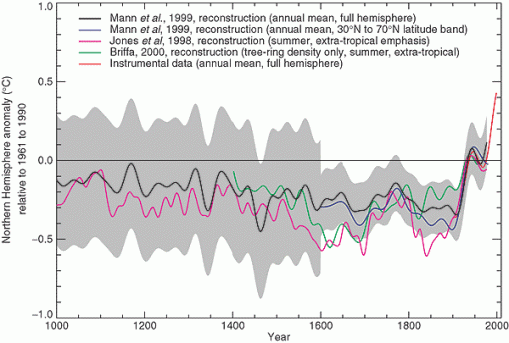
So here’s the question, the press release below mentions sediments. Place your bets now on whether the Tiljander sediment series remains inverted or not. (h/t to Leif Svalgaard) – Anthony
Past regional cold and warm periods linked to natural climate drivers
Intervals of regional warmth and cold in the past are linked to the El Niño phenomenon and the so-called “North Atlantic Oscillation” in the Northern hemisphere’s jet stream, according to a team of climate scientists. These linkages may be important in assessing the regional effects of future climate change.
“Studying the past can potentially inform our understanding of what the future may hold,” said Michael Mann, Professor of meteorology, Penn State.
Mann stresses that an understanding of how past natural changes have influenced phenomena such as El Niño, can perhaps help to resolve current disparities between state-of the-art climate models regarding how human-caused climate change may impact this key climate pattern.
Mann and his team used a network of diverse climate proxies such as tree ring samples, ice cores, coral and sediments to reconstruct spatial patterns of ocean and land surface temperature over the past 1500 years. They found that the patterns of temperature change show dynamic connections to natural phenomena such as El Niño. They report their findings in today’s issue (Nov. 27) of Science.
Mann and his colleagues reproduced the relatively cool interval from the 1400s to the 1800s known as the “Little Ice Age” and the relatively mild conditions of the 900s to 1300s sometimes termed the “Medieval Warm Period.”
“However, these terms can be misleading,” said Mann. “Though the medieval period appears modestly warmer globally in comparison with the later centuries of the Little Ice Age, some key regions were in fact colder. For this reason, we prefer to use ‘Medieval Climate Anomaly’ to underscore that, while there were significant climate anomalies at the time, they were highly variable from region to region.”
The researchers found that 1,000 years ago, regions such as southern Greenland may have been as warm as today. However, a very large area covering much of the tropical Pacific was unusually cold at the same time, suggesting the cold La Niña phase of the El Niño phenomenon.
This regional cooling offset relative warmth in other locations, helping to explain previous observations that the globe and Northern hemisphere on average were not as warm as they are today.
Comparisons between the reconstructed temperature patterns and the results of theoretical climate model simulations suggest an important role for natural drivers of climate such as volcanoes and changes in solar output in explaining the past changes. The warmer conditions of the medieval era were tied to higher solar output and few volcanic eruptions, while the cooler conditions of the Little Ice Age resulted from lower solar output and frequent explosive volcanic eruptions.
These drivers had an even more important, though subtle, influence on regional temperature patterns through their impact on climate phenomena such as El Niño and the North Atlantic Oscillation. The modest increase in solar output during medieval times appears to have favored the tendency for the positive phase of the NAO associated with a more northerly jet stream over the North Atlantic. This brought greater warmth in winter to the North Atlantic and Eurasia. A tendency toward the opposite negative NAO phase helps to explain the enhanced winter cooling over a large part of Eurasia during the later Little Ice Age period.
The researchers also found that the model simulations failed to reproduce the medieval La Nina pattern seen in the temperature reconstructions. Other climate models focused more specifically on the mechanisms of El Niño do however reproduce that pattern. Those models favor the “Thermostat” mechanism, where the tropical Pacific counter-intuitively tends to the cold La Niña phase during periods of increased heating, such as provided by the increase in solar output and quiescent volcanism of the medieval era.
The researchers note that, if the thermostat response holds for the future human-caused climate change, it could have profound impacts on particular regions. It would, for example, make the projected tendency for increased drought in the Southwestern U.S. worse.
Other researchers on the project were Zhihua Zhang, former postdoctoral fellow in meteorology now at the National Oceanic and Atmospheric Administration; Scott Rutherford, Roger Williams University; Raymond S. Bradley, University of Massachusetts; Malcolm K. Hughes and Fenbiao Ni, University of Arizona; Drew Shindell and Greg Faluvegi, NASA Goddard Institute for Space Studies, and Caspar Ammann, National Center for Atmospheric Research.
The National Science Foundation, the U.S. Department of Energy, NOAA, and NASA supported this work.
Discover more from Watts Up With That?
Subscribe to get the latest posts sent to your email.

Drought is nothing new to the U.S.
Please see here and
here
May one assume that Mann’s paper is both robust and peer reviewed? [ /snark off] I find myself sorry for resorting to snark like this, but peer review is supposed to be a genuine aid to the search for scientific knowledge and the revelations of the past few days tend to leave a bitter taste regarding the process.
“The researchers found that 1,000 years ago, regions such as southern Greenland may have been as warm as today”
This is a joke right? They’ve just discovered this…. What’s next? will they announce that they’ve discovered for the first time that the Classical Antiquity period was warm as well, so warm in fact that grapes were grown in the Roman provence of Britannia? 🙂
Hmmm….
Variations on a Theme by Mann written by Mann
Let me guess – featuring a warped and twisted hockey stick, proving once again that we are experiencing unprecedented warmth.
For this reason, we prefer to use ‘Medieval Climate Anomaly’
Additionally, we’ve changed Greenland to Whiteland.
I had a thought looking at the CO2 graph in the widget. CO2 seems to be virtually a straight line since 1978 according to the graph. Is this actually true? Have there been no volcanic eruptions to provide a spike in the record? Has the use of carbon based fuels been continuous and even over the 30 year period? Even in the current recession has fuel consumption continued a steady increase?
Perhaps the CO2 data may be fudged also.
Just a thought.
“The researchers found that 1,000 years ago, regions such as southern Greenland may have been as warm as today.”
The corpses of the Greenland dead are still there, frozen in the ice that used to be farmland. Historians are curious as to how they managed to farm land that was frozen and where they got the JCBs from to dig the graves. I know this is “unscientific” but…
“It would, for example, make the projected tendency for increased drought in the Southwestern U.S. worse.”
Cute way of not saying “could” so many times. This could easily be translated by some popsci writer as “would increase drought in the SW”. Mighta-coulda-woulda-shoulda science. I hope Mike gets plenty of gifts for Xmas, tea leaves, goat entrails, bones to toss. We need to be threatened over and over again with increasing projected tendencies.
Not another “PlayStation-state-of the-clumsy-art climate models”, please!
When the bulldozing of climate dept requires the bulldozing of the History dept, eventually you will get push back I hope.
One of the better articles I’ve seen so far (National Post in Canada).
http://network.nationalpost.com/np/blogs/fpcomment/archive/2009/11/26/skewed-science.aspx
F. Patrick Crowley (22:02:08) :
I had a thought looking at the CO2 graph in the widget. CO2 seems to be virtually a straight line since 1978 according to the graph. Is this actually true? Have there been no volcanic eruptions to provide a spike in the record? Has the use of carbon based fuels been continuous and even over the 30 year period? Even in the current recession has fuel consumption continued a steady increase?
Perhaps the CO2 data may be fudged also.
Just a thought.
You’re not the only one to question this. Does anyone have alternate sites of Co2 samples?
Pompous Git, please go back to Climatechangedebate. We miss all the fun we had when you were tearing apart those warmaholic trolls. Seriously!
Why has no blogger mentioned the elephant in the room? Jones and Hansen control all the temperature data, and they simply are not showing it.
Why doesn’t this jump out at everyone?
F. Patrick Crowley (22:02:08) :
“I had a thought looking at the CO2 graph in the widget. CO2 seems to be virtually a straight line since 1978 according to the graph.”
You’re looking at temperature. The upward line is CO2.
“Perhaps the CO2 data may be fudged also.”
Could be.
I’m seeing these “independent” re-creations of past temperatures as a continued “lamination” of the blade.
As anyone knows, the more “laminations” there are, the harder it is to break the blade…
‘Medieval Climate Anomaly’
I hate that term. There was nothing anomalous about it. The climate was what it was.
To Mann et.al. (look at the co-author list!) its just another unexplained divergence from canonical tree ring data.
‘Medieval Climate Anomaly’
If a 400 years climate phenomenon is called an anomaly, how do you call this little 30 years warmish cycle we just went through? C’mon!
Boy! I’m getting confused. I thought “the science was settled. Every night before I went to bed I would offer a prayer to Gaia:
“Gaia, bless me for I have sinned. For most of my life I was unaware that ‘the science was settled’. I now know the ‘science is settled’ and I repent for ever thinking otherwise.”
Now my high priest is telling me the science isn’t settled. What is a poor acolyte to do?
Is there an actual list anywhere of the countries that won’t release the data for free? That seems to be another wild claim, esp with the context of some of the email.
REPLY: working on that one, expect a post soon, -A
http://en.wikipedia.org/wiki/Medieval_Warm_Period
Well, that graph looks a bit different, doesn’t it…and it looks a LOT different if we exclude the garbage data at the right.
Unreal. What a scam.
“I found it!!! FOUND IT!!!”
I do not want to harp on this but in an earlier posting I pointed out that “Hide the decline” has been removed from all of YouTube’s most viewed videos.
As well as most popular videos. Now we have been complaining about the mass media not covering this story. This has been a great advert for ClimateGate.
This video was fast becoming one of the most viewed vids on YouTube and it has now been “hidden”.
Check for yourself – http://www.youtube.com/videos?s=mp.
Has YouTube now also joined the mass media in hiding the decline ?
Finally they get at it:
From: Jonathan Overpeck
To: Keith Briffa , t.osborn@xxxxxxxxx.xxx
Subject: the new “warm period myths” box
Date: Thu, 13 Jan 2005 21:45:38 -0700
Cc: Eystein Jansen , Valerie Masson-Delmotte
Hi Keith and Tim – since you’re off the 6.2.2 hook until Eystein
hangs you back up on it, you have more time to focus on that new Box.
In reading Valerie’s Holocene section, I get the sense that I’m not
the only one who would like to deal a mortal blow to the misuse of
supposed warm period terms and myths in the literature. The sceptics
and uninformed love to cite these periods as natural analogs for
current warming too – pure rubbish.
So, pls DO try hard to follow up on my advice provided in previous
email. No need to go into details on any but the MWP, but good to
mention the others in the same dismissive effort. “Holocene Thermal
Maximum” is another one that should only be used with care, and with
the explicit knowledge that it was a time-transgressive event totally
unlike the recent global warming.
Thanks for doing this on – if you have a cool figure idea, include it.
Best, peck
—
Jonathan T. Overpeck
Director, Institute for the Study of Planet Earth
Professor, Department of Geosciences
Professor, Department of Atmospheric Sciences
AND
From: Stefan Rahmstorf
To: Jonathan Overpeck
Subject: Box 6.1: The Medieval Warm Period
Date: Thu, 13 Jan 2005 19:47:04 +0100
Cc: t.osborn@xxxxxxxxx.xxx, Keith Briffa , Eystein Jansen , drind@xxxxxxxxx.xxx, Valerie Masson-Delmotte , joos
Hi friends,
good idea for a box. Just want to make sure you’re aware of the attached
paper by Goosse et al., which may be helpful in illustrating what we all
know, but what here is shown in a citeable way: local climate variations
are dominated by internal variability (redistribution of heat), only
very large scale averages can be expected to reflect the global forcings
(GHG, solar) over the past millennium.
Stefan
—
Stefan Rahmstorf
http://www.ozean-klima.de
http://www.realclimate.org
“local climate variations
are dominated by internal variability (redistribution of heat), only
very large scale averages can be expected to reflect the global forcings
(GHG, solar) over the past millennium.”
This is such a proof they do not have a clue on how the climate works!
Still ignoring the solar activity – cosmic ray – low level cloud – increase albedo hypothesis, interesting but not surprising.
By limiting solar effects to solar activity – irradience, that means less watts/m^2 are needed to give the 100+ year trends. This allows the computer models or AGCMs (when properly tuned for big temp changes for small watts/m^2 changes) to be more sensitive to the calculated watts/m^2 of CO@ur momisugly and other GHGs.
I relly hope that Svensmark starts getting some quantitative data in the next few months. I understand that their test setup at the CERN is almost ready. (It uses one of the older particle accelerators, not the new Hadron Super Collider.)
OT: “Greenhouse-Gas Pledges by China, U.S. May Drive Climate Deal in Copenhagen”
http://www.bloomberg.com/apps/news?pid=20601087&sid=aCW45d130AgY&pos=8
oops, CO2 not CO@ur momisugly and really not relly.
sorry