Sorry no graphics, no abstract or paper (not published yet, due Friday the 27th, I hate it when they do this) the Penn State press release was rather spartan. So I’ll provide this one showing Mann’s previous work where the Medieval Warm Period doesn’t much show up at all:
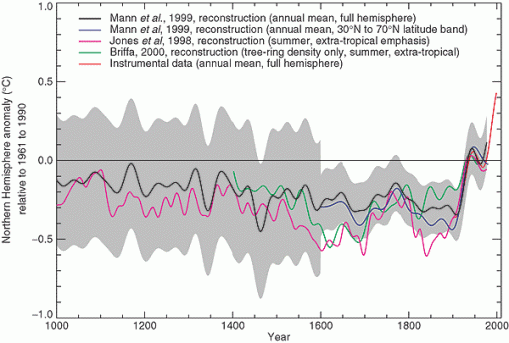
So here’s the question, the press release below mentions sediments. Place your bets now on whether the Tiljander sediment series remains inverted or not. (h/t to Leif Svalgaard) – Anthony
Past regional cold and warm periods linked to natural climate drivers
Intervals of regional warmth and cold in the past are linked to the El Niño phenomenon and the so-called “North Atlantic Oscillation” in the Northern hemisphere’s jet stream, according to a team of climate scientists. These linkages may be important in assessing the regional effects of future climate change.
“Studying the past can potentially inform our understanding of what the future may hold,” said Michael Mann, Professor of meteorology, Penn State.
Mann stresses that an understanding of how past natural changes have influenced phenomena such as El Niño, can perhaps help to resolve current disparities between state-of the-art climate models regarding how human-caused climate change may impact this key climate pattern.
Mann and his team used a network of diverse climate proxies such as tree ring samples, ice cores, coral and sediments to reconstruct spatial patterns of ocean and land surface temperature over the past 1500 years. They found that the patterns of temperature change show dynamic connections to natural phenomena such as El Niño. They report their findings in today’s issue (Nov. 27) of Science.
Mann and his colleagues reproduced the relatively cool interval from the 1400s to the 1800s known as the “Little Ice Age” and the relatively mild conditions of the 900s to 1300s sometimes termed the “Medieval Warm Period.”
“However, these terms can be misleading,” said Mann. “Though the medieval period appears modestly warmer globally in comparison with the later centuries of the Little Ice Age, some key regions were in fact colder. For this reason, we prefer to use ‘Medieval Climate Anomaly’ to underscore that, while there were significant climate anomalies at the time, they were highly variable from region to region.”
The researchers found that 1,000 years ago, regions such as southern Greenland may have been as warm as today. However, a very large area covering much of the tropical Pacific was unusually cold at the same time, suggesting the cold La Niña phase of the El Niño phenomenon.
This regional cooling offset relative warmth in other locations, helping to explain previous observations that the globe and Northern hemisphere on average were not as warm as they are today.
Comparisons between the reconstructed temperature patterns and the results of theoretical climate model simulations suggest an important role for natural drivers of climate such as volcanoes and changes in solar output in explaining the past changes. The warmer conditions of the medieval era were tied to higher solar output and few volcanic eruptions, while the cooler conditions of the Little Ice Age resulted from lower solar output and frequent explosive volcanic eruptions.
These drivers had an even more important, though subtle, influence on regional temperature patterns through their impact on climate phenomena such as El Niño and the North Atlantic Oscillation. The modest increase in solar output during medieval times appears to have favored the tendency for the positive phase of the NAO associated with a more northerly jet stream over the North Atlantic. This brought greater warmth in winter to the North Atlantic and Eurasia. A tendency toward the opposite negative NAO phase helps to explain the enhanced winter cooling over a large part of Eurasia during the later Little Ice Age period.
The researchers also found that the model simulations failed to reproduce the medieval La Nina pattern seen in the temperature reconstructions. Other climate models focused more specifically on the mechanisms of El Niño do however reproduce that pattern. Those models favor the “Thermostat” mechanism, where the tropical Pacific counter-intuitively tends to the cold La Niña phase during periods of increased heating, such as provided by the increase in solar output and quiescent volcanism of the medieval era.
The researchers note that, if the thermostat response holds for the future human-caused climate change, it could have profound impacts on particular regions. It would, for example, make the projected tendency for increased drought in the Southwestern U.S. worse.
Other researchers on the project were Zhihua Zhang, former postdoctoral fellow in meteorology now at the National Oceanic and Atmospheric Administration; Scott Rutherford, Roger Williams University; Raymond S. Bradley, University of Massachusetts; Malcolm K. Hughes and Fenbiao Ni, University of Arizona; Drew Shindell and Greg Faluvegi, NASA Goddard Institute for Space Studies, and Caspar Ammann, National Center for Atmospheric Research.
The National Science Foundation, the U.S. Department of Energy, NOAA, and NASA supported this work.
Discover more from Watts Up With That?
Subscribe to get the latest posts sent to your email.

DocMartyn 18:03
Anyone can download the Greenland ice core d018 isotope data here.
ftp://ftp.ncdc.noaa.gov/pub/data/paleo/icecore/greenland/summit/gisp2/isotopes/gispd18o.txt
The formula for converting the Greenland d018 isotope data into a Temperature Anomaly (and each area is a little different) is:
Greenland Temp Anomaly C = (d018% +13.4)/0.72 + 30.056
And I can confirm that the figures you quoted for the Greenland temperature history are about right (although there is still variability within the averages).
Molon Labe: Sorry about the delay in replying, but Mann et al (2009) leaves me with more questions than answers.
You quoted and asked me to comment on, “They found that the patterns of temperature change show dynamic connections to natural phenomena such as El Niño.”
Mann et al write, “The high-frequency fluctuations of the Niño3 series are consistent with the oscillatory nature of ENSO.”
But then they smoothed it with a decadal filter for their Figure 1 and spliced it to the HADSST2 anomaly data for the NINO3 region.
http://wattsupwiththat.files.wordpress.com/2009/11/mann_326_1256_f1_small.jpg
And of course they failed to note how unreliable eastern equatorial Pacific SST data are before the opening of the Panama Canal in 1914 and without noting the decadal gap in the HADSST2 data for that area from the 1860s to the 1870s.
http://i46.tinypic.com/54d1ue.png
Would that gap in the data bias the NINO3 SST anomalies down during the early decades of the HADSST2 data when smoothed with a decadal filter? It might. Were there El Nino events during that period? Dunno, based on the data. Were there La Nina events? Dunno. Did the frequency and magnitude of El Nino events exceed those of La Nina events, or were La Nina events dominant? No one knows, based on that dataset.
Why did they stop their reconstructed SST data in 1850 and splice the observational reconstruction data onto the end? Why isn’t there an overlap? The proxy SST data doesn’t simply stop in 1850.
Paper by Dr Craig Loehle on non-tree proxies
http://www.freesundayschoollessons.org/pdfs/climate-history.pdf
The corrected section of this paper shows a corrected global temperature reconstruction based on non-tree proxies .[ See Fig2. ]If this graph is more representative of the real past climate , then non of the proxy graphs being debated here come anywhere close to this shape .Clearly MWP was much warmer than now.
Ed (13:02:11) :
“That is why this sort of anecdotal evidence is almost useless and we need hard physical evidence.”
Like tree rings, maybe?
Rational debate:
Hi mate, the BBC man in question is called Paul Hudson and the story of him has now been outed by a leading tabloid (The Daily Mail).
Sorry I can’t add to the science like most of you good folk on here but I may be able to give a perspective as to how this story is being suppressed in the UK.
@Lucy Skywalker (16:30:25)
Hi Lucy,
I’m no expert, but am pretty certain that there’s a huge difference between merely having forest, versus actual structural timber. You can have forests that are of either soft, or crooked, or simply not large enough diameter trees very easily – all of which would be unusable for structural timbers.
As to grape growing in Britian – we’d have to know if the current grapes are special/new cultivars or even genetically engineered to be able to survive in temperatures colder than grapes during the MWP would have been able to survive. Maybe not, but its certainly a consideration that would have to be accounted for before being able to make any determination. I believe I’d read somewhere recently that grapes were grown back then something like 500km (miles?) further north than they are now…
Then there are various reports of MWP treelines being notably further north, and/or higher, in a number of places relative to current day treelines. I believe Canada is one of those areas.
The recent indo-pacific warm pool study of sediments, and so on.
It seems that at the very least we can say the science is not settled, and the WPM could very well have been at least as warm and quite possibly warmer than present day. Significant flaws would have to be found in each of these studies if one were to try to dispute their temperature comparisons/reconstructions.
Which of course says that today could very well be nothing more than natural variation. Which pretty much blows the whole AGW theory right there, in addition to all of the other holes that have been shot thru it over the years, but that have also gone ignored by the AGW machine. I mean, when you have alternative explanations to your theory, that have even a reasonable possibility of being as correct as your theory, then your theory is kaput, at least in that form/evolution because it doesn’t describe or explain the system or data you are studying any more conclusively than other theories.
I think Mann is correct, and I’m not Mann Fan 🙂
Warmth over the Arctic and northern Europe leads to more La NIñas because of excess melting in the Arctic that drives water downward up there and pushes it up in the equatorial Pacific. At the same time, if the Arctic is unusually cold and less melting occurs, less upwelling occurs in the Niño zones, inducing El Niño.
Previous studies support this notion not only due to sediment cores in the tropical Pacific, but also historical events like the downfalls of the Mayans and desert southwest civilizations due to prolonged drought (no doubt tied to persistent La Niña conditions that favor drought in those regions).
Other studies have found that the earth was more or less in a constant state of El Niño during the ice age, suggesting that less Arctic melting and weaker trade winds pushed warmer water eastward in the Pacific.
El Niño and La Niña are a negative feedback loop ultimately caused by weather patterns in the Arctic and north Atlantic.
Even so, some El Niño and La Niña events are purely atmosphere driven and ahve little to do with Arctic melting. These Niño events also tend to ahve the smallest impact on global temps. (Look at large tropical volcanic eruptions and the strong El Niños that tend to form shortly afterward… and yet the planet cools).
I believe a colder planet ultimately results in a persistent state of weak El Niño while a hot planet results in a persistent state of strong La Niña.
I also have theorized that the intensity (though not the cycles themselves) of the PDO is correlated to solar activity. PDO intensity seems to be weaker when the sun is weaker and vice versa. The negative PDO phase of 1945-1975 and the positive PDO of 1977-1998 were very intense cycles that coincided with the strongest sun in centuries.
Again: La Niña is a sign that there is a lot of melting going on but ultimately cools the planet since the massive pool of colder water at teh equator stores energy from the sun… while El Niño is a product of less melting but ultimately warms the atmosphere by releasing some of that stored energy and water vapor into the atmosphere.
Now of course some El Niños and La Niñas are simply reactions to preceding episodes since the ENSO is rarely in balance (like this El Niño likely being a reaction to the strong La Niña in 07/08 and its weak sister last winter).