Personally, I think this has to do with thunderstorms being essentially linear accelerators, vertical SLAC’s if you will. Huge charge differentials from top of cloud to bottom makes for a nice particle slingshot. There’s plenty of opportunity for antimatter (positrons) to be created in energetic collisions from particles coming out of the tops of thunderstorms. Sprites and blue jets for example, may be indicators for energetic particles.

It could also be very energetic photons from lightning as seen in the diagram below. At the high photon energies (twice the rest energy of electrons at 511 keV) and above 1.022 MeV positron-electron pair production may take place. Getting energies of 1.022 million electron volts certainly seems easy enough in thunderstorms. – Anthony
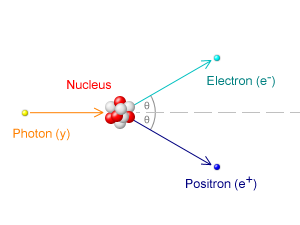
From Sciencenews.org: Signature of antimatter detected in lightning
Fermi telescope finds evidence that positrons, not just electrons, are in storms on Earth

Washington — Designed to scan the heavens thousands to billions of light-years beyond the solar system for gamma rays, the Fermi Gamma-ray Space Telescope has also picked up a shocking vibe from Earth. During its first 14 months of operation, the flying observatory has detected 17 gamma-ray flashes associated with terrestrial storms — and some of those flashes have contained a surprising signature of antimatter.
During two recent lightning storms, Fermi recorded gamma-ray emissions of a particular energy that could have been produced only by the decay of energetic positrons, the antimatter equivalent of electrons. The observations are the first of their kind for lightning storms. Michael Briggs of the University of Alabama in Huntsville announced the puzzling findings November 5 at the 2009 Fermi Symposium.
It’s a surprise to have found the signature of positrons during a lightning storm, Briggs said.
The17 flashes Fermi detected occurred just before, during and immediately after lightning strikes, as tracked by the World Wide Lightning Location Network.
During lightning storms previously observed by other spacecraft, energetic electrons moving toward the craft slowed down and produced gamma rays. The unusual positron signature seen by Fermi suggests that the normal orientation for an electric field associated with a lightning storm somehow reversed, Briggs said. Modelers are now working to figure out how the field reversal could have occurred. But for now, he said, the answer is up in the air.
Recording gamma-ray flashes — which have the potential to harm airplanes in storms — isn’t new. The first were found by NASA’s Compton Gamma-ray Observatory in the early 1990s. NASA’s RHESSI satellite, which primarily looks at X-ray and gamma-ray emissions from the sun, has found some 800 terrestrial gamma-ray flashes, Briggs noted.
anna v (21:58:25) :
If we look at the image provided with this post with the exotic elves and sprites, if there is an accelerator phenomenon it would be there with the fields at the top where the density is very low, no? I am trying to find an open link for a table or figure of density versus height in the atmosphere unsuccessfully .
As for positrons existing transiently anyway, it is true, from decays of isotopes of gasses, but why would they concentrate where the lightening strikes in order to create bursts? Sounds more difficult to find a mechanism than an acceleration phenomenon.
At 86 km height, which is the end of the standard atmosphere model, the density is 6 milligrams per cubic meter. That is far too much gas to allow a needed path length. Maybe once in a very great while some electron performs the unthinkable feat of traveling a meter or two, but is the field in these regions more than million volts per meter? And the article implies that the gammas come from lightning which is much lower and in far denser air.
I just think the signal is so small that I am skeptical of any interpretation, and perhaps skeptical of the observation itself. Please, convince me that there is a reasonable signal strength, that coincidence detectors show that these gammas come from beyond the sensor, and that the events are so unlikely to occur with lightning strikes by chance that we must conclude that lightning produces them. Even then I’ll suggest alternative mechanisms by which pre-existing positrons are involved, though.
Kevin Kilty,
At 96km meters the pressure is 10^-5 atmospheres, and the ionosphere goes up to 1000km I think.
I would expect the densities would be thin enough to allow for the tail of the electron distribution to travel enough and be accelerated. I would need to research this but all relevant articles I can google are behind pay walls. Must be a lucrative business this ionosphere .
*************************
Kevin Kilty (07:32:15) :
I don’t think lightning does this directly…something else is up.
*************************
What about the sea of virtual particles that are always present, even in a vacuum. I might point out there is a lot of space between particles in the rarefied upper atmosphere. All it takes is a field strong enough to pull the virtual particle pair apart to create real particles. In a black hole, gravity accomplishes this by eating one of the pair leaving the other to escape. Could the magnetic fields around lightning be strong enough to do this? What about the electric field?
“”” Kevin Kilty (07:32:15) :
George E. Smith (16:26:05) :
I was speaking at 9:30 of direct conversion of electron KE to the pair of particles. See my 15:30 post about why it is unlikely we can get electrons to a few Mev in the atmosphere.
I don’t think lightning does this directly…something else is up. “””
Well I did catch that Kevin, and I have to admit to being a bit hazy on how such a mechanism would work.
But the important thing is that any such mechanism would produce a pair, so there is no charge creation problem that Jim was hinting at.
As far as I know the only way to get isolated positrons; rather than a pair creation is by the radioactive beta decay of some appropriate isotope; and that would be the result of either spontaneous decay of such an isotope or the result of a nuclear collision with some charged particle; well I suppose it could be neutrons as well generating temporarily on e of these isotopes that beta decays via positron emission.
The table of the isotopes in any CRC handbook of Chemistry and Physics, lists a huge number of positron emitter isotopes; and the ones that aren’t natural may be readily produced in nuclear collisions.
These days, positron emission is hardly earth shattering news; heck you can go to a clinic and get your picture taken inside and out with PET scanners.
People would freak out if you told them you wanted to take their picture with anti-matter.
They already had to change the name of Nuclear Magnetic Resonance imaging (NMR), to just Magnetic Resonance Imaging (MRI) because people freaked out over the “Nuclear” connotations.
I’ve been CAT scanned, and NMR’d; but I haven’t been PET’d yet.
But I don’t think that any free positron is going to hang around anywhere for very long; there’s just too much free electrons everywhere, and those things just like to anihilate positrons as soon as they encounter them.
The problem of gas density seems to be easy to side step.
Imagine a column of gas being heated by a multi-million volt
electric discharge. The gas will heat up. Molecules of gas will
speed away from the center of the column with great energy.
As they leave — radially — from the center of the column, a
vacuum is created. The discharge continues, and some of
the remaining particles get accelerated to very high velocities.
Photoelectric effects or very high local electric fields strip away
electrons, and perhaps even decompose water so there are
free protons around.
In a 100km long discharges happening 10^7 times a day, there will
be plenty of random, transient, high vacuum conditions a few meters
long.
Look at it the other way. How could this _not_ happen. How could
it be prevented?
A quick look at the light elements shows that bB8, 6C10, 6C11, 7N12, 7N13 are all b+ emitters.
None of those are natural isotopes so they would have to be produced in some atmospheric collision; perhaps by cosmetic rays. The 6C10 decay also emitts two gamma rays at 0.72, and 1.04 MeV, and ALL of those b+ decays are characterized by anihilation radiation which is the 511keV gamma from the anihilation of the positron.
The half lives of those beta decays range from 0.78 seconds for the Boron to 20.5 minutes. Well the Nitrogen12 is particularly unstable with a half life of 0.011 sec. But really all of those are relatively long lived compared to some of the transuranic isotopes.
So you need some atmospheric transmutation from CRs or somesuch collision to create one of those isotopes, or else you have to get a pair production event.
Note, that it is the light unnatural isotopes that decay by positron emissions. Then you go through the heavier stable natural isotopes, and then when you get to the heavier unstable isotopes they are b- emitters.
Talking about one element here such as Nitrogen in all its isotopic varieties.
Positron emission turns a proton into a neutron, so the atomic weight remains unchanged, but you go down one in the periodic table, so 7N12, and 7N13 decay to 6C12, and 6C13 respectively, both of which are stable.
So the neutron light isotopes are unhappy about that, and want to move down the periodic table to where they are happier; and conversely if you try to stash too many neutrons in the nucleus, they want to beta devcay by electron emission which turns a neutron into a proton, and moves you up the periodic table to the next element.
The lighter elements like a 1:1 neutron to proton ratio; but as you go higher up the table, it takes a higher fraction of neutrons to keep the nucleus stable.
It also seems that a nuclear neutron capture event from cosmic rays, produces a neutron rich isotope nucleus, which if unstable would decay by regular electron emission. So it would seem that a proton capture event is most likely to result in positron emission, in those lighter atmospheric elements.
Well the lightest positron emitter I could find is 5B8 which b+ decays with a 0.78 second half life. They list the decay energy as 18.0 MeV, and the particle energies as 14.0MeV
6C10 is also a b+ emitter with a 19.0 sec half life. The positron energy is 1.9MeV
6C11 is also a p[ositron emitter, with a 20.5 min half life and a b+ energy of 0.96MeV. There also are two gamma rays of 0.72, and 1.04 MeV.
All three of the above decays are accompanied by anihilation radiation the 0.511 MeV gamma ray from the positron anihilation.
7N12 and 7
I have no idea how the result above occurred; I thought the latter posting got eaten by some trick M$ keyboard slip; but it reappeared after I entered the first item; fancy that.
FROZEN LIGHTNING
http://www.techeblog.com/index.php/tech-gadget/plexiglass-gets-zapped-with-2-2-million-volts-captures-lightning
total protonic reversal!
George E. Smith (11:57:15) :
I think his blog hoster is glyching, or something. My post didn’t appear right away, and then I got an email saying there was a new post, but it wasn’t there until I refreshed my browser a couple of times.
yonason (12:21:16) :
FROZEN LIGHTNING
And with Christmas coming, here it is with the lighted frames…
http://www.capturedlightning.com/frames/interesting.html
Off the thread but not topic, I’d like to propose the notion that blue jets and sprites, and possibly ‘elves’ are on a continuum with solar flares and other similar phenomena.
George E. Smith (11:55:12) :
Radon, which is not light but is a gas and can be found high up and has many isotopes, and has a long decay chain down to the stable lead. There must be a beta+ there somewhere.
I found it in a plot correlating it with ionisation in the atmosphere but do not seem to have kept the link.
Doesn’t matter-antimatter collision create annihilation??? Or is it part of the storm!!!
Chirag Patel (11:45:37) :
Their mass is totally converted into a pair of high energy photons (two particles of light) of a characteristic wavelength, which is why detecting light of that wavelength (energy) is called a “signature.”