 Dr. Roy Spencer sent me a notice of his most recent post in email. He offers an invitation for anyone to help “figure this one out”. The result could be “worse than we thought”. – Anthony
(edited 8/23/09 0710 CDT: Changed plots & revised text to reflect the fact that NCDC, not CRU, is apparently the source of the SST dataset; also add discussion of possible RFI interference in satellite measurements)
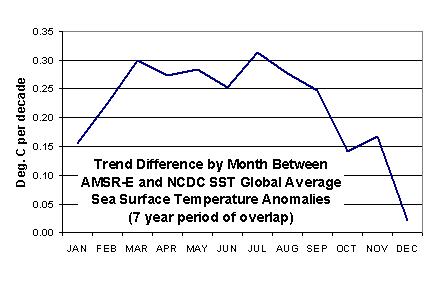
(edited 8/22/09 1415 CDT: added plot of trend differences by month at bottom)
By Dr. Roy Spencer
In my previous blog posting I showed the satellite-based global-average monthly sea surface temperature (SST) variations since mid-2002, which was when the NASA Aqua satellite was launched carrying the Advanced Microwave Scanning Radiometer for EOS (AMSR-E). The AMSR-E instrument (which I serve as the U.S. Science Team Leader for) provides nearly all-weather SST measurements.
The plot I showed yesterday agreed with the NOAA announcement that July 2009 was unusually warm…NOAA claims it was even a new record for July based upon their 100+ year record of global SSTs.
But I didn’t know just HOW warm, since our satellite data extend back to only 2002. So, I decided to download the NOAA/NCDC SST data from their website — which do NOT include the AMSR-E measurements — to do a more quantitative comparison.
From the NOAA data, I computed monthly anomalies in exactly the same manner I computed them with the AMSR-E data, that is, relative to the June 2002 through July 2009 period of record. The results (shown below) were so surprising, I had to go to my office this Saturday morning to make sure I didn’t make a mistake in my processing of the AMSR-E data.
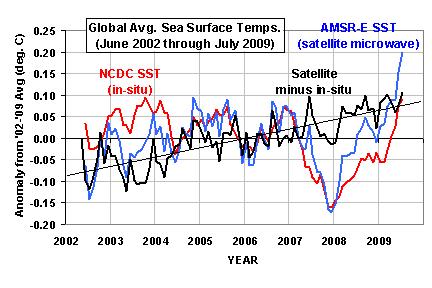
As can be seen, the satellite-based temperatures have been steadily rising relative to the conventional SST measurements, with a total linear increase of 0.15 deg C over the 7 year period of record versus the conventional SST measurements.
If the satellite data are correct, then this means that the July 2009 SSTs reached a considerably higher record temperature than NOAA has claimed. The discrepancy is huge in terms of climate measurements; the trend in the difference between the two datasets shown in the above figure is the same size as the anthropogenic global warming signal expected by the IPCC.
I have no idea what is going on here. Frank Wentz and Chelle Gentemann at Remote Sensing Systems have been very careful about tracking the accuracy of the AMSR-E SST retrievals with millions of buoy measurements. I checked their daily statistics they post at their website and I don’t see anything like what is shown in the above figure.
Is it possible that the NCDC SST temperature dataset has been understating recent warming? I don’t know…I’m mystified. Maybe Frank, Chelle, Phil Jones, or some enterprising blogger out there can figure this one out.
UPDATE #1 (8/22/09)
Here’s the trend differences between the satellite and in-situ data, broken out by calendar month. The problem seems to be mainly a Northern Hemisphere warm season phenomenon.
UPDATE#2 (8/23/09)
Anthony Watts has suggested that the radio frequency interference (RFI) that we see in the AMSR-E 6.9 GHz data over land might be gradually invading the ocean as more boats install various kinds of microwave transmitters. While it’s hard for me to believe such an effect could be this strong (we have never seen obvious evidence of oceanic RFI before), this is still an interesting hypothesis, so this week I will examine the daily 1/4 deg. grids of AMSR-E SST and compute a spatial “speckle” statistic to see if there is any evidence of this kind of interference increasing over time. I should note that we HAVE seen more RFI reflected off the ocean from geostationary TV communication satellites in the AMSR-E data in recent years.
UPDATE#3 (8/24/09)
OK, gang, this is what I found out today before having to leave work. I downloaded the monthly grids of SST from NCDC (both their v2 and v3b products), and I computed the monthly anomalies at each gridpoint relative to the June 2002 through July 2009 period (since that is the period we have AMSR-E measurements for).
I then differenced the later part of the period (since 2007) with the earlier part (during and before 2004), separately for the NCDC and AMSR-E products.
Then I differences THOSE differences.
What it shows is that AMSRE has either spuriously warmed, or NCDC has spuriously cooled, by 1 to 2 deg C over all of the ‘warmer’ waters of the globe. The problem seems to diminish and then go away poleward of about 30S latitude, and poleward of 45N latitude.
This does NOT look like an RFI issue…it is too uniform spatially. Someone has made a major boo-boo…and I hope it isn’t me. 🙂
I have a hunch that the TLT data is more sensitive to volcanism than the SST data.
Gary (05:30:47) :
As one of a team who performed insight/oversight to the AMSR-E thermal design for the Aqua program, I can relate that the warm calibration target design was suspect, with a gradient issue. As a foreign “gift” instrument, our influence in getting the design issue addressed was inadequate. Not sure if this has anything to do with the observed trend, but just another tidbit to consider.
Gary-
As the system is passive, is it calibrated to a known source and are the
results uplinked or generated internally? Is there a bias table and
can it be updated? …….How is it calibrated?
Anthony, Roy, someone: can I access some type of “guide to calibration” for the satelliet measurements?
I just wondered what effect suspended plastic particulates in the ocean would have on;
a) sensor malfunction
b) the correct reading of temperatures whether by buoys or satellites.
http://en.wikipedia.org/wiki/Great_Pacific_Garbage_Patch
This patch seems to be the size of the arctic ice cap and there are others like it drifting round the world. Interestingly such patches can’t be seen by satellites.
tonyb
Richard (15:02:40) :
I remember Tallguy (where has he gone?) had a hypothesis that geothermal heat could have a significant impact on the climate.
Working away this last week.
I make no claims for the degree of geothermal heat transfer, as there is no good global data as far as I can see. I simply note that it will vary with the changing depth of sub crustal currents evidenced by changes in the earth’s length of day, and will be non zero in magnitude.
Bob Tisdales graph of southern ocean temperatures against south of southwest of Pacific tempreatures is very interesting. It seems to lend some support to my main hypothesis that the oceans have somewhat distinct heat absorption and heat release modes, with the currents that drive them possessing a momentum and inertia which are probably linked to the ~60 year oceanic cycles we have seen in the SST record.
The big swings in the high latitude southern ocean at the end of the C19th seem to coincide with the big el nino events which stand out from my temperature model derived from sunspots and LOD variation. To me this indicates that these heat release events are drivien by the ocean’s need for internal adjustment to changing external conditions.
Another question about the measurement: If the satellite measures 6.9 GHz energy, assuming amplitude, how much amplitude change occurs with a 1 degree change in surface temperature? How accurately can that amplitude be measured? There is a big difference between resolution and accuracy.
Microwave receivers drift with time. For consumer items like cell phones, it doesn’t matter as they ‘measure’ frequency change (FM or one of it’s derivatives). But for amplitude measurements, you need a very stable signal processing chain. How do they claim to make this work? How do they verify it?
I think there is more to this than just ships, satellites, and adjustments. The infrared budget is a key component. Sensors in/on the ocean measure temperature directly at a deeper depth. Satellites measure heat based on the infrared budget at the outer edge of the atmosphere. What, if any, differences do we see there during this discrepant period?
Bob Tisdale (03:29:08) :
Tom in Texas: You asked, “Have you added 2.4°C to the AVHRR data and plotted?
“Graph from here: http://i30.tinypic.com/23ws5tv.png”
To what end?
Bob, I find it more instructive, when comparing trends, to start those trends at the same point. In your graph, adding 2.4°C to all the AVHRR data will raise its trend line to begin at same initial point.
wattsupwiththat (21:49:01) : 6.9GHz hotspots… “The problem seems to be mainly a Northern Hemisphere warm season phenomenon”
So there’s a possible contamination from ‘6.9GHz hotspots’. A frequency interference on satellites recordings working a same effect as an UHI on surface stations? Will there be a volunteer photo crew on this one too?
6.9GHzHotSpots.org ? 😉
WUWT is fantastic!
If I understand this and the data sets are correct then over the last seven years something has been warming the skin of the oceans exclusively. Is there anything that can do that? I can’t imagine there are a lot of things, maybe a component of solar radiation or ocean water, maybe the atmosphere. If those things can’t explain it then one of the data sets is wrong. How likely is it that the direct physical measurements of buoys and ships are systematically wrong? Wouldn’t their errors more likely be random? How likely is it that the satellite measurements are systematically wrong?
SSMRs measure a surface “brightness temperature” signal, which is dependent upon wind-generated wave slopes and whitecaps that increase that brightness. This is not a direct themometric measurement. The SST estimates are obtained via a complicated, nonunique mathematical inversion process that relies upon judicious choice of frequencies, polarizations and incidence angles. To expect very high coherence between the resulting global monthly averages and those of surface-based thermometric readings is a bit much, given the distinctly different measurands (and geographic coverage) involved. Discrepancies of a few tenths of a degree should be fully expected. While the apparent trend of discrepancies may strike some as very significant, the short time interval of seven years cannot provide an adequate basis for any far-reaching inferences. Given the broadband cyclicalty of climate variables, that “trend” should be quite volatile. If it persists, then sensing and/or signal processing issues should be adressed first.
vukcevic (07:07:31) :
However, I am coming to a conclusion that correlation is not direct, but result of some intermediary factor, but it appears not to be the Svensmark’s effect.
If you tell us which station(s) are used for the graph then we can accurately calculate the component for any time half of the last 1000 years, so can extend the graph that far.
vukcevic (05:28:47)
Links to updated charts on temperature-geomagnetic anomaly
Please note the geomagnetic anomaly gradient is negative
http://www.vukcevic.co.uk/TGa.gif
http://www.vukcevic.co.uk/TGc.gif
Vukcevic, how exactly are you calculating your anomalies?
Gary (05:30:47) “[…] the warm calibration target design was suspect, with a gradient issue.”
Can you elaborate (in layman’s terms)?
Hmmm … 6.9 GHz is second harmonic to 3.45 GHz which is encompassed by the 3.5 to 3.7 GHz WiMax et al spectrum (varies on globally; different bands in different countries).
We have/there are requirements for harmonic emissions for this equipment (both infrastructure and subscriber hardware), as well as radiated emission limits from the chassis/radio hardware itself, but, all these values are finite; there is no such thing as infinite attenuation of shielding effectiveness, and today’s markets support only meeting spec (ETSI or FCC) with not a lot of margin to spare (certainly not an order of magnitude.)
Also note that 6.9 GHz is 3rd harmonic for 2.3 GHz WiMax gear and other occupiers of that particular spectrum …
There are other issues that even the WiMax folks have to deal with, like satellite services that occupy the 2.3 GHz band, as discussed here:
COMPATIBILITY OF SERVICES USING
WiMAX TECHNOLOGY WITH
SATELLITE SERVICES IN THE
2.3 – 2.7 GHz AND 3.3 – 3.8 GHz BANDS
Full disclosure: This be the ‘bidness’ I’m currently involved in.
.
.
tallbloke (09:26:38) “Bob Tisdales graph of southern ocean […] is very interesting. […] The big swings in the high latitude southern ocean at the end of the C19th seem to coincide with the big el nino events […]”
I noticed that – and it’s also late C20th:
http://i41.tinypic.com/2q20f88.jpg
http://i44.tinypic.com/a331xv.jpg
– –
tallbloke (09:26:38) “[…] the changing depth of sub crustal currents evidenced by changes in the earth’s length of day […]”
Can you provide references &/or links to materials that are influencing your thinking here tallbloke?
Leif Svalgaard (11:34:17) :
If you tell us which station(s) are used for the graph then we can accurately calculate the component for any time half of the last 1000 years, so can extend the graph that far.
Correlation is high, but it would be wrong to finally conclude that one is cause of the other; it is more likely that there is a common modulating factor, while each has a fundamentaly independent driver.
John S. (11:32:46) “[…] nonunique mathematical inversion process that relies upon judicious choice of frequencies, polarizations and incidence angles […] distinctly different measurands (and geographic coverage) […] the short time interval of seven years cannot provide an adequate basis […] “trend” should be quite volatile.”
As often, thanks for the valuable notes.
–
Bob, the KNMI Climate Explorer site is great. Thanks.
–
Basil, your graphs are instructive. Comparing the amplitude-variation & phase-relation patterns in your plots suggests further lines of questioning…
Tom in Texas (10:00:52) :
Bob, I find it more instructive, when comparing trends, to start those trends at the same point. In your graph, adding 2.4°C to all the AVHRR data will raise its trend line to begin at same initial point.
Tom
Tom, did you mean to write 0.24C instead of 2.4C?
Paul Vaughan (12:15:33) :
Vukcevic, how exactly are you calculating your anomalies?
Temperature data is readily available. Magnetic data is normalised to the same scale for the period (1900-2005, variations are wide) and an average (negative) gradient calculated; the result is then normalised to the temperature scale. In the absolute terms, obviously temperature (deg.K) varies less than +-0.2%, while magnetic field variations are much greater but far less erratic.
Aaron Wells (13:38:32) : “Tom, did you mean to write 0.24C instead of 2.4C?”
Yes, sorry. My point was that its easier to compare the wiggles when the trends originate at the same point (much the same thing as using anomalies).
Bill Illis (12:43:45) :
The trend differential between AMSE-R minus the CRU SST in-situ data as well according to the RSS validation data. The average is +0.035C per decade but there is wide dispersion amongst the different methods of in-situ measurement:
+0.066C per decade for ship engine intake
-0.104C per decade for moored bouys
-0.027C per decade for drifting bouys
+0.077C per decade for ship bucket
+0.165C per decade for ship hulls
Possibilities
(1) too little data for these differences to be significant
(2) they are a product of different (and somewhat arbitrary) corrective factors
(3) they point to real differences eg Are moored buoys nearer land than drifting buoys? Do buoys generally cool more due to wind evaporating spray, a factor missing from ship hulls? Have wind effects (not just hurricanes) subsided? Above all, are land, sea-above-surface, and sea-below-surface affected differently by a changing Sun? Does land cool with quiet sun while oceans warm? The hemispheric difference is surely a big clue.
That 6.9 Ghz is a 10x multiple of UHF channel 50-52 (at 686-704 Mhz).
While it’s “anecdotal” my son reports significant increases in interference with various wireless equipment since the “Digital TV” cutover hit. I’ve noticed degradation of my computer wireless connection as well.
The digital modulation method looks to me like it could easily generate a large number of harmonics and sidebands. And TV stations broadcast with rather very large power. Oh, and seasonally, the power output changes. There is a requirement that power be reduced (at least for radio, and I think for Digital TV still) at sundown with ionospheric propagation changes. That could account for some of the seasonal variation…
Yes, all speculative, but I’ve seen more interference caused by less…
I would also tend to look for how the solar changes have changed the ionized layers of the atmosphere and how those might impact transmissivity as well as ground sourced signal propagation / reflection. With the air a lot thinner right now, I could easily see a marginal “noise” source becoming significant as it crosses a sensitivity threshold.
Basically, we’re putting one heck of a lot more kW into the upper MHz and GHz ranges. To expect equipment to be immune to any effect is a bit daft.
OT perhaps, but here’s a quote from a news article that concerns me:
“[…] the new, denser, shrubbier tundra could speed up global warming even further simply because that vegetation is darker and absorbs more solar energy. Previous studies have suggested that a global spread of thicker plant growth on the tundra could have the same effect as doubling the amount of carbon dioxide in the atmosphere.”
http://www.ctv.ca/servlet/ArticleNews/story/CTVNews/20090823/climate_tundra_090823/20090823?hub=SciTech
As an ecologist I find the spin on this story truly irksome. I appreciate that a good funding-hook is part of survival for a researcher and I also love any excuse to be around fiords, but the polished & sophisticated storyline does not tell the whole truth, so deception needs to be called.
I note that the article points out that, “other researchers […] soon start reporting results from similar experiments in other parts of the world.”
Anthony, I know you have a few contacts – maybe you know someone scientifically qualified to put the significance of insolation at that latitude into perspective (relative to, say, the role of convection from the south) and provide commentary moving forward as these “other” studies come out “soon”. I’ve got all the background I need to assess the claims about the plant ecology & range shifts, but I would certainly appreciate a (concise) relative/comparative look at the elements of the physical energetics.
– –
Re: vukcevic (13:54:50)
My question is about how you calculate your “magnetic anomalies”. Are you using aa index? Are you calculating a “climatology” and then subtracting it? If so, based on annual cycles? – other cycles? Are you differencing? (If so, at what step-size?) Are you smoothing? (If so, what bandwidth?) In order to judge your work, I need to be able to reproduce it. Perhaps semantics are getting in the way, but that should be easy enough to overcome. Your graph is interesting. Maybe you can provide a ‘Vukcevic’s-magnetic-anomaly-calculation step-by-step-for-idiots’ cookbook recipe?
[ :