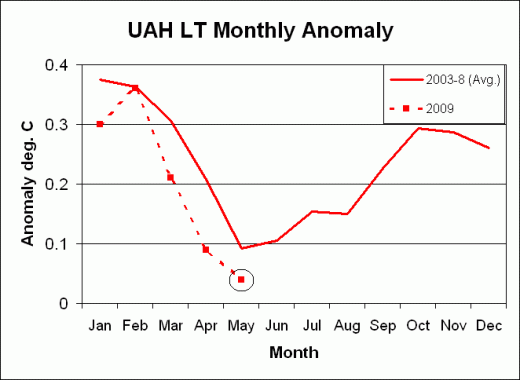
As promised, I contacted Dr. John Christy regarding the seasonal signal that the anonymous blogger “deepclimate” says he/she has identified in the UAH data, seen below. He/she says: “I am a Canadian citizen residing in Canada. For private and professional reasons, I prefer to remain anonymous to the general public, at least for now.”
I’ve never understood the need for some people to remain anonymous while at the same time attempt to do science. Imagine the furor if scientists like Christy or Spencer created an anonymous blog and then were later discovered. I’m sure it would be immediately up there on sourcewatch with “tsk tsk” attached.
Science really should be done out in the open. Here’s Dr. Christy’s in the open response.
Dr. Christy has made a response in the readme file at the UAH website here:
http://www.nsstc.uah.edu/data/msu/t2lt/readme.18Jul2009
Update 18 Jul 2009 ************************************
Corrected trend values (1700 CST)
It was brought to my attention by Anthony Watts that there has been some discussion about the noticeable annual cycle in the LT and MT trends when done by months. In other words, the trend for Februaries is on the order of 0.12 C/decade warmer than the trend for Mays. Other data sets don’t have such a large range in trends when calculated by months, RSS for example has a range of 0.05 C/decade. (Note, this issue doesn’t affect the overall trend.)
The feature arises when the AMSU data are adjusted and merged into the MSU data stream beginning with NOAA-15 in Aug 1998, then carries forward with NOAA-16 and AQUA (both of which are AMSUs too). The process involves at one point
the removal of a mean annual cycle in the anomaly differences from one satellite to another. It turns out that all satellites have a residual annual cycle due to each instrument’s peculiarities. In the end, all annual cycles are matched to NOAA-6 and NOAA-7.
Detecting the impact of this peculiarity is difficult. For example, it is not seen when
gridded data are directly compared against radiosondes (see Christy
and Norris 2006 and 2009.) However, an annual cycle in the difference time series is clear in RSS data when compared with balloons (see Fig. 2 of both papers.)
I’ve tested a number of alternate processing methods (basically versions of
not removing the annual cycle in the difference time series from the first
AMSU onward) and the range from the highest to lowest is reduced
to just under 0.09 C/decade. This in effect establishes a new annual
cycle for the AMSUs based on the first AMSU.
I think the magnitude of the annual cycle in the monthly trends is a
legitimate problem to address. The range in the current v5.2 LT looks too large
(about 0.12 C/decade). However, one should expect differences from month to month, especially when ENSOs and a volcano have different impacts by months so
so the range shouldn’t be zero. I’ll keep looking into this and if a
reasonable result is produced, I’ll rename the dataset v5.3.
The important point in all of this is that the overall global trend of the entire
time series ranges insignificantly from +0.123 to +0.125 C/decade even
under the different merging methods used to date. This is because the removal of the annual cycle of differences from satellite to satellite does not add any bias
to the time series, so the overall trend doesn’t change.
FWIW, According to the domain registration history, DeepClimate belongs to Dave Clarke of the band Steel Rail in Canada.
http://steelrail.ca
Robert A Cook PE (08:14:58) : Statements can be fact checked without knowing from whom they come. I kind of like judging the content rather than the source. This leaves out all the human biases like status and such, and just highlights the idea or content.
tallbloke (01:51:23) : Actually, guys, what is happening is the Earth is expanding as it cools and further solidifies 🙂
So HADCRU comes in as the 3rd warmest on record, NCDC as the 2nd warmest, with the warmest SST’s for the month on record and GISS as the 2nd warmest.
Why oh Why can’t some people accept that Christy is so far out for his monthly anomaly that it beggars belief.
Currently UAH data is running around 0.5C ahead of July this time last year, I wonder what the monthly anomaly will be come 2 mins past midnight on the 1st of August.
To me it’s obvious that before the 98 El Nino UAH was the last of the datasets to start the sharp upward trend, the same is happening this time, July will pop up to be the 4th or 5th warmest on record for UAH and guess what, WUWT probably won’t run the story……
The Iceberg (12:27:54) : Is the methodology used for HADCRU data processing public?
Jim (12:27:54) I guess the iceberg doesn’t think it is important to reveal methodology for replication. WUWT? would likely run THAT story if it was revealed.
David Ball (21:11:19) : Yep, an “inconvenient question” I suppose.
” Jim (12:57:41) :
The Iceberg (12:27:54) : Is the methodology used for HADCRU data processing public?”
Is the methodology of UAH processing public?
Jack (12:31:58) :
“” Jim (12:57:41) :
The Iceberg (12:27:54) : Is the methodology used for HADCRU data processing public?”
Is the methodology of UAH processing public?”
Good question! I’ll ask.
I noticed that Dave Clarke lives in the same town as Andrew Weaver, and that they seem to have the same climate perspective (hmmmmm). Interesting that Dave Clarke wants to remain anonymous and that Andrew Weaver will not debate Dr. Tim Ball in an open forum. Hmmmmmm, … Typical AGW tactics. The tactics of cowards who know they are wrong. Bring it, boys, ….
To Tallblock, and Smokey, and David Ball… We have eviscerated the rather ill-advised attempt to compare the monthly UAH June global anomaly, with GISS or NOAA or HadCRU. This was the point of several WUWT posts.
Isn’t it true that even the UAH scientists are shying away from directly comparing their monthly anomalies with the other records? I see no real scientific support at all for the WUWT comparisons.
You say Bring it, boys. We brought it, and lets face it, the WUWT regulars lost this argument. Get over it. You don’t have any legs left to stand to on to support the comparisons made here.
Changing the subject to arcane minutiae of how the anomalies are calculated won’t change the major issue here. The monthly UAH data cannot be compared directly with the GISS data, and even the UAH guys say that they don’t question specific GISS monthly data.
Paul K (19:12:28):
Why the hell not??
With CO2 rising and the planet’s temperature falling, your falsified CO2=AGW hypothesis is in shambles. Forget skeptics, the planet itself is laughing at your hubris.
Paul K (19:12:28) : You are correct that a direct comparison cannot be made, but wrong about what that means. In point of fact, the comparison should be between UAH/1.2 to a surface data set (preferably not GISS, which extrapolates over the area very near the poles where no one else does, and which seems to cause the temps in GISS to behave oddly in terms of fluctuations.
The reason why is that we expect the LT change to be greater than the surface change. Of course, even ignoring the caveats, one can see that the expectation of greater warming aloft than at the surface doesn’t hold up, strongly suggesting that something is amiss with either 1. Theory 2. Models 3. Data or some combination (note that if theory is wrong, the models are also wrong).
Hardly suggests to me a “loss” for WUWT and a “win” for sophomoric dopes who declare victory based on the fact that a battle is over, before making body counts…
Try again guys, do the scientists behind the UAH data support your arguments in attacking the GISS monthly data? This is what WUWT tried to do, and they failed, and for good reason. The different temperature records can only be compared over the long term (15+ years) and only by qualitatively comparing the warming trend ( K/decade) in each temperature record.
The short term comparisons attempted here turned out to be flawed. And the UAH scientists do not support the use of UAH monthly data to attack GISS monthly data. The different temperature records measure different variables, with different assumptions, often with different base periods (for calculating the anomalies). Give it up, and get over it.
Paul K (21:42:20) : “The different temperature records can only be compared over the long term (15+ years) and only by qualitatively comparing the warming trend ( K/decade) in each temperature record.”
Aside from the fact that you say qualitative when you mean quantitative-why don’t you try actually doing such a comparison? I told you what such a comparison, if done properly (or even not done properly) would say-GISS has a warm bias. Your misdirection to the issue of month to month variability is odd, surely it is the trend comparison which really matters-SO TRY DOING ONE SOME TIME! Call us back to tell us to give up when you have done a comparison to find the difference in trends.
Do your homework lassy, or don’t come back to school at all.
Jack (12:31:58) : ” Jim (12:57:41) : The Iceberg (12:27:54) : Is the methodology used for HADCRU data processing public?” Is the methodology of UAH processing public?
Here is the UAH documentation. As you can see, UAH have been very public with their methodology – now where is the HADCRU documentation?
Spencer, R.W., and J.R. Christy, 1992: Precision and Radiosonde Validation of Satellite Gridpoint Temperature Anomalies. Part I: MSU Channel 2. J. Climate, 5, 847–857.
Spencer, R.W., and J.R. Christy, 1992: Precision and Radiosonde Validation of Satellite Gridpoint Temperature Anomalies. Part II: A Tropospheric Retrieval and Trends during 1979–90. J. Climate, 5, 858–866.
Christy, J.R., R.W. Spencer, and R.T. McNider, 1995: Reducing Noise in the MSU Daily Lower-Tropospheric Global Temperature Dataset. J. Climate, 8, 888–896.
Christy, J.R., R.W. Spencer, and E.S. Lobl, 1998: Analysis of the Merging Procedure for the MSU Daily Temperature Time Series. J. Climate, 11, 2016–2041.
Christy, J.R., R.W. Spencer, and W.D. Braswell, 2000: MSU Tropospheric Temperatures: Dataset Construction and Radiosonde Comparisons. J. Atmos. Oceanic Technol., 17, 1153–1170.
Christy, J.R., R.W. Spencer, W.B. Norris, W.D. Braswell, and D.E. Parker, 2003: Error Estimates of Version 5.0 of MSU–AMSU Bulk Atmospheric Temperatures. J. Atmos. Oceanic Technol., 20, 613–629.
Christy, J. R., W. B. Norris, R. W. Spencer, and J. J. Hnilo (2007), Tropospheric temperature change since 1979 from
tropical radiosonde and satellite measurements, J. Geophys. Res., 112, D06102, doi:10.1029/2005JD006881.
Christy, J.R., and W.B. Norris, 2009: Discontinuity Issues with Radiosonde and Satellite Temperatures in the Australian Region 1979–2006. J. Atmos. Oceanic Technol., 26, 508–522.
Paul K (21:42:20) : “Try again guys, do the scientists behind the UAH data support your arguments in attacking the GISS monthly data?”
What the %*&!@ur momisugly# does that have to do with anything? The computer code behind the GISS data is what matters, along with the sparsity of the monitoring stations, the frequent station moves, removing stations, citing stations on concrete, asphalt, and tarmac, the list is just too long!! The fact is that GISS is useless for climate research. I’m betting the same is true for HADCRU – otherwise they would quit hiding behind this and that excuse and publish it for all the world to see. The sad truth is that because GISS has been so badly managed, we don’t have any reliable land/sea surface temperature data for the last 100 – 200 years.
>Jim (06:53:55) :
>Here is the UAH documentation.
Jim,
Thanks for a good list of publications. I’ll try to look into them.