As promised, I contacted Dr. John Christy regarding the seasonal signal that the anonymous blogger “deepclimate” says he/she has identified in the UAH data, seen below. He/she says: “I am a Canadian citizen residing in Canada. For private and professional reasons, I prefer to remain anonymous to the general public, at least for now.”
I’ve never understood the need for some people to remain anonymous while at the same time attempt to do science. Imagine the furor if scientists like Christy or Spencer created an anonymous blog and then were later discovered. I’m sure it would be immediately up there on sourcewatch with “tsk tsk” attached.
Science really should be done out in the open. Here’s Dr. Christy’s in the open response.
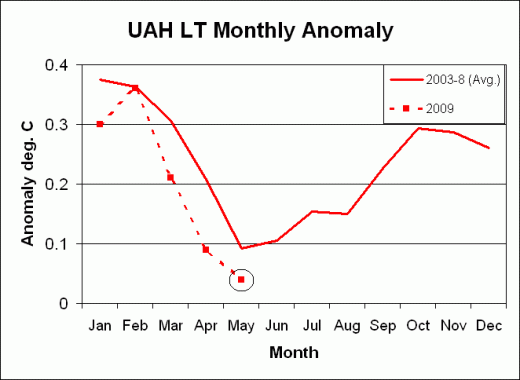
Dr. Christy has made a response in the readme file at the UAH website here:
http://www.nsstc.uah.edu/data/msu/t2lt/readme.18Jul2009
Update 18 Jul 2009 ************************************
Corrected trend values (1700 CST)
It was brought to my attention by Anthony Watts that there has been some discussion about the noticeable annual cycle in the LT and MT trends when done by months. In other words, the trend for Februaries is on the order of 0.12 C/decade warmer than the trend for Mays. Other data sets don’t have such a large range in trends when calculated by months, RSS for example has a range of 0.05 C/decade. (Note, this issue doesn’t affect the overall trend.)
The feature arises when the AMSU data are adjusted and merged into the MSU data stream beginning with NOAA-15 in Aug 1998, then carries forward with NOAA-16 and AQUA (both of which are AMSUs too). The process involves at one point
the removal of a mean annual cycle in the anomaly differences from one satellite to another. It turns out that all satellites have a residual annual cycle due to each instrument’s peculiarities. In the end, all annual cycles are matched to NOAA-6 and NOAA-7.
Detecting the impact of this peculiarity is difficult. For example, it is not seen when
gridded data are directly compared against radiosondes (see Christy
and Norris 2006 and 2009.) However, an annual cycle in the difference time series is clear in RSS data when compared with balloons (see Fig. 2 of both papers.)
I’ve tested a number of alternate processing methods (basically versions of
not removing the annual cycle in the difference time series from the first
AMSU onward) and the range from the highest to lowest is reduced
to just under 0.09 C/decade. This in effect establishes a new annual
cycle for the AMSUs based on the first AMSU.
I think the magnitude of the annual cycle in the monthly trends is a
legitimate problem to address. The range in the current v5.2 LT looks too large
(about 0.12 C/decade). However, one should expect differences from month to month, especially when ENSOs and a volcano have different impacts by months so
so the range shouldn’t be zero. I’ll keep looking into this and if a
reasonable result is produced, I’ll rename the dataset v5.3.
The important point in all of this is that the overall global trend of the entire
time series ranges insignificantly from +0.123 to +0.125 C/decade even
under the different merging methods used to date. This is because the removal of the annual cycle of differences from satellite to satellite does not add any bias
to the time series, so the overall trend doesn’t change.
The anonymous poster might be better off adopting a silly nom de plume like “the platypus,’ ‘oddsbodkins,’ or ‘Tamino,’ for example. Some people will then inevitably give them some counterculture streetcred they might not otherwise attain anonymously.
Jim, regarding the GISS temperature record… Prove to me the claims you make in your post are correct.
First, what is the trend for the US land stations for the ‘best stations’ that Mr. Watts has identified versus the trend for the worst? You imply in your post that there should be a 1 to 2 degree difference. Does the data show this? Please link to the analysis supporting your claims.
Secondly, the US land measurements only cover 2% of the globe. The highest warming is in the higher latitudes such as the Arctic and Siberia, and over the oceans. This is what we would expect if global warming was heating the oceans, and reducing the outflow of heat from the polar regions. All of this contradicts your simple minded extrapolation of land station data to entire surface of the Earth.
These inaccuracies have been debunked so many times, that one science reporter, Peter Sinclair has made some videos on this, that even non-experts can review and see the logical errors in the theory you espouse.
For me, I find that Mr. Watts and the commentators here are focussed too much on minor details or short data periods, and are missing the overwhelming big picture. As I posted, sea level rise clearly shows ocean heating over the long term, with swings in the data that seem to be caused by ENSO and other ocean cycles. I have read over and over how some here claim global warming stopped in 1998. Yet the sea level has risen significantly since 1998, and the bulk of that rise is due to the thermal expansion of water. This is overwhelming evidence of ocean heating, and the minor temperature swings in the atmospheric record would be caused by much less heat than the major heat build in the oceans.
Dr. Roger Pielke Sr. is correct that ocean heating is the key metric to measure global warming, and SLR is the most robust metric to reflect this heat build. Just look at the graph of SLR since 1998, and realize that we are leaving a La Nina period…
The SLR graph clearly shows a major build of ocean heat since the mid 90s.
http://sealevel.colorado.edu/current/sl_ib_ns_global.jpg
The focus of the posts on WUWT on US land station data, and month to month variation in the global anomalies, and trying to compare the month to month numbers of the various temperature records, and all the anecdotal “its cold here today” posts, are off-target and missing the most overwhelming pieces of evidence shows the planet is heating.
Christy:
“It turns out that all satellites have a residual annual cycle due to each instrument’s peculiarities.”
As you go an look at the AMSU-A at http://discover.itsc.uah.edu/amsutemps/execute.csh?amsutemps, you notice that the cycle is more than 5 degrees F.
With this level of instrumental error, what is the credibility of the satellite measurements at all? It is not evident that the trend becomes correct after such huge corrections needed.
Paul K (13:14:41) : The GISS temperature methods are published after all, along with the computer code. However, the description of adjustments apparently isn’t laid out in a clear, step-by-step manner; so at least some of the original criticism remains. The GISS adjustments should be spelled out in a crystal clear manner.
Moderator, these links might work, last post was bad! Thanks.
Is there a connection between DeepClimate and this Dave Clarke guy? DC, geddit? He’s the domain registrant and also these searches are revealing.
http://www.google.com/search?q=%22dave+clarke%22+site%3Aclimateaudit.org
http://www.google.com/search?q=%22dave+clarke%22+site%3Arealclimate.org
BTW Cassandra, the DC out of the Dave Clark Five lacked an ‘e’ at the end of his surname.
Paul K,
You say: “Prove to me the claims you make in your post are correct.” While at the same time you give erroneous information. For example:
The ARGO buoys do not show any warming at all, so you’re wrong about ocean warming. In fact, they show a slight cooling. And global temperatures are normal.
I understand that you global warming alarmists are truly agonizing over the plain fact that there is no global warming currently going on. And there is no unnatural coral bleaching. And there is no measurable change in ocean acidification. And global sea ice isn’t declining, it’s increasing. And the polar bears aren’t drowning, they’re increasing, too. And the sea level is not rising any more now than it has since the pre-SUV LIA. And the ozone hole is still there like it always is, causing no harm. And CO2 is not harmful, it is beneficial; more is better. Etc., etc.
In fact, just about every claim made by the alarmist crowd over the past twenty years has turned out to be flat wrong. Being consistently wrong means it’s time to stop digging that AGW hole, don’t you think?
It may surprise you, but the sea level rises and falls predictably: click. Trying to blame it on human activity is a fool’s errand.
[for the record, this comment was empty as received. Either Paul K left it empty or put code it that was removed by WordPress. I’m posting this so he doesn’t “jump to conclusions” and say he’s being censored” again – Anthony]
Adam from Kansas wrote: “Though with recent stories of below average temperatures around the globe one may wonder what the exact reason is.”
There are also recent stories of above average temperatures around the globe, but you won’t see them reported here. I’d rather not see any of those, either way. ENSO, SLR, Methane emissions, (minimum) Arctic Sea Ice Extent etc. are much more interesting subjects. Which also get their fair share here most of the time, BTW.
Well the people who spray graffitti all over public places like to have anonymity too; they want you to read their messages; specially the ones in public rest rooms; but they don’t want to admit the did it.
It’s very similar to the message; “We have no quarrel with those who offer their wares for sale for less; they after all should know just what their stuff is worth !
One reason, why I don’t believe anything I read in ANY newspaper, that comes form some “usually reliable source”, or some “high placed White House official” or sources who wish to remain anonymous, is because among the things that it is the public’s right to know: the gospel of all news reporters, is the original source of that “information”. Without that the public has no way to place a credibility index on the story.
Anonymous “information, isn’t worth the paper it is printed on.
Smokey, I hate to break this to you, but the Argo buoys don’t measure sea level rise.
Sea level rise is a terrific way to measure ocean heating, which is why Dr. Roger Pielke Sr. is obsessing with the short term trend in SLR. The Argo buoys try to measure OHC using upper level ocean temperatures over the entire planet. The Argo system won’t measure variables like increased upwelling of deeper ocean waters. It is going to take some time to understand the Argo data, and independently confirm it with heat balance calculations.
But SLR is a robust measurement, and the amount of the rise due to land based ice sheet melt, and ocean mass balance changes, can be confirmed by the GRACE satellite measurements of the ocean mass. In any case, the SLR is much higher than can be explained by ice sheet melt, and much higher than can be explained by the short record of OHC measured by Argo buoys. The SLR is consistent with the correct longer term OHC rise, and is consistent with the estimated global energy imbalance.
I can see why you push the Argo data, because SLR is a huge thorn in the side of skeptics. No wonder Dr. Pielke is obsessing on it. He needs to have SLR slow down substantially, or else the ocean heating evidenced by SLR is devastating to skeptical arguments.
My view, is that data on SLR should at least cover an entire ENSO cycle, so when Dr. Pielke only looks at data since the last El Nino, during La Nina conditions, to eyeball a flat SLR trend, he is really reaching. If we get a reasonably strong El Nino this fall and winter, my bet is that we see an uptick in SLR and the global temperature anomalies. But in any case, this is very short term data… the longer trend of 15 years, which is a reasonable climate record time scale, clearly shows substantial SLR with a large increase in ocean heat, and a substantial global temperature increase. The data strongly supports global heating.
Paul K writes
“That is why we shouldn’t be using the monthly UAH data, particularly for May and June! ”
By your measure, let’s throw them all out then, take our balls and go home. Newsflash for Paul K – ALL the datasets have problems.
GISS is a statistcal trainwreck run by a man with obvious biases, biases enough to get him thrown in jail, RSS uses the same data as UAH with a different algorithm, also with seasonal signals, HadCRUT refuses to divulge any of their methodology making it suspect for lack of replication and verification, and GHCN is mostly airports.
Still waiting for a real apology from you for the accusation of censorship. For you to be able to move on here it is a requirement.
Just going to throw this out there without having had time to read all comments…
Is there any chance that winter is warming more than summer (and thus that these data are real?). I apologize if this has already been covered (busy day).
Paul K (16:35:08) :
“I can see why you push the Argo data, because SLR is a huge thorn in the side of skeptics. No wonder Dr. Pielke is obsessing on it. He needs to have SLR slow down substantially, or else the ocean heating evidenced by SLR is devastating to skeptical arguments.”
You are aware that the sea level has been rising for the vast majority of the last 12,000 years eh. This is not actually a new thing. And if you want to take an extended look at sea level rise verse GHG’s, there’s not really a very good correlation at all. So to use SLR as “proof” of GHG warming would require you to be rather selective in the data used. Its proof of thermal expansion sure. But thats all. Correlation isnt proof of effect. Especially when you have to be rather selective in time frames to achieve youre correlation.
So the sea level rise is not new, a basic knowledge of the Holocene period would show that the current climate trends are inside “normal” variation. So the raised GHG warming could easily be inside normal climate noise. And indeed the “flattening” of SLR, and temperature trends of the last decade would suggest its certainly not an overriding factor at this stage. And that the forcing parameters used have been exaggerated.
PaulK, knockin’ over garbage cans,…… the desperation is palpable. What happened to deepclimate?
Neven (16:28:34) As has been pointed out many times, the MSM presents only the CAGW side of the story. Are you so insecure in your beliefs that you can not handle a blog like Anthony’s posting climate information that DOES NOT get presented in MSM, and DOES NOT agree with your views? Poor Neven (and all those doomsayers) who have hung their collective hat on a failed theory. People are entitled to their opinions and the right to express them (within reason, and a blog is reasonable). To think otherwise is a vote for fascism. Don’t tread on me, …..
MikeE wrote: “You are aware that the sea level has been rising for the vast majority of the last 12,000 years eh. This is not actually a new thing.”
Actually MikeE, it is a new thing, or better said, a “different” thing. Most of the long term rise in sea level has been due to glacier melting since the last ice age. But the bulk of the recent rise in sea level for the last 30 years is due to the thermal expansion of water. This clearly shows the heat content of the oceans is increasing.
If you want to argue about this, you might as well argue about the theory of gravity. This physical property of water is very well established. Water does expand as it is heated, and we can measure that thermal expansion quite accurately.
I would suggest that the commentators asking about this, read this five page report on the heat balance in the oceans, related to SLR, and for that matter, the measures of global energy imbalance. The link below is to the first page, then click on the links to additional pages. The most interesting results are on page 4 and page 5.
http://earthobservatory.nasa.gov/Features/OceanCooling/
Another MikeE comment: “And indeed the “flattening” of SLR, and temperature trends of the last decade would suggest its certainly not an overriding factor at this stage.”
My response: Sea level has not been flattening over the last decade… only a few hopeful skeptics eyeball the graph, and conclude it may be flattening over the last couple of years (in La Nina conditions, and following the last push up in an emerging El Nino). But sea level rise since the mid-1990s has been huge, and this means big ocean and planetary heating during that timeframe.
wattsupwiththat (17:16:04) :
By your measure, let’s throw them all out then, take our balls and go home. Newsflash for Paul K – ALL the datasets have problems.
GISS is a statistcal trainwreck run by a man with obvious biases, biases enough to get him thrown in jail, RSS uses the same data as UAH with a different algorithm, also with seasonal signals, HadCRUT refuses to divulge any of their methodology making it suspect for lack of replication and verification, and GHCN is mostly airports.
RSS doesn’t show the exaggerated seasonal factor that UAH does, which leads one to question the seasonal swing in UAH even more. As for me, I am not completely sure the satellites aren’t measuring a change in the annual cycle of temperatures in the mid and lower troposphere. The UAH data could be right, and the RSS data incorrect. We can’t say with certainty. But what is clear, is that the satellite data for the troposphere is clearly different than the temperature records that utilize SSTs.
The long range trends in the anomaly data are much more robust than these monthly numbers, so No, I don’t want to throw them all out. I think they are showing global warming of the atmosphere. But as my comments above reflect, I underweight this evidence in favor of the buildup of heat in the oceans. That is the really strong signal of global heating.
Still waiting for a real apology from you for the accusation of censorship. For you to be able to move on here it is a requirement.
If I respond to this with data, which I would prefer to do, the moderator could (and should) snip it for being off-topic. I already thanked him for rescuing one of my longer posts from the spam bucket. For the censorship issue, I replied to you via email to take this off the public burner.
REPLY: What a ridiculous statement, “responding with data” when an apology is called for. Well then you win the penalty box prize k my man. The words “I apologize” are usually effective at solving such gaffs, but you don’t seem to know how to use those words. It will remain on the “public burner” since you jumped (publicly) to the accusations of censorship. So now you get the penalty box. If you wish to have the penalty removed simply say “I apologize”. – Anthony Watts
Paul K (19:54:17) :
You missed my point completely. Proof of warming is not proof of the cause! Im not arguing against thermal expansion, i was merely pointing out youre reasoning is simplistic at best. The thermal expansion of the oceans is not new, neither is climate change. And of course a proportion of the historical rise will be due too thermal expansion, as well as glacial melt. Since the end of the last glacial maximum sea level has risen around 100m, that would be 8.33mm a year if it was a uniform event extended to the present day. Dwarfing the current trends(and kinda ironically, we survived it with stone age technology). Thermal expansion of the oceans is a slow process. But its not really proof of the cause. Its proof that the oceans are warming, which they have been for the last twelve thousand years!
Yet “sea levels” are still well below their Holocene maximum height. Nothing we’re seeing is unprecedented.
Paul K (19:54:17) :
But sea level rise since the mid-1990s has been huge, and this means big ocean and planetary heating during that timeframe.
You correctly identify ocean heat content and sea level rise as an issue which is key to understanding C20th warming, but you don’t discuss figures.
The sea level rise due to expansion was around 16mm 1993-2003 with about the same again due to ice melt, mostly from Greenland.
The ocean gained around 14×10^22J over the same period. This extra ocean heat content is equivalent to around 4W/m^2 and is therefore most solar in origin, due to the run of high postwar cycles.
The sea level fell between the last four solar cycles according to Holgate’s reconstruction
http://climatesanity.files.wordpress.com/2008/08/holgate-9-station-with-std-dev-digitized.jpg
Logic dictates that this was due to a lowering of the rate of rise in ocean heat content at solar minima and/or accretion of ice.
Domingues et al’s reconstruction of ocean heat content indicates the former is a significant factor.
The discharge from Greenland has been back to long term averages since 2007, and the outgoing longwave radiation from the surface is up 4W/m^2 from mid 2000. The Pacific ocean has cooled slightly since 2003 as shown by sea level maps.
If you’d like to discuss real facts and figures, I’m happy to do so.
If you wish to posture and handwave instead, that’s fine too.
John (18:01:30) :
There are large, very profound cracks along the seabed where water is already making contact with the fire inside the Earth. These cracks are due entirely to the atomic tests that scientists and their countries -believing themselves powerful- are carrying out without measuring the consequences of the barbaric acts they have committed and are committing against our planet and Humanity.
—
And incorrect – more accurately – completely false – claims like this are why people shjould post comments with consistent and verifiable names. (There are too many demonstrably false notions in this single paragraph to bother writing more.)
Though, as Galileo and other historic science critics have found, posting as “student” and “Simplicio” – or when on one’s deathbed as Copernicus did – is a way to avoid the slings and arrows of those who’s ox is being Al-Gored.
I can sympathize with being unnamed: But, “deepclimate” has nothing to lose and everything to gain in today’s apolitically corrupt science venues by pushing his (her?) “conventional wisdom”for conventional funding and conventional acclaim by the masses and misses.
I’ve played around with the UAH anomalies a bit in order to better illustrate the problem.
I have taken 5-year averages of redefined “seasons” in order to reduce the noise level while still leaving enough data points to discern the time evolution. I shifted the “seasons” by one month as Feb/Mar/Apr, May/Jun/Jul, Aug/Sep/Oct and Nov/Dec/Jan, because the impact of Christy’s adjustment is largest in MJJ. The 5-year periods are indicated in the plot. Conveniently 1998 (the year both of the transition between data sets and the big El Nino) lies at the border between two 5-year periods.
http://i26.tinypic.com/azfbte.png
The mean anomalies of the period 1994-1998 are high because of the El Nino in 1998. The mean anomalies of 1994-1997 (4 years) are about 0.1°C lower.
Tallbloke, posture and handwave is all he’s got. It’s all any of them have. I hope he can swallow his pride and say, sorry, I am wrong. What do you think the chances of that are? It sure gets tiresome when you keep showing them they are wrong, and it is ignored.
Geocentric sea-level trend estimates from GPS analyses at relevant tide gauges world-wide.
http://ff.org/centers/csspp/library/co2weekly/20070809/20070809_06.pdf