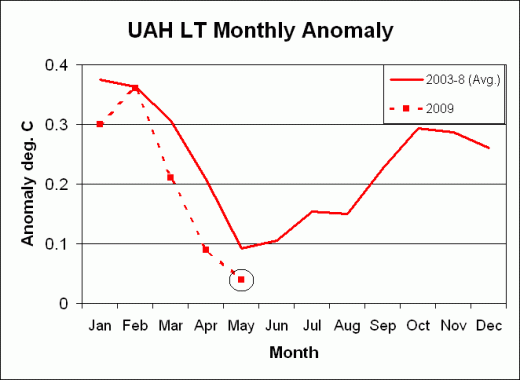
As promised, I contacted Dr. John Christy regarding the seasonal signal that the anonymous blogger “deepclimate” says he/she has identified in the UAH data, seen below. He/she says: “I am a Canadian citizen residing in Canada. For private and professional reasons, I prefer to remain anonymous to the general public, at least for now.”
I’ve never understood the need for some people to remain anonymous while at the same time attempt to do science. Imagine the furor if scientists like Christy or Spencer created an anonymous blog and then were later discovered. I’m sure it would be immediately up there on sourcewatch with “tsk tsk” attached.
Science really should be done out in the open. Here’s Dr. Christy’s in the open response.
Dr. Christy has made a response in the readme file at the UAH website here:
http://www.nsstc.uah.edu/data/msu/t2lt/readme.18Jul2009
Update 18 Jul 2009 ************************************
Corrected trend values (1700 CST)
It was brought to my attention by Anthony Watts that there has been some discussion about the noticeable annual cycle in the LT and MT trends when done by months. In other words, the trend for Februaries is on the order of 0.12 C/decade warmer than the trend for Mays. Other data sets don’t have such a large range in trends when calculated by months, RSS for example has a range of 0.05 C/decade. (Note, this issue doesn’t affect the overall trend.)
The feature arises when the AMSU data are adjusted and merged into the MSU data stream beginning with NOAA-15 in Aug 1998, then carries forward with NOAA-16 and AQUA (both of which are AMSUs too). The process involves at one point
the removal of a mean annual cycle in the anomaly differences from one satellite to another. It turns out that all satellites have a residual annual cycle due to each instrument’s peculiarities. In the end, all annual cycles are matched to NOAA-6 and NOAA-7.
Detecting the impact of this peculiarity is difficult. For example, it is not seen when
gridded data are directly compared against radiosondes (see Christy
and Norris 2006 and 2009.) However, an annual cycle in the difference time series is clear in RSS data when compared with balloons (see Fig. 2 of both papers.)
I’ve tested a number of alternate processing methods (basically versions of
not removing the annual cycle in the difference time series from the first
AMSU onward) and the range from the highest to lowest is reduced
to just under 0.09 C/decade. This in effect establishes a new annual
cycle for the AMSUs based on the first AMSU.
I think the magnitude of the annual cycle in the monthly trends is a
legitimate problem to address. The range in the current v5.2 LT looks too large
(about 0.12 C/decade). However, one should expect differences from month to month, especially when ENSOs and a volcano have different impacts by months so
so the range shouldn’t be zero. I’ll keep looking into this and if a
reasonable result is produced, I’ll rename the dataset v5.3.
The important point in all of this is that the overall global trend of the entire
time series ranges insignificantly from +0.123 to +0.125 C/decade even
under the different merging methods used to date. This is because the removal of the annual cycle of differences from satellite to satellite does not add any bias
to the time series, so the overall trend doesn’t change.
Mike D., well the moderator seems to have completely eliminated my post with the links to Tamino’s analysis, as well as the links to the two recent WUWT posts dealing with the June monthly global temperature anomaly. I don’t know why, but it this makes it really hard to discuss the discrepancy between UAH and RSS. I can’t reference previous work, and discussion, even here on the WUWT site!!
Frustrating to say the least. This site is the most heavily censored site I have ever posted on.
[Reply: Your post was in the spam bucket, probably because of the number of links it contained. It’s been rescued and posted. ~dbstealey, moderator]
REPLY2: Paul K what was that again about be very careful about “jumping to conclusions”? Comments with 3 or more links automatically go to the SPAM filter as that fits the profile for commercial spam behavior. It is standard on WordPress.
Your opportunity for an apology is open now. – Anthony
Kevin, there is a very simple way to deal with this. Do like I do.
I work for a large multinational; engineering compnay founded in the 19th century by a very special inventor. I do not participate in discussions involving that company. (And it wasn’t Nicoli Tesla).
New York breaks 1916 record:
http://capitalclimate.blogspot.com/2009/07/new-york-breaks-summer-cool-streak.html
Dr. Christy: “The process involves at one point the removal of a mean annual cycle in the anomaly differences from one satellite to another.”
Thank you for this valuable information. I applaud your efforts to find a way to avoid prescribing annual structure. My first instinct would be to work with rates of change.
–
Those who are promoting the notion that the small amounts involved are irrelevant should consider brushing up on Stat 101 – (see chapter 2). It is not the magnitude of the residuals that violates the model assumptions; it is the scatter.
So: If you want to retain your credibility for attacking global warming computer fantasies, be sure you do not set a double-standard by dismissing bad assumptions (in this case about annual structure) when it is convenient to your politics.
–
As for anonymity: Workplace culture-intolerance is the norm. A vicious baseball-bat-to-the-face is to be expected. Some of us choose to endure such extreme prejudices, which have real and serious consequences. Not everyone is positioned to weather such impacts.
Jul 19, 2009
El Nino Now Official? – Possible Implications
By Joseph D’Aleo, CCM, AMS Fellow
IT WILL BE A HOT WINTER, NOT!
http://www.icecaps.us
Michael Jankowski (16:43:43) :
I think most readers of WUWT would agree that the science matters, not the individual. But Deep
throatclimate wouldn’t have much to say if it weren’t for his ad hominem attacks. For example:Monckton has forgotten more than Deepclimate will ever know about the climate. That is no doubt the reason DC feels he needs to resort to name calling and character assassination — all because he’s not in agreement with Viscount Monckton.
No wonder the alarmist contingent is losing the science debate.
So all we need now are some Senators and Congressmen in here.
Paul Vaughan (16:58:03) :
consider brushing up on Stat 101 – (see chapter 2). It is not the magnitude of the residuals that violates the model assumptions; it is the scatter.
Consider brushing up on Physics 101. What is important to first order is the magnitude of the residuals. If you predict something and your model is 100 degrees off, that shows a gross violation. Perhaps you could clarify how you distinguish between magnitude of residuals and scatter…
Paul K (16:51:07) :
Man, you sure jump the gun on the censorship thing. Relax. The multiple links thing has happened to you at least once before, just keep it in mind, ok?
There are large, very profound cracks along the seabed where water is already making contact with the fire inside the Earth. These cracks are due entirely to the atomic tests that scientists and their countries -believing themselves powerful- are carrying out without measuring the consequences of the barbaric acts they have committed and are committing against our planet and Humanity.
A free gift for those that seek the truth is available. No group to join, no money required. Any human being, regardless of color, religion, political or religious position has the potential within. Please ask for a free book at: http://www.hercolubus.tv You and you alone can prepare for what is already happening: Floods, Earthquakes, Global Warming, Pandemics, World Wars etc.
Paul K (16:24:58) : What is your position on the GISS data? Are you privy to the computer code and methods used to massage the raw data. Do you consider it to be a better representation of the temperature trend that either RSS or UAH or both?
John F. Hultquist wrote:
“Well, Trevor, I deciphered most of this but what does “Brits” mean?”
LOL!!!
(next q.; what does LOL mean?)
So Leif,
All of this cooling has nothing to do with the sun having no spots? Sure seems like the Jet stream is acting weird this summer. No sun spots still, what’s up with that?
thanks,
Steve
I don’t now, it all seems to be a bunch of angels on pins to me. The differences between the two data sets are tiny. If you get three people doing something in different ways you will get three different results and all three will claim theirs is “best”. I rend to prefer UAH over RSS but it really doesn’t matter. The differences people are talking here are basically negligible. It seems to be a mountain building operation out of a molehill.
The real focus should be on NOAA and why the NCDC and GISS data sets are not only diverging from both UAH and RSS in magnitude but moving in opposite directions (both RSS and UAH cooling, NOAA-based data warming). Spitting hairs here over hundredths of degrees in the satellite data is simply a distraction … but maybe that is the intention.
Smokey (17:15:12) : Likely retaliation for Monckton’s “bed wetters” comments.
Still, pretty immature of the lad.
You know, I’m glad to see that something constructive has come of the tribal attacks on UAH by Deep and pals (Yup, there are motives here-obvious ones-Spencer and Christy are “them” so they must be attacked by “us”-Team mentality…even though Deep isn’t on the Team, he is obviously a fan!)-Christy has responded and we may actually see some resolution to this issues. Can’t wait to here all the apologies when nothing much comes of it…although I fully expect silence….
To all who say the world is warming from CO2, consider this.
I quick looked into CO2 science’s temperature dataset for towns outside of major urban heat islands, take El Dorado Kansas’ dataset for example.
Average maximum July temperature trend is 0
Average summer temperature trend shows the trend line going up by just 4-5 pixels
The winter average high is where the warming is, the one season showing the biggest uptrend.
Now how much of the global warming the last 100 years is from the Winter compared to the Summer? If Winter wins out by a longshot, it’s only a good thing for the biosphere.
For the GISS record don’t forget that 1000’s of square miles of concrete, asphalt, and skyscrapers were created since 1979 especially in the developing world where urban heat islands there would be bound to explode.
For UAH you’d think it’d see a residual UHI effect like at night for example, the the heat given off by buildings and roads would have to escape to space somehow and the way is up through the the layers of the atmosphere
And yet doesn’t the GISS record show big heat in the 30’s before it was adjusted down? The amount of non-urban(rural) space was tons more then, the cities have expanded greatly, the UHI areas and strength have increased as cities have gotton bigger, more towns grew into big cities and new Urban Heat Islands have sprang up. One may think they correct for UHI, but does one really trust their corrective measures and because of that their data should never be questioned, like an emperor who says he always wins in chess so you must play badly on purpose so he can be proven right and also that your life depended on letting him be right and be forced to make sure he can win the game hands down?
The truth is starting to catch up with these guys and they are now knocking over garbage cans as they run in order to delay the inevitable. The harsh light of reality burns away the false veneer. I’m looking at you, deepclimate.
I find this blog fascinating and look at it regularly. Your surfacestations project is of great importance and long overdue. I am partly skeptical of mainstream AGW issues, and am, thus, naturally inclined to this site.
However, I disagree with you on two points. First, I think the anonymity of this type of blog is very useful. It is better to receive comments from people anonymously than not at all, and if many of those who frequent this site are correct – that dissenting voices are being quashed in the mainstream climate research field – then the anonymity you provide allows them to speak their mind. It would be preferable to be able to do this without ridicule. I personally prefer anonymity for my own set of reasons, and would (at present) cease to post if I thought I might be ridiculed or revealed. Many of us would like to make comments as private citizens rather than as scientists, but if we are known at a particular institution, people tend to assume that we are speaking as experts. For those involved in science related to climate, the anonymity allows us to avoid this issue. Also, emotion sometimes gets involved when debate gets heavy and we could be held to our word when we make jokes, flippant remarks or strong statements to highlight a point. Those willing to put their first and last names up front and centre earn my respect (I guess they are better men and women than I in this respect), but there are good reasons for many of us to prefer anonymity.
The second point is with regard to your treatment of a character named Flanagan. Clearly, he has bought the mainstream science hook line and sinker and predictable comments are rather irritating, but if we dish out the criticism on this blog, we should take it too. Otherwise the folks at RC will have nothing but proponents and the folks at WUWT will end up equally polarized. I’m all for the friendly, optional anonymity model.
It’s disgraceful that people hide behind silly screen names. Come along all you anonymous commenters, be out and proud!
Lots of love
FatBigot
DeepClimate?
Leif Svalgaard (17:27:39) “Consider brushing up on Physics 101.”
I do not profess expertise in physics.
–
Leif Svalgaard (17:27:39) “What is important to first order is the magnitude of the residuals. If you predict something and your model is 100 degrees off, that shows a gross violation. Perhaps you could clarify how you distinguish between magnitude of residuals and scatter…”
A model that is useful in practice for a physicist may not meet statistical-model assumptions. If this is the case, you canNOT (credibly) base statistical inference on that model, no matter how useful the model may be in practice. (An example: your 10.7cm flux model.)
A standard regression model assumption is that residuals are scattered as N(0,sigma^2). The usual diagnostic is a scatterplot of the residuals to check for “random scatter”. If any systematic pattern is evident in the residuals plot, YOUR P-VALUES ARE JUNK.
A more thorough treatment of the residuals involves partial-residuals plots & timeplots.
Be aware that a statistically-valid model (that may be junk to a physicist) can have very low r-squared (e.g. I recently found one with r-squared=0.05). (This is just basic Stat 101 – (chapter 2).)
Anecdote
About 15 years ago I had a contract to estimate missing temperature data and my boss instructed me to “use anything with r-squared over 30% if the residuals are ok” …(not saying I agreed with his judgement – but I understood his concern: validity of statistical inference, which is touted as part of good science …again: not saying I agree unconditionally!)
–
I know a statistical consultant who has lots of “funny stories” about clients’ comments (& the clients are publishing academics from a wide variety of disciplines), but ridiculing the clients does not change the hard constraints they face from their respective disciplines.
Clearly where Physics 101 & Stat 101 (or Ecology 101 or whatever) are at odds about what is “proper”, there is cause to exercise sensible judgement. This may mean abandoning p-values – or choosing alternate models with relaxed assumptions (which usually afford less detection-power). There may be other options, depending upon the context.
If we’re only “astroturf”, then please, as befits, roll us up.
Anonymity, or not to be.
It’s a minor distraction, arguable to both sides.
Don’t allow it to distract from the ISSUE at hand.
We are at the pivot, folks.
Ah, sunspots, my favorite.
Out west, we have a monster high pressure cell over the 4 corners region. It ain’t moving. So, all you folks to the East wishing for a summer you’ll have to wait until it decides to move.
It’s stuck in the same lazy pattern our Sun is: Lodi.
Far as I can tell it’s not producing many records, it’s just hot and it’s stuck.
Do you remember this one?
Catch me if you can……….. oooooh ooooooh