By Joseph D’Aleo, CCM, ICECAP

Map of US weather records for week ending 4/6/09 click image to enlarge or here for source. Map created by HAMWeather,
UPDATE: NOAA predicts the Red River Will Crest Again in Fargo-Moorhead in Late April here possibly again at records levels.
Just a week after the last major northern plains blizzard another significant snowfall occurred this weekend. Models did poorly with the location of the heaviest snow bands and generally overdid the magnitude. These models sometimes have difficult with the first 48 hours, but Susan Solomon and friends tell us you can depend on cruder models to predict the climate 100 years or even a thousand years in advance.
Several inches of snow fell in parts of Nebraska, South Dakota, Iowa, southern Minnesota into southern Wisconsin. This will include parts of the Red River Basin already in flood and with deep snowcover (click here to enlarge).
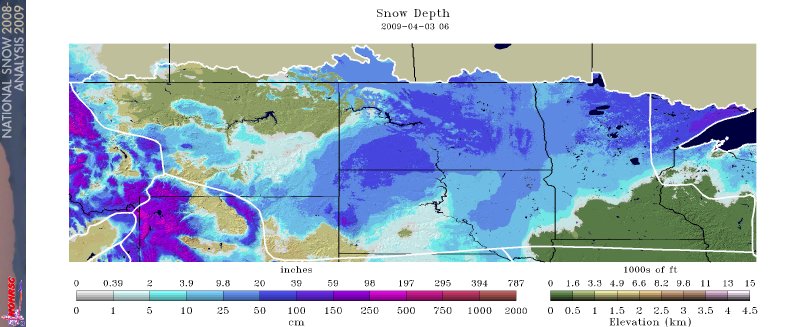

The northern plains has been hit hard this year. Fargo set a record for snowfall and precipitation for March, Bismarck also in North Dakota had record snowfall in December and the second snowiest March, the first year with with two monthly totals in the top ten enlarged here.
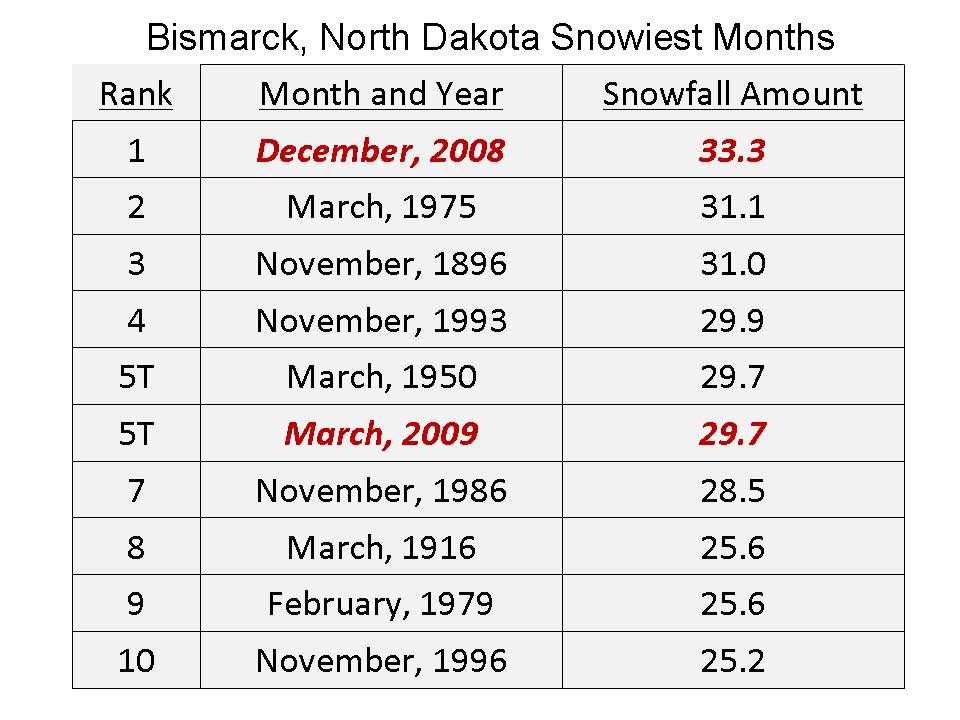

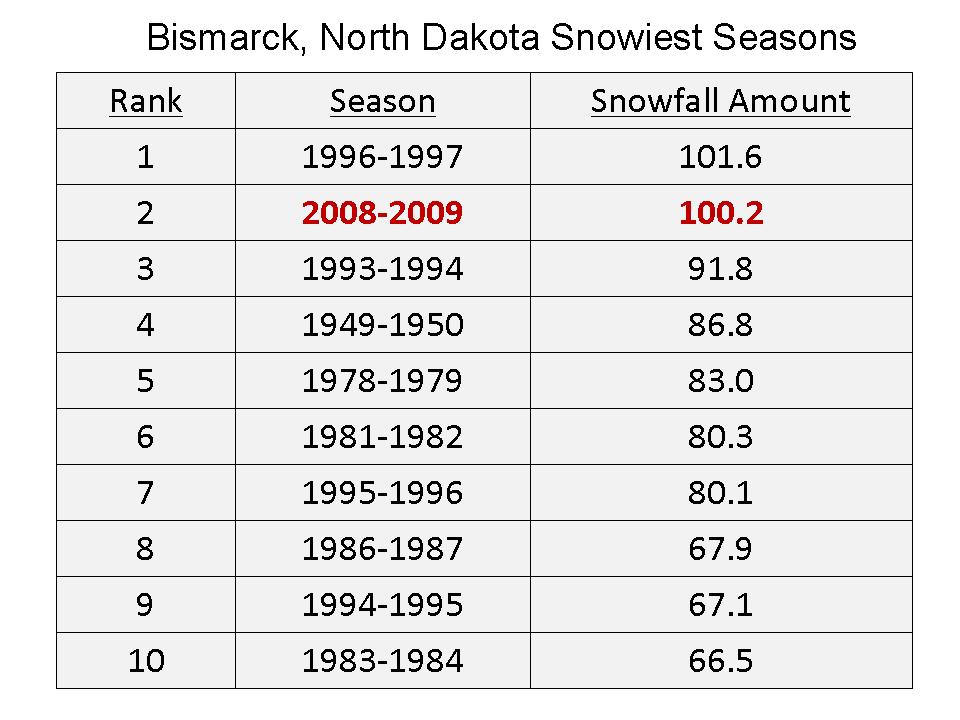
Bismarck is on the northern edge of this storm. If they get more than 1.4 inches of snow from this (or some later) storm, they will set an all-time snow record. See the enlarged listing shown below here as of April 1 after the big blizzard. See all the watches and warnings here.

The National Weather Service said International Falls, with the reputation as the nation’s icebox, recorded 124.2 inches of snow this winter. That tops the old record of 116 inches set in 1995-1996. The nearly 9-inch dump from this week’s snowstorm pushed International Falls over the edge. The Minnesota-Ontario border area has been pummeled with snowstorms this winter.
And from KOMO News Weary Spokane residents who are sick of snow can at least now be consoled by the fact that they were a part of history.
A snow storm on Sunday has made this the snowiest winter on record in Spokane. The National Weather Service said 93.6 inches of snow has been recorded at Spokane International Airport this winter, breaking the record set in 1949-50 by a tenth of an inch. It took snowfall of 3.9 inches of Sunday, a record for the date, to break the all-time record. This is the second-consecutive heavy winter in Spokane. Last year, more than 92 inches of snow fell on the Lilac City, third most since records started in 1893.
Spokane’s Top 5 Snow Years:
RANK WINTER SNOW TOTAL
1 2008-2009 93.6
2 1949-1950 93.5
3 2007-2008 92.6
4 1974-1975 89.0
5 1992-1993 87.3
Spokane is also mired in unseasonable cold. Normal high temperatures at the of March are in the low 50s, but this month has seen highs in the 30s and 40s.
See here how an amazing 358 lowest temperature records and 409 snowfall records were broken for the week ending Apr 2, 2009.
Matt,
You’re “trust of” and “deference for” climate scientists is definitely misplaced. You are the willing victim of a PR push. The quicker you wake up the better for you and yours. Unless, of course, you are a part of the disinformation.
Mike
Matt Bennett (23:02:05) :
No I am not a design engineer, my specialty lies elsewhere.
Ooh, that presents a problem, Matt. You said this:
How convenient that a process that has delivered a doubling of your life span and put humans on the moon ‘falls down’ and is ‘corrupted’ just where you happen to disagree with it…
So you admittedly do not have the qualifications to make a statement regarding a process that is known as engineering design review.
Have you authored and/or reviewed any academic/journal papers?
Neither, I assume, are you a glaciologist.
No, but I can read Wikipedia.
It does not stop us from conversing on these matters, but we should both bear in mind (this is my point continually) that we defer to the specialists on any given topic.
I have, you have not.
Given that they say…”most of the glaciers we monitor are receding”… (your quote) and given that this dovetails neatly with other aspects of AGW, you’re the one left in need of an explanation of why this is so.
a) Correlation is not equal to causation b) the glaciers began retreating after the little ice age, long before AGW was an issue. This information is readily available on every website dedicated to glaciers. Nice try.
AGW does not predict all glaciers will immediately retreat off the tops of their mountains, or even that every single one must be waning at the same time. The balance of evidence is there though, you make up you’re own mind.
The alternate, and better, explanations are there if you open your mind.
So, I reiterate, more generally, have you EVER been involved with the review process?
Mark
there Matt goes with the UN bought and paid for information from the IPCC
Matt Bennett (23:57:37) :
Straight from your beloved Wiki, Mark. So, CodeTech, which papers were you referring to that support your contention that the majority of glaciers ARE NOT in retreat?
Wow, I can cherry pick comments, too. But beyond that, I never said the majority of glaciers “ARE NOT in retreat.” You have moved the goal posts, too, from “almost all” to “majority.” Are you having a crisis of conscience?
Mark
Oddly there has not been new glacier data published for a few years… At least I can’t find it.
Mike
Meh – this is what happens when I post at 2am or 3am or whenever it was.
A large number of glaciers have been receding at a fairly consistent rate since the end of the LIA. There is not, however, an acceleration or mysterious increase in this rate, there’s no “hockey stick” correlation. There are a large number of glaciers advancing, and the large mass of glaciers nearest me are currently either in balance or advancing. Interesting that it is difficult to find that information on the internet.
There is no indication whatsoever that any glacial reductions are caused by humans, or our works.