Vacationing on Venus Basic Geology Series Part 1
Guest post by Steven Goddard

Magellan radar imaged Venus – NASA Image
In some ways, Venus is similar to earth. It is about the same size as the earth, has a nickel-iron core, and has volcanic activity due to radioactive heating in the interior. But that is where the similarities end. Venus has some serious problems as a vacation spot – mainly that it is extremely hot and the atmosphere is a thick cloud of sulfuric acid, CO2 and other unpleasant chemicals.
So how did Venus get to be like that, and why is the earth different?
- Venus is closer to the sun, which makes it hotter and prevents formation of oceans due to excessive evaporation.
- Venus suffered a traumatic collision in it’s early days, which causes it to rotate very slowly and parallel to the ecliptic. This makes for long afternoons (thousands of hours long) which get extremely hot.
- Because of 1 and 2, Venus was never able to sequester CO2 in limestones like the earth.
For the last few billion years, volcanoes on earth have been spewing out the greenhouse gases H2O, CO2 and CH4, as well as, H2SO4, SO2, H2S, HCl and Cl2. If not for the oceans and limestone sequestration, we would have a very thick, hot acidic atmosphere like Venus which could not support life. Fortunately, temperatures and other conditions on earth were just right to allow huge volumes of CO2 to move into the oceans and precipitate carbonate rock layers, where the CO2 became sequestered. This makes earth the pleasant place which we all enjoy.
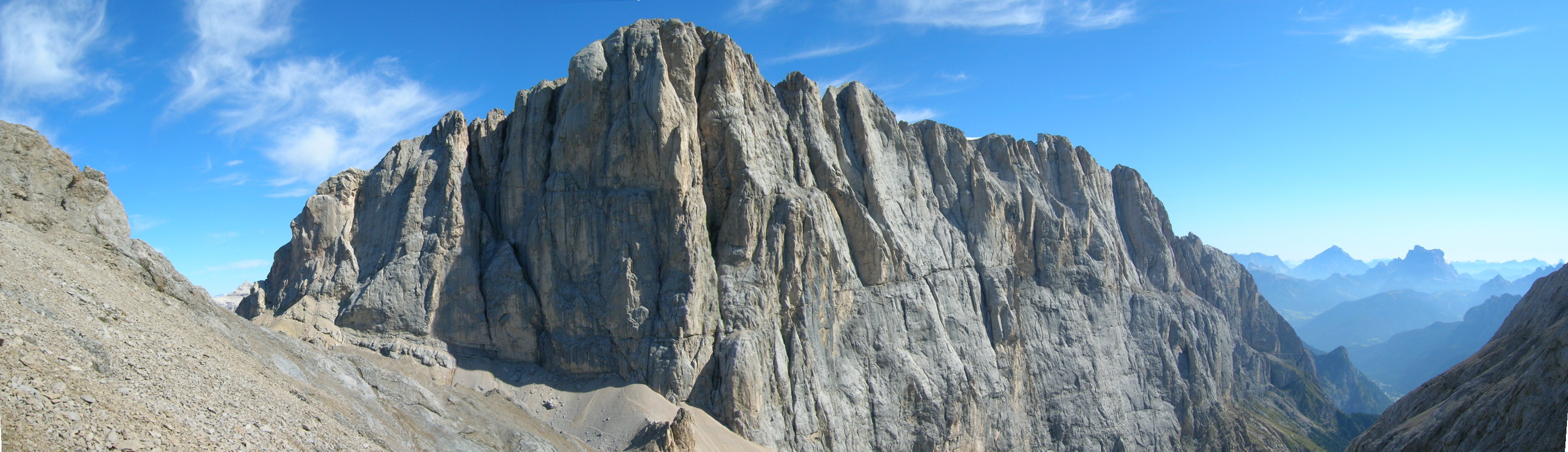
Wikipedia image – carbonate rocks in Italy, uplifted miles above sea level.
One of the oft stated concerns by the IPCC and others is excess CO2 from cement production, which involves heating carbonate rocks and has the side effect of returning CO2 to the atmosphere. Dr. Hansen and others have also suggested that periods of rapid warming in the past have been due to limestone formations being subducted into hot volcanic regions and losing their CO2 to the atmosphere.
But make no mistake, without the CO2 sequestered in limestone and other carbonate rocks, earth would be hot, toxic and probably unlivable – like Venus.
Some more detailed discussion here and here .
Part 2 will be a discussion of how fossil fuels fit into the picture.
E.M.Smith, I didn’t know that about CO2 sensors (lack of).
Good enough for Evolution work, indeed.
E.M.Smith (11:44:41) :
Alfvén rarely benefited from the acceptance generally afforded senior scientists in scientific journals. He once submitted a paper on the theory of magnetic storms and auroras to the American journal Terrestrial Magnetism and Atmospheric Electricity and his paper was rejected on the ground that it did not agree with the theoretical calculations of conventional physics of the time. He was regarded as a person with unorthodox opinions in the field by many physicists.
Good job E.M.! The perfect resume.
Steve Keohane, I’d say your NE Colorado winds are Chinook, but I’m not familiar with area. Katabatic winds require a plateau or basin where cold air can accumulate and I don’t see one on the map. What I see is a north/south mountain range ideal for Chinooks.
Chinook type winds result from air flowing over mountains from high to low pressure systems. Although around the high/low pressure due to the Coriolis Effect.
Katabatic winds result from cold (and hence denser) air at higher elevations flowing downhill under gravity, often funneled into valleys. As the air flows downhill it is compressed and may arrive as a hot wind. The Santa Ana wind is an example of katabatic wind that starts out cold in the Mohave Desert but arrives in the LA Basin hot.
The Mistral is an example of a katabatic wind that arrives cold, because the elevation drop from central France to the Riviera is small and hence there is little heating from compression.
Finally, a hot wind is often just that. Where I live in Western Australia we get very hot winds from the interior. No Katabatic or Chinook type effect. Just a hot desert out there.
Is Geoff (nobwainer) Sharp about?
http://landscheidt.auditblogs.com/
is giving a ‘server not responding’ message…
http://www.vukcevic.co.uk/solarcurrent.pdf
Is that prior link without the spurious ‘i’ in the front…
Given that Jupiter and Saturn have by far the thickest atmospheres, and both rotate quickly, in the correct direction and perpendicular to the ecliptic, I don’t find the tidal argument very compelling with respect to Venus.
As far as CO2 warming goes, it is rather basic physics. I don’t know of any scientist on either side of the AGW debate who disputes that a doubling of CO2 will cause warming of at least 1C.
You might find this article of interest. Venus proably initially had an ocean, but a runaway greenhouse effect, aggravated by those sulfur dioxide clouds, led to the current warming. The author states that if the CO2 could react with with surface rocks, Venus would cool to about 400 degrees
http://adsabs.harvard.edu/abs/1997PhDT……..36B
Here’s the full paper
http://www.boulder.swri.edu/~bullock/Homedocs/PhDThesis.pdf
realitycheck (14:30:21) : During Minor SSWS the polar vortex typically gets pushed to the side and/or weakened. However during Major SSWs (this one was a record since 1979, the start of Satelite data) the polar vortex can be entirelly split in 2.
So we have a correlation but no clear causal mechanism…
Those polar Birkeland currents and Flux Transfer Events are looking more and more interesting… Unfortunately, since they were only recently shown to exist, there is undoubtedly little historical data available to test correlation with SSW and Ozone maps… Maybe an ozone polar split correlation could be shown, historically.
While I’m left unsatisfied, it looks like it would make a decent PhD thesis… Wonder if I’m too old to find somewhere to apply…
FWIW, TWC is reporting expected snow Tuesday clear down into Arizona & New Mexico to near Mexico (‘near’ in the scale of a US map filling the whole screen and maybe 10% of New Mexico near the border not showing white…). Guess it really is winter…
Then again, the cute presenter was expressing surprise that folks (who had run out of ‘road salt’ ) were able to use table salt to melt snow… The recent purchase of The Weather Channel has resulted in ‘hotter costumes’ on the ladies; but I’m not so sure they’ve been giving enough attention to the technical skills…
E.M.Smith (16:53:41) :
Is Geoff (nobwainer) Sharp about?
http://landscheidt.auditblogs.com/
is giving a ’server not responding’ message…
Looks like all auditblogs are down…I will send John A an email.
“” Steven Goddard (16:56:53) :
As far as CO2 warming goes, it is rather basic physics. I don’t know of any scientist on either side of the AGW debate who disputes that a doubling of CO2 will cause warming of at least 1C. “”
I would tend to agree so long as the climate modelers continue to ignore the total effect of water in the atmosphere. Water vapor greatly exceeds CO2 in the atmosphere in any latitude range where significant solar radiation arrives on earth, or when any significant amount of earth thermal radiation tries to leave earth; so doubling CO2 is a small change in total GHG in the atmosphere and they both attack essentially the same thermal radiation spectrum.
But then water has this nasty habit of existing in the atmosphere in all three phases, and only the vapor phase results in positive feedback warming; the other two, liquid and solid, in the from of clouds, and particularly precipitating clouds produce negative feedback cooling. so when will they put clouds in their models properly to account for the negative feedback cooling.
More CO2 just leads to more precipitable clouds, and very little net temperature change.
And a one degree mean surface temperature change results in 7% increase in water total , evaporation, and precipitation, and by inference, in precipitable clouds, and that is a lot of ground level insolation reduction.
George
George E. Smith (14:08:12)
Proportion is the the wrong word but in terms of absolute flux the Sun emits more radiation at all wavelengths then does the earth.
Steve: You’ve omitted that the surface of Venus is highly metallic, and consequently the surface emissivity is extremely low… below 0.1. This is really quite stunning.
“What little knowledge of physics I had and a very slight acquaintance with botany argued that trees of such height could not exist, but there must be some special, adaptive forces operating on Venus that permit the seemingly impossible. I have attempted to figure it out in terms of earthly conditions, and I have arrived at some conclusions that suggest possible explanations for the phenomenon. If vertical osmosis is affected by gravity, then the lesser gravity of Venus would favor the growth of taller trees, and the fact that their tops are forever in the clouds would permit them to build up an ample supply of carbohydrates from the abundant water vapor, provided there was the requisite amount of carbon dioxide in the atmosphere of Venus to promote this photosynthetic process.
I must admit, however, that at the time I was not greatly interested in these intriguing speculations…”
http://gutenberg.net.au/ebooks03/0300211h.html
As a professional and practising geologist, one test of the runway greenhouse effect would be to examine temperature estimates of Venus over time.
If the hypothesis is correct, Venus’ temperature has to be increasing.
Any data on this?
And I am somewhat bemused with the various geological op-eds here – on what evidence does Venus have an nickel-iron core?
Who has done age determinations of any rock to work out Venus’ geological age?
George E. Smith:
“Maybe because the sun doesn’t emit a large proportion in the IR.”
proportions of solar radiation by band:
UV (0 to 380nm) 10%
Visible (380 to 760nm) 44.8%
IR (760+ nm) 45.2%
AM
Louis Hissink,
The solar system condensed from the same cloud of dust and gas. Given the close proximity and similar size of Earth and Venus, it is reasonable to expect that the chemical composition and age are similar.
There hasn’t been a lot of field work done on Venus because they can’t find any professional geologists willing to work there. The Russians landed a craft on Venus once, but it only lasted a few hours because the heat and sulfuric acid.
The interior of Venus is probably very similar to that of Earth: an iron core about 3000 km in radius, a molten rocky mantle comprising the majority of the planet. Recent results from the Magellan gravity data indicate that Venus’ crust is stronger and thicker than had previously been assumed. Like Earth, convection in the mantle produces stress on the surface. However on Venus the stress is relieved in many relatively small regions instead of being concentrated at the boundaries of large plates as is the case on Earth. Venus has no magnetic field, perhaps because of its slow rotation.
http://www.nineplanets.org/venus.html
Steve,
At one time I asked how atrophysicists knew planetary magnetic fields came from magnetohydrodynamics in liquid metallic cores, I was then offered the fact that Venus does not have a magnetic field because it has no liquid iron core as evidence. When I then asked how they knew Venus did not have a liquid iron core, I was told that they knew Venus had no liquid iron core because it had no magnetic field. 🙂
One question I’ve never seen answered, where did the nitrogen in the atmospheres (and originally interiors) of Earth, Venus, and Mars come from? Breakdown of ammonia? Carbon-14 decay? Could frozen N2 accrete into the rocky planets?
@Glenn Skankey (22:48:52) :
The gravity of Venus is only 10% less than that of our own planet. That’s not much.
Tom_R,
One of the most common techniques abused by scientists is to assume something to be true, and then selectively gather evidence in support of their theory.
When planets heat up from radioactive decay and start to melt on the interior, the more dense materials like iron and nickel tend to migrate towards the center. There is lots of evidence of this from fragments of broken former planets, which occasionaly strike the earth as nickel-iron meteorites.
It intuitively makes sense that the low rotation speed of Venus impacts it’s ability to generate a magnetic field, but whatever the state of the interior is, it seems safe to hypothesize that the core is of similar composition to earth.
Louis Hissink says:
I think the prevailing understanding is that the runaway occurred in the past, not that it is still continuing. When you get such a runaway effect, it is not going to go on forever…Eventually something will intervene to stop it. (If nothing else, the laws of thermodynamics won’t allow the temperature of the planet to get hotter than the surface of the sun!) In this case, I think what is believed to have stopped it was once all of the water boiled away from the surface (and then eventually even escaped from the atmosphere).
Current reconstructions are that Earth has had three atmospheres. (This is an area still being researched)
1. Before the Earth had cooled enough to have a crust, the atmosphere was hydrogen and helium. It is believed that the solar wind dissipated this atmosphere.
2. Soon after the crust formed, a second atmosphere was generated by vulcanism. This would have been very similar to Venus’s atmosphere, including density.
3. Water from in falling small comets enabled sequestration of CO2 into rock, thinning the atmosphere greatly, and the occurrence of oxygen producing life eventually created the third atmosphere. BTW, those small comets will not survive much further in past Earths orbit. We are still getting ~20 million tons of water a year from this in fall, just about enough to balance the loss to subduction. cf http://smallcomets.physics.uiowa.edu/
“”” Allan M (03:46:15) :
George E. Smith:
“Maybe because the sun doesn’t emit a large proportion in the IR.”
proportions of solar radiation by band:
UV (0 to 380nm) 10%
Visible (380 to 760nm) 44.8%
IR (760+ nm) 45.2%
AM “””
Alan, no dispute with your numbers; which are in complete agreement with mine. I pulled mine right out of the black body radiation graph on page 194 of Warren J Smith’s “Modern Optical Engineering” in the chapter on Radiometry and Photometry.
I should have used somewhat different terminology; I was specifically referring to the portion of the IR spectrum where at least CO2 has significant absorption bands; and that is not until about 1.9 microns, above which lies only about5-6% of solar spectrum; well that is based on air mass zero spectrum. If you use air mass one or two as a reference, then you lose a lot of the short end to ozone, so the CO2 range IR might get up to 10%, and then it may actually be lower,because water vapor will have already removed a lot of the near IR.
So I still stand by my statement as far as CO2 is concerned. Water takes out a big chunk of that 760 nm and up solar spectrum. I could go check the tables in the IR Handbook to see what they give for a standard air mass one atmosphere solar spectrum.
George
Larry D,
I think the 3 atmosphere concept needs to run past the catasrophic planetoid strike concept that is beleived to have led to our moon, the ocean basins, and our axial tilt.
In pure sepculaiton, I think it would be interesting to try and see if the strike that resulted in Venus being a such a slow rotation, and Earth’s event, which led to what we are, happened in the same gneral period of time.
Large infalling planetoids coming in towards a soalr grave could cause a lot of mischief on the way.
“”” Chico (19:16:09) :
George E. Smith (14:08:12)
Proportion is the the wrong word but in terms of absolute flux the Sun emits more radiation at all wavelengths then does the earth. “””
Au contrair; proportion is a perfectly satisfactory word; although maybe not the best choice; and it was Alan M’s choice not mine.
Steven Goddard was talking about the basic Physics of CO2 absorption; a process that no knowlegeable physicist would deny. It was that discussion that then pegged in my mind that the IR spectrum of interest; would be that portion that was available for CO2 absorption, which is only from about 1.9 microns up; not 760 nm where Alan M pegged his IR spectrum.
Well optics folks like myself tend to consider 400-800 as the visible spectrum; but I’m not going to quibble over Alan’s 760 nm.
I’m not aware that I said anything about the relative total radiant flux from sun and earth; so I’m not quite sure what your point is. And Syrius emits far more radiation at all wavelengths than does the sun; but who cares ?
What matters is what the solar radiation is INCIDENT ON THE EARTH and what the earth radiation is away from the earth.
Hopefully, the total solar radiation captured by the earth, is about equal to the total thermal radiation emitted from the earth, and since the spectral peaks of those two sources are a factor of 20:1 apart in wavelength, I seriously doubt that the solar radiation at the earth is greater than the earth radiation at all wavelengths; since their integrated totals are about equal.
The bottom line is that CO2 accounts for very little of the total atmospheric warming due to capture of infrared radiation from either the sun, or from the earth thermal emission. So doubling the CO2 does not double the total GHG species, so the heating impact is minimal. The energy captured by any GHG is rapidly transferred to the normal atmospheric gases of N2, O2, and Ar, by collisions, so the atmosphere could care less which GHG species intercepted the radiant energy form either sun or earth.
Why the climate models don’t properly account for water in all three phases; is quite beyond my understanding; but that’s whay I believe that “climatology” has about as much scientific basis as astrology. I read just the other day, who it was who invented climatology; I’ll dig out that referrence.
Maybe starting around 1979 or 80, climatology may have started to take on a scientific mantle; certainly not before the IGY of 1957/58, but the satellite age may improve the situation.
Larry_D,
RE #3, that theory of the origin of water on Earth is highly debatable. Wouldn’t we see lots of active cratering on the moon if it were true? Wouldn’t the astronauts regularly see at least a few of these thousands-per-day house-sized objects striking the Earth?
This is not to mention that if CO2 ice was accreted into the inner planets and later released through volcanism, H2O ice would also have been accreted and later released.
It kinda stands to reason that when the solar system was formed Earth, Mars and Venus would have had a similar make up. And if the water from earth has come from meteorites mars and Venus would have been exposed to similiar debris in there formation.
I personally believe that the lack of a magnetic field, resulting in Venus being blasted by the searing solar winds accounts for the lack of water, it has been vaporized and escaped the planets atmosphere. Which goes a long way too explaining the why with Venus, So the atmosphere has accumulated over time gaining in density, with no mechanism for the co2 to be sequestered… Well it works in my head.