A guest post by Steven Goddard
One of the most widely discussed climate feedbacks is the albedo effect of polar sea ice loss. Ice has a relatively high albedo (reflectance) so a reduction in polar ice area has the effect of causing more shortwave radiation (sunlight) to be absorbed by the oceans, warming the water. Likewise, an increase in polar sea ice area causes more sunlight to be reflected, decreasing the warming of the ocean. The earths radiative balance is shown in the image below. It is believed that about 30% of the sunlight reaching the earth’s atmosphere is directly reflected – 20% by clouds, 6% by other components of the atmosphere, and 4% by the earth’s surface.

We all have heard many times that summer sea ice minimums have declined in the northern hemisphere over the last 30 years. As mentioned above, this causes more sunlight to reach the dark ocean water, and results in a warming of the water. What is not so widely discussed is that southern hemisphere sea ice has been increasing, causing a net cooling effect. This article explains why the cooling effect of excess Antarctic ice is significantly greater than the warming effect of missing Arctic ice.
Over the last 30 years Antarctic sea ice has been steadily increasing, as shown below.
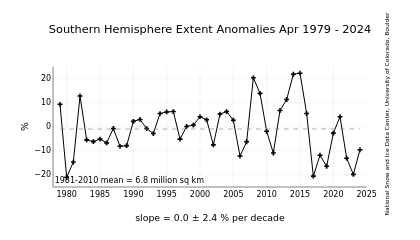
December is the month when the Antarctic sun is highest in the sky, and when the most sunlight reaches the surface. Thus an excess of ice in December has the maximum impact on the southern hemisphere’s radiative balance. In the Antarctic, the most important months are mid-October through mid-February, because those are months when the sun is closest to the zenith. The rest of the year there is almost no shortwave radiation to reflect, so the excess ice has little effect on the shortwave radiative (SW) balance.
This has been discussed in detail by Roger Pielke Sr. and others in several papers.
So how does this work? Below are the details of this article’s thesis.

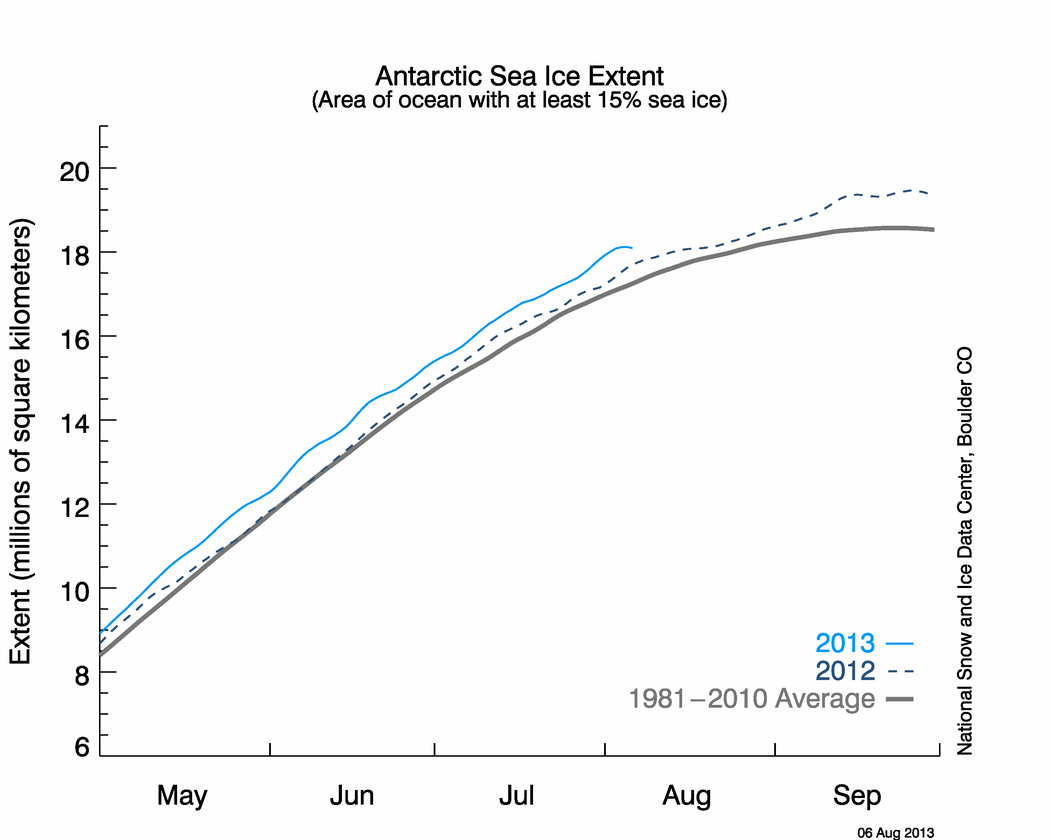
1. As mentioned above, the Antarctic ice excess occurs near the December solstice when the sun is highest above the horizon. By contrast, the Arctic ice deficiency appears near the equinox – when the sun is low above the horizon. Note in the graph below, that Arctic ice reaches it’s minimum in mid-September – just when the sun is setting for the winter at the North Pole. While the September, 2008 ice minimum maps were dramatic, what they did not show is that there was little sunlight reaching the water that time of year. The deviation from normal did not begin in earnest until mid-August, so there were only a couple of weeks where the northern hemisphere SW radiative balance was significantly impacted. Thus the water in most of the ice-deficient areas did not warm significantly, allowing for the fast freeze-up we saw during the autumn.
The 2008 peak Arctic ice anomaly occurred near the equinox, when it had the minimum heating effect on the ocean.
By contrast, the peak Antarctic ice anomaly occurred at the December solstice, when it had a maximum cooling effect, as shown below.
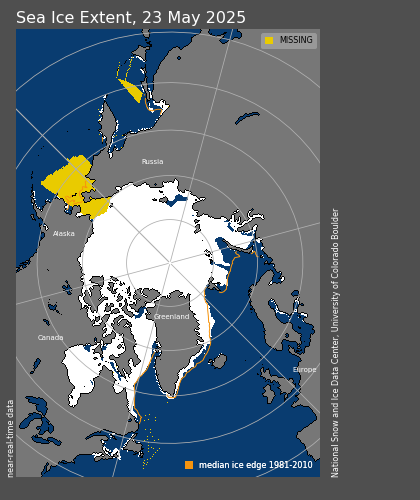
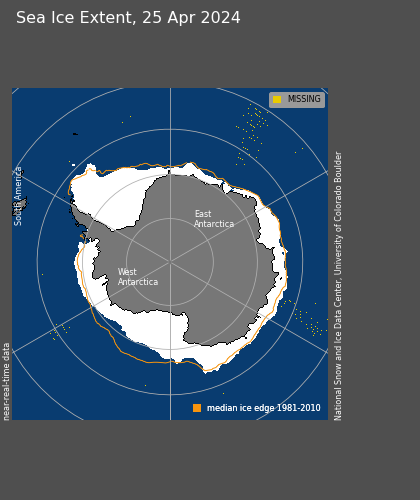
2. The next factor to consider is the latitude of the ice, which has a strong effect on the amount of solar insolation received. Arctic sea ice is closer to the pole than Antarctic sea ice. This is because of the geography of the two regions, and can be seen in the NSIDC images below.
Antarctic sea ice forms at latitudes of about 55-75 degrees, whereas most Arctic ice forms closer to the pole at latitudes of 70-90 degrees. Because Antarctic ice is closer to the tropics than Arctic ice, and the sun there reaches a higher angle above the horizon, Antarctic sea ice receives significantly more solar radiation in summer than Arctic sea ice does in its’ summer. Thus the presence or absence of Antarctic ice has a larger impact on the SW radiative balance than does the presence or absence of Arctic ice.
At a latitude of -65 degrees, the sun is about 40 degrees below the zenith on the day of the solstice. Compare that to early September negative anomaly peak in the Arctic at a latitude of 80 degrees, when the sun is more than 70 degrees below the zenith. The amount of solar radiation hitting the ice surface at those maxima is approximately 2.2 times greater in the the Antarctic than it is in the Arctic = cos(70) / cos(40) .
The point being again, that due to the latitude and date, areas of excess Antarctic ice reflect a lot of SW radiation back out into space, whereas deficient Arctic ice areas allow a much smaller quantity of SW radiation to reach the dark surface of water. Furthermore, in September the angle of incidence of the sun above the water is below the critical angle, so little sunlight penetrates the surface, further compounding the effect. Thus the Antarctic positive anomaly has a significantly larger effect on the earth’s SW balance than does the Arctic negative anomaly.
3. The next point is an extension of 2. By definition, excess ice is further from the pole than missing ice. Thus a 10% positive anomaly has more impact on the earth’s SW balance than does a 10% negative anomaly.
4. Due to eccentricity of the earth’s orbit, the earth is 3% closer to the sun near the December solstice, than it is during the June solstice. This further compounds the importance of Antarctic ice excess relative to Arctic ice deficiency.
All of these points work together to support the idea that so far, polar ice albedo feedback has been opposite of what the models have predicted. To date, the effect of polar albedo change has most likely been negative, whereas all the models predicted it to be positive. There appears to be a tendency in the climate community to discount the importance of the Antarctic sea ice increase, and this may not be appropriate.
nobrainer says:
Please note, my name is spelled Sharpe.
Since I acquired it in roughly the same way as the main character in the series by Bernard Cornwall, I am quite proud of it.
nobwainer says:
I think you fail to understand the endeavour that is Science.
We can never prove scientific theories, only disprove those that are wrong. We continually strive to improve the accuracy and utility of our theories.
Leif said,
“No, not at all. Angular momentum is with respect to an origin or axis. If angular momentum with respect to one origin [barycenter] changes that has no corresponding effect on angular momentum around the other origin [center of Sun].”
The curve ball (maybe you will respond to it this time) spinning around and towards the hitter. If I could increase the forward movement of the ball at this moment but not the spin there would be an increasing vector forward which would slow down the spin. As it is more forward than around in comparison to the first snapshot. Forces like this are acting on the sun one around (the spin) and one orbiting.
Leif said “As the Sun doesn’t spin up/down the way you think, the answer to this doesn’t matter. And any effect goes the other way: more magnetic activity slows the Sun down.”
The first point covers this.
Ed said to Leif,
“If you can prove that tightening magnetic canals don’t increase pressure and that loosening canals don’t decrease then this would prove that no energetic change can be caused by this process or if you can prove that no such loosening tightening takes place then this would disprove it also.”
You didn’t disprove this you just stated it wasn’t the case. Point out where and how each point of mine is wrong. Science is this as you say.
Leif said, “The Sun is not ‘pulled around’”
Leif you said a bit back that “of course it does” Nobwainer was talking about the movement of the sun effected by Jupiter around the centre of mass of the solar system.
Ed
Leif Svalgaard (10:35:55) :
The Sun is not ‘pulled around’, it is in free fall and feels no forces from that. And the word ‘NO’ is meaningless as stated.
Ok…so you cant give a guarantee. Enough said, nothing is invalidated.
the Hale cycle is just twice the Schwabe cycle, and the length of that is set by the speed of the meridional circulation which in turn may be set by a temperature difference between pole and equator.
I am looking for a dynamo theory that controls the Schwabe cycle length…you and I both know that doesnt exist as stated by your reference Jager.
the strength of the polar fields [itself a result of a random walk] controls the modulation of the solar cycle.
Great piece of science that one…the sunspot records and C14 records over 11000 yrs certainly show a less than random walk.
Solar Grand Minima and Random Fluctuations in Dynamo Parameters,
You can throw any papers you like at me…but you know you have no answers to the frequency and modulation of grand minima.
That the Hale polarity law is violated.
And if your Hale polarity law is proved by another function?….that is a weak argument. The polarity change is just one aspect of the solar function, it is not the make or break solution.
My question still stands unanswered…
By my reckoning there is 2 questions outstanding.
What does that movement do to the distance between the Sun and the Earth?
Good question, I would think no distance change, the Earth follows the path of the Sun.
what would you consider to be a convincing proof [that can be given today] that the planetary theory is invalid? […] what aspects of the planetary theory can be falsified today?
[that can be given today] Your answer re the Hale cycle cant be quantified today, so we are not on even ground. But I will be more realistic, if we dont experience grand minimum in SC24/25 and the J+S alignment happens before cycle max on both occasions the theory is shot.
Richard Sharpe (11:06:56) :
We can never prove scientific theories,
Mighty big statement there?
Leif asked Nobwainer
“What does that movement do to the distance between the Sun and the Earth?”
Nobwainer replied “Good question, I would think no distance change, the Earth follows the path of the Sun.”
Ed says it changes the distance.
Edward Morgan (11:24:06) :
The curve ball (maybe you will respond to it this time) spinning around and towards the hitter. If I could increase the forward movement of the ball at this moment but not the spin there would be an increasing vector forward which would slow down the spin.
If the pitcher was at the top of a very tall tower and gave the ball a spin throwing it towards the ground, the forward movement would be faster and faster, you are saying that the spin would be slowed down and eventually stop if the tower is tall enough?
more magnetic activity slows the Sun down.
is an observational fact.
“If you can prove that tightening magnetic canals don’t increase pressure
is too vague to comment on. What does ‘tightening’ mean? where is the canal? pressure measured where?
Leif said, “The Sun is not ‘pulled around’”
Leif you said a bit back that “of course it does”
You misunderstand orbital mechanics. To pull is to exert a force and there are no forces involved. The planets [and the Sun] are pulled or pushed around in their orbits.
nobwainer (Geoff Sharp) (11:27:01) :
Ok…so you cant give a guarantee. Enough said, nothing is invalidated. I can give a guarantee that no measurable effect arises.
I am looking for a dynamo theory that controls the Schwabe cycle length…you and I both know that doesnt exist as stated by your reference Jager.
http://www.iiap.res.in/PostDocuments/DibyenduNandy_4Dec07.pdf page 24 explains what is involved and what control what.
Great piece of science that one…the sunspot records and C14 records over 11000 yrs certainly show a less than random walk.
Even if they do [and people find that don’t] the issue was how dynamo theory explains the modulation from cycle to cycle.
You can throw any papers you like at me
Papers are mostly the result of serious scientific work. If you are impervious to them [don’t read them, don’t understand them, disregard them on the basis that they don’t fit dogma, whatever…] then it indeed difficult to have a serious discussion.
‘That the Hale polarity law is violated.”
And if your Hale polarity law is proved by another function?….that is a weak argument. The polarity change is just one aspect of the solar function, it is not the make or break solution.
In dynamo there there is no other function to provide that, and the question was what would disprove dynamo theory. For me, a violation of the Hale law would be enough.
“What does that movement do to the distance between the Sun and the Earth?
Good question, I would think no distance change, the Earth follows the path of the Sun.
So, does the Earth not orbit the barycenter? Does Jupiter? Would Jupiter also just follow the Sun? Is the law of gravity different for the Earth and Jupiter?
if we dont experience grand minimum in SC24/25 and the J+S alignment happens before cycle max on both occasions the theory is shot.
To quantify this give the size of the cycle that makes it qualify for a Grand minimum. Cycle 14 was 64, so a Grand Minimum would be smaller than that; Would both 24 and 25 have to be smaller than the Grand minimum limit or only one of them? when are the two J+S alignments?
nobwainer said:
See, for example: Einstein’s statement.
Note, I was using prove in the normal, every day sense, which is closer to the mathematical version of prove than the scientific version (if it exists, as I suspect they tend to say “this experimental result/observation supports …”
Please show that you understand Einstein’s statement.
Correcting a typo:
Leif said, “The Sun is not ‘pulled around’”
Leif you said a bit back that “of course it does”
You misunderstand orbital mechanics. To pull is to exert a force and there are no forces involved. The planets [and the Sun] are NOT pulled or pushed around in their orbits.
Leif, you agreed that the centre of mass of the solar system changes and that this creates changes in the movements of the planets. That is what Nobwainer and me are talking about.
Don’t disappear on my other points. Ed
I see you have answered them. I’ll take a look.
Edward Morgan (13:56:05) :
Leif, you agreed that the centre of mass of the solar system changes and that this creates changes in the movements of the planets. That is what Nobwainer and me are talking about.
The changes are with respect to the center, not to the bodies. But first can you and no-brain agree as to what you talking out? e.g. about the distance between the Sun and the Earth.
Leif said,
“If the pitcher was at the top of a very tall tower and gave the ball a spin throwing it towards the ground, the forward movement would be faster and faster, you are saying that the spin would be slowed down and eventually stop if the tower is tall enough?”
It would slow down but not necessarily stop as this would depend on how fast you spinned it (on earth)
Leif said “If you can prove that tightening magnetic canals don’t increase pressure
is too vague to comment on. What does ‘tightening’ mean? where is the canal? pressure measured where?
Fig 5 here (again)
http://www.tmgnow.com/repository/solar/percyseymour1.html
pressure can be measured by the tightening caused by the spin and evidence of this is the occurrence in sync of the x-ray quieter times e.t.c
Pulled around means the changes in accordance with the planets to the Centre of gravity of the solar system, the effect on this moving whole.
Ed
Leif said, The changes are with respect to the center, not to the bodies
Leif I am saying that when Jupiter and Saturn for example come into conjunction with centre of mass of the solar system and the sun is on the other side of the centre of mass of the solar system, the centre of mass changes as the planets are moving. Now this effects other planets too, its a constant exchange, the whole system is flux. Every bit effecting every other bit. That’s what we mean by pulled around. Ed
Edward Morgan (14:20:50) :
“If the pitcher was at the top of a very tall tower and gave the ball a spin throwing it towards the ground, the forward movement would be faster and faster, you are saying that the spin would be slowed down and eventually stop if the tower is tall enough?”
It would slow down but not necessarily stop as this would depend on how fast you spinned it (on earth)
At a given spin there would then be height of the tower that would stop the spin. If it is not slowed down enough we just make the tower a bit higher. Right?
Leif said “If you can prove that tightening magnetic canals don’t increase pressure
is too vague to comment on. What does ‘tightening’ mean? where is the canal? pressure measured where?
Fig 5 here (again)
http://www.tmgnow.com/repository/solar/percyseymour1.html
does not mention pressure anywhere [except for two references to [terrestrial] atmospheric pressure], so the enaswer is not to be found in your reference, so you must elaborate.
Leif said,
“At a given spin there would then be height of the tower that would stop the spin. If it is not slowed down enough we just make the tower a bit higher. Right?” Within the limited realm of the pitcher’s ability to spin, yes.
“elaborate”
The increased stretching of the lines as seen in the picture would increase the pressure.
Ed
Leif Svalgaard (10:35:55) :
No, not at all. Angular momentum is with respect to an origin or axis. If angular momentum with respect to one origin [barycenter] changes that has no corresponding effect on angular momentum around the other origin [center of Sun].
Angular Momentum is a property of the solar system as such. It does not really care which origin you choose as reference. It is computed from the individual masses and orbital velocities of each object in the system. Then add the spin component of each object.
Angular momentum is rigorously preserved for the whole the solar system on the condition that no external torque is acting upon the system.
If one component contributing to the angular momentum is changing, something else within the system must be changing also to compensate and preserve the total angular momentum of the solar system.
http://www.astronomynotes.com/angmom/s1.htm
Carsten Arnholm, Norway (16:35:17) :
If one component contributing to the angular momentum is changing, something else within the system must be changing also to compensate and preserve the total angular momentum of the solar system.
If the orbital angular momentum of the Sun changes because of its orbit around the barycenter, the orbital angular momentum of Jupiter [mostly] changes to compensate for that. The spin angular momentum of the Sun and of Jupiter and [very importantly – because we measure it very precisely] of the Earth do not change.
Edward Morgan (15:30:32) :
“At a given spin there would then be height of the tower that would stop the spin. If it is not slowed down enough we just make the tower a bit higher. Right?” Within the limited realm of the pitcher’s ability to spin, yes.
Well, if the pitcher can’t spin, then your example goes out the window, so we assume he can spin and that his ability depends on his arm and other bodily things and not on the height of the tower. So, let’s make the tower higher still, now the ball would begin to spin the other way around, right? because the ‘forwards vector’ that changed the spin is still operating.
“elaborate”
The increased stretching of the lines as seen in the picture would increase the pressure.
Where would it increase the pressure? and the pressure of what?
Leif said
“Well, if the pitcher can’t spin, then your example goes out the window, so we assume he can spin and that his ability depends on his arm and other bodily things and not on the height of the tower. So, let’s make the tower higher still, now the ball would begin to spin the other way around, right? because the ‘forwards vector’ that changed the spin is still operating.”
The pitcher can spin it is just limited because he is not infinite. That’s what I meant. The downward vector in your example would stop the spin because it is acting down and not around as long as the ball is spinning horizontal to the earth. It would not then go in the other direction.
Leif asked “Where would it increase the pressure? and the pressure of what?”
It would increase the pressure all around/over the sun and the pressure is of the gas.
Ed
Edward Morgan (17:25:37) :
It would not then go in the other direction.
1st: it would not slow down the ball, and if it did it would eventually cause the ball to rotate the other way.
It would increase the pressure all around/over the sun and the pressure is of the gas.
No, it would not and it is not of the gas. The is magnetic pressure which is not of the gas. But, since there is no mention of pressure in the paper you cited, I think that you have come up with your own version. Unfortunately you have not shown that the winding up of the ‘canl’ would increase the gas pressure all over the Sun. You probably can’t see where you go wrong even when pointed out to you.
Edward Morgan (14:26:19) :
I am saying that when Jupiter and Saturn for example come into conjunction with centre of mass of the solar system and the sun is on the other side of the centre of mass of the solar system, the centre of mass changes as the planets are moving. Now this effects other planets too
Take a look at http://www.leif.org/research/Barycenters.pdf
The first panel shows the Sun [yellow], Earth [green] and Jupiter [pink]. The barycenter is marked with a small purple square. The distance between the Earth and th Sun by the double-headed arrow.
The next panel shows when Saturn [blue] is added. that changes the position of the barycenter, but not of the other planets, in particular, the Sun-Earth distance stays the same.
The next panel shows what would happen if a distant large planet [perhaps 1000 time further away than Jupiter] is added: the barycenter now moves out away from the Sun even to the other side of Saturn. the position of the other planets are not altered and in particular then Sun-Earth distance stays the same.
The next panel shows what happens if Jupiter moves a bit: the barycenter moves with. The Sun-Earth distance stays the same.
In the last panel, jupiter has moved to the other side of the Sun. The barycenter has moved with and the Sun-Earth distance is unchanged. Can we all agree that this is what happens?
Leif Svalgaard (19:38:07) :
1st: it would not slow down the ball, and if it did it would eventually cause the ball to rotate the other way.
The purpose of this exercise was to convince you that the forwards motion of the ball has not influence on its spin, but I guess I failed in that.
Leif Svalgaard (13:27:13) :
To quantify this give the size of the cycle that makes it qualify for a Grand minimum. Cycle 14 was 64, so a Grand Minimum would be smaller than that; Would both 24 and 25 have to be smaller than the Grand minimum limit or only one of them? when are the two J+S alignments?
To disprove the angular momentum theory we would need to have a high cycle when all the conditions of the theory suggest otherwise. An SSN over 100 if SC24 cycle max is after 2012 and SC25 cycle max is after 2021 would qualify the theory busted in my opinion.
Richard Sharpe (13:39:52) :
I prefer this quote from Einstein.
“Whoever undertakes to set himself up as a judge of Truth and Knowledge is shipwrecked by the laughter of the gods.”