UPADATED AT 8:30AM PST Sept 2nd-
More on SIDC’s decision to count a sunspeck (technically a “pore”) days after the fact. NOAA has now followed SIDC in adding a 0.5 sunspot where there was none before. But as commenter Basil points out, SIDC’s own records are in contrast to their last minute decision to count the sunspeck or “pore” on August 21.
There is an archive of the daily SIDC “ursigrams” here:
http://sidc.oma.be/html/SWAPP/dailyreport/dailyreport.html
If you select the ursigrams for August 22 and 23, you get the reported data for the 21st and 22nd:
August 21:
TODAY’S ESTIMATED ISN : 000, BASED ON 07 STATIONS.
SOLAR INDICES FOR 21 Aug 2008
WOLF NUMBER CATANIA : 011
10CM SOLAR FLUX : 067
AK CHAMBON LA FORET : ///
AK WINGST : 004
ESTIMATED AP : 005
ESTIMATED ISN : 000, BASED ON 14 STATIONS.
August 22:
TODAY’S ESTIMATED ISN : 000, BASED ON 11 STATIONS.
SOLAR INDICES FOR 22 Aug 2008
WOLF NUMBER CATANIA : 013
10CM SOLAR FLUX : 068
AK CHAMBON LA FORET : ///
AK WINGST : 003
ESTIMATED AP : 003
ESTIMATED ISN : 000, BASED ON 11 STATIONS.
In both cases, the daily estimated “International Sunspot Number” based on multiple stations, not just the Catania Wolf Number, was 000. So how did SIDC end up with positive values in the monthly report?
UPDATED at 2:42 PM PST Sept 1st –
After going days without counting the August 21/22 “sunspeck” NOAA and SIDC Brussels now says it was NOT a spotless month! Both data sets below have been recently revised.
Here is the SIDC data:
http://www.sidc.be/products/ri_hemispheric/
Here is the NOAA data:
ftp://ftp.ngdc.noaa.gov/STP/SOLAR_DATA/SUNSPOT_NUMBERS/MONTHLY
The NOAA data shows July as 0.5 but they have not yet updated for August as SIDC has. SIDC reports 0.5 for August. It will be interesting to see what NOAA will do.
SIDC officially counted that sunspeck after all. It only took them a week to figure out if they were going to count it or not, since no number was assigned originally.
But there appears to be an error in the data from the one station that reported a spot, Catania, Italy. No other stations monitoring that day reported a spot. Here is the drawing from that Observatory:
ftp://ftp.ct.astro.it/sundraw/OAC_D_20080821_063500.jpg
ftp://ftp.ct.astro.it/sundraw/OAC_D_20080822_055000.jpg
But according to Leif Svalgaard, “SIDC reported a spot in the south, while the spot(s) Catania [reported] was in the north.” This is a puzzle. See his exchange below.
Also, other observatories show no spots at all. For example, at the 150 foot solar solar tower at the Mount Wilson Observatory, the drawings from those dates show no spots at all:
ftp://howard.astro.ucla.edu/pub/obs/drawings/dr080821.jpg
ftp://howard.astro.ucla.edu/pub/obs/drawings/dr080822.jpg
Inquires have been sent, stay tuned.
Here is an exchange in comments from Leif Svalgaard.
——-
REPLY: So What gives Leif….? You yourself said these sunspecks weren’t given a number. I trusted your assessment. Hence this article. Given the Brussels folks decided to change their minds later, what is the rationale ? – Anthony
The active region numbering is done by NOAA, not by Brussels. The Brussels folks occasionally disagree. In this case, they did. Rudolf Wolf would not have counted this spot. Nor would I. What puzzles me is this:
21 7 4 3
22 8 4 4
The 3rd column are ’spots’ in the Northern hemisphere, and the 4th column are ’spots’ in the Southern hemisphere [both weighted with the ‘k’-factor: SSN = k(10g+s)]. But there weren’t any in the south. The Catania spot was at 15 degrees north latitude, IIRC. Maybe the last word is not in on this.
——–
Hmm….apparently there’s some backstory to this. There is a debate raging in comments to this story, be sure to check them. – Anthony
# MONTHLY REPORT ON THE INTERNATIONAL SUNSPOT NUMBER #
# from the SIDC (RWC-Belgium) #
#——————————————————————–#
AUGUST 2008
PROVISIONAL INTERNATIONAL NORMALIZED HEMISPHERIC SUNSPOT NUMBERS
Date Ri Rn Rs
__________________________________________________________________
1 0 0 0
2 0 0 0
3 0 0 0
4 0 0 0
5 0 0 0
6 0 0 0
7 0 0 0
8 0 0 0
9 0 0 0
10 0 0 0
11 0 0 0
12 0 0 0
13 0 0 0
14 0 0 0
15 0 0 0
16 0 0 0
17 0 0 0
18 0 0 0
19 0 0 0
20 0 0 0
21 7 4 3
22 8 4 4
23 0 0 0
24 0 0 0
25 0 0 0
26 0 0 0
27 0 0 0
28 0 0 0
29 0 0 0
30 0 0 0
31 0 0 0
__________________________________________________________________
MONTHLY MEAN : 0.5 0.3 0.2
========================================================
ORIGINAL STORY FOLLOWS:
Many have been keeping a watchful eye on solar activity recently. The most popular thing to watch has been sunspots. While not a direct indication of solar activity, they are a proxy for the sun’s internal magnetic dynamo. There have been a number of indicators recently that it has been slowing down.
August 2008 has made solar history. As of 00 UTC (5PM PST) we just posted the first spotless calendar month since June 1913. Solar time is measured by Coordinated Universal Time (UTC) so it is now September 1st in UTC time. I’ve determined this to be the first spotless calendar month according to sunspot data from NOAA’s National Geophysical Data Center, which goes back to 1749. In the 95 years since 1913, we’ve had quite an active sun. But that has been changing in the last few years. The sun today is a nearly featureless sphere and has been for many days:

Image from SOHO
And there are other indicators. For example, some solar forecasts have been revised recently because the forecast models haven’t matched the observations. Australia’s space weather agency recently revised their solar cycle 24 forecast, pushing the expected date for a ramping up of cycle 24 sunspots into the future by six months.
The net effect of having no sunspots is about 0.1% drop in the TSI (Total Solar Irradiance). My view is that TSI alone isn’t the main factor in modulating Earth’s climate.
I think it’s solar magnetism modulating Galactic Cosmic Rays, and hence more cloud nuclei from GCR’s, per Svensmark’s theory. We’ve had indications since October 2005 that the sun’s dynamo is slowing down. It dropped significantly then, and has remained that way since. Seeing no sunpots now is another indicator of that idling dynamo.
Graph of solar Geomagnetic Index (Ap):

Click for a larger image
Earth of course is a big heat sink, so it takes awhile to catch up to any changes that originate on the sun, but temperature drops indicated by 4 global temperature metrics (UAH, RSS and to a lesser degree HadCrit and GISS) show a significant and sharp cooling in 2007 and 2008 that has not rebounded.In the 20 years since “global warming” started life as a public issue with Dr. James Hansen’s testimony before congress in June 1988, we are actually cooler.

Click for a larger image
Reference: UAH lower troposphere data
Coincidence? Possibly, but nature will be the final arbiter of climate change debate, and I think we would do well to listen to what it’s saying now.
Joe D’Aleo of ICECAP also wrote some interesting things which I’ll reprint here.
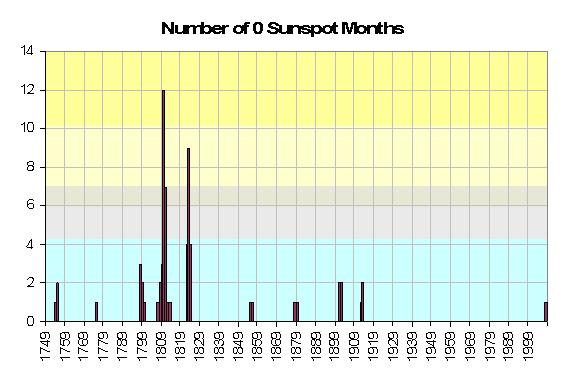
…we have had a 0 sunspot calendar month (there have been more 30 day intervals without sunspots as recent as 1954 but they have crossed months). Following is a plot of the number of months with 0 sunspots by year over the period of record – 23 cycles since 1749.
See larger image here.
Note that cluster of zero month years in the early 1800s (a very cold period called the Dalton minimum – at the time of Charles Dickens and snowy London town and including thanks to Tambora, the Year without a Summer 1816) and again to a lesser degree in the early 1900s. These correspond to the 106 and 213 year cycle minimums. This would suggest that the next cycle minimum around 2020 when both cycles are in phase at a minimum could be especially weak. Even David Hathaway of NASA who has been a believer in the cycle 24 peak being strong, thinks the next minimum and cycle 25 maximum could be the weakest in centuries based on slowdown of the plasma conveyor belt on the sun.
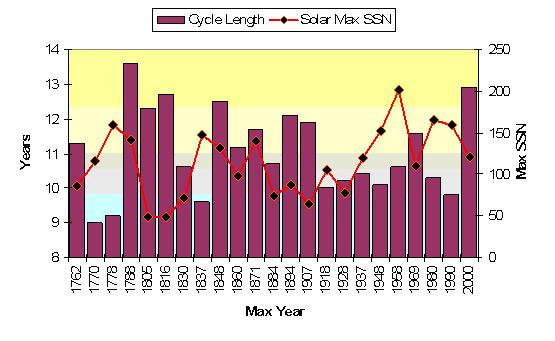
In this plot of the cycle lengths and sunspot number at peak of the cycles, assuming this upcoming cycle will begin in 2009 show the similarity of the recent cycles to cycle numbers 2- 4, two centuries ago preceding the Dalton Minimum. This cycle 23 could end up the longest since cycle 4, which had a similar size peak and also similarly, two prior short cycles.
See larger image here.


Will this mean anything for climate in our near future? Possibly. But we’ll have to wait to see how this experiment pans out.
Discover more from Watts Up With That?
Subscribe to get the latest posts sent to your email.
Graeme Rodaughan (23:55:57) “its likely that the AGW crowd will just switch to AGCooling without skipping a beat.”
Already happened, see ICECAP today quoting Sydney Herald. “Big Chill a symptom of Climate Change… Forget global warming – the latest problem is global cooling… The freezing temperatures are proof of the urgent need to cut carbon pollution, according to WWF development and sustainability program manager Paul Toni.”
[…] discussione e’ “in diretta” a questo link, dove partecipa l’esperto Leif […]
NEWS
“Spotless Month” story quoted by Rush Limbaugh – nationwide, millions of listeners, ~600 radio stations. Stated without mention of SIDC non-zero count or any controversy, just that August was spotless.
He who gets to the media first, wins.
Sun Makes History: First Spotless Month in a Century
The record-setting surface of the sun. A full month has gone by without a single spot (Source: Solar and Heliospheric Observatory (SOHO))
Sunspot activity of the past decade. Over the past year, SIDC has continually revised its predictions downward (Source: Solar Influences Data Center)
Geomagnetic solar activity for the past two decades. The recent drop corresponds to the decline in sunspots. (Source: Anthony Watts)
A chart of sunspot activity showing two prior solar minima, along with heightened activity during the 20th century (Source: Wikimedia Commons)
Drop in solar activity has potential effect for climate on earth.
The sun has reached a milestone not seen for nearly 100 years: an entire month has passed without a single visible sunspot being noted.
http://www.dailytech.com/Sun+Makes+History+First+Spotless+Month+in+a+Century/article12823.htm
REPLY: For me it wasn’t about “winning” it was about reporting on something significant as it happened. I had no idea (nor did many others) that SIDC would all of the sudden change, and count a sunspeck or “pore” as a spot. – Anthony
Doug,
We dilettantes would also like to see the mathematic threorems behind a correction of data in one domain arising from one non-linear phenomena at the photosphere with data from another domain from a distinct non-linear phenomena arising at the earth where no mapping, transform between or relations for either are proposed.
[…] It’s 71 Days Without A Sunspot 2 09 2008 Confusion reigns tonight on the date the last sunspot has been seen. Until yesterday, it had been July 18 with sunspot […]
Is Pluto a planet? Regardless of the latest definition, if you are standing on a solid body with appreciable gravity, and can pick up rocks from its surface, then regardless of what body it is orbiting around, it’s a planet. The Moon is a planet – if you fall on it you will hurt yourself. It is orbiting around the Earth, but it’s also going around the Sun once a year. Maybe Pluto is a planet in my sense, but not a Planet in the classical sense.
Well, as of now, solarcycle24.com is counting 31 spotless days in August. Or are they showing 30.5—oh well, no matter. Even if it turns out to be 30, this cycle is certainly showing a different minimum pattern than the last.
http://www.solarcycle24.com/graphs/sunspotgraph.gif
Thanks Lucy S,
(I was quoting jn above me). The problem we face is a highly motivated political movement which is trashing science to achieve it’s ends.
We need more scientists to stand up and defend their own profession and point out the pseudoscientific basis of the current AGW scare.
The consequences of not doing so will involve (I suspect) a substantial reduction in the living standards of the whole world and an increased death rate amongst the poor due to the lack of effective economic development.
WRT sunspots – at this juncture – any physical evidence contrary to the AGW thesis needs to be “managed”.
CONFIRMED
NOAA (Boulder) defers to SIDC (Brussels) for the “official” number.
ftp://ftp.ngdc.noaa.gov/STP/SOLAR_DATA/SUNSPOT_NUMBERS/MONTHLY
So the official number for August, now and forever, is 0.5
Only the southern [solar] hemisphere goof-up will be corrected.
The fact that NOAA has also counted that “speck” comes as no surprise and it’s not from holding any conspiracy suspicions. There’s the fact that there were terrestrial based observations, with manual drawings of the disturbances. I would suppose that processing such manual notes would delay recording the data. NOAA may have been aware of the event and, through normal inertia, never went back to amend the data they had while SOHO was acting up.
It doesn’t change the fact that such slow solar activity shows no sign of changing. The next several months should prove fascinating.
Maurizio
per favore, L’Osservatorio di Catania.
Inserisci qui gli altri fogli di lavoro.
g = Giorno
tutti sono il primo giorno del mese di agosto 2008. (??????)
please, L’Osservatorio di Catania .
Insert here the other spreadsheets.
g = Day
all are the first day of the month of August 2008. (??????)
hmmmmm???
Malcolm Miller (16:24:41) :
“Maybe Pluto is a planet in my sense, but not a Planet in the classical sense.”
What’s something you can jump off of and not return?
http://wermenh.com/deimos.html
Douglas Hoyt (08:25:52) :
From the abstract of Mursula et al.’s paper: “Rather, we find that the Rz numbers are fairly uniform after mid-19th century. The Wolf Sunspot Number Rz and Group Sunspot Number Rg were derived using entirely different observers and agree rather closely for 1880 to 1995. There is no trend difference between them and only small differences in sunspot peak values such as in 1957.”
This paper is typical of the type of papers that defend status-quo, complete with vague statements like “we find that the Rz numbers are fairly uniform after mid-19th century”. What does that mean? Presumably that Rz is pretty good. Other statements are flatly wrong, like “Rz and Rg […] agree rather closely for 1880 to 1995, using the loose “rather closely” phrase. To see how wrong it is, we simply just form the ratio between Rg and Rz [omitting a few values where Rz is close to zero, where the ratio is undefined] and plot that ratio as a function of time. this is an exercise that anybody can easily do in, say, twenty minutes using publicly available data. Here is what I get: http://www.leif.org/research/RgRz-Ratio.png . It is quite clear [and quantitative] that the ratio has a discontinuity of 20% in the 1940s when Waldmeier took over production of the Zurich sunspot number [as well as another one in about 1890]. So, to say that all is well is plainly wrong. It could, of course, be the case as Mursula et al. maintains that Rz is pretty good and that it is Hoyt and Schatten’s Group Number Rg that is wrong. Either way, it shows that our measures of sunspots and solar activity are not on firm ground.
Graeme Rodaughan (16:54:56)
“We need more scientists to stand up and defend their own profession and point out the pseudoscientific basis of the current AGW scare.
The consequences of not doing so will involve (I suspect) a substantial reduction in the living standards of the whole world and an increased death rate amongst the poor due to the lack of effective economic development.”
The consequences of doing so may involve a substantial reduction in living standards (and government grants) of the scientist brave (foolish) enough to stand up. Always look out for #1.
Please Leif, do not say that some kind of measurement is not up to snuff and has calibration problems. The list of shaky ground measuring devices is getting quite long and Anthony is only one man. Besides, it is a bit difficult to drive to some satellite and inspect, photo, and otherwise survey such measuring devices.
Basil (07:45:44) :
Anthony, I copied down the whole year’s worth of ursigrams.
Yesterday upon the Sun
I spied a spot that wasn’t fun.
It wasn’t there again today.
I wish that spot would stop its play.
Leif,
I agree, I remember a post something like that on CA about a paper that says it is rigorous, agree and other statements but not it is or it is not. Science is not vague interpolations of the facts. I myself do indulge in far off ideas but I say so in my statements. Leif has great patients in my far flung ideas. He also has great patients in responding to all with no ill will. My hat off to you Leif.
Leon Brozyna (17:27:06) :
The fact that NOAA has also counted that “speck” comes as no surprise and it’s not from holding any conspiracy suspicions.
Folks it is really quite simple [but tedious]. I have tried to explain it before but clearly failed. Let me try again:
NOAA assigns a region number to a collection of spots that represent a clear physical grouping of some significance. They have established criteria for this and the assignment is done almost in real time and is available shortly after the end of each UT [Greenwich Time] day and hence labeled one day earlier]. Here is the one for today, referring to the 2nd Sept.: http://www.swpc.noaa.gov/ftpdir/forecasts/SRS/0903SRS.txt which reads:
:Product: 0903SRS.txt
:Issued: 2008 Sep 03 0031 UTC
# Prepared jointly by the U.S. Dept. of Commerce, NOAA,
# Space Weather Prediction Center and the U.S. Air Force.
#
Joint USAF/NOAA Solar Region Summary
SRS Number 247 Issued at 0030Z on 03 Sep 2008
Report compiled from data received at SWO on 02 Sep
I. Regions with Sunspots. Locations Valid at 02/2400Z
Nmbr Location Lo Area Z LL NN Mag Type
None
IA. H-alpha Plages without Spots. Locations Valid at 02/2400Z Sep
Nmbr Location Lo
None
II. Regions Due to Return 03 Sep to 05 Sep
Nmbr Lat Lo
None
and for the 23nd August http://www.swpc.noaa.gov/ftpdir/forecasts/SRS/0823SRS.txt which reads:
:Product: 0823SRS.txt
:Issued: 2008 Aug 23 0031 UTC
# Prepared jointly by the U.S. Dept. of Commerce, NOAA,
# Space Weather Prediction Center and the U.S. Air Force.
#
Joint USAF/NOAA Solar Region Summary
SRS Number 236 Issued at 0030Z on 23 Aug 2008
Report compiled from data received at SWO on 22 Aug
I. Regions with Sunspots. Locations Valid at 22/2400Z
Nmbr Location Lo Area Z LL NN Mag Type
None
IA. H-alpha Plages without Spots. Locations Valid at 22/2400Z Aug
Nmbr Location Lo
None
II. Regions Due to Return 23 Aug to 25 Aug
Nmbr Lat Lo
None
Note the ‘None’ [my emphasis]. The above was picked from their website right now, and has not been changed since it was issued on Aug.23rd. They have not changed their mind, and not taken their time doing so, or any such nonsense.
Now, the last ‘active region’ assigned a number by NOAA was on July 20th:
http://www.swpc.noaa.gov/ftpdir/forecasts/SRS/0721SRS.txt . Here is what the report reads:
:Product: 0721SRS.txt
:Issued: 2008 Jul 21 0033 UTC
# Prepared jointly by the U.S. Dept. of Commerce, NOAA,
# Space Weather Prediction Center and the U.S. Air Force.
#
Joint USAF/NOAA Solar Region Summary
SRS Number 203 Issued at 0030Z on 21 Jul 2008
Report compiled from data received at SWO on 20 Jul
I. Regions with Sunspots. Locations Valid at 20/2400Z
Nmbr Location Lo Area Z LL NN Mag Type
1000 S12W05 179 0010 Axx 01 01 Alpha
IA. H-alpha Plages without Spots. Locations Valid at 20/2400Z Jul
Nmbr Location Lo
None
II. Regions Due to Return 21 Jul to 23 Jul
Nmbr Lat Lo
None
The number ‘1000’ is the region number [minus 10000, so the ‘real’ region number was 11000 – simply numbered from 1 and up since they started the count in the 1970s]
So, a correct statement would be: “There were no active regions in August”
The region number is not ‘the number of spots [regions] seen on a given day’ but the sequence number of the spot [region] since they started counting.
NOAA in summary reports lists the SIDC number, as is proper. So there is no discrepancy, no conspiracy, no problem. I may be partly to blame for [some] of the confusion. On my website, I maintain [ page 8 of http://www.leif.org/research/Most%20Recent%20IMF,%20SW,%20and%20Solar%20Data.pdf ] a plot of the average number of ‘active regions’ recognized as such by NOAA as a function of time for the last few cycles. This is my own ‘summary plot’ that is fairly insensitive to Tiny Tims.
The chairman of our panel even showed it in one of his presentations (slide 10 of http://www.swpc.noaa.gov/SolarCycle/SC24/Biesecker2008.ppt ) – look very closely at the tiny lettering at the top of the graphs.
Now, the SIDC in Brussels has its own method for calculating the sunspot number from a large number [~60] of co-operating observatories. They may or may not count a Tiny Tim [or pore] depending on things like the number of stations reporting it as seen or how long it has lived. They have automated the calculation and may from time to time be victims of bad input data, as they were this time around when some stations reported the pore in the wrong hemisphere. They may go back and change the [clearly marked as] ‘provisional’ and ‘preliminary’ count given at the end of each month [if they discover any errors]. It is unfortunate that there was an error this time as it fueled conspiracy theories and other nonsense. And also unfortunate that they reported a [preliminary] SSN of 000 on the two days where Catania actually had data. I have urged that a manual quality control be inserted somewhere in the loop, but doubt that they will do anything about it.
It is a judgment call whether to count a pore. I would argue that the one on Aug.21 should not have been counted [and Wolf would certainly not have counted it], but admit that the three on the Aug.22 with some justification might qualify.
Lastly, there is a another sunspot number around, derived every day from the observations collected by the Solar Division, AAVSO: http://www.aavso.org/observing/programs/solar/ called the ‘American sunspot number’ . Real-time values can be found here: http://www.hamqsl.com/solar.html .
The NOAA SWPC Space Weather Operations (SWO) collects these data and publishes them here: http://www.swpc.noaa.gov/weekly/index.html
It is noteworthy that for Aug.21-22, this ‘America’ or ‘SWO’ or ‘Boulder’ SSN was zero. BTW, I’m not 100% sure about where that data really comes from and how it is processed. The official international sunspot number from SIDC is typically 30-50% lower than the American SSN.
http://space.newscientist.com/article/dn14652-suns-face-virtually-spotfree-for-months.html
For those climate change skeptics forever looking for any kind of ammunition to support their agenda, this is just not that relevant. I’d really suggest anyone who cares enough to comment publicly or call AGW ‘psuedoscience’ (as has occurred in this forum) to be diligent enough to have at least a minimal understanding of the science (eg. to have read and understood at least some of the wikipedia article on, say, global warming).
Solar cycles are factored into the models and have been for decades, as are almost all of the arguments commonly thrown up by sceptics (the vast, vast majority of whom have no professional background in climate research). Of course if there are phenomenon leading to unforeseen increases in solar output this will effect climate in the short-term – they may even give us some more time by slowing some of the positive feedback effects of AGW, which would be great. And obviously, the complexity of all the positive and negative feedback mechanisms are huge sources of imprecision in modeling the speed of AGW and related problems (such as ocean water pH).
But lets not let wishful thinking get in the way of science. Looking for evidence to support how you want reality to be is not science. Its the opposite of science.
Ric Werme (19:47:55): “…I wish that spot would stop its play.”
Go, Ric! Man after my own whims and fancies.
Leif gets some ink from the folks at NewSocialistScientist.com.
The last two paragraphs are a classic example of the subtle way that those purporting to be “unbiased science journalists” hide their AGW agenda in plain sight.
To wit:
So, in the Gorewellian Parallel Universe™, high sunspot activity merely means you lose your cell phone signal or have to surf the ‘Net by candlelight. But, according to their interpretation, only low sunspot activity is associated with a “cooler climate”.
In their world, if A=B and B=C, then A ≠ C.
Is there not a single AGW disciple out there who can see the utter cognitive disconnect here?
http://www.swpc.noaa.gov/ftpdir/indices/DSD.txt
Sept 3 2008 no sunspots for August or are my bifocals in trouble again.
REPLY: No you don’t need bifocals – Anthony
Oops. Sorry Leif. I didn’t see that you’d already posted the link to the article. As a preemptive clarification, I was associating you with the author(s) of the article in the AGW comments.
BTW, is it mandatory for guys with kick-@ss Norse names, such as “Leif Svalgaard” to have at least one set of Viking horns on hand at all times in case someone calls an impromptu raid on a village? 😉