UPADATED AT 8:30AM PST Sept 2nd-
More on SIDC’s decision to count a sunspeck (technically a “pore”) days after the fact. NOAA has now followed SIDC in adding a 0.5 sunspot where there was none before. But as commenter Basil points out, SIDC’s own records are in contrast to their last minute decision to count the sunspeck or “pore” on August 21.
There is an archive of the daily SIDC “ursigrams” here:
http://sidc.oma.be/html/SWAPP/dailyreport/dailyreport.html
If you select the ursigrams for August 22 and 23, you get the reported data for the 21st and 22nd:
August 21:
TODAY’S ESTIMATED ISN : 000, BASED ON 07 STATIONS.
SOLAR INDICES FOR 21 Aug 2008
WOLF NUMBER CATANIA : 011
10CM SOLAR FLUX : 067
AK CHAMBON LA FORET : ///
AK WINGST : 004
ESTIMATED AP : 005
ESTIMATED ISN : 000, BASED ON 14 STATIONS.
August 22:
TODAY’S ESTIMATED ISN : 000, BASED ON 11 STATIONS.
SOLAR INDICES FOR 22 Aug 2008
WOLF NUMBER CATANIA : 013
10CM SOLAR FLUX : 068
AK CHAMBON LA FORET : ///
AK WINGST : 003
ESTIMATED AP : 003
ESTIMATED ISN : 000, BASED ON 11 STATIONS.
In both cases, the daily estimated “International Sunspot Number” based on multiple stations, not just the Catania Wolf Number, was 000. So how did SIDC end up with positive values in the monthly report?
UPDATED at 2:42 PM PST Sept 1st –
After going days without counting the August 21/22 “sunspeck” NOAA and SIDC Brussels now says it was NOT a spotless month! Both data sets below have been recently revised.
Here is the SIDC data:
http://www.sidc.be/products/ri_hemispheric/
Here is the NOAA data:
ftp://ftp.ngdc.noaa.gov/STP/SOLAR_DATA/SUNSPOT_NUMBERS/MONTHLY
The NOAA data shows July as 0.5 but they have not yet updated for August as SIDC has. SIDC reports 0.5 for August. It will be interesting to see what NOAA will do.
SIDC officially counted that sunspeck after all. It only took them a week to figure out if they were going to count it or not, since no number was assigned originally.
But there appears to be an error in the data from the one station that reported a spot, Catania, Italy. No other stations monitoring that day reported a spot. Here is the drawing from that Observatory:
ftp://ftp.ct.astro.it/sundraw/OAC_D_20080821_063500.jpg
ftp://ftp.ct.astro.it/sundraw/OAC_D_20080822_055000.jpg
But according to Leif Svalgaard, “SIDC reported a spot in the south, while the spot(s) Catania [reported] was in the north.” This is a puzzle. See his exchange below.
Also, other observatories show no spots at all. For example, at the 150 foot solar solar tower at the Mount Wilson Observatory, the drawings from those dates show no spots at all:
ftp://howard.astro.ucla.edu/pub/obs/drawings/dr080821.jpg
ftp://howard.astro.ucla.edu/pub/obs/drawings/dr080822.jpg
Inquires have been sent, stay tuned.
Here is an exchange in comments from Leif Svalgaard.
——-
REPLY: So What gives Leif….? You yourself said these sunspecks weren’t given a number. I trusted your assessment. Hence this article. Given the Brussels folks decided to change their minds later, what is the rationale ? – Anthony
The active region numbering is done by NOAA, not by Brussels. The Brussels folks occasionally disagree. In this case, they did. Rudolf Wolf would not have counted this spot. Nor would I. What puzzles me is this:
21 7 4 3
22 8 4 4
The 3rd column are ’spots’ in the Northern hemisphere, and the 4th column are ’spots’ in the Southern hemisphere [both weighted with the ‘k’-factor: SSN = k(10g+s)]. But there weren’t any in the south. The Catania spot was at 15 degrees north latitude, IIRC. Maybe the last word is not in on this.
——–
Hmm….apparently there’s some backstory to this. There is a debate raging in comments to this story, be sure to check them. – Anthony
# MONTHLY REPORT ON THE INTERNATIONAL SUNSPOT NUMBER #
# from the SIDC (RWC-Belgium) #
#——————————————————————–#
AUGUST 2008
PROVISIONAL INTERNATIONAL NORMALIZED HEMISPHERIC SUNSPOT NUMBERS
Date Ri Rn Rs
__________________________________________________________________
1 0 0 0
2 0 0 0
3 0 0 0
4 0 0 0
5 0 0 0
6 0 0 0
7 0 0 0
8 0 0 0
9 0 0 0
10 0 0 0
11 0 0 0
12 0 0 0
13 0 0 0
14 0 0 0
15 0 0 0
16 0 0 0
17 0 0 0
18 0 0 0
19 0 0 0
20 0 0 0
21 7 4 3
22 8 4 4
23 0 0 0
24 0 0 0
25 0 0 0
26 0 0 0
27 0 0 0
28 0 0 0
29 0 0 0
30 0 0 0
31 0 0 0
__________________________________________________________________
MONTHLY MEAN : 0.5 0.3 0.2
========================================================
ORIGINAL STORY FOLLOWS:
Many have been keeping a watchful eye on solar activity recently. The most popular thing to watch has been sunspots. While not a direct indication of solar activity, they are a proxy for the sun’s internal magnetic dynamo. There have been a number of indicators recently that it has been slowing down.
August 2008 has made solar history. As of 00 UTC (5PM PST) we just posted the first spotless calendar month since June 1913. Solar time is measured by Coordinated Universal Time (UTC) so it is now September 1st in UTC time. I’ve determined this to be the first spotless calendar month according to sunspot data from NOAA’s National Geophysical Data Center, which goes back to 1749. In the 95 years since 1913, we’ve had quite an active sun. But that has been changing in the last few years. The sun today is a nearly featureless sphere and has been for many days:

Image from SOHO
And there are other indicators. For example, some solar forecasts have been revised recently because the forecast models haven’t matched the observations. Australia’s space weather agency recently revised their solar cycle 24 forecast, pushing the expected date for a ramping up of cycle 24 sunspots into the future by six months.
The net effect of having no sunspots is about 0.1% drop in the TSI (Total Solar Irradiance). My view is that TSI alone isn’t the main factor in modulating Earth’s climate.
I think it’s solar magnetism modulating Galactic Cosmic Rays, and hence more cloud nuclei from GCR’s, per Svensmark’s theory. We’ve had indications since October 2005 that the sun’s dynamo is slowing down. It dropped significantly then, and has remained that way since. Seeing no sunpots now is another indicator of that idling dynamo.
Graph of solar Geomagnetic Index (Ap):

Click for a larger image
Earth of course is a big heat sink, so it takes awhile to catch up to any changes that originate on the sun, but temperature drops indicated by 4 global temperature metrics (UAH, RSS and to a lesser degree HadCrit and GISS) show a significant and sharp cooling in 2007 and 2008 that has not rebounded.In the 20 years since “global warming” started life as a public issue with Dr. James Hansen’s testimony before congress in June 1988, we are actually cooler.

Click for a larger image
Reference: UAH lower troposphere data
Coincidence? Possibly, but nature will be the final arbiter of climate change debate, and I think we would do well to listen to what it’s saying now.
Joe D’Aleo of ICECAP also wrote some interesting things which I’ll reprint here.
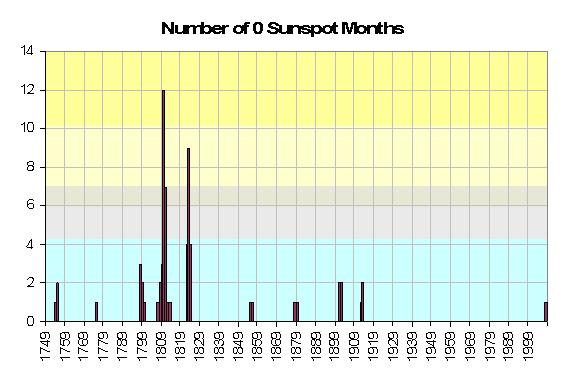
…we have had a 0 sunspot calendar month (there have been more 30 day intervals without sunspots as recent as 1954 but they have crossed months). Following is a plot of the number of months with 0 sunspots by year over the period of record – 23 cycles since 1749.
See larger image here.
Note that cluster of zero month years in the early 1800s (a very cold period called the Dalton minimum – at the time of Charles Dickens and snowy London town and including thanks to Tambora, the Year without a Summer 1816) and again to a lesser degree in the early 1900s. These correspond to the 106 and 213 year cycle minimums. This would suggest that the next cycle minimum around 2020 when both cycles are in phase at a minimum could be especially weak. Even David Hathaway of NASA who has been a believer in the cycle 24 peak being strong, thinks the next minimum and cycle 25 maximum could be the weakest in centuries based on slowdown of the plasma conveyor belt on the sun.
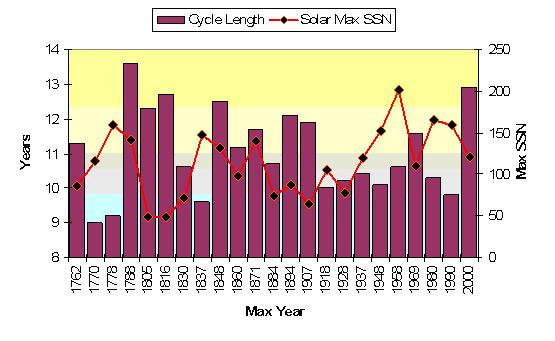
In this plot of the cycle lengths and sunspot number at peak of the cycles, assuming this upcoming cycle will begin in 2009 show the similarity of the recent cycles to cycle numbers 2- 4, two centuries ago preceding the Dalton Minimum. This cycle 23 could end up the longest since cycle 4, which had a similar size peak and also similarly, two prior short cycles.
See larger image here.


Will this mean anything for climate in our near future? Possibly. But we’ll have to wait to see how this experiment pans out.
To Jnicklin,
“Looking back to other “phase changes” its likely that the AGW crowd will just switch to AGCooling without skipping a beat. The media and their cast of supporting scientists have done it before.”
Refer to http://news.smh.com.au/national/big-chill-a-symptom-of-climate-chaos-20080901-46yx.html
This article blames CO2 for “cooling” – now CO2 does everything and AGW cannot be falsified.
I ashamed to say that Australia (my home) appears to have won the gold medal in climate gullability.
Johnny B: “I think that most fat people feel bad about their weight, and certainly have to suffer the physical discomfort and social embarassment of being fat.”
I agree that we should be sensitive about fat people, given their often visible discomfort about their appearance. School-yard taunts such as ‘lard-arse’, ‘blubber-guts’ and ‘Michael Moore’ can be very hurtful, and not only to the younger chubby cheeks but also to the older porker.
My practice on these occasions is to use strictly denotative descriptors such as ‘very large person’, and I find that fatties are often pleasantly surprised and even a little flattered by such neutral and respectful terms.
That said, the hard question must be asked: are very large people pulling their weight in society? Regrettably, I have to say no. There is a good argument that our more solid citizens are free-riding off the svelte and slender, and that this burden is a sizeable one. For example, very large people create disproportionate wear and tear on the public sidewalks, even as their vast bulk prevents the free and unfettered movement of their fellow citizens.
However, while the very large person’s hefty footprint – carbon or otherwise – is a substantial issue, I don’t believe that heavy-handed government regulations or onerous taxation is the answer. I am sure that, given sufficiently generous inducements, there would be ample opportunity for very large people to tackle the weighty issues that confront them every day as a matter of course, or rather, many courses.
My empathy can only carry so much baggage, though. It’s undeniable that the full-bodied are a gross negative externality, although this aspect is probably beyond the purview of government. The only recourse of the normal majority in this case is to grin and bear it.
While some folks have advocated calling the next solar minimum the “Al Gore Minimum”. I’d like to suggest that in addition to reminding them of the proper name “Landscheidt Minimum” that they be consoled with the suggestion to call the cold climate associate with it:
“The Al Gore Cold Period” just a thought 😉
I also suspect that it ought to be considered to be “Bond Event 0” since it fits the pattern…
Oh, and speaking of mangling names, shouldn’t we now admit that Al Gore won the Nobel PeaCe Prize? 😉
I am not a republican. I’m a registered independent. They are all crooks… (though MaCain & Palin have convinced me to stop being quite so cynical for One More Time; and yet I’d be happy if Obama won because we could finally bury the White Guilt monster… maybe I just don’t have enough passion in me to be in a political party, right or left wing…
I agree with the sentiment that we will have plenty of time to count spotless months. My Pink Brandywine tomato has failed to set fruit all “summer” here in San Jose, Ca. (the Siberian is doing fine.) It’s cold, feels like about 1 month ahead of schedule. I’m a 50 something native of Ca. so have a long personal database of experience. Things are ‘not right’ and headed colder.
It would be interesting to check the ‘degree day’ statistics from the wineries. The major factor in proper grape ripening is the total time spent warm. Any modern large winery ought to calculate the degree-days along with measuring fruit sugar. I’m sure someone (U.C.Davis?) has the statistics. Just don’t know where to get them.
We’ll know it’s cooler for sure if the German style whites are record breakers while the dark reds are thin and insipid… Anyone got grant money for a taste test? 🙂
[…] from “Sunspeck counts after all…Sun DOES NOT have first spotless calendar month since June 1913“, Anthony Watts, posted at his blog Watts Up with That, 1 September […]
NEWS
Jan Janssens has updated his famous Spotless Days page (using the data as provided by SIDC).
http://users.telenet.be/j.janssens/Spotless/Spotless.html
He lists the spotless streak as 31 days, from 21 July to 20 August, rank #22 since 1849.
“Pending further review of the preliminary daily sunspot data by SIDC, the period from 21 July 2008 till 20 August 2008 is one of the longer ones since the beginning of daily solar observations in 1849…”
Commentary he posted about the spot, sunspeck or pore on August 22
http://users.telenet.be/j.janssens/Engnieuwtjes.html#Zon
Leif Svalgaard (20:35:10) :
Well, the Aug 21 drawing shows 1 speck (maybe even 1 pixel, but let’s not go there) and the 22 Aug drawing shows 3. Any spots that formed just after the 8/21 drawing and disappeared just before the 23.8 check would have lived about 47 hours.
We could argue a lot about that, so please accept my apology-in-advance for mentioning it.
I fear we’re all guilty of “pore science” too.
“Pending further review of the preliminary daily sunspot data by SIDC,…”
I love the idea that the referee might go “under the hood,” as in the NFL (National Football League), then come out on the field and announce the call:
“After further review, the sunspots’ feet were out-of-bounds. The ruling on the field is reversed – NO Touchdown! The ball will be placed at the 44-day yard line.”
Prof. Manuel.
Thank you for posting that link! Very interesting stuff indeed.
“REPLY: “Pore judgement” if you ask me. – Anthony”
I agree. As Leif pointed out earlier, and again above, the standard practice is to NOT count pores.
This is not merely a judgment call, or honest people honestly disagreeing.
As Leif also pointed out earlier, to change the counting rules means that today’s sunspot counts and historical sunspot counts DO NOT MATCH, and we do not have a proper historical series based on OBJECTIVE (if imperfect) counting rules.
This problem REQUIRES that someone go in and correct the record to make it a proper series again.
And if the person or group doing the “adjusting,” is either incompetent or has a different agenda, we all know where that leads.
You’d think that after the whole Iraq War .. Bush lied meme, that people would be a bit more skeptical of (world) government truths. Afterall it was the consensus of the global intelligence community that Saddam Hussein had WMD (chemical & biological at least), so a consensus on Global Warming goes relatively unchallenged.
Fool me once .. shame on you.
Fool me twice .. shame on me.
But remember that it is an imperative that lawmakers do something now, lest the whole Global Warming thing will be “cured” by Nature, leaving them without any chance of claiming credit for ending the warming trend.
REPLY: You need to talk to SOD, our resident Iraq War debunker. He doesn’t seem to embrace this message. – Anthony
Tim Lindt (23:24:45) :
http://www.glerl.noaa.gov/data/ice/atlas/ice_charts/1977/index.html
http://www.glerl.noaa.gov/data/ice/atlas/ice_charts/1977/pages/c77feb09_jpg.htm
Someone else agrees with your first assessment of no sunspots: Dailytech.com (see http://tinyurl.com/562srq)
More fuel for the fire.
There is an archive of the daily SIDC “ursigrams” here:
http://sidc.oma.be/html/SWAPP/dailyreport/dailyreport.html
If you select the ursigrams for August 22 and 23, you get the reported data for the 21st and 22nd:
August 21:
TODAY’S ESTIMATED ISN : 000, BASED ON 07 STATIONS.
SOLAR INDICES FOR 21 Aug 2008
WOLF NUMBER CATANIA : 011
10CM SOLAR FLUX : 067
AK CHAMBON LA FORET : ///
AK WINGST : 004
ESTIMATED AP : 005
ESTIMATED ISN : 000, BASED ON 14 STATIONS.
August 22:
TODAY’S ESTIMATED ISN : 000, BASED ON 11 STATIONS.
SOLAR INDICES FOR 22 Aug 2008
WOLF NUMBER CATANIA : 013
10CM SOLAR FLUX : 068
AK CHAMBON LA FORET : ///
AK WINGST : 003
ESTIMATED AP : 003
ESTIMATED ISN : 000, BASED ON 11 STATIONS.
In both cases, the daily estimated “International Sunspot Number” based on multiple stations, not just the Catania Wolf Number, was 000. So how did SIDC end up with positive values in the monthly report?
REPLY: Thanks Basil. I sent you some email last week, have not heard a response. – Anthony
Thank you! Oliver Manuel:
It makes me feel a little ignorant. (Or crazy).
….Efforts to understand unusual weather or abrupt changes in climate have been plagued by deficiencies of the standard solar model (SSM) [1]. While it assumes that our primary source of energy began as a homogeneous ball of hydrogen (H) with a steady, well-behaved H-fusion reactor at its core, observations instead reveal a very heterogeneous, dynamic Sun. As examples,
the upward acceleration and departure of H+ ions from the surface of the quiet Sun and abrupt climatic changes, including geomagnetic reversals and periodic magnetic storms that eject material from the solar surface are not explained by the SSM. The present magnetic fields are probably deep-seated remnants of very ancient origin. These could have been generated from two mechanisms. These are: a) Bose-Einstein condensation [2] of iron-rich, zero-spin material into a rotating, superfluid, superconductor surrounding the solar core and/or b) superfluidity and quantized vortices in nucleon-paired Fermions at the core [3]…..
http://www.omatumr.com/abstracts2003/jfe-superfluidity.pdf
“As Leif also pointed out earlier, to change the counting rules means that today’s sunspot counts and historical sunspot counts DO NOT MATCH, and we do not have a proper historical series based on OBJECTIVE (if imperfect) counting rules.
This problem REQUIRES that someone go in and correct the record to make it a proper series again.”
Already been done. See Hoyt, D. V., and K. H. Schatten, 1998. Group sunspot numbers: A new solar activity reconstruction. Solar Physics, 181, 491-512.
Svalgarrd doesn’t like but prefers a proxy. Unfortunately his proxy is not homogeneous as explained in the following paper:
Does sunspot number calibration by the “magnetic needle” make sense?
In Press, Corrected Proof, Available online 10 May 2008
K. Mursula, I. Usoskin, O. Yakovchouk
whose abstract says:
It has been suggested recently that early sunspot numbers should be re-calibrated and significantly corrected using the observed daily range of the geomagnetic declination (so-called rY values). The suggested “correction” method makes an a priori detrending of the rY series and then extends the linear regression between rY and sunspot numbers established for the last 25 years to earlier times. The suggested “correction” of sunspot numbers by roughly 30% goes far beyond the traditional estimates of observational uncertainties of sunspots. Concentrating here on Zürich sunspot numbers (Rz), we demonstrate that the rY values do not actually imply that the observed Rz values in the 19th century are systematically underestimated. Rather, we find that the Rz numbers are fairly uniform after mid-19th century. The suggested “correction” is largely induced by the detrending of the rY series, which enhances the rY-based sunspot activity in the 19th century relative to later times. We also show that while the annually averaged declinations have a rough relation between sunspots and other related solar parameters, this relation is strongly seasonally dependent and, therefore, not sufficiently accurate or uniform to allow annually averaged rY values to be used as a very reliable proxy of solar activity in early times.
The Wolf Sunspot Number and Group Sunspot Number were derived using entirely different observers and agree rather closely for 1880 to 1995. There is no trend difference between them and only small differences in sunspot peak values such as in 1957.
The Group Sunspot Number is constructed by ratioing the observations made by different observers to calibrate the observers to the standard observations of the Royal Greenwich Observatory. Observations back to 1795 can be homogeneous with a rather high confidence (plus/minus 10%) and for 1730 to 1795 with less confidence. Isotopic proxies agree with the Group Sunspot Number reconstruction.
This story has been Slashdotted,
http://science.slashdot.org/article.pl?sid=08/09/02/142218
so expect SIDC’s decision to change at the last moment to be in full glare of techies worldwide.
[…] 2008 has made solar history. As of 00 UTC September 1st 2008 (5PM PST) we just witnessed the first spotless calendar month since June 1913.This was determined according to sunspot data from NOAA’s National Geophysical Data Center, […]
The above comment by Leif Svalgaard about sunspot measurements:
“So it all comes down to if one should count pores. . . . . , it is always a question of judgment.”
Reminds me of Leif’s comment on August 09, 2008 at 18:39:12 pm in the spaceweather discussion of Solar Cycle 24 about the solar neutrino measurements at the Sudbury Neutrino Observatory:
“Remember that nobody has yet been able to tell the difference between neutrinos and antineutrinos.”
http://solarcycle24.forumco.com/topic.asp?TOPIC_ID=353&whichpage=8
Actually solar neutrino measurements at the Homestake Mine by Ray Davis counted only electron neutrinos that induced the following nuclear reaction:
v (electron neutrino) + Cl-37 -> Ar-37
That same Homestake Mine might have been used to count electron anti-neutrinos predicted by the Iron Sun:
_
v (electron anti-neutrino) + Cl-35 -> S-35
According to the Iron Sun hypothesis, two anti-neutrinos are produced for each neutrino made in the Sun [O. Manuel, “The need to measure low energy anti-neutrinos (E < 0.782MeV) from the Sun,” Physics of Atomic Nucleus 67 (2004) 1959-1962; Yad. Fiz. 67 (2004) 1983-1986: http://arxiv.org/abs/astro-ph/0410168 ]
–
v/v = 2
However, the Homestake Mine was flooded with water, instead of using this expensive solar neutrino counting facility to test the Iron Sun hypothesis.
Yet all is well,
Oliver K. Manuel
“Truth is victorious, never untruth.”
http://myprofile.cos.com/manuelo09
wattsupwiththat (08:34:54) :
“This story has been Slashdotted,”
You’re enjoying this, aren’t you? 🙂
I saved four of the ursigrams at work, I’ll save more at home tonight. Key data:
$ egrep ‘ISN|WOLF’ meu23*
meu234.htm:TODAY’S ESTIMATED ISN : 000, BASED ON 10 STATIONS.
meu234.htm:WOLF NUMBER CATANIA : 000
meu234.htm:ESTIMATED ISN : 000, BASED ON 25 STATIONS.
meu235.htm:TODAY’S ESTIMATED ISN : 000, BASED ON 07 STATIONS.
meu235.htm:WOLF NUMBER CATANIA : 011
meu235.htm:ESTIMATED ISN : 000, BASED ON 14 STATIONS.
meu236.htm:TODAY’S ESTIMATED ISN : 000, BASED ON 11 STATIONS.
meu236.htm:WOLF NUMBER CATANIA : 013
meu236.htm:ESTIMATED ISN : 000, BASED ON 11 STATIONS.
meu237.htm:TODAY’S ESTIMATED ISN : 000, BASED ON 09 STATIONS.
meu237.htm:WOLF NUMBER CATANIA : 000
meu237.htm:ESTIMATED ISN : 000, BASED ON 18 STATIONS.
I’d like to know how Wolf numbers are converted between ISN (International Sunspot Number, I believe, though Interpolated Sunspot Number might be part of the answer). Note that their monthly reports refer to “Provisional international and normalized hemispheric daily sunspot numbers.”
And who are these “other stations” and what sort of ranking is there?
Man is the only creature that uses the earths resources, and that’s not fair! The earth has feelings too. I think humans should cut down on carbohydrates, because Al Gore has already proven that human flatulence has caused ozone depletion. Lets save the mosquitos, the spotted owl, the baby seals, the polar bears, the rain forrest, and return to the primitive. Hell, who cares about mankind anyway? “They told me to say that”
So lets all forget about spotless days now. Its not important anymore. You guys messed it up and the cow is out of the barn now.
Douglas Hoyt (08:25:52) :
Svalgaard doesn’t like but prefers a proxy. Unfortunately his proxy is not homogeneous as explained in the following paper:
Does sunspot number calibration by the “magnetic needle” make sense?
In Press, Corrected Proof, Available online 10 May 2008
K. Mursula, I. Usoskin, O. Yakovchouk
Doug, Although not pertinent to the topic, I’ll just have to rebut that: http://www.leif.org/research/AGU%20Spring%202008%20SP23A-07.pdf
Whether the “sunspec” should be counted or not is more of just an interesting statistical sidenote to the bigger picture of continued low solar activity & an increasing long cycle 23. The important thing is that this is giving us a chance to test the solar hypothesis – the sun as a significant driver of climate. That is exciting as a scientist. The solar hypothesis suggests a colder climatewith longer cycle / lower activity. It will be interesting to see if this verifies and to what degree (see plot by Archibald on Icecap : http://icecap.us/images/uploads/HanoverNH.JPG )
Always remember this should be about pursuing science – regardless of the answer & how it fits a particular politcal agenda.
This is a shame! Another blow in what science should be. As someone pointed out, if one counts micro-spots this way, values a century ago are certainly much lower than they were.
I support that someone call this the “Gore minimum”. Mother nature and the Sun will make sure he gets exposed. In some time, taking the Nobel away from him and the IPCC will be the hot way to go.
Ecotretas
http://ecotretas.blogspot.com
Svalgaard’s link above states: “We now assume that this holds back in time for the whole rY-series [detrended by normalizing to its mean].”
Mursula et al.’s paper shows why this assumption is wrong.