UPADATED AT 8:30AM PST Sept 2nd-
More on SIDC’s decision to count a sunspeck (technically a “pore”) days after the fact. NOAA has now followed SIDC in adding a 0.5 sunspot where there was none before. But as commenter Basil points out, SIDC’s own records are in contrast to their last minute decision to count the sunspeck or “pore” on August 21.
There is an archive of the daily SIDC “ursigrams” here:
http://sidc.oma.be/html/SWAPP/dailyreport/dailyreport.html
If you select the ursigrams for August 22 and 23, you get the reported data for the 21st and 22nd:
August 21:
TODAY’S ESTIMATED ISN : 000, BASED ON 07 STATIONS.
SOLAR INDICES FOR 21 Aug 2008
WOLF NUMBER CATANIA : 011
10CM SOLAR FLUX : 067
AK CHAMBON LA FORET : ///
AK WINGST : 004
ESTIMATED AP : 005
ESTIMATED ISN : 000, BASED ON 14 STATIONS.
August 22:
TODAY’S ESTIMATED ISN : 000, BASED ON 11 STATIONS.
SOLAR INDICES FOR 22 Aug 2008
WOLF NUMBER CATANIA : 013
10CM SOLAR FLUX : 068
AK CHAMBON LA FORET : ///
AK WINGST : 003
ESTIMATED AP : 003
ESTIMATED ISN : 000, BASED ON 11 STATIONS.
In both cases, the daily estimated “International Sunspot Number” based on multiple stations, not just the Catania Wolf Number, was 000. So how did SIDC end up with positive values in the monthly report?
UPDATED at 2:42 PM PST Sept 1st –
After going days without counting the August 21/22 “sunspeck” NOAA and SIDC Brussels now says it was NOT a spotless month! Both data sets below have been recently revised.
Here is the SIDC data:
http://www.sidc.be/products/ri_hemispheric/
Here is the NOAA data:
ftp://ftp.ngdc.noaa.gov/STP/SOLAR_DATA/SUNSPOT_NUMBERS/MONTHLY
The NOAA data shows July as 0.5 but they have not yet updated for August as SIDC has. SIDC reports 0.5 for August. It will be interesting to see what NOAA will do.
SIDC officially counted that sunspeck after all. It only took them a week to figure out if they were going to count it or not, since no number was assigned originally.
But there appears to be an error in the data from the one station that reported a spot, Catania, Italy. No other stations monitoring that day reported a spot. Here is the drawing from that Observatory:
ftp://ftp.ct.astro.it/sundraw/OAC_D_20080821_063500.jpg
ftp://ftp.ct.astro.it/sundraw/OAC_D_20080822_055000.jpg
But according to Leif Svalgaard, “SIDC reported a spot in the south, while the spot(s) Catania [reported] was in the north.” This is a puzzle. See his exchange below.
Also, other observatories show no spots at all. For example, at the 150 foot solar solar tower at the Mount Wilson Observatory, the drawings from those dates show no spots at all:
ftp://howard.astro.ucla.edu/pub/obs/drawings/dr080821.jpg
ftp://howard.astro.ucla.edu/pub/obs/drawings/dr080822.jpg
Inquires have been sent, stay tuned.
Here is an exchange in comments from Leif Svalgaard.
——-
REPLY: So What gives Leif….? You yourself said these sunspecks weren’t given a number. I trusted your assessment. Hence this article. Given the Brussels folks decided to change their minds later, what is the rationale ? – Anthony
The active region numbering is done by NOAA, not by Brussels. The Brussels folks occasionally disagree. In this case, they did. Rudolf Wolf would not have counted this spot. Nor would I. What puzzles me is this:
21 7 4 3
22 8 4 4
The 3rd column are ’spots’ in the Northern hemisphere, and the 4th column are ’spots’ in the Southern hemisphere [both weighted with the ‘k’-factor: SSN = k(10g+s)]. But there weren’t any in the south. The Catania spot was at 15 degrees north latitude, IIRC. Maybe the last word is not in on this.
——–
Hmm….apparently there’s some backstory to this. There is a debate raging in comments to this story, be sure to check them. – Anthony
# MONTHLY REPORT ON THE INTERNATIONAL SUNSPOT NUMBER #
# from the SIDC (RWC-Belgium) #
#——————————————————————–#
AUGUST 2008
PROVISIONAL INTERNATIONAL NORMALIZED HEMISPHERIC SUNSPOT NUMBERS
Date Ri Rn Rs
__________________________________________________________________
1 0 0 0
2 0 0 0
3 0 0 0
4 0 0 0
5 0 0 0
6 0 0 0
7 0 0 0
8 0 0 0
9 0 0 0
10 0 0 0
11 0 0 0
12 0 0 0
13 0 0 0
14 0 0 0
15 0 0 0
16 0 0 0
17 0 0 0
18 0 0 0
19 0 0 0
20 0 0 0
21 7 4 3
22 8 4 4
23 0 0 0
24 0 0 0
25 0 0 0
26 0 0 0
27 0 0 0
28 0 0 0
29 0 0 0
30 0 0 0
31 0 0 0
__________________________________________________________________
MONTHLY MEAN : 0.5 0.3 0.2
========================================================
ORIGINAL STORY FOLLOWS:
Many have been keeping a watchful eye on solar activity recently. The most popular thing to watch has been sunspots. While not a direct indication of solar activity, they are a proxy for the sun’s internal magnetic dynamo. There have been a number of indicators recently that it has been slowing down.
August 2008 has made solar history. As of 00 UTC (5PM PST) we just posted the first spotless calendar month since June 1913. Solar time is measured by Coordinated Universal Time (UTC) so it is now September 1st in UTC time. I’ve determined this to be the first spotless calendar month according to sunspot data from NOAA’s National Geophysical Data Center, which goes back to 1749. In the 95 years since 1913, we’ve had quite an active sun. But that has been changing in the last few years. The sun today is a nearly featureless sphere and has been for many days:

Image from SOHO
And there are other indicators. For example, some solar forecasts have been revised recently because the forecast models haven’t matched the observations. Australia’s space weather agency recently revised their solar cycle 24 forecast, pushing the expected date for a ramping up of cycle 24 sunspots into the future by six months.
The net effect of having no sunspots is about 0.1% drop in the TSI (Total Solar Irradiance). My view is that TSI alone isn’t the main factor in modulating Earth’s climate.
I think it’s solar magnetism modulating Galactic Cosmic Rays, and hence more cloud nuclei from GCR’s, per Svensmark’s theory. We’ve had indications since October 2005 that the sun’s dynamo is slowing down. It dropped significantly then, and has remained that way since. Seeing no sunpots now is another indicator of that idling dynamo.
Graph of solar Geomagnetic Index (Ap):

Click for a larger image
Earth of course is a big heat sink, so it takes awhile to catch up to any changes that originate on the sun, but temperature drops indicated by 4 global temperature metrics (UAH, RSS and to a lesser degree HadCrit and GISS) show a significant and sharp cooling in 2007 and 2008 that has not rebounded.In the 20 years since “global warming” started life as a public issue with Dr. James Hansen’s testimony before congress in June 1988, we are actually cooler.

Click for a larger image
Reference: UAH lower troposphere data
Coincidence? Possibly, but nature will be the final arbiter of climate change debate, and I think we would do well to listen to what it’s saying now.
Joe D’Aleo of ICECAP also wrote some interesting things which I’ll reprint here.
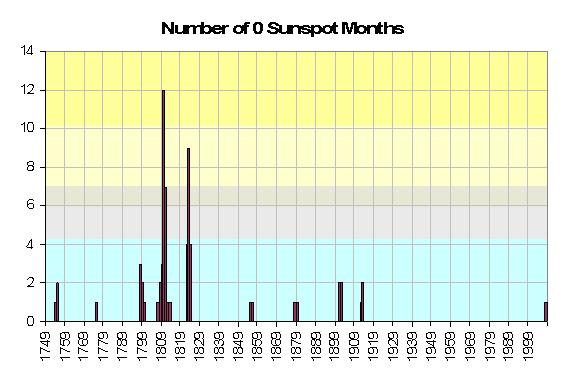
…we have had a 0 sunspot calendar month (there have been more 30 day intervals without sunspots as recent as 1954 but they have crossed months). Following is a plot of the number of months with 0 sunspots by year over the period of record – 23 cycles since 1749.
See larger image here.
Note that cluster of zero month years in the early 1800s (a very cold period called the Dalton minimum – at the time of Charles Dickens and snowy London town and including thanks to Tambora, the Year without a Summer 1816) and again to a lesser degree in the early 1900s. These correspond to the 106 and 213 year cycle minimums. This would suggest that the next cycle minimum around 2020 when both cycles are in phase at a minimum could be especially weak. Even David Hathaway of NASA who has been a believer in the cycle 24 peak being strong, thinks the next minimum and cycle 25 maximum could be the weakest in centuries based on slowdown of the plasma conveyor belt on the sun.
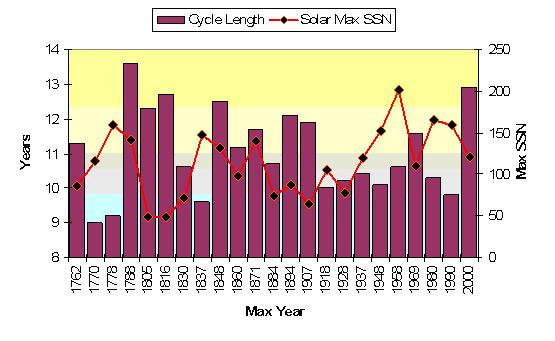
In this plot of the cycle lengths and sunspot number at peak of the cycles, assuming this upcoming cycle will begin in 2009 show the similarity of the recent cycles to cycle numbers 2- 4, two centuries ago preceding the Dalton Minimum. This cycle 23 could end up the longest since cycle 4, which had a similar size peak and also similarly, two prior short cycles.
See larger image here.


Will this mean anything for climate in our near future? Possibly. But we’ll have to wait to see how this experiment pans out.
Seems to me that they should also be using 1750`s or earlier equipment to check for sun spots not specks that would not be seen in that era.
I haven’t read all the comments yet. But, in an earlier post, I asked how long these sun-specks lasted. I thought maybe 12 hours. Is this so? Are there time limits to become a real suns spot?
Secondly, I reckon, in all innocence, that it took a week because the authorities that be were getting concerned about all the “month-without-a-sunspot” talk going around the climate realists groups.
OK, I will rephrase it — How do we know the same procedures were used in June 1913 as they are using today– And the spots were viewed the same way ….. For that matter, how did they measure sunspots in 1813? The question is still relevant even if it’s not technology but eyesight that drew the charts.
I see the exact same problem with using 1800s thermometers versus those in use today —- and trying to make sense out of charts down to 0.01 degree.
I see a data measurement integrity strain developing through the whole of the observed climate data, which would not stand up to normal scientific scrutiny. It is simply a guessing game, turned into a political parlor game — to extract more tax money from the unwary.
Tax money or grant money? To scientists, its all about the grant from big government or big business.
And therein lies the credibility problem.
Ric Werme (10:01:03) wrote: “Come one guys, chill out (yeah, just like the climate). Whether or not different organizations assign a zero the August ISN is not going to influence the climate over the next decade one whit.”
Ric, I’ve always enjoyed your posts as well as info on your website. But I think your remarks on this situation are out of character.
It’s not only the data per se, it’s the INTEGRITY of the dataset. Many datasets, as you know, are used, manipulated, and twisted by the [snip] to support their AGW claims. This seems to just another example.
Jack Koenig, Editor
The Mysterious Climate Project
http://www.climateclinic.com
Folks,
Just a retired engineer here who taught some telecom once upon a time. In the courses we examined cause and effect. My statement at the time was “If it walks like a duck, quacks like a duck, and looks like a duck, you can say its a duck with a reasonable chance of being correct.” One tiny sunspot one way or another will not affect the outcome over many days without them. The majority of the stories about the sun are about some really distrubing changes in activity, and we’re not talking an increase here.
A zit doesn’t mean acne, and while the idea of a calendar month without spots is a good talking point, it doesn’t change the picture that the sun is asleep.
Time will tell if it wakes up – the other stories on the plasma flow and magnetic field strength and temps are far more troubling than just the single spottett (spotet – spottet – um, yea you get it!)
Mike
May 10, 2006: The Sun’s Great Conveyor Belt has slowed to a record-low crawl, according to research by NASA solar physicist David Hathaway. “It’s off the bottom of the charts,” he says. “This has important repercussions for future solar activity.”
http://science.nasa.gov/headlines/y2006/10may_longrange.htm
My questions would be:
Why are we counting specks at all? Do they have some scientific value?
Do they (as I rather suspect) have some propagadist value that the Sun is not after all, contrary to reports, spotless this month? Ergo, global cooling cannot be setting in because the Sun is not spotless.
There may be some honest scientific value in it, but given that this is coming from Brussels (home of the EU and the IPCC) I sincerely doubt this is anything more than an effort to “slow the train” of news that the Sun is spotless and what this might mean for the globe and for AGW.
Cracks in the dike. Simply cracks in the dike.
Please, Anthony, or Leif, can you answer my question?
How long were these sun-specks apparent? I figure 12 hours.
How long do they need to be seen before they become “spots”?
I imagine some bright light will realize there is future funding for understanding why the sun went to sleep and triggered global cooling. Of course, this will lead to someone claiming to have a solar-engineering solution that will wake the sun up.
Hmmmm… perhaps I should write up a treatment and pitch it to Hollywood?
Bobby: You suspect right, slow the train until they can concoct some other nonsensical theory — try and brush off the obvious.
The speck has political propaganda value. Nothing more, nothing less. Consider the headline “Sun spotless first calender month since June 1913” and the impact it would have on the ordinary ill informed citizen. Heck people might even think the sun has something to do with Earth’s climate. Probably figured that out one day while laying on the beach.
As an engineer, I find the whole climate data and debate something that if this were the quality of data presented to me for an engineering decision, I would immediately fire the engineers. Sure science is supposed to be different, debate and all that, but there is still the issue of individual integrity.
It’s odd all the fudge goes only one way.
And now for something different. While others are talking about predicting SC24, here is my latest and “greatest” regression analysis attempt at projecting earthly temperature anomalies. Listed below are the August 2007 actual numbers for 4 datasets and my predicted numbers for August 2008
Year ====== Hadley GISS UAH RSS
2007 actual== 0.370 0.56 0.286 0.367
2008 predict= 0.293 0.41 0.048 0.090
I have a suggestion.
Why not set up a dual sunspot record.
1) A Wolf record utilizing only equipment available in 1848 ( this would mean that the “k” factor would be “1” and not a SWAG).
2) A Modern Number based on the best equipment available today.
As it is now, the Wolf fomula seems to do OK near the top of the cycle, but at the minimum there will be more of these controversies about whether a spot is to be counted. Later this year those two satelites will be in position to view the entire sun at once. How will this affect sunspot Numbers listed?
SWAG = Scientific Wild A** Guess as opposed to a WAG that I could give.
David, actually Al Gore IS out to make big bucks. He is co-founder, co- owner and chairman of a firm that invests in “green” companies: Generation Investment Management LLP These investments are bound to increase in value significantly if he can keep AGW constantly in the news cycle. Much of what he is doing is providing indirect marketing for his company.
He has a big conflict of interest in this debate. It doesn’t mean that he is wrong. Maybe he is a visionary who saw an opportunity and took advantage of it. But everything he says should be taken with a grain of salt.
Bill Livingston actually saw the ‘spots’ and says:
“Certainly this was a pore(s). Without penumbrae”
So, they were not spots, but pores. And pores should not be counted [and are not when the Sun is active – there may be scores of them at any given time], only real spots with a penumbra [the fuzzy area between the central very dark area and the surrounding photosphere (see: http://en.wikipedia.org/wiki/Image:Sunspot-2004.jpeg ). Looking at that group, I would count 19 spots [and I think Rudolf Wolf would have too -reading his descriptions of how he did things]. His successor, Wolfer, insisted on counting all spots that he could see within the penumbra, and would probably have counted ~40 total [try to count yourself and see what number you come up with and get a feeling for how difficult this is]. Wolfer himself determined that one should adjust [there is that dreaded word again] his counts by a factor of 0.6 to match Wolf’s counts, and that is what Zurich and SIDC have been doing ever since Wolf’s death in 1893 [when he could no longer complain].
Since Catania reported pores on Aug.21-22, these must have lived at least 24 hours, unless you want to entertain the idea that they died within a few hours and then reformed again the next day just in time to be observed by Catania.
So it all comes down to if one should count pores. I and Rudolf Wolf and NOAA don’t think so. Wolfer and SIDC think that pores should be counted. Nobody is more ‘correct’ than the other in this, it is always a question of judgment.
REPLY: “Pore judgement” if you ask me. – Anthony
[…] Follow The Sun on Watts Up With That? […]
They sure saw you coming! 😉
Well, it was either that or cod-liver oil, so the choice was easy.
The day we fell to their level
The day the sun died
The day every dream was burned
The day the sun died
God definitely has a sense of humor.
Turning off the Sun, soon after the politicians and the consensus scientists (feeding on public funds) told us that they knew how to control Earth’s climate!
All is well,
Oliver K. Manuel
“Truth is victorious, never untruth.”
http://myprofile.cos.com/manuelo09
Solar Terrestrial Activity Report has just stopped their consecutive spotless streak count and acted like it never happened, but perhaps strangely/suspiciously, the sunspot graph does not show the spot on August 21; it is just a flat line still. Jan Alvestad now lists 0.5 as the spot count for August without saying why.
http://dxlc.com/solar/
That little spot… what ever it was… was really tiny and almost undetected even by the most powerful telescopes. This brings questions on the past black spots-free months. If today with all our technology we were not able to see this spot, imagine 100, 200 or even 300 years ago how they could see those tiny spots. By bet is than they could not and so it was recorded that month without spot were maybe in fact filled with those micro black spots. But that we will never know.
Note to Oliver K. Manuel (21:53:44): Nice lines, sir!
Wish, though, you would put your web page inside a table so it didn’t spread right off the screen. Very interesting reading; but difficult due to the bleed.
Hi Guys,
Sorry but some of us have families and have to have “fun” over the weekend. Leif is exactly correct and that a few surprises does not mean a birthday party. Let the cycle progress and then we will see. Gustav will make an impact no doubt. That is what is important right now. Wait for Hanna
my 10 cents worth
I thought that 30 months represents momentum fairly well,
by adding spot counts for this time and dividing by 30 we get and average number
here are the results.
1811
25.7/30=0.86
1913 11
87.6/30=2.92
1934 11
236/30=7.8
2008 09-01
259/27=9.6
265/30=8.8
1954
462/30=15.4
notes
second set for 2008 is fudged for sept. and oct.
counts start on may and end on october.
well as we see we are close to the period of 1933,34
and at 3 times the number of 1912,13 (Dalton Minimum)
links to cycles of warm and cold no need for instraments to see this!
note 1978-1979 IE blizard of 78
hey keep up the good work, will be a laugh to see the agw’s explane what’s comming after the fact. 🙂
http://www.glerl.noaa.gov/data/ice/atlas/ice_charts/index.html