UPADATED AT 8:30AM PST Sept 2nd-
More on SIDC’s decision to count a sunspeck (technically a “pore”) days after the fact. NOAA has now followed SIDC in adding a 0.5 sunspot where there was none before. But as commenter Basil points out, SIDC’s own records are in contrast to their last minute decision to count the sunspeck or “pore” on August 21.
There is an archive of the daily SIDC “ursigrams” here:
http://sidc.oma.be/html/SWAPP/dailyreport/dailyreport.html
If you select the ursigrams for August 22 and 23, you get the reported data for the 21st and 22nd:
August 21:
TODAY’S ESTIMATED ISN : 000, BASED ON 07 STATIONS.
SOLAR INDICES FOR 21 Aug 2008
WOLF NUMBER CATANIA : 011
10CM SOLAR FLUX : 067
AK CHAMBON LA FORET : ///
AK WINGST : 004
ESTIMATED AP : 005
ESTIMATED ISN : 000, BASED ON 14 STATIONS.
August 22:
TODAY’S ESTIMATED ISN : 000, BASED ON 11 STATIONS.
SOLAR INDICES FOR 22 Aug 2008
WOLF NUMBER CATANIA : 013
10CM SOLAR FLUX : 068
AK CHAMBON LA FORET : ///
AK WINGST : 003
ESTIMATED AP : 003
ESTIMATED ISN : 000, BASED ON 11 STATIONS.
In both cases, the daily estimated “International Sunspot Number” based on multiple stations, not just the Catania Wolf Number, was 000. So how did SIDC end up with positive values in the monthly report?
UPDATED at 2:42 PM PST Sept 1st –
After going days without counting the August 21/22 “sunspeck” NOAA and SIDC Brussels now says it was NOT a spotless month! Both data sets below have been recently revised.
Here is the SIDC data:
http://www.sidc.be/products/ri_hemispheric/
Here is the NOAA data:
ftp://ftp.ngdc.noaa.gov/STP/SOLAR_DATA/SUNSPOT_NUMBERS/MONTHLY
The NOAA data shows July as 0.5 but they have not yet updated for August as SIDC has. SIDC reports 0.5 for August. It will be interesting to see what NOAA will do.
SIDC officially counted that sunspeck after all. It only took them a week to figure out if they were going to count it or not, since no number was assigned originally.
But there appears to be an error in the data from the one station that reported a spot, Catania, Italy. No other stations monitoring that day reported a spot. Here is the drawing from that Observatory:
ftp://ftp.ct.astro.it/sundraw/OAC_D_20080821_063500.jpg
ftp://ftp.ct.astro.it/sundraw/OAC_D_20080822_055000.jpg
But according to Leif Svalgaard, “SIDC reported a spot in the south, while the spot(s) Catania [reported] was in the north.” This is a puzzle. See his exchange below.
Also, other observatories show no spots at all. For example, at the 150 foot solar solar tower at the Mount Wilson Observatory, the drawings from those dates show no spots at all:
ftp://howard.astro.ucla.edu/pub/obs/drawings/dr080821.jpg
ftp://howard.astro.ucla.edu/pub/obs/drawings/dr080822.jpg
Inquires have been sent, stay tuned.
Here is an exchange in comments from Leif Svalgaard.
——-
REPLY: So What gives Leif….? You yourself said these sunspecks weren’t given a number. I trusted your assessment. Hence this article. Given the Brussels folks decided to change their minds later, what is the rationale ? – Anthony
The active region numbering is done by NOAA, not by Brussels. The Brussels folks occasionally disagree. In this case, they did. Rudolf Wolf would not have counted this spot. Nor would I. What puzzles me is this:
21 7 4 3
22 8 4 4
The 3rd column are ’spots’ in the Northern hemisphere, and the 4th column are ’spots’ in the Southern hemisphere [both weighted with the ‘k’-factor: SSN = k(10g+s)]. But there weren’t any in the south. The Catania spot was at 15 degrees north latitude, IIRC. Maybe the last word is not in on this.
——–
Hmm….apparently there’s some backstory to this. There is a debate raging in comments to this story, be sure to check them. – Anthony
# MONTHLY REPORT ON THE INTERNATIONAL SUNSPOT NUMBER #
# from the SIDC (RWC-Belgium) #
#——————————————————————–#
AUGUST 2008
PROVISIONAL INTERNATIONAL NORMALIZED HEMISPHERIC SUNSPOT NUMBERS
Date Ri Rn Rs
__________________________________________________________________
1 0 0 0
2 0 0 0
3 0 0 0
4 0 0 0
5 0 0 0
6 0 0 0
7 0 0 0
8 0 0 0
9 0 0 0
10 0 0 0
11 0 0 0
12 0 0 0
13 0 0 0
14 0 0 0
15 0 0 0
16 0 0 0
17 0 0 0
18 0 0 0
19 0 0 0
20 0 0 0
21 7 4 3
22 8 4 4
23 0 0 0
24 0 0 0
25 0 0 0
26 0 0 0
27 0 0 0
28 0 0 0
29 0 0 0
30 0 0 0
31 0 0 0
__________________________________________________________________
MONTHLY MEAN : 0.5 0.3 0.2
========================================================
ORIGINAL STORY FOLLOWS:
Many have been keeping a watchful eye on solar activity recently. The most popular thing to watch has been sunspots. While not a direct indication of solar activity, they are a proxy for the sun’s internal magnetic dynamo. There have been a number of indicators recently that it has been slowing down.
August 2008 has made solar history. As of 00 UTC (5PM PST) we just posted the first spotless calendar month since June 1913. Solar time is measured by Coordinated Universal Time (UTC) so it is now September 1st in UTC time. I’ve determined this to be the first spotless calendar month according to sunspot data from NOAA’s National Geophysical Data Center, which goes back to 1749. In the 95 years since 1913, we’ve had quite an active sun. But that has been changing in the last few years. The sun today is a nearly featureless sphere and has been for many days:

Image from SOHO
And there are other indicators. For example, some solar forecasts have been revised recently because the forecast models haven’t matched the observations. Australia’s space weather agency recently revised their solar cycle 24 forecast, pushing the expected date for a ramping up of cycle 24 sunspots into the future by six months.
The net effect of having no sunspots is about 0.1% drop in the TSI (Total Solar Irradiance). My view is that TSI alone isn’t the main factor in modulating Earth’s climate.
I think it’s solar magnetism modulating Galactic Cosmic Rays, and hence more cloud nuclei from GCR’s, per Svensmark’s theory. We’ve had indications since October 2005 that the sun’s dynamo is slowing down. It dropped significantly then, and has remained that way since. Seeing no sunpots now is another indicator of that idling dynamo.
Graph of solar Geomagnetic Index (Ap):

Click for a larger image
Earth of course is a big heat sink, so it takes awhile to catch up to any changes that originate on the sun, but temperature drops indicated by 4 global temperature metrics (UAH, RSS and to a lesser degree HadCrit and GISS) show a significant and sharp cooling in 2007 and 2008 that has not rebounded.In the 20 years since “global warming” started life as a public issue with Dr. James Hansen’s testimony before congress in June 1988, we are actually cooler.

Click for a larger image
Reference: UAH lower troposphere data
Coincidence? Possibly, but nature will be the final arbiter of climate change debate, and I think we would do well to listen to what it’s saying now.
Joe D’Aleo of ICECAP also wrote some interesting things which I’ll reprint here.
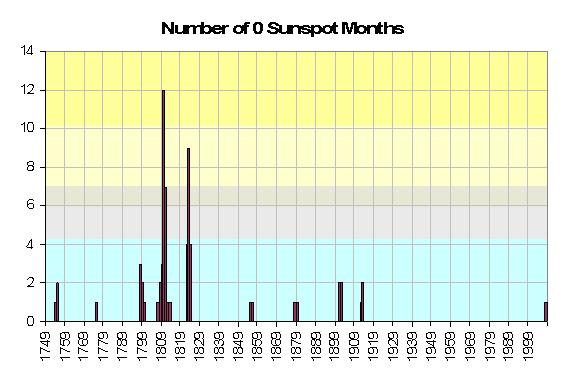
…we have had a 0 sunspot calendar month (there have been more 30 day intervals without sunspots as recent as 1954 but they have crossed months). Following is a plot of the number of months with 0 sunspots by year over the period of record – 23 cycles since 1749.
See larger image here.
Note that cluster of zero month years in the early 1800s (a very cold period called the Dalton minimum – at the time of Charles Dickens and snowy London town and including thanks to Tambora, the Year without a Summer 1816) and again to a lesser degree in the early 1900s. These correspond to the 106 and 213 year cycle minimums. This would suggest that the next cycle minimum around 2020 when both cycles are in phase at a minimum could be especially weak. Even David Hathaway of NASA who has been a believer in the cycle 24 peak being strong, thinks the next minimum and cycle 25 maximum could be the weakest in centuries based on slowdown of the plasma conveyor belt on the sun.
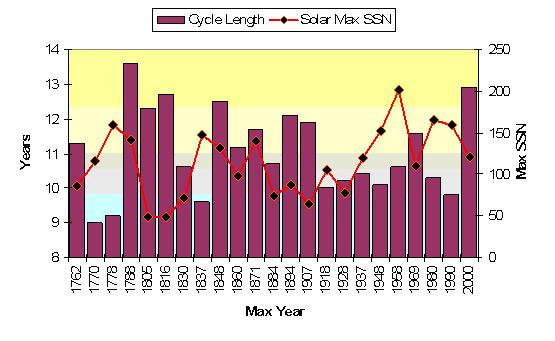
In this plot of the cycle lengths and sunspot number at peak of the cycles, assuming this upcoming cycle will begin in 2009 show the similarity of the recent cycles to cycle numbers 2- 4, two centuries ago preceding the Dalton Minimum. This cycle 23 could end up the longest since cycle 4, which had a similar size peak and also similarly, two prior short cycles.
See larger image here.


Will this mean anything for climate in our near future? Possibly. But we’ll have to wait to see how this experiment pans out.
Discover more from Watts Up With That?
Subscribe to get the latest posts sent to your email.
Even if the official count for August is 1 sunspot, well, no BFD. It’s still getting colder and we could be in for a long chill. I’d rather see more sunspots and a return of a cool climate via the PDO and AMO turning negative. At least it won’t be a repeat of the Maunder or Dalton Minima. A lot of people will die if those Minima events reappear.
Basil (09:10:03) :
So it seems to me that the NOAA/SWPC data still support the claim of a spotless August. It is just SIDC that has counted something.
There was a tiny ‘spot’ on August 21-22. Or, more accurately, what is called a ‘pore’. The difference is whether there is a well-defined penumbra surrounding the dark central part, the umbra. The pore was observed by Bill Livingston [as I have reported in this blog] and he even measured its magnetic field and temperature [and found the pore to be just on his projected trend for disappearance of spots by 2015]. The issue is whether to count the pore and here NOAA and SIDC seem to differ. A side-issue is why SIDC reported the pore to be present in both hemispheres at the same time. This is clearly wrong as they have admitted. A procedural question is why they chose not to check into this “at that [sic] time”.
Those Italians must have one serious observatory to count that sunspeck, according to SOHO (NASA) the sun appeared ‘blank’.
DAV (08:18:52) :
“…Disclosure: I worked on Triana.”
Am I correct that Triana, DSCOVR or GoreSat was never launched, that we paid $100M for it, and that we’re paying $1M per year to keep it in storage?
If so, I say, launch the damn thing. I for one think that continuous weather satellite images from the L1 perspective would be useful.
Douglas Hoyt (08:52:03) :
Although June 1913 is officially said to have had no sunspots, Stefko in Moscow reported sunspots on June 3 and 4th. None of the other 20 observers reported any sunspots in June 1913.
The policy in Zurich was to have a ‘primary’ observer [usually the Zurich observer – maybe always], and to report his count for the day, unless the weather or other things prevented observations. In such cases, a ‘secondary’ observer’s count would be used, or if that was unavailable, a ‘tertiary’ observer, etc. They did not tote up all observers and report the average as is done now. One can argue which is best, but when you change method like this you screw up the statistics and the homogeneity of the series.
Isn’t it likely that this short duration speck wouldn’t have been noticed in 1913? Are we really comparing apples to apples when we compare these old observations with modern ones made with the latest technology and vastly more eyes on the sun?
Nathan Stone (09:47:34) :
Isn’t it likely that this short duration speck wouldn’t have been noticed in 1913? Are we really comparing apples to apples when we compare these old observations with modern ones made with the latest technology and vastly more eyes on the sun?
There are indications that the modern counts are too high with possible repercussions for reconstructions of TSI and the climate debate.
Tad off topic, but the ASU temps look like this August is going to come in about .31 F cooler than last August.
Come one guys, chill out (yeah, just like the climate). Whether or not different organizations assign a zero the August ISN is not going to influence the climate over the next decade one whit. If climate models come up with significantly different forecasts based on the length of spotless days, then those models need to be taken back to the drawing board.
Does this change how interesting the current solar activity is? No.
Does this change expectations for cycle 24? No.
Could there have been a countable sunspot that was missed because it lived its life on the far side of the Sun? Yes.
Does this change the Guiness Book of Climate Records? Well, if there was such a book, it might – the record isn’t settled yet (thank you Leif for taking this on), but scientifically a record is just a curiosity. It is significant for political and propaganda purposes, but fudging temperature records is so much more effective. No one here was planning to use a spotless August for propaganda purposes, right?
What’s the the ISN for September going to be? Well, so far, it might be 0.
There really is a lot more to life than counting sunspecks. Or so I thought. I’ve been wrong before.
Lots of interesting information here–thanks for all the hard work. A very good read.
(08:36:20) :
REPLY: Leif, there is a lot of confusion on this, then WHO did count the sunspot? SIDC? NOAA?
Who made the decision to count it? Initially I thought is was SIDC, but then in your earlier comments you said “NOAA is responsible for numbering the active regions”.
So where does the decision get made, and who makes it? Is it an individual or by committee, or by procedural analysis of data?
NOAA and SIDC are independent and make their own decisions regardless of the other. NOAA numbers the ‘active region’ if [according to their – very specific rules] it qualifies to be considered as such. As far as I know, this decision is made by a person – not always the same one, but the rules are clear, so different person would make the same decision. SIDC does not number regions but adds up counts from a large number {~60] observers to form an average. This is done by an automated procedure and is [it seems] not checked manually. I have suggested to them to make a real-time manual check, but I don’t think it will have any effect. You know, a knee-jerk reaction to suggestions like this is to hunker down, batten the hatches, and do nothing, waiting for the storm to blow over. If this blog can help change this that would be great.
John-X (09:44:19) : Am I correct that Triana, DSCOVR or GoreSat was never launched, that we paid $100M for it, and that we’re paying $1M per year to keep it in storage? If so, I say, launch the damn thing. I for one think that continuous weather satellite images from the L1 perspective would be useful.
Yep. Launching is not my decision, though. I’m all for it. Certainly hate to see what I’ve worked on lying around in mothballs. Just as I hated when HST (which I also worked on) sat in storage for all that time. Maybe it will be launched eventually just as HST.
But there are several factors keeping it on the ground; not the least of which is its political football status. Budget is becoming a real issue at NASA, especially for unmanned near-Earth projects. To put it in operation could cost well over 10x the annual storage cost. To give an example, HST’s monthly budget is around $25M per month albeit it is a much larger project being likely the penultimate Large Telescope. The “honor” for last is currently being held by another project I worked on, Spitzer. Sad to think that Spitzer’s namesake is on the last of his concept, though.
Can people (Leif, that means you) handle a technical question today or is today reserved for ranting?
What puzzles me is how an equation like k(10g+s) can yield 4. Leif, can you explain that a bit better?
If there was one countable sunspeck in the northern hemisphere, that would be 1 group(g) and 1 speck/spot(s) and hence k would be 11. Are the 3s and 4s due to averaging observations from the multiple observers? And are there three observers?
I understand the southern hemisphere data is counted as a typo, so I’m happily ignoring that.
Hey, doesn’t this set a new record for the most excitement over a single digit number? Oops, ranting again.
Leif,
I’m aware of the sun speck/tiny tim sunspot that appeared briefly in August. My point was that NOAA didn’t count it, but SIDC did. So that leads to two things (well more, but two that I’m writing about). First, on NOAA’s count the claim that August was “spotless” still holds, and second, given this, why is the contrary claim being attributed to NOAA? It seems that NOAA and SIDC are at odds on whether or not the August sun speck should have been counted. As you’ve said, NOAA hasn’t flipped, and by reckoning shouldn’t have figured in the update to the original post at all.
As others have said, it really doesn’t change anything. Whatever happened in August happened, and we’re still looking at an unusually quiet minimum, with whatever that portends for the future. That’s my claim (“unusually quiet minimum”), based on a comparison to the last few cycles. I know you disagree.
Basil
“If so, I say, launch the damn thing. I for one think that continuous weather satellite images from the L1 perspective would be useful.” John-X
Yes, it has a radiometer on it so maybe it could measure the energy reflected/radiated away from earth so we determine the long term heating trend on earth. Le Mr. Al G. get the credit for putting the global warming debate to bed.
Spotless, but not speckless.
I agree with Ric, the sun is awfully darn quiet. Squibble all you want over a few specks. It’s nonsense.
Leif Svalgaard (09:35:22) :
“A side-issue is why SIDC reported the pore to be present in both hemispheres at the same time. This is clearly wrong as they have admitted. A procedural question is why they chose not to check into this “at that [sic] time”.”
And that in every one of their daily reports for August, they listed the ISN as “000,” then in their monthly report, listed the ISN (Ri) as 7 and 8 for 21 and 22 August respectively.
They MENTIONED the speck in the dailies, NOTED it had a Catania Number (84) but no NOAA number, but offered no commentary on why it would or would not be included in any count.
I had assumed, right up until I got the email of the monthly report first thing this morning, that the SIDC count was going to be zero for the entire month, and likewise with NOAA, which AVOIDED any mention of the speck.
In fact, in NOAA/SWPC’s daily “Analysis of Solar Active Regions and Activity,” issued at 22:00 UTC daily, there is a comment on spotless days, such as this one from yesterday’s report:
“Analysis of Solar Active Regions and Activity from 30/2100Z
to 31/2100Z: Solar activity was very low. The visible solar disk
remained spotless.”
http://www.swpc.noaa.gov/forecast.html
On the days when the speck or pore was present, the “visible disk” comment was simply omitted without explanation.
Opps,
Seeing Anthony’s latest update, I can see where a claim of implicating NOAA in this comes from.
But as I and others have posted, and which anyone can check by looking here:
http://www.swpc.noaa.gov/ftpdir/indices/dayind/
the raw data shows no sunspots since 7-20.
So Leif, do you know where the “0.5” came from in the NOAA report? Are they just reporting the SIDC number, and ignoring their own data?
REPLY: Somebody please save those offline before they change, I don’t want to be the only source if they do. – Anthony
Now here’s an interesting summary of current climate drivers:
http://www.onlineopinion.com.au/view.asp?article=7824&page=0
Hat tip J Marohasy
Let’s see what comes out of NOAA/SWPC in the next few days when they post their report for August. What SIDC has put out sounds like a preliminary report. I expect the lines between NOAA & SIDC will be buzzing while they debate the merits of that little speck. If the prediction of no spots by 2015 holds then all this fuss over one speck will pale. But watching scientist argue over this is most fascinating.
Many solar scientists are present.
An ignorant question.
The Sun ejects particles, positive and negative, right.
After 4 billion years.
The Sun is positive or negative?
Sorry … a link please
Basil (10:30:12) :
So Leif, do you know where the “0.5″ came from in the NOAA report? Are they just reporting the SIDC number, and ignoring their own data?
The sunspot number at http://www.swpc.noaa.gov/SolarCycle/ is [as it should be] the official SIDC number.
Leon Brozyna (10:36:23) :
I expect the lines between NOAA & SIDC will be buzzing while they debate the merits of that little speck
I don’t think so. Their rules were laid down long ago and they don’t care for such discussions. It will be interesting to see if SIDC even fixes their “obvious” error. I’ll not bet on it.
Duane & Lucy: Eight or nine months ago, I too believed in AGW. What changed my mind was reading about sunspots and the Maunder Minimum. Suddenly, there appeared to be an equally good scientific explanation for the global warming of last century. But the vast majority of the population has not heard of it. Most of the people who are messengers for the anti-AGW crowd never mention it either. Governor Palin hasn’t said a thing about it yet. Then we have thoughtful people like Lief who is unconvinced by it.
I am a progressive; not a liberal. Progressives are much more akin to Libertarians on issues like foreign policy, monetary policy and matters of science than they are like liberals. So it surprises me not one iota that Gore and Kerry are still saying the things they say.
But politicians, all politicians, have much the same dilemma as lawyers (my profession) when it comes to matters of science. We do not have the luxury of waiting a hundred years till science resolves an issue. We have to go with the best information at the time or the consensus at the time. Last time I checked, AGW is is still the consensus. And the media is doing nothing to promote solar activity as the cause of global increases in temperature. When the media begins reporting it, I think many liberals will change their tune. After all, global cooling could be more catastrophic than global warming.
And whether its global warming or global cooling, we are going to get taxed to prevent it. That is the New World Order. Better get used to it.
From the SWPC website http://www.swpc.noaa.gov/ftpdir/weekly/README3
“TERMS AND DEFINITIONS:
The official International Sunspot Number (RI) is issued by the Sunspot
Index Data Center (SIDC) in Brussels. Data and plots are available from
the SIDC web site at
http://sidc.oma.be
The Space Weather Prediction Center (SWPC) issues a preliminary sunspot number.
At http://www.swpc.noaa.gov/ftpmenu/indices.html see
Daily Solar Data — last 30 days
Daily Solar Data — current quarter”
This sounds as though NOAA (“preliminary”) defers to Brussels (“official”).
From the same page:
“UPDATE SCHEDULE:
The Solar Cycle products are updated once a month and are
put on-line the first Tuesday after the new values are available.
The latest values are usually available on the 3rd of every month.”
So their graphs of the Solar Cycle progression should be updated tomorrow, with the values by Wednesday.
“Here is the NOAA data: ftp://ftp.ngdc.noaa.gov/STP/SOLAR_DATA/SUNSPOT_NUMBERS/MONTHLY”
I still only see data through July on this table. Are you getting August data Anthony?
REPLY: You are correct, July is showing 0.5 not August