UPADATED AT 8:30AM PST Sept 2nd-
More on SIDC’s decision to count a sunspeck (technically a “pore”) days after the fact. NOAA has now followed SIDC in adding a 0.5 sunspot where there was none before. But as commenter Basil points out, SIDC’s own records are in contrast to their last minute decision to count the sunspeck or “pore” on August 21.
There is an archive of the daily SIDC “ursigrams” here:
http://sidc.oma.be/html/SWAPP/dailyreport/dailyreport.html
If you select the ursigrams for August 22 and 23, you get the reported data for the 21st and 22nd:
August 21:
TODAY’S ESTIMATED ISN : 000, BASED ON 07 STATIONS.
SOLAR INDICES FOR 21 Aug 2008
WOLF NUMBER CATANIA : 011
10CM SOLAR FLUX : 067
AK CHAMBON LA FORET : ///
AK WINGST : 004
ESTIMATED AP : 005
ESTIMATED ISN : 000, BASED ON 14 STATIONS.
August 22:
TODAY’S ESTIMATED ISN : 000, BASED ON 11 STATIONS.
SOLAR INDICES FOR 22 Aug 2008
WOLF NUMBER CATANIA : 013
10CM SOLAR FLUX : 068
AK CHAMBON LA FORET : ///
AK WINGST : 003
ESTIMATED AP : 003
ESTIMATED ISN : 000, BASED ON 11 STATIONS.
In both cases, the daily estimated “International Sunspot Number” based on multiple stations, not just the Catania Wolf Number, was 000. So how did SIDC end up with positive values in the monthly report?
UPDATED at 2:42 PM PST Sept 1st –
After going days without counting the August 21/22 “sunspeck” NOAA and SIDC Brussels now says it was NOT a spotless month! Both data sets below have been recently revised.
Here is the SIDC data:
http://www.sidc.be/products/ri_hemispheric/
Here is the NOAA data:
ftp://ftp.ngdc.noaa.gov/STP/SOLAR_DATA/SUNSPOT_NUMBERS/MONTHLY
The NOAA data shows July as 0.5 but they have not yet updated for August as SIDC has. SIDC reports 0.5 for August. It will be interesting to see what NOAA will do.
SIDC officially counted that sunspeck after all. It only took them a week to figure out if they were going to count it or not, since no number was assigned originally.
But there appears to be an error in the data from the one station that reported a spot, Catania, Italy. No other stations monitoring that day reported a spot. Here is the drawing from that Observatory:
ftp://ftp.ct.astro.it/sundraw/OAC_D_20080821_063500.jpg
ftp://ftp.ct.astro.it/sundraw/OAC_D_20080822_055000.jpg
But according to Leif Svalgaard, “SIDC reported a spot in the south, while the spot(s) Catania [reported] was in the north.” This is a puzzle. See his exchange below.
Also, other observatories show no spots at all. For example, at the 150 foot solar solar tower at the Mount Wilson Observatory, the drawings from those dates show no spots at all:
ftp://howard.astro.ucla.edu/pub/obs/drawings/dr080821.jpg
ftp://howard.astro.ucla.edu/pub/obs/drawings/dr080822.jpg
Inquires have been sent, stay tuned.
Here is an exchange in comments from Leif Svalgaard.
——-
REPLY: So What gives Leif….? You yourself said these sunspecks weren’t given a number. I trusted your assessment. Hence this article. Given the Brussels folks decided to change their minds later, what is the rationale ? – Anthony
The active region numbering is done by NOAA, not by Brussels. The Brussels folks occasionally disagree. In this case, they did. Rudolf Wolf would not have counted this spot. Nor would I. What puzzles me is this:
21 7 4 3
22 8 4 4
The 3rd column are ’spots’ in the Northern hemisphere, and the 4th column are ’spots’ in the Southern hemisphere [both weighted with the ‘k’-factor: SSN = k(10g+s)]. But there weren’t any in the south. The Catania spot was at 15 degrees north latitude, IIRC. Maybe the last word is not in on this.
——–
Hmm….apparently there’s some backstory to this. There is a debate raging in comments to this story, be sure to check them. – Anthony
# MONTHLY REPORT ON THE INTERNATIONAL SUNSPOT NUMBER #
# from the SIDC (RWC-Belgium) #
#——————————————————————–#
AUGUST 2008
PROVISIONAL INTERNATIONAL NORMALIZED HEMISPHERIC SUNSPOT NUMBERS
Date Ri Rn Rs
__________________________________________________________________
1 0 0 0
2 0 0 0
3 0 0 0
4 0 0 0
5 0 0 0
6 0 0 0
7 0 0 0
8 0 0 0
9 0 0 0
10 0 0 0
11 0 0 0
12 0 0 0
13 0 0 0
14 0 0 0
15 0 0 0
16 0 0 0
17 0 0 0
18 0 0 0
19 0 0 0
20 0 0 0
21 7 4 3
22 8 4 4
23 0 0 0
24 0 0 0
25 0 0 0
26 0 0 0
27 0 0 0
28 0 0 0
29 0 0 0
30 0 0 0
31 0 0 0
__________________________________________________________________
MONTHLY MEAN : 0.5 0.3 0.2
========================================================
ORIGINAL STORY FOLLOWS:
Many have been keeping a watchful eye on solar activity recently. The most popular thing to watch has been sunspots. While not a direct indication of solar activity, they are a proxy for the sun’s internal magnetic dynamo. There have been a number of indicators recently that it has been slowing down.
August 2008 has made solar history. As of 00 UTC (5PM PST) we just posted the first spotless calendar month since June 1913. Solar time is measured by Coordinated Universal Time (UTC) so it is now September 1st in UTC time. I’ve determined this to be the first spotless calendar month according to sunspot data from NOAA’s National Geophysical Data Center, which goes back to 1749. In the 95 years since 1913, we’ve had quite an active sun. But that has been changing in the last few years. The sun today is a nearly featureless sphere and has been for many days:

Image from SOHO
And there are other indicators. For example, some solar forecasts have been revised recently because the forecast models haven’t matched the observations. Australia’s space weather agency recently revised their solar cycle 24 forecast, pushing the expected date for a ramping up of cycle 24 sunspots into the future by six months.
The net effect of having no sunspots is about 0.1% drop in the TSI (Total Solar Irradiance). My view is that TSI alone isn’t the main factor in modulating Earth’s climate.
I think it’s solar magnetism modulating Galactic Cosmic Rays, and hence more cloud nuclei from GCR’s, per Svensmark’s theory. We’ve had indications since October 2005 that the sun’s dynamo is slowing down. It dropped significantly then, and has remained that way since. Seeing no sunpots now is another indicator of that idling dynamo.
Graph of solar Geomagnetic Index (Ap):

Click for a larger image
Earth of course is a big heat sink, so it takes awhile to catch up to any changes that originate on the sun, but temperature drops indicated by 4 global temperature metrics (UAH, RSS and to a lesser degree HadCrit and GISS) show a significant and sharp cooling in 2007 and 2008 that has not rebounded.In the 20 years since “global warming” started life as a public issue with Dr. James Hansen’s testimony before congress in June 1988, we are actually cooler.

Click for a larger image
Reference: UAH lower troposphere data
Coincidence? Possibly, but nature will be the final arbiter of climate change debate, and I think we would do well to listen to what it’s saying now.
Joe D’Aleo of ICECAP also wrote some interesting things which I’ll reprint here.
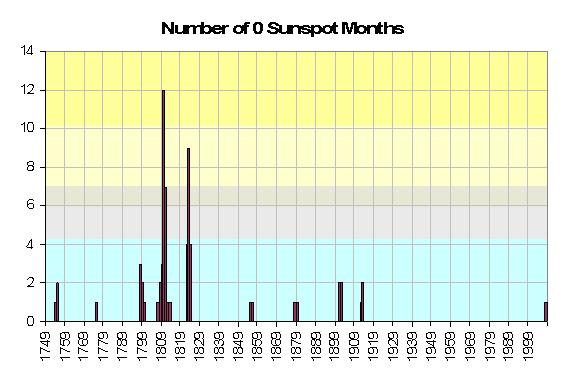
…we have had a 0 sunspot calendar month (there have been more 30 day intervals without sunspots as recent as 1954 but they have crossed months). Following is a plot of the number of months with 0 sunspots by year over the period of record – 23 cycles since 1749.
See larger image here.
Note that cluster of zero month years in the early 1800s (a very cold period called the Dalton minimum – at the time of Charles Dickens and snowy London town and including thanks to Tambora, the Year without a Summer 1816) and again to a lesser degree in the early 1900s. These correspond to the 106 and 213 year cycle minimums. This would suggest that the next cycle minimum around 2020 when both cycles are in phase at a minimum could be especially weak. Even David Hathaway of NASA who has been a believer in the cycle 24 peak being strong, thinks the next minimum and cycle 25 maximum could be the weakest in centuries based on slowdown of the plasma conveyor belt on the sun.
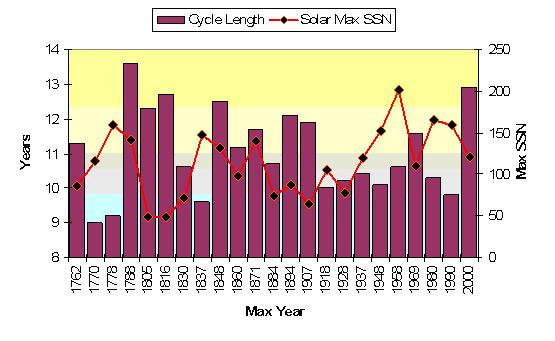
In this plot of the cycle lengths and sunspot number at peak of the cycles, assuming this upcoming cycle will begin in 2009 show the similarity of the recent cycles to cycle numbers 2- 4, two centuries ago preceding the Dalton Minimum. This cycle 23 could end up the longest since cycle 4, which had a similar size peak and also similarly, two prior short cycles.
See larger image here.


Will this mean anything for climate in our near future? Possibly. But we’ll have to wait to see how this experiment pans out.
Folks, take a breath. Scientists have changed data taken in the past since scientific inquiry began. Most often it is done for accuracy’s sake. I don’t see propaganda in action here. Maybe someone was sick that day and just hadn’t gotten around to assigning a number. Maybe they have a desk piled high with work. Maybe somebody came up with a more lucid argument to number it anyway. I am not losing sleep over a single sunspot from cycle 23. Besides, I am more interested in what other aspects of the Sun affect my cold hands, butt, and feet than breaking a record of one month.
This wouldn’t be the first time an ‘adjustment’ was made to get the desired results. And probably not the last.
Why should he change the title of this post, Leif? I say no, no, no!
This is a clear case of politics and nothing you can say will change that. Anthony, stick to your guns. We all saw how this came down in real time.
REPLY: The possibility exists for human error, particularly since Catania reporting stations data is in question. I’m not the expert on sunspot counting process, Leif is, so I’ll defer to him. There’s plenty of time to throw flame later if indeed this is a decision rather than error.
David Gladstone (07:40:51) :
“These miserable idiots at NOAA are doing this for one reason only- for propaganda. They just don’t want and will not allow the skeptics to have any ammunition. This is a case of science corrupted by politics. I’d like to maroon these fools on an iceberg.”
Well, I’ve worked with one of the space weather forecasters, and I can vouch for him as a damn good guy. The forecasters interact directly with the customers, and that’s their focus – getting the best possible information to the customer.
Of course, if management is “influencing” the official count in a way that is contrary to standard practice and their official policy, that should be a national scandal with congressional investigations.
I still don’t know why NOAA 1) didn’t count it, and 2) didn’t say a WORD about it (as Brussels DID), when some of their daily products include a “comments” section.
I would like to know NOAA/SWPC official policy on spots that are clearly there, but are considered “too small” or otherwise “uncountable,” even if the policy is just, “ignore it, it’ll be gone soon anyway.”
As Stalin said, it’s not the people who cast the votes who count, it’s the people who count the votes. Stalin was the supreme brutal realist and he was right.
I’m sorry you caved on this, Anthony. This is a clear case of political influence and Leif is dead wrong. He should be held to a higher standard of proof than what he’s offered here.
REPLY: This may yet change. For now I’m being cautious until I get a clear explanation. Yes it smells, but at the same time I’ll wait to hear what the explanation is. I’m as upset about it as you are, but I’d rather cave to caution than to emotion.
“Besides, I am more interested in what other aspects of the Sun affect my cold hands, [user-snip], and feet than breaking a record of one month.” Pamela the Read
Too warm here in Tucson.
Weather tis nobler and not.
Some like it cold.
Some like it hot.
I love how Kerry and the democrats seems to make the assertion that Palin’s position on AGW is a negative in this campaign.
It amazes me how a vocal 10% of the US population has the Government firmly believing that 100% of us think it is a problem.
The August sun-blemishes should not have been counted but I think that it was a better safe to count them then get blamed for not counting them later. I think the 29 other ZERO days speak loudly to the issue.
To turn a phrase used in AGW camps a lot, “a single instance does not negate a trend” The trend clearly is lower activity and a spot free calendar month is really a psychological milestone. Keep watching, you are going to get another chance at it.
John-X, I don’t care if someone’s a good guy- nothing could be more irrelevant! That’s just a waste of words, imo. This is not about persons or friends; this is about scientific truth and politics. I want to see how these weasels try to to sell this as honest science. It just won’t fly with me. I’ve already sent out the original article and will continue to do so no matter what anyone says. This is a war of words and science isn’t in the room.
Reply: There’s a Daily tech article on it that’s made Drudge,
http://www.dailytech.com/Sun+Makes+History+First+Spotless+Month+in+a+Century/article12823.htm
so NOAA and SIDC will be in full public glare on this one. – Anthony
David G. Mills (20:07:54) : But if you want to abuse the water carrier, it is your prerogative. I still like Al Gore though I now think that solar activity is the most likely cause of the warming of the 1900’s. I don’t think its Al’s fault that he trusted the wrong scientists or accepted the scientific “consensus.”
You only need to look at Al’s record to know differently.
Al has vacillated from statements to the effect that every American has the right to cheap gasoline (it’s in one of his books and I’m too lazy to look up which) to his current stance.
Al has claimed to be American technology’s biggest boon (invented the Internet donchya know) yet was almost solely responsible for the Triana spacecraft (aka GoreSat in some circles now known as DSCOVR). The only spacecraft conceived without a mission — in a Lagrangian orbit no less. Al’s idea essentially: we should have a camera in orbit constantly looking at the Earth. You should have seen the scrambling to find things for it to do. The final mission instrument complement was all after the fact add-on. When it comes to technology I think Al is clueless.
What misleads Al isn’t the “consensus” so much as belief in his own ability to forecast the direction of the wind.
Disclosure: I worked on Triana.
NOAA and SIDC are independent of each other. Nobody is influencing anybody else. NOAA did not count the region, following their rules. SIDC did count, following their rules. So far, so good. They can disagree a little without any problems. I am puzzled why SIDC reports a spot in the southern hemisphere, when the Tiny Tim was in the North. I have asked SIDC and we shall see. No need to dream up any conspiracy theories.
“but I’d rather cave to caution than to emotion.”
One reason we love this site.
Here is the answer form SIDC:
Dear Leif,
We’ve already discussed this before. The separation of the one spot over the two hemispheres is due to the fact that some observers do send us wrong locations. We do not just use Catania for that. Purely based on statistics, it is impossible to decide who is right and who is wrong, so for an automated procedure it is difficult to handle. Nevertheless, it is obvious a wrong result, and will be correctly manually when we provide the definitive numbers. We could do the same thing for the provisional numbers already, but we prefer not to interfere manually at that time.
Kind regards
Ronald
Leif and I have had long arguments about basic science by email and I shared his replies with several physicists who could clearly perceive the gaps in his knowledge of Einstein’s gravity theory *and* his sense of absolute certainty in what he doesn’t know. Like all too many other specialists, he doesn’t see the forest for the trees. I give no one a free pass, but indeed, we will see how this plays out in the coming days.
Actually this issue points up the need for a revamping of science education in this country. When an eminent physicist like Lee Smolin has to write a book called ‘The Trouble with Physics’ and attack the rot and political and money corruption at the foundations of science, we know there’s trouble in River City.
“Spotless month” is just a headline. The fact is that there are hardly any, and it’s been that way for ages. Even if someone _did_ sneak in and write a few 2’s and 3’s where there used to be 0’s, that doesn’t change the big picture. It’s a second-order effect, and not worth worrying about.
And NOAA did not “count the sunspeck after all” as the title of this thread suggests.
REPLY: Leif, there is a lot of confusion on this, then WHO did count the sunspot? SIDC? NOAA?
Who made the decision to count it? Initially I thought is was SIDC, but then in your earlier comments you said “NOAA is responsible for numbering the active regions”.
So where does the decision get made, and who makes it? Is it an individual or by committee, or by procedural analysis of data?
UPDATE: I see you answered in a previous comment, so please ignore the question, comments passed in the ether.
One of the problems is that SOHO was down during this period so it is a little difficult to double-check.
There is 1 image from August 21, 2008 which does show a few small spots (although these are sometimes instrument artifacts and you need to animate over multiple images to see if the spots rotate with the Sun. Instrument artifacts stay in one place. Unfortunately with no other images around the time, one cannot use this test.)
http://sohowww.nascom.nasa.gov/data/realtime/javagif/gifs_small/20080821_0102_mdi_igr.gif
Although June 1913 is officially said to have had no sunspots, Stefko in Moscow reported sunspots on June 3 and 4th. None of the other 20 observers reported any sunspots in June 1913.
The reports of sunspots by Stefko can be found in volume 11, page 109 of Astronomische Mittheilungen, written by A. Wolfer.
Back to the Future
Back to the Future II
Back to the Future III
Folks, I have sent this to SIDC:
Ronald,
It is disturbing that these things happen. Rudolf Wolf’s procedure of ranking the observers in order of trustworthiness and have a very good ‘primary’ observer and only fill in from other observers when there were missing data was a good one.
Clearly some manual quality control is needed in real time. You can expect a fair amount of heat on this, so it will be good to be proactive.
Folks,
let’s pace down littla bitta. I aggree with Pamela.
As lot of us think, there possibly will come quite a bunch of another spotless days, possible even spotless months.
And if not? We can allways return to the drawing board.
I don’t understand where the attribution to NOAA comes from. One source I routinely follow for sunspot data is
http://www.dxlc.com/solar/
As I understand it, this site relies on NOAA, not SIDC, but proffers the following caveat:
“Unofficial, accumulated value based on the Boulder (NOAA/SWPC) sunspot number. The official international sunspot number is typically 30-50% lower.”
This is clearly not the case here, because NOAA/SWPC has recorded no sunspot since 7-20. The daily data is available here
http://www.swpc.noaa.gov/ftpdir/indices/dayind/
and it supports the DXLC graph showing no sunspots since 7-20.
So it seems to me that the NOAA/SWPC data still support the claim of a spotless August. It is just SIDC that has counted something.
Since SIDC “is typically 30-50% lower” than the NOAA number, maybe they left off a negative sign? 🙂
David Gladstone (08:12:48) : John-X, I don’t care if someone’s a good guy- nothing could be more irrelevant! That’s just a waste of words, imo. This is not about persons or friends; this is about scientific truth and politics.
Well, part of being a “good guy” is being honest. Would that count? And as far as whether we had a month with NO sunspots vs. a FEW does it really matter? Exactly how much has this degraded the skeptics point?
If you ask me, Joe D’Aleo’s point about other “months” being spot free is far more damaging to the Daily Tech headline of “First Spotless Month in a Century” than a “flip-flop” on last month’s count. It’s a lot like counting blue moons — an accident of the calender.
Is Pluto a planet? Does it really matter if it’s called one or not? Why would anyone care anyway? Is the “flip-flop” on Pluto’s status indicative of conspiracy? How is it any different than the sun sot thing?
I think seeing conspiracy in some wavering over whether or not a particular solar feature should be called a sunspot is just being a bit knee-jerk. Maybe you’re right but I still don’t see any real gain one way or the other.
I think they simply wanted a SC24 spot to count this way the ‘solar cycle progressing normally’ crowd can sleep easy for the next couple of weeks.
Funny how similar specks weren’t counted earlier in the year but now, suddenly, they are.
I guess the next step is making a definition for what consists of a sunspot. The same way they designated Pluto a ‘dwarf planet’ because ‘planet’ had not been defined since the ancient Greeks.
My opinion, if the spot is small enough that one needs specialized equipment to see it, as opposed to the method used to count spots ‘back in the day’, then it shouldn’t be counted. The same spot wouldn’t have been counted back in the 1700’s and 1800’s and we’re still adding on to the same data set. If they want to start counting every little speck on the sun, then make a new data set.