UPADATED AT 8:30AM PST Sept 2nd-
More on SIDC’s decision to count a sunspeck (technically a “pore”) days after the fact. NOAA has now followed SIDC in adding a 0.5 sunspot where there was none before. But as commenter Basil points out, SIDC’s own records are in contrast to their last minute decision to count the sunspeck or “pore” on August 21.
There is an archive of the daily SIDC “ursigrams” here:
http://sidc.oma.be/html/SWAPP/dailyreport/dailyreport.html
If you select the ursigrams for August 22 and 23, you get the reported data for the 21st and 22nd:
August 21:
TODAY’S ESTIMATED ISN : 000, BASED ON 07 STATIONS.
SOLAR INDICES FOR 21 Aug 2008
WOLF NUMBER CATANIA : 011
10CM SOLAR FLUX : 067
AK CHAMBON LA FORET : ///
AK WINGST : 004
ESTIMATED AP : 005
ESTIMATED ISN : 000, BASED ON 14 STATIONS.
August 22:
TODAY’S ESTIMATED ISN : 000, BASED ON 11 STATIONS.
SOLAR INDICES FOR 22 Aug 2008
WOLF NUMBER CATANIA : 013
10CM SOLAR FLUX : 068
AK CHAMBON LA FORET : ///
AK WINGST : 003
ESTIMATED AP : 003
ESTIMATED ISN : 000, BASED ON 11 STATIONS.
In both cases, the daily estimated “International Sunspot Number” based on multiple stations, not just the Catania Wolf Number, was 000. So how did SIDC end up with positive values in the monthly report?
UPDATED at 2:42 PM PST Sept 1st –
After going days without counting the August 21/22 “sunspeck” NOAA and SIDC Brussels now says it was NOT a spotless month! Both data sets below have been recently revised.
Here is the SIDC data:
http://www.sidc.be/products/ri_hemispheric/
Here is the NOAA data:
ftp://ftp.ngdc.noaa.gov/STP/SOLAR_DATA/SUNSPOT_NUMBERS/MONTHLY
The NOAA data shows July as 0.5 but they have not yet updated for August as SIDC has. SIDC reports 0.5 for August. It will be interesting to see what NOAA will do.
SIDC officially counted that sunspeck after all. It only took them a week to figure out if they were going to count it or not, since no number was assigned originally.
But there appears to be an error in the data from the one station that reported a spot, Catania, Italy. No other stations monitoring that day reported a spot. Here is the drawing from that Observatory:
ftp://ftp.ct.astro.it/sundraw/OAC_D_20080821_063500.jpg
ftp://ftp.ct.astro.it/sundraw/OAC_D_20080822_055000.jpg
But according to Leif Svalgaard, “SIDC reported a spot in the south, while the spot(s) Catania [reported] was in the north.” This is a puzzle. See his exchange below.
Also, other observatories show no spots at all. For example, at the 150 foot solar solar tower at the Mount Wilson Observatory, the drawings from those dates show no spots at all:
ftp://howard.astro.ucla.edu/pub/obs/drawings/dr080821.jpg
ftp://howard.astro.ucla.edu/pub/obs/drawings/dr080822.jpg
Inquires have been sent, stay tuned.
Here is an exchange in comments from Leif Svalgaard.
——-
REPLY: So What gives Leif….? You yourself said these sunspecks weren’t given a number. I trusted your assessment. Hence this article. Given the Brussels folks decided to change their minds later, what is the rationale ? – Anthony
The active region numbering is done by NOAA, not by Brussels. The Brussels folks occasionally disagree. In this case, they did. Rudolf Wolf would not have counted this spot. Nor would I. What puzzles me is this:
21 7 4 3
22 8 4 4
The 3rd column are ’spots’ in the Northern hemisphere, and the 4th column are ’spots’ in the Southern hemisphere [both weighted with the ‘k’-factor: SSN = k(10g+s)]. But there weren’t any in the south. The Catania spot was at 15 degrees north latitude, IIRC. Maybe the last word is not in on this.
——–
Hmm….apparently there’s some backstory to this. There is a debate raging in comments to this story, be sure to check them. – Anthony
# MONTHLY REPORT ON THE INTERNATIONAL SUNSPOT NUMBER #
# from the SIDC (RWC-Belgium) #
#——————————————————————–#
AUGUST 2008
PROVISIONAL INTERNATIONAL NORMALIZED HEMISPHERIC SUNSPOT NUMBERS
Date Ri Rn Rs
__________________________________________________________________
1 0 0 0
2 0 0 0
3 0 0 0
4 0 0 0
5 0 0 0
6 0 0 0
7 0 0 0
8 0 0 0
9 0 0 0
10 0 0 0
11 0 0 0
12 0 0 0
13 0 0 0
14 0 0 0
15 0 0 0
16 0 0 0
17 0 0 0
18 0 0 0
19 0 0 0
20 0 0 0
21 7 4 3
22 8 4 4
23 0 0 0
24 0 0 0
25 0 0 0
26 0 0 0
27 0 0 0
28 0 0 0
29 0 0 0
30 0 0 0
31 0 0 0
__________________________________________________________________
MONTHLY MEAN : 0.5 0.3 0.2
========================================================
ORIGINAL STORY FOLLOWS:
Many have been keeping a watchful eye on solar activity recently. The most popular thing to watch has been sunspots. While not a direct indication of solar activity, they are a proxy for the sun’s internal magnetic dynamo. There have been a number of indicators recently that it has been slowing down.
August 2008 has made solar history. As of 00 UTC (5PM PST) we just posted the first spotless calendar month since June 1913. Solar time is measured by Coordinated Universal Time (UTC) so it is now September 1st in UTC time. I’ve determined this to be the first spotless calendar month according to sunspot data from NOAA’s National Geophysical Data Center, which goes back to 1749. In the 95 years since 1913, we’ve had quite an active sun. But that has been changing in the last few years. The sun today is a nearly featureless sphere and has been for many days:

Image from SOHO
And there are other indicators. For example, some solar forecasts have been revised recently because the forecast models haven’t matched the observations. Australia’s space weather agency recently revised their solar cycle 24 forecast, pushing the expected date for a ramping up of cycle 24 sunspots into the future by six months.
The net effect of having no sunspots is about 0.1% drop in the TSI (Total Solar Irradiance). My view is that TSI alone isn’t the main factor in modulating Earth’s climate.
I think it’s solar magnetism modulating Galactic Cosmic Rays, and hence more cloud nuclei from GCR’s, per Svensmark’s theory. We’ve had indications since October 2005 that the sun’s dynamo is slowing down. It dropped significantly then, and has remained that way since. Seeing no sunpots now is another indicator of that idling dynamo.
Graph of solar Geomagnetic Index (Ap):

Click for a larger image
Earth of course is a big heat sink, so it takes awhile to catch up to any changes that originate on the sun, but temperature drops indicated by 4 global temperature metrics (UAH, RSS and to a lesser degree HadCrit and GISS) show a significant and sharp cooling in 2007 and 2008 that has not rebounded.In the 20 years since “global warming” started life as a public issue with Dr. James Hansen’s testimony before congress in June 1988, we are actually cooler.

Click for a larger image
Reference: UAH lower troposphere data
Coincidence? Possibly, but nature will be the final arbiter of climate change debate, and I think we would do well to listen to what it’s saying now.
Joe D’Aleo of ICECAP also wrote some interesting things which I’ll reprint here.
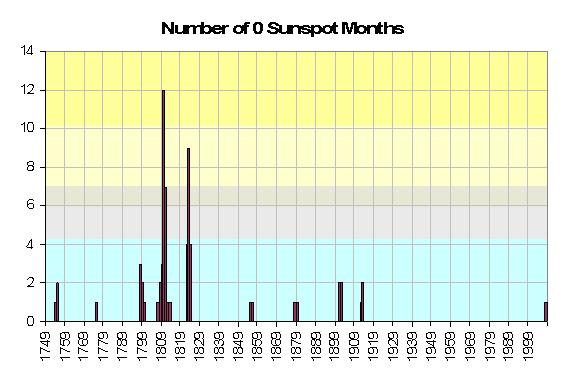
…we have had a 0 sunspot calendar month (there have been more 30 day intervals without sunspots as recent as 1954 but they have crossed months). Following is a plot of the number of months with 0 sunspots by year over the period of record – 23 cycles since 1749.
See larger image here.
Note that cluster of zero month years in the early 1800s (a very cold period called the Dalton minimum – at the time of Charles Dickens and snowy London town and including thanks to Tambora, the Year without a Summer 1816) and again to a lesser degree in the early 1900s. These correspond to the 106 and 213 year cycle minimums. This would suggest that the next cycle minimum around 2020 when both cycles are in phase at a minimum could be especially weak. Even David Hathaway of NASA who has been a believer in the cycle 24 peak being strong, thinks the next minimum and cycle 25 maximum could be the weakest in centuries based on slowdown of the plasma conveyor belt on the sun.
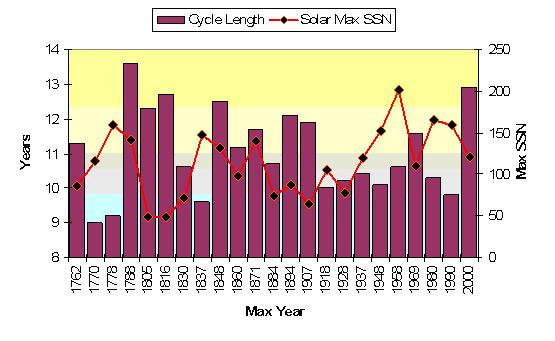
In this plot of the cycle lengths and sunspot number at peak of the cycles, assuming this upcoming cycle will begin in 2009 show the similarity of the recent cycles to cycle numbers 2- 4, two centuries ago preceding the Dalton Minimum. This cycle 23 could end up the longest since cycle 4, which had a similar size peak and also similarly, two prior short cycles.
See larger image here.


Will this mean anything for climate in our near future? Possibly. But we’ll have to wait to see how this experiment pans out.
[…] few years. The sun today is a nearly featureless sphere and has been for many days…." (fonte Sun has first spotless calendar month since June 1913 Watts Up With That?) Da notare che giugno 2008 è stato uno dei più freddi degli ultimi anni "….temperature […]
“BREAKING NEWS”
SIDC Brussels says NOT a spotless month!
They officially counted that sunspeck:
# MONTHLY REPORT ON THE INTERNATIONAL SUNSPOT NUMBER #
# from the SIDC (RWC-Belgium) #
#——————————————————————–#
AUGUST 2008
PROVISIONAL INTERNATIONAL NORMALIZED HEMISPHERIC SUNSPOT NUMBERS
Date Ri Rn Rs
__________________________________________________________________
1 0 0 0
2 0 0 0
3 0 0 0
4 0 0 0
5 0 0 0
6 0 0 0
7 0 0 0
8 0 0 0
9 0 0 0
10 0 0 0
11 0 0 0
12 0 0 0
13 0 0 0
14 0 0 0
15 0 0 0
16 0 0 0
17 0 0 0
18 0 0 0
19 0 0 0
20 0 0 0
21 7 4 3
22 8 4 4
23 0 0 0
24 0 0 0
25 0 0 0
26 0 0 0
27 0 0 0
28 0 0 0
29 0 0 0
30 0 0 0
31 0 0 0
__________________________________________________________________
MONTHLY MEAN : 0.5 0.3 0.2
COOPERATING STATIONS : 65 59 59
PILOT STATION : Specola Solare Ticinese, Locarno
__________________________________________________________________
Reproduction permitted if source mentionned
R. Van der Linden
avenue Circulaire, 3 B-1180 BRUXELLES – BELGIUM
I’m signed up to get email alerts from the SIDC, and that’s where I got the above table of monthly sunspot numbers, issued at 9:45 UTC.
Here’s the web link to the same data
http://sidc.oma.be/products/ri_hemispheric/
I am interested to see how this will affect the winter. If we see a continued significant cooling the AGW movment will remain unaffected even if it becomes severe. It would force the addition of another layer of calculation to the models which would still have the magic layer about CO2 putting more moisture in the atpmosphere. We’ll be in the next ice age before they consider that the models might be wrong.
For those of us who recognize that trashing our economy is a greater problem than 1 degree C mother nature may be throwing us a nice juicy bone. Once again we would show that the weatherman ain’t always right.
noconsensus.wordpress.com
Robert Wood (18:44:00) :
BC, the main problem your ski resort will face in Florida isn’t lack of snow; it’s lack of mountains, hills, or even bumpy bits. You really ought to consult a reality expert. 🙂
Reality is that you don’t need a hill, just a change of elevation.
Think sinkhole.
Speaking of 1913….
This graph of geomagnetic aa index shows the average of 2006-2007 to be the calmest since 1913-1914.
http://www.ngdc.noaa.gov/stp/GEOMAG/image/aastar07.jpg
The two Russian solar physicists who bet James Annan in 2005 $10,000 that the earth would be cooler, not warmer, over the following ten years are looking good.
AUGUST 2008
PROVISIONAL INTERNATIONAL NORMALIZED HEMISPHERIC SUNSPOT NUMBERS
Date Ri Rn Rs
__________________________________________________________________
1 0 0 0
2 0 0 0
3 0 0 0
4 0 0 0
5 0 0 0
6 0 0 0
7 0 0 0
8 0 0 0
9 0 0 0
10 0 0 0
11 0 0 0
12 0 0 0
13 0 0 0
14 0 0 0
15 0 0 0
16 0 0 0
17 0 0 0
18 0 0 0
19 0 0 0
20 0 0 0
21 7 4 3
22 8 4 4
23 0 0 0
24 0 0 0
25 0 0 0
26 0 0 0
27 0 0 0
28 0 0 0
29 0 0 0
30 0 0 0
31 0 0 0
__________________________________________________________________
MONTHLY MEAN : 0.5 0.3 0.2
REPLY: So What gives Leif….? You yourself said these sunspecks weren’t given a number. I trusted your assessment. Hence this article. Given the Brussels folks decided to change their minds later, what is the rationale ? – Anthony
Fatbigot – enjoy. Hope it is Dilmah tea you have carried over there 😉
To all our American friends – have a good one.
Kim Mackey (00:18:23) :
My question is, if cycle 24 is, as you think, a low activity cycle, will this completely negate the validity of the Dikpati dynamo model, or can it be tweaked somehow?
Dikpati’s model is what is technically called a ‘flux transport’ model. That is, the magnetic field is moving with the plasma flow and then goes where the plasma is going with the speed the plasma is going.
Other dynamo models are ‘diffusion’ models, where the magnetic field only partly follows the flow and it allowed to ‘diffuse’ across the flow and thus can move faster to depth than the flow.
Yet others are ‘shallow’ dynamos where the amplification takes place much nearer the surface.
Flux transport models tend to have a long ‘internal memory’ [i.e. integrates over several cycles] because the conveyor belt moves to slowly. The two other classes of models tend to have a short internal memory [half a cycle].
I once asked Mausumi Dikpati your question and she said [and I would concur] that a small cycle 24 really would be a death knell to the flux transport models. So, they cannot be tweaked. But there are lots of other models, some of which do predict a low cycle, so we are not back to the drawing board.
Leif Svalgaard (06:33:05) :
AUGUST 2008
MONTHLY MEAN : 0.5 0.3 0.2
REPLY: So What gives Leif….? You yourself said these sunspecks weren’t given a number. I trusted your assessment. Hence this article. Given the Brussels folks decided to change their minds later, what is the rationale ? – Anthony
The active region numbering is done by NOAA, not by Brussels. The Brussels folks occasionally disagree. In this case, they did. Rudolf Wolf would not have counted this spot. Nor would I. What puzzles me is this:
21 7 4 3
22 8 4 4
The 3rd column are ‘spots’ in the Northern hemisphere, and the 4th column are ‘spots’ in the Southern hemisphere [both weighted with the ‘k’-factor: SSN = k(10g+s)]. But there weren’t any in the south. The Catania spot was at 15 degrees north latitude, IIRC. Maybe the last word is not in on this.
Julie, I agree with you that it is a huge mistake to turn a scientific issue into a political war, and I also wish we could get far, far away from that. However, we have to be honest and admit exactly why that has happened. This theme, and I have a link to a transcript to prove this, is being pushed every day by leading democrats, and it is a conscious political decision by them to make this one of their campaign issues.
So – tragically, mistakenly, foolishly – the democrats this year have decided to lash themselves to this issue. There was no good reason for them to have made this mistake – but they have, and that is the group you need to address if this situation is ever going to change.
http://liberalvaluesblog.com/?p=4132
from the interview, John Kerry, this weekend: “With the choice of Governor Palin, it’s now the third term of Bush-Cheney, because what he’s done is he’s chosen somebody who actually doesn’t believe that climate change is manmade.”
Sorry to get in so late, I just fled Houston because of the AGW-induced hurricane coming. I’m up in Iowa to avoid the flooding.
evanjones (19:21:28) :
After all, when the carny sold you snake oil, you actually got the snake oil.
David Corcoran (21:23:24) :
Amazingly apt criticism.
Amazingly asp criticism.
John Riddell (22:58:33) :
Can someone please explain (in simple words that even I can understand) why the TSI varies only by very small amounts (did I read 0.2%) while . . .
The TSI seems to be a mechanism the AGW believers use to make it seem as if solar variation cannot be responsible for climate change.
Just a back of the envelope calculation –
Since the earth would be about as cold as the PLANET Pluto without the sun, I’d guess we owe around 250 K to TSI.
0.2% of that would be 0.5 degrees K, which is a big variation if you look on the temperature charts used in the AGW debate.
Got in so late my comment showed up on the next entry. Sorry, the previous belongs on the Spotless month entry.
julie (18:12:04) :
I’ve taken to editing some of the text I quote to fix typos and occasionally change Algore to Al Gore. I haven’t quite figured out if I should flag them with [brackets] or otherwise call attention to them, or if I’d be better off just ignoring posters who call people names.
Though, I confess I do like the suggestion of the Gore Minimum. Easier to explain than the Eddy Minimum which is more deserving.
“…REPLY: So What gives Leif….? You yourself said these sunspecks weren’t given a number. I trusted your assessment. Hence this article. Given the Brussels folks decided to change their minds later, what is the rationale ? – Anthony”
I am very interested to find this out as well.
I get the daily reports from the SIDC.
Every single one of them for the month of August said “today’s estimated ISN [International Sunspot Number]: 000 ”
Here’s the message from the morning of 21 August
Issued: 2008 Aug 21 1224 UTC
:Product: documentation at http://www.sidc.be/products/xut
#——————————————————————–#
# GEOALERT message from the SIDC (RWC-Belgium) #
#——————————————————————–#
GEOALERT BRU234
UGEOA 30512 80821 1218/ 9930/
10212 20212 30212
99999
PLAIN
NOTE: the above forecasts are valid from 1230UT, 21 Aug 2008 until 23 Aug 2008
PREDICTIONS FOR 21 Aug 2008 10CM FLUX: 066 / AP: 003
PREDICTIONS FOR 22 Aug 2008 10CM FLUX: 067 / AP: 002
PREDICTIONS FOR 23 Aug 2008 10CM FLUX: 066 / AP: 002
COMMENT: The only sunspot group on the solar disk (Catania number 84,
no NOAA number yet) is small and weak, so it is unlikely to produce a
C-flare. The Earth is currently inside the slow (around 400 km/s) solar
wind flow with average (around 4 nT) magnitude of the interplanetary
magnetic field. We expect quiet geomagnetic conditions.
TODAY’S ESTIMATED ISN : 000, BASED ON 10 STATIONS.
I have just sent an email to the Director of SIDC, Ronald Vanderlinden, asking for clarification:
21 7 4 3
22 8 4 4
Ronald, we are puzzled why SIDC reports spots in the southern
hemisphere in August. The spot reported by Catania was in the north.
Why is Rs not zero?
And Anthony, NOAA did not flip.
REPLY: OK then I’m at a loss to understand the chain of spot counting…are you saying NOAA always counted this?
Amongst several other locations worldwide, the observer at the Mt. Wilson Observatory (University of California, Los Angeles) takes daily observations of the sun, and produces a drawing of any sunspots seen.
http://www.astro.ucla.edu/~obs/cur_drw.html
When they did their observation yesterday, August 31, at 14:30 UTC, they printed a big “No Spots Seen Today,” followed by the date and time, the “seeing conditions” (4 on a scale of 5 yesterday – very good), the name of the observer, and then a remark at the bottom of the observation:
“43 days without sunspots”
To my knowledge, only the observer at Catania, Italy recorded a spot.
Would SIDC count an official sunspot, based on an observation from only one station?
.. Why did it take them a month to figure out if the spec should be considdered a sunspot?
Well, heres some free speculation as to why:
In march, sunspots of cycle 24 (the last we have seen) was so small that it got some attention that they where caled sunspots… but.. It kept cycle 24 “alive” officially.
Now.. in August 2008 the little speck happened to belong to cyclw 23. Damn.
And no official sunspot number came out.
The thing is:
By officially recognicing the speck in august as a sunspot, it will further press away any official minimum, because the minimum is when there are more cycle 24 sunspots than cycle 23.
And now, a little late, after Watts up article about sunspot free month, they decided to officially have another cycle 23 sunspot. Damn. Plague or Cholera?
SORRY: A week! Not a month!
These miserable idiots at NOAA are doing this for one reason only- for propaganda. They just don’t want and will not allow the skeptics to have any ammunition. This is a case of science corrupted by politics. I’d like to maroon these fools on an iceberg.
REPLY: let’s wait and see what the explanation is before we hurl invective please. – Anthony
Anthony, change the title of the post. NOAA did not flip.
REPLY: Please elaborate. I’ve chnaged the title to be more generic.
The numbering of last month’s speck a week after the fact gives the appearance of the politicization of science.
I hope that Leif is correct that this story is not over yet.
Meanwhile, the sun knows nothing of our numbering controversy on Earth and remains in a deep minimum. A bogusly numbered spot will not reduce the number of Svensmark clouds one whit.
Leif, the last word *is* in; this is not a science based flip flop and anyone who says it is, is suspect, as far as I see it. The emperor has no clothes.
I didn’t flee Houston during category 5 Gilbert in 1988. It missed Houston and we had a lovely day.
20 years later Gustav made landfall as a category 2. More proof that hurricanes are getting stronger due to AGW? The last category 5 to make landfall in the US was in 1992.
Wait, what?
Anthony, did _NOAA_ change their mind as well?!
I thought it was just Brussels that decided to count it, and NOAA maintained their numbers at zero.
Who’s counting what (and why)?!