UPADATED AT 8:30AM PST Sept 2nd-
More on SIDC’s decision to count a sunspeck (technically a “pore”) days after the fact. NOAA has now followed SIDC in adding a 0.5 sunspot where there was none before. But as commenter Basil points out, SIDC’s own records are in contrast to their last minute decision to count the sunspeck or “pore” on August 21.
There is an archive of the daily SIDC “ursigrams” here:
http://sidc.oma.be/html/SWAPP/dailyreport/dailyreport.html
If you select the ursigrams for August 22 and 23, you get the reported data for the 21st and 22nd:
August 21:
TODAY’S ESTIMATED ISN : 000, BASED ON 07 STATIONS.
SOLAR INDICES FOR 21 Aug 2008
WOLF NUMBER CATANIA : 011
10CM SOLAR FLUX : 067
AK CHAMBON LA FORET : ///
AK WINGST : 004
ESTIMATED AP : 005
ESTIMATED ISN : 000, BASED ON 14 STATIONS.
August 22:
TODAY’S ESTIMATED ISN : 000, BASED ON 11 STATIONS.
SOLAR INDICES FOR 22 Aug 2008
WOLF NUMBER CATANIA : 013
10CM SOLAR FLUX : 068
AK CHAMBON LA FORET : ///
AK WINGST : 003
ESTIMATED AP : 003
ESTIMATED ISN : 000, BASED ON 11 STATIONS.
In both cases, the daily estimated “International Sunspot Number” based on multiple stations, not just the Catania Wolf Number, was 000. So how did SIDC end up with positive values in the monthly report?
UPDATED at 2:42 PM PST Sept 1st –
After going days without counting the August 21/22 “sunspeck” NOAA and SIDC Brussels now says it was NOT a spotless month! Both data sets below have been recently revised.
Here is the SIDC data:
http://www.sidc.be/products/ri_hemispheric/
Here is the NOAA data:
ftp://ftp.ngdc.noaa.gov/STP/SOLAR_DATA/SUNSPOT_NUMBERS/MONTHLY
The NOAA data shows July as 0.5 but they have not yet updated for August as SIDC has. SIDC reports 0.5 for August. It will be interesting to see what NOAA will do.
SIDC officially counted that sunspeck after all. It only took them a week to figure out if they were going to count it or not, since no number was assigned originally.
But there appears to be an error in the data from the one station that reported a spot, Catania, Italy. No other stations monitoring that day reported a spot. Here is the drawing from that Observatory:
ftp://ftp.ct.astro.it/sundraw/OAC_D_20080821_063500.jpg
ftp://ftp.ct.astro.it/sundraw/OAC_D_20080822_055000.jpg
But according to Leif Svalgaard, “SIDC reported a spot in the south, while the spot(s) Catania [reported] was in the north.” This is a puzzle. See his exchange below.
Also, other observatories show no spots at all. For example, at the 150 foot solar solar tower at the Mount Wilson Observatory, the drawings from those dates show no spots at all:
ftp://howard.astro.ucla.edu/pub/obs/drawings/dr080821.jpg
ftp://howard.astro.ucla.edu/pub/obs/drawings/dr080822.jpg
Inquires have been sent, stay tuned.
Here is an exchange in comments from Leif Svalgaard.
——-
REPLY: So What gives Leif….? You yourself said these sunspecks weren’t given a number. I trusted your assessment. Hence this article. Given the Brussels folks decided to change their minds later, what is the rationale ? – Anthony
The active region numbering is done by NOAA, not by Brussels. The Brussels folks occasionally disagree. In this case, they did. Rudolf Wolf would not have counted this spot. Nor would I. What puzzles me is this:
21 7 4 3
22 8 4 4
The 3rd column are ’spots’ in the Northern hemisphere, and the 4th column are ’spots’ in the Southern hemisphere [both weighted with the ‘k’-factor: SSN = k(10g+s)]. But there weren’t any in the south. The Catania spot was at 15 degrees north latitude, IIRC. Maybe the last word is not in on this.
——–
Hmm….apparently there’s some backstory to this. There is a debate raging in comments to this story, be sure to check them. – Anthony
# MONTHLY REPORT ON THE INTERNATIONAL SUNSPOT NUMBER #
# from the SIDC (RWC-Belgium) #
#——————————————————————–#
AUGUST 2008
PROVISIONAL INTERNATIONAL NORMALIZED HEMISPHERIC SUNSPOT NUMBERS
Date Ri Rn Rs
__________________________________________________________________
1 0 0 0
2 0 0 0
3 0 0 0
4 0 0 0
5 0 0 0
6 0 0 0
7 0 0 0
8 0 0 0
9 0 0 0
10 0 0 0
11 0 0 0
12 0 0 0
13 0 0 0
14 0 0 0
15 0 0 0
16 0 0 0
17 0 0 0
18 0 0 0
19 0 0 0
20 0 0 0
21 7 4 3
22 8 4 4
23 0 0 0
24 0 0 0
25 0 0 0
26 0 0 0
27 0 0 0
28 0 0 0
29 0 0 0
30 0 0 0
31 0 0 0
__________________________________________________________________
MONTHLY MEAN : 0.5 0.3 0.2
========================================================
ORIGINAL STORY FOLLOWS:
Many have been keeping a watchful eye on solar activity recently. The most popular thing to watch has been sunspots. While not a direct indication of solar activity, they are a proxy for the sun’s internal magnetic dynamo. There have been a number of indicators recently that it has been slowing down.
August 2008 has made solar history. As of 00 UTC (5PM PST) we just posted the first spotless calendar month since June 1913. Solar time is measured by Coordinated Universal Time (UTC) so it is now September 1st in UTC time. I’ve determined this to be the first spotless calendar month according to sunspot data from NOAA’s National Geophysical Data Center, which goes back to 1749. In the 95 years since 1913, we’ve had quite an active sun. But that has been changing in the last few years. The sun today is a nearly featureless sphere and has been for many days:

Image from SOHO
And there are other indicators. For example, some solar forecasts have been revised recently because the forecast models haven’t matched the observations. Australia’s space weather agency recently revised their solar cycle 24 forecast, pushing the expected date for a ramping up of cycle 24 sunspots into the future by six months.
The net effect of having no sunspots is about 0.1% drop in the TSI (Total Solar Irradiance). My view is that TSI alone isn’t the main factor in modulating Earth’s climate.
I think it’s solar magnetism modulating Galactic Cosmic Rays, and hence more cloud nuclei from GCR’s, per Svensmark’s theory. We’ve had indications since October 2005 that the sun’s dynamo is slowing down. It dropped significantly then, and has remained that way since. Seeing no sunpots now is another indicator of that idling dynamo.
Graph of solar Geomagnetic Index (Ap):

Click for a larger image
Earth of course is a big heat sink, so it takes awhile to catch up to any changes that originate on the sun, but temperature drops indicated by 4 global temperature metrics (UAH, RSS and to a lesser degree HadCrit and GISS) show a significant and sharp cooling in 2007 and 2008 that has not rebounded.In the 20 years since “global warming” started life as a public issue with Dr. James Hansen’s testimony before congress in June 1988, we are actually cooler.

Click for a larger image
Reference: UAH lower troposphere data
Coincidence? Possibly, but nature will be the final arbiter of climate change debate, and I think we would do well to listen to what it’s saying now.
Joe D’Aleo of ICECAP also wrote some interesting things which I’ll reprint here.
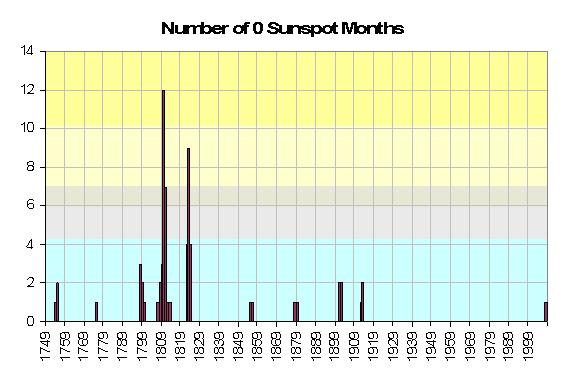
…we have had a 0 sunspot calendar month (there have been more 30 day intervals without sunspots as recent as 1954 but they have crossed months). Following is a plot of the number of months with 0 sunspots by year over the period of record – 23 cycles since 1749.
See larger image here.
Note that cluster of zero month years in the early 1800s (a very cold period called the Dalton minimum – at the time of Charles Dickens and snowy London town and including thanks to Tambora, the Year without a Summer 1816) and again to a lesser degree in the early 1900s. These correspond to the 106 and 213 year cycle minimums. This would suggest that the next cycle minimum around 2020 when both cycles are in phase at a minimum could be especially weak. Even David Hathaway of NASA who has been a believer in the cycle 24 peak being strong, thinks the next minimum and cycle 25 maximum could be the weakest in centuries based on slowdown of the plasma conveyor belt on the sun.
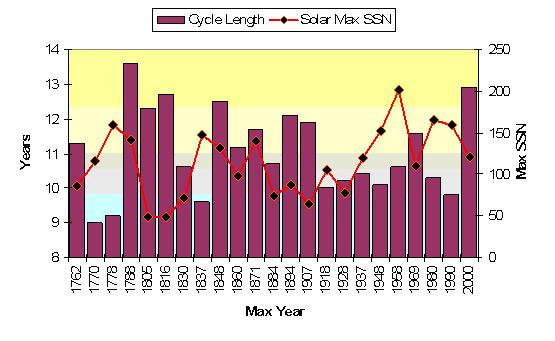
In this plot of the cycle lengths and sunspot number at peak of the cycles, assuming this upcoming cycle will begin in 2009 show the similarity of the recent cycles to cycle numbers 2- 4, two centuries ago preceding the Dalton Minimum. This cycle 23 could end up the longest since cycle 4, which had a similar size peak and also similarly, two prior short cycles.
See larger image here.


Will this mean anything for climate in our near future? Possibly. But we’ll have to wait to see how this experiment pans out.
Discover more from Watts Up With That?
Subscribe to get the latest posts sent to your email.
You know as well as I that we could trade references, or as you say “evidence” all day long, and not come to an agreement. Some are in support of your contention, some are not.
It appears to me that you are trying to impress and argue from authority. If so, would you really want to convince others on that basis?
I’ll put historical narratives about famine and cold weather above borehole data anyday, and I did not as you say, claim that the data is poor. You did.
Of course you can equivocate on what “cold” is, but from your last reference, I’d say that 3 or 4C below present temp can not be interpreted as not being “cold”. And that is in Japan, not a global temp decrease for those Minimas. But from that article “The results suggested the existence of four cold periods…” You do realize that “cold” is not quite the same as your statement “and yet the temperature was high”?
evanjones (18:21:03) :
Hmm. I had thought the Greenland colonies were hulled in well before 1500. Am I mistaken?
No, they were done in by the cold in the 1300s, and strife with the Inuit. In 1350 somebody was sent to the northern settlement – Vesterbygden – but all he met were Inuit. The last written proof of the Norse in Greenland was a wedding in the Hvalsey Church in 1408 [or 1407?]. After that they were gone [or at least we have no records or 14C dates any later].
Wiki has”The Western Settlement was abandoned around 1350. In 1378, there was no longer a bishop at Garðar. After 1408, when a marriage was recorded, no written records mention the settlers. It is probable that the Eastern Settlement was defunct by the late 15th century although no exact date has been established.”
http://en.wikipedia.org/wiki/History_of_Greenland
evanjones (18:21:03) :
I had thought the Greenland colonies were hulled in well before 1500. Am I mistaken?
The Holocene, Vol. 7, No. 4, 489-499 (1997)
DOI: 10.1177/095968369700700411
Interdisciplinary investigations of the end of the Norse Western Settlement in Greenland
L.K. Barlow et al.
Abstract:
The loss of the Norse Western Settlement in Greenland around the mid-fourteenth century has long been taken as a prime example of the impact of changing climate on human populations. This study employs an interdisciplinary approach combining historical documents, detailed archaeological investigations, and a high-resolution proxy climate record from the Greenland Ice Sheet Project 2 (GISP2) to investigate possible causes for the end of this settlement. Historical climate records, mainly from Iceland, contain evidence for lowered temperatures and severe weather in the north Atlantic region around the mid-fourteenth century. Archaeological, palaeoecological and historical data specifically concerning the Western Settlement suggest that Norse living conditions left little buffer for unseasonable climate, and provide evidence for a sudden and catastrophic end around the mid-fourteenth century. Isotopic data from the GISP2 ice core provide annual- and seasonal-scale proxy-temperature signals which suggest multiyear intervals of lowered temperatures in the early and mid-fourteenth century. The research synthesized here suggests that, while periods of unfavourable climatic fluctuations are likely to have played a role in the end of the Western Settlement, it was their cultural vulnerabilities to environmental change that left the Norse far more subject to disaster than their Inuit neighbours.
Thanks for the answers, guys! Very informative. (I had heard it as 1405, but that’s close enough for government work.) And, yes, I’d heard the Vikings wouldn’t adapt to the Inuit lifestyle (which I suppose makes them a pretty fair climate proxy).
Good to have that confirmed. Thanks for the sourcing.
I’ve also heard about the early 14th century as when a whole slew of European crop failures occurred.
I have one more question, and I don’t know if the answer exists, but at the height of the MWP, how much of Southern Greenland was iced up? Today, of course, the ice goes down to the southernmost extremities.
And is there any hint about sea levels? Back then they were into those damned “T-maps” that are useless for geographical purposes. (And it wasn’t until the Age of Exploration that they really got serious.) Are there any bio/geological reconstructions of medieval sea levels?
Well, okay. More than one more question . . .
(I’ll save my questions about the Vinland Map for later–though it seems fairly clear to me, for a number of reasons, it’s got to be the old fakeroo. )
Glenn (18:12:50) :
Leif, In your last post you have me confused with Gary Galrud, although I may be guilty as well of “ill-befitting high-brow previous lament”.
Yes, sorry about that.
Glenn (18:32:35) :
You know as well as I that we could trade references, or as you say “evidence” all day long, and not come to an agreement. Some are in support of your contention, some are not.
It appears to me that you are trying to impress and argue from authority. If so, would you really want to convince others on that basis?
No not at all. I hate authority-arguments.
Of course you can equivocate on what “cold” is, but from your last reference, I’d say that 3 or 4C below present temp can not be interpreted as not being “cold”
I’m trying to parse this one, by reversing the negatives: ‘4C below present cannot be interpreted as being warm‘ -> ‘4C below present can be interpreted as cold. Thus we agree that is was cold.
And that is in Japan, not a global temp decrease for those Minimas.
The other location was northern Europe. I thought it was good that it was in Japan, showing that is was not a regional European thing.
“The results suggested the existence of four cold periods…” You do realize that “cold” is not quite the same as your statement “and yet the temperature was high”?
The periods were 1330-1350, 1520-1550, […] thus on either side of the Spoerer Minimum. So the Spoerer minimum was not one of those four cold periods, so I do not understand your “You do realize that “cold” is not quite the same as your statement “and yet the temperature was high”?” Please explain what you meant. Maybe I confused you by writing “1330-1350, [Spoerer minimum here], 1520-1550,” where I had simply shown that the SM was between two of the cold periods.
About trading references, mine were specific and recent.
Little Ice Age in Southern Hemisphere?
http://www.worldclimatereport.com/index.php/2008/04/21/little-ice-age-in-southern-south-america/
evanjones (19:02:22) :
I have one more question, and I don’t know if the answer exists, but at the height of the MWP, how much of Southern Greenland was iced up? Today, of course, the ice goes down to the southernmost extremities.
I don’t know off the top of head, except that the Vikings settled more along the West coast rather than at the southernmost tip.
And is there any hint about sea levels? Back then they were into those damned “T-maps” that are useless for geographical purposes. (And it wasn’t until the Age of Exploration that they really got serious.) Are there any bio/geological reconstructions of medieval sea levels?
Sea level in general has long been known to fluctuate. Probably more because of tectonic forces rather than climate. a famous example is http://findarticles.com/p/articles/mi_m1134/is_4_108/ai_54574597/pg_1?tag=artBody;col1
And THAT map is fake.
And THAT map is fake.
I can list around a half dozen compelling reasons why it must be a fake. (For that matter, 90% of maps “discovered” at that time have later been proven to be fakes.)
Yet fairly recently, Columbia University (IRRC) saw fit to pronounce it genuine and insured it for 25,000,000 smackers. (I howled in protest.)
They had some phony-baloney excuse about the anatase that seemed like a stretch and a half. (“Princess Anatase” anyone?) No explanation for any of the other glaring fallacies.
(Is that smoke I smell in the rare books room?)
Interesting article on Sea Level. Makes me more sympathetic to Moerner’s frustration with the IPCC.
” otherwise they are just going into the abyss.”
More help? Next time consider collaboration with someone like Koutsoyiannis before the first draft.
Leif, so “we agree that is was cold.” Is this your way of saying you were wrong when you claimed “The Spoerer solar minimum was deeper than the Maunder minimum, and yet the temperature was high”? That wasn’t in reference to the time period between these minimas, and both minima are recognized as coinciding with cold periods.
Glenn (15:42:33) :
Leif, so “we agree that is was cold.” Is this your way of saying you were wrong when you claimed “The Spoerer solar minimum was deeper than the Maunder minimum, and yet the temperature was high”?
No, the article said:
“The results suggested the existence of four cold periods, 1330-1350, 1520-1550, 1670-1700, and 1825-1830, during which periods the estimated March mean temperature was 4-5 °C, about 3-4 °C lower than the present normal temperature”.
None of those four include the Spoerer Minimum.
I was just trying to make sense of your statement:
I’d say that 3 or 4C below present temp can not be interpreted as not being “cold”.The double negatives cancel out so we agree that 3 or 4C below present temp is ‘cold’.
But from that article “The results suggested the existence of four cold periods…” You do realize that “cold” is not quite the same as your statement “and yet the temperature was high”?
Of course I do, as you should, because the SM [which was warm] was not one of those four cold periods. Frankly, I don’t see how you can interpret it otherwise, but maybe you can explain…
That wasn’t in reference to the time period between these minimas, and both minima are recognized as coinciding with cold periods.
I said that the SM was warm, and since the SM is from 1415–1534, I would say that that was in reference to the time between 1330-1350 and 1520-1550, so where is your disconnect?
Glenn (15:42:33) :
I’m struggling to make sense of your comment. I said:
“The Spoerer solar minimum was deeper than the Maunder minimum, and yet the temperature was high”
the meaning of this statement is clearly that I was saying that it was warm during the SM.
Then you go on:
That wasn’t in reference to the time period between these minimas,
Here you seem to agree that I was not talking about the period between the SM and the MM, but about the SM.
and both minima are recognized as coinciding with cold periods.
And the article identified 1330-1350 [in 14th century] and 1520-1550 [in 16th century] as cold periods, meaning that the SM was not one these colds periods, since the SM was in the 15th century.
So, again, please explain.
Leif, are you just trying to goad? If your intent was to support your claim that it was “warm” during the Spoerer Minimum, you don’t get there by using an article which claims
“The results suggested the existence of four cold periods, 1330-1350, 1520-1550, 1670-1700, and 1825-1830, during which periods the estimated March mean temperature was 4-5 °C, about 3-4 °C lower than the present normal temperature. These cold periods coincided with the less extreme periods, known as the Wolf, Spoerer, Maunder, and Dalton minima, in the long-term solar variation cycle, which has a periodicity of 150-250 years.”
In fact, going with your argument, this is contradictory, since the Maunder MInimum does coincide with the 1670-1700 range, yet they include the Maunder as one minimum that is “less extreme”, and the Maunder Minimum
(1645-1715) is another well known cold period, some say the coldest part of the Little Ice age. These authors claim that the Maunder Minimum, like the Spoerer Minimum, were “less extreme” than the periods which they identify as
being colder. Even if that were true and those periods were colder than the periods of the minimas, they do not claim that the periods between are “warm”
in any sense of the word, and the article can not be interpreted as evidence that the Spoerer Minimum was a “warm” period.
Of course as far as I know, we are both going by the article’s abstract. Yet if they had meant the Minima’s were found to be warm, they would not have said
“less extreme”. Less extreme than 3 or 4 C could still be quite cold, as in the middle of the LIA. Danced on the Thames lately? The first “Frost Fair” was in 1607, in one of those “less extreme” periods claimed to occur in Japan at the same time. Not regional? Going to claim that the Maunder MInimum was a warm period too?
Glenn (09:58:30) :
“The results suggested the existence of four cold periods, 1330-1350, 1520-1550, 1670-1700, and 1825-1830, during which periods the estimated March mean temperature was 4-5 °C, about 3-4 °C lower than the present normal temperature. These cold periods coincided with the less extreme periods, known as the Wolf, Spoerer, Maunder, and Dalton minima,
The authors are correct about their periods in years, but are not correct that the second period 1520-1550 was the Spoerer minimum. I thought we agreed [at least I agreed with your claim] that the Spoerer minimum was a hundred years before that. I’m amazed that you can’t see that, but I guess AGW makes blind for facts 🙂
Glenn (09:58:30) : “These cold periods coincided with the less extreme periods, known as the Wolf, Spoerer, Maunder, and Dalton minima”, what the authors mean here is simply the ‘less active solar cycles’, not temperatures. Go read the paper [if you can’t see that].
No, I can’t see that, Leif. The “less extreme” is in reference to the subject of temperature, in English. They claim that these cold temp times *coincide with the minimas*.
It doesn’t matter whether we agreed on when the Spoerer MInimum occured (I don’t recall you ever confirming mine was the same as your understanding) – but if you are suggesting that the paper got the date ranges for the minimas wrong, you need to support that. The language used clearly indicates the date ranges they identify are *distinct from* the solar minima’s; the abstract makes no mention of the temps during the solar minimas, except that they were “less extreme”.
As to reading the paper, I am in the same boat as you with regard to the Wilson’s AU paper. If you have anything particular to quote from the paper itself, I suggest you quote it here, instead of asking me to pay $35 or so to read every reference you offer, or provide a URL to the whole paper.
I found, quite by fortuitous accident, the URL to the first paper you mentioned which you claimed was evidence the LIA didn’t start till 1400 AD:
http://www.geo.lsa.umich.edu/~shaopeng/2008GL034187.pdf
The Spoerer Minimum is said to have occured 1415–1534 AD, but that article does not even mention “Spoerer Minimum”. I fail to see how either article you offer holds evidence that the Spoerer MInimum was a “warm” period.
Leif,
“A late Quaternary climate reconstruction based on borehole heat flux data, borehole temperature data, and the instrumental recordGeophys. Res. Lett., 35, L13703, doi:10.1029/2008GL034187. 4 July 2008
or just look at their main Figure here: http://www.leif.org/research/T-Boreholes.png
It shows that the little Ice age did not start before 1500.”
Actually, no it doesn’t. The figure on your site that matches the article graph is for the last 2000 years:
http://www.geo.lsa.umich.edu/~shaopeng/2008GL034187.pdf
“Figure 2. Same suite of reconstructions as in Figure 1, but
displayed over only the past 2,000 years on an expanded
timescale.”
That graph matches the one on your site exactly.
I suspect you meant to reference Figure 1 instead, although Figure 1 is in contradiction to your other reference: “The results suggested the existence of four cold periods, 1330-1350…” since 1330 is at the top, or warmest period of that chart. Is there something missing that explains this problem?
Glenn (15:04:36) :
You are correct that I showed [from a different paper] a blow-up of the last 2000 years. But that is just quibbling.
I suspect you meant to reference Figure 1 instead, although Figure 1 is in contradiction to your other reference: “The results suggested the existence of four cold periods, 1330-1350…” since 1330 is at the top, or warmest period of that chart. Is there something missing that explains this problem?
What is missing is that the borehole reconstruction does not have a time resolution high enough to resolve 20 years, but works ok with periods several times longer.
The “less extreme” is in reference to the subject of temperature, in English.
Take into account that the authors are Japanese. Ever tired to read a user manual for some erectronic device made in Japan?
Glenn (14:18:23) :
suggesting that the paper got the date ranges for the minimas wrong, you need to support that.
What they have correct is the dates of their own stuff. You and I both know that none of those date ranges cover the Spoerer minimum, so what is there to ‘support’? They say A, we say B. Either they are wrong or we are. I suggest that we [including you] are not. I base my assessment on the cosmic ray flux [e.g. seen in the graph on my website I referred to earlier]. You base yours on Wikipedia.
Leif:
“Either they are wrong or we are. I suggest that we [including you] are not.”
One of us is wrong, since you claim that it was “warm” during the Spoerer MInimum, and I do not. I don’t base my opinion on Wiki alone, but they often
include references to pertinent articles. And when it is said “The Spörer Minimum has also been identified with a significant cooling period near the beginning of the Little Ice Age” I suspect is supported by some research. For example, Wiki’s entry for “Medieval Warm Period” has a graph taken from
http://www.ncdc.noaa.gov/paleo/globalwarming/medieval.html
showing that around the time of the Spoerer Minimum temps in the NH surface could have approached a degree C below today’s mean.
WIki’s “Little Ice Age” entry has “Other indicators of low solar activity during this period are levels of the isotopes carbon-14 and beryllium-10” which includes a chart not available for view from the referenced abstract provided
http://www.sciencemag.org/cgi/content/abstract/289/5477/270
but shows several minimas following the Medieval Maximum, then in the last hundred fifty years or so, an increase in solar activity. This in my opinion matches the temperature record in general. And as I have commented elsewhere, a increase in just one or two w/m2 is claimed to be the cause of the increase due to AGW in the last 50 -100 years. Minimas it appears can vary
Earth’s total solar irradiance by at least that much. I don’t think anyone believes things can happen instantly on a global scale, but it sure looks like solar activity has played at least a significant if not major part in the temp of the Earth for the last thousand years.
Glenn (17:53:24) :
it sure looks like solar activity has played at least a significant if not major part in the temp of the Earth for the last thousand years.
It is evident that nothing can rock the faith of a real believer.
Glenn (17:53:24) :
And as I have commented elsewhere, a increase in just one or two w/m2 is claimed to be the cause of the increase due to AGW in the last 50 -100 years.
Except that TSI has not increased 1-2 W/m2 in the last 50-100 years. And you are traditionally vague: one or two, 50-100. The make that amenable for discussion I would interpret that as 1.5 W/m2 in the last 75 years, and that simply did not happen.
[…] AFTER the SIDC came out with their monthly report on September 1st. See my report about that event here and the follow up email I got from SIDC when I questioned the […]
From another thread:
Glenn (12:15:26) :
solar activity for the last thousand years on that chart is the highest during the last hundred or so years
Simply because the calculation in the Appendix is based on the systematically too low past sunspot numbers.