Yesterday I showed satellite imagery of the North Pole and areas into northern Canada. It was still quite icebound.
Today I offer this graph from the National Snow and Ice Data Center, which was oft cited back in early June with the phrase “if this trend continues…”.

Click for larger image – annotation added
You can see the source graph here, updated daily:
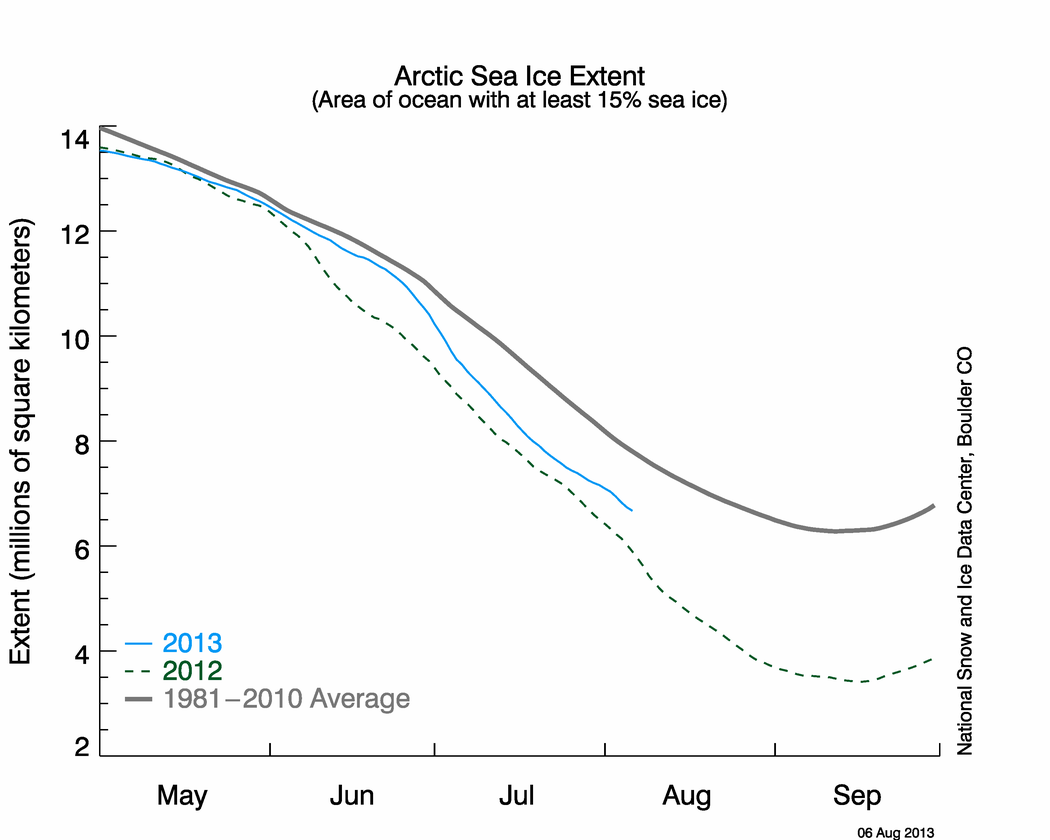
Nature is a kick in the pants, isn’t she?
Discover more from Watts Up With That?
Subscribe to get the latest posts sent to your email.
I watch this everyday. CO2 rises and the ice stays. Sort of ruins Gore’s arguement, don’t you think?
OT – When was the last time that the sun has registered no sunspots for as long as at present?
Another good link for daily-updated graph of sea ice extent, which also puts 2008 in context with every year since 2002 is:
Data of Sea Ice Extent
CA has had some comments that had the values for the day for each year. 2008 is also behind 2006 and 2005 for minima at this point.
By eyeball, If 2008 rate follows the average rather than the anomalous 2007, the final value will be much closer to the average than to 2007. The “knee” in the graph about Jul was where 2007 really collapsed. You’d have to see an even bigger one for 2008 to get to where 2007 was. Of course what you will get from this is spin (2008 was the second, third, … lowest extent, it would have been lower except for ….. and so on). I’m guessing the same technique as saying that last year was one of the highest temps on record while ignoring the fact that the temps are flat or downward.
The graph at Cryosphere doesn’t seem to have been updated for awhile. Waiting for the adjustments to come in?
On that page, check out at the bottom of the page in the “Notes on the data” section:
The numbers of sea ice extent in this site are estimates calculated by certain algorism.
You can’t make this stuff up!
Less then two months to go to maximum melt. If the melt continues at the present rate, I wonder if the media will be all over the story. No, wait — they’ll be so busy covering politics that they’ll just let the event pass without notice.
Anthony,
Thanks for the update. I may do a follow-up story for The Register in a few weeks, when the Arctic dust (soot) settles. The current trajectory has ice extent near normal in August – with below freezing temperatures forecast for most of the Arctic Basin the rest of the month.
http://wxmaps.org/pix/temp2.html
So, what we are seeing is the rate of decline is equal to or better than (for some months) the average, just the starting point is around 2k lower, which must mean current temperatures must be relative to the average? Does this assumption sound reasonable?
“The numbers of sea ice extent in this site are estimates calculated by certain algorism.”
Hilarious! Or is that Hillary-ous?!
The apparent durability of the polar icecap is even more surprising when you consider the predicted frailty of all of that 1 year ice.
Mind you, anyone wondering where the media will get its next “North Pole Doomed” story can have a look at this from Friday 11th July:
http://news.bbc.co.uk/1/hi/sci/tech/7503060.stm
bsneath
According to Hathaway and NASA, this spotless period is normal.
http://science.nasa.gov/headlines/y2008/11jul_solarcycleupdate.htm
If I’m not mistaken, cycle 23 is now about 12 years long – which is long, but not abnormally long.
In mid June 2007, there was an abrupt melting. Ányone know why, or can provide a link explaining that?
Aaron,
Thanks for the great link!
I think the guy running WoodforTrees was looking for a data source like that.
bsneath: Lots of good stuff at Jan Janssens
http://users.telenet.be/j.janssens/Spotless/Spotless.html
Someone needs to post up a graphic of what the weather systems are doing in the Arctic. Last year’s minimum was a result of high and low pressure patterns that set themselves up there. Question is, will they or are they repeating the same pattern this year.
BrianMcL
Typical selective reporting by the BBC. They chose a region where it happens to be warm this summer. Look at the chart I’ve provided. The area they are referring seems to be coloured dark red.
http://www.osdpd.noaa.gov/PSB/EPS/SST/climo&hot.html
Anyone with camera can document a place that’s warmer than normal. This is typical science by anecdotes and misrepresentation. It’s crap.
Arron,
Yes, indeed. “All your ice are belong to us.”
bsneath: OT – When was the last time that the sun has registered no sunspots for as long as at present?
at the previous solar minimum in 1996.
Pierre,
Should SS23 persist for another 2 months (and it certainly appears that this will happen) I wonder what the spin will be then (since SS23 is currently 140 months old and the limit on 1 StdDev is 142 months). What happens if/when SS23 cycle length stray into 2 StdDev territory?
I question the whole notion of “one year” and “multiyear” ice.
I will grant that the chemistry of ice may change the long it’s in a solid state. But I would also challenge anyone to produce an irrefutable date set demonstrating that all ice that resists melting is necessarily “multiyear.” Ice can become very thick rapidly. This can occur from higher than normal snowfall, as well as from compression events. Similarly, “older” ice can incur extension, wind erosion, and outright sublimation, and become quite thin.
I think way too much has been assumed about what makes ice thick or thin, and how rapidly such things can occur.
Think “plate tectonics.”
Lief,
Not quite correct. Last period >20 days was Nov 2007, before that Sept 2007, then Sept-Oct 1996. This makes three periods better than 20days (so far) for SS23/24, while the previous solar minimum had one period (42 days).
Leif,
Sorry for misspelling your name, unintentional.
This is slightly off-topic; this mean sea level graph may not be current, but early 2008 levels are no higher than 5 years earlier. Due to the ebb and flow of the smoothed line, there were previously times when the level was no higher than 3 years earlier, but not 5.
http://icecap.us/images/uploads/SeaLevel_TOPEX.jpg
Because of the recent roll-over, the linear line does not seem a good fit, unless it were drawn between 1992 and 2006 data, and then the leveling-off would be even more obvious. Any comments or new trend lines from you technical people?
long -> longer. date -> data.
Sorry for the typos, no spell checker is capable of detecting them, and my eyeballs are older and weaker everyday. May need to go for bifocals.
It would be interesting to see would be the other years, instead of just an average.
Pierre and BrianMcL,
Something’s not right with that story. As I look at the track of station 35, it appears that the location on July 11 was just north and east of the Svalbaard Islands. If I look at this graph of the current ice from NSIDC, it appears that that particular area is well within normal ice extents:
Sea Ice Extent 07/13/2008
If you look just to the right of and a little bit above the northernmost tip of Greenland, you can see Svalbaard Islands. Station 35 should be just north and east of those islands, which appears to be well within normal exents.