GISS Ts+dSST Numbers Are In

by John Goetz

The GISS Ts+dSST numbers are in.

June comes in at 26, continuing the downward trend at GISS and making it the seventh lowest anomaly this decade.

Lots of history was rewritten by the June temperature, with 89 monthly adjustments upward and 22 downward. Most of the downward adjustments were made this decade, and most of the upward adjustments were made pre-1941. At an annual level, 9 years before 1928 were adjusted upward, and 2007 was adjusted downward.

As for 2008, Jan and Feb were unchanged, Mar up 2, Apr up 1, and May up 3. The uplifts in M-A-M surprised me some, because I would have expected out of season months (such as June) to have no effect. Such is the GISS method.

I will post up a plot later today, unless Anthony beats me to it (I like his format).

REPLY: Go for it. I’m jammed up today, fires are threatening again. 1/4 mile visibility due to smoke.

Added reference: A number of comments ask why the historical numbers change. I wrote a post on that earlier this year, which was publicized on this blog and Climate Audit. I am not saying it is OK that they change, only describing why they change.

Get notified when a new post is published.
Subscribe today!
0 0 votes
Article Rating
80 Comments
Inline Feedbacks
View all comments
Editor
July 9, 2008 6:28 pm

jeez (11:51:54) :

It is still unfathomable to me that historical data is revised every month. I can’t think of a real life analogy for this circumstance. The closest thing that comes to mind is the “fish that got away” whose size tends to be directly related to number of times the tale is told.
Imagine if stock charts were backward revised every month.

First, only missing data is adjusted in this pass. Second, temperature records from a single station are typically recorded by a single person and propagated to not too many other people. Company stock prices are recorded many times in many places and there is strong financial incentive to do that. OTOH, you might have trouble finding the stock price for DEC for, say July 9, 1968. DEC was bought by Compaq, that was bought by HP. DEC is no longer traded, so you probably can’t find it at your favorite online broker.

July 9, 2008 6:32 pm

Questions. Is CO2 dispersed equally in the circumference of the globe? If it isn’t, where is it concentrated? I looked for actual numbers but all the web sites I went to gave me ……well garbage and interpretive language. Just wondering about the dynamics of the CO2 theory. If it does capture heat, and it is concentrated, shouldn’t we see warming where it is concentrated? If it is evenly dispersed, shouldn’t we see a smoother line in our global temps?

Admin
July 9, 2008 6:36 pm

Yes, adjusting the value of missing days in 1927 because we had a cold June in 2008.
If we keep doing this for another thousand years, can we assume we will know better what the exact temperature was on some random day and random place in 1927 than we know it today? I see CRU temperatures for a 100 years ago stated in 1000’s of a degree. Does this remotely make any logical sense to you?
No more accuracy is being added by this process, only a false sense of sciency looking adjusting.
And what relevance is there to your DEC example? Just because information is obscure doesn’t mean it won’t be accurate and consistent when located. I don’t feel like subscribing to Hoovers just to find this information.

Evan Jones
Editor
July 9, 2008 6:56 pm

Does GISS then adjust adjusted data?
To be clear:
GISS uses fully adjusted NOAA data as its own raw data. It then adjusts it further.

Admin
July 9, 2008 6:57 pm

Hey Evan, you live in SF right? Ok if I send you an email?

Evan Jones
Editor
July 9, 2008 6:58 pm

I see CRU temperatures for a 100 years ago stated in 1000’s of a degree.
Fischer is pleased to refer to this as “the fallacy of misplaced precision”.

Admin
July 9, 2008 7:00 pm

When I was in high school science class it was called spurious accuracy–same thing.

Philip_B
July 9, 2008 7:00 pm

Temperature data is a proxy for heat gain by the climate system. Some scientists like Pielke senior argue we should put more effort into directly measuring heat gain.
Using an average of min max is a poor way of trying to measure heat gain, because the difference from min to max to the next min is just a measure of how much heat is gained and then lost over the day and what we are interested in the net heat gain after the daily gain and loss. Hence we should use minimum temperatures only.
However, most people in most places are much more interested in the daily high temps than the lows and most people would consider rising minimum temps, ie less cold nights to be a good thing. So using just minimum temperatures would have a much weaker propaganda value.

Glenn
July 9, 2008 7:02 pm

Ric, how do you adjust missing data? I must be missing something.

Evan Jones
Editor
July 9, 2008 7:16 pm

Hey Evan, you live in SF right? Ok if I send you an email?
I live in NYC. But it’s still OK if you send me an email.
My email address is: [email snipped by jeez, now officially known as Charles the moderator]

Admin
July 9, 2008 7:19 pm

Maybe I will, but I was looking for a potential drinking buddy. I’m mixing you up with someone else around here. I cut your email above. It’s never a good idea to leave it hanging out there.

Peter
July 9, 2008 7:30 pm

I found this article interesting: “Mysterious California Glaciers Keep Growing Despite Warming” http://www.foxnews.com/story/0,2933,378144,00.html

Brute
July 9, 2008 7:38 pm

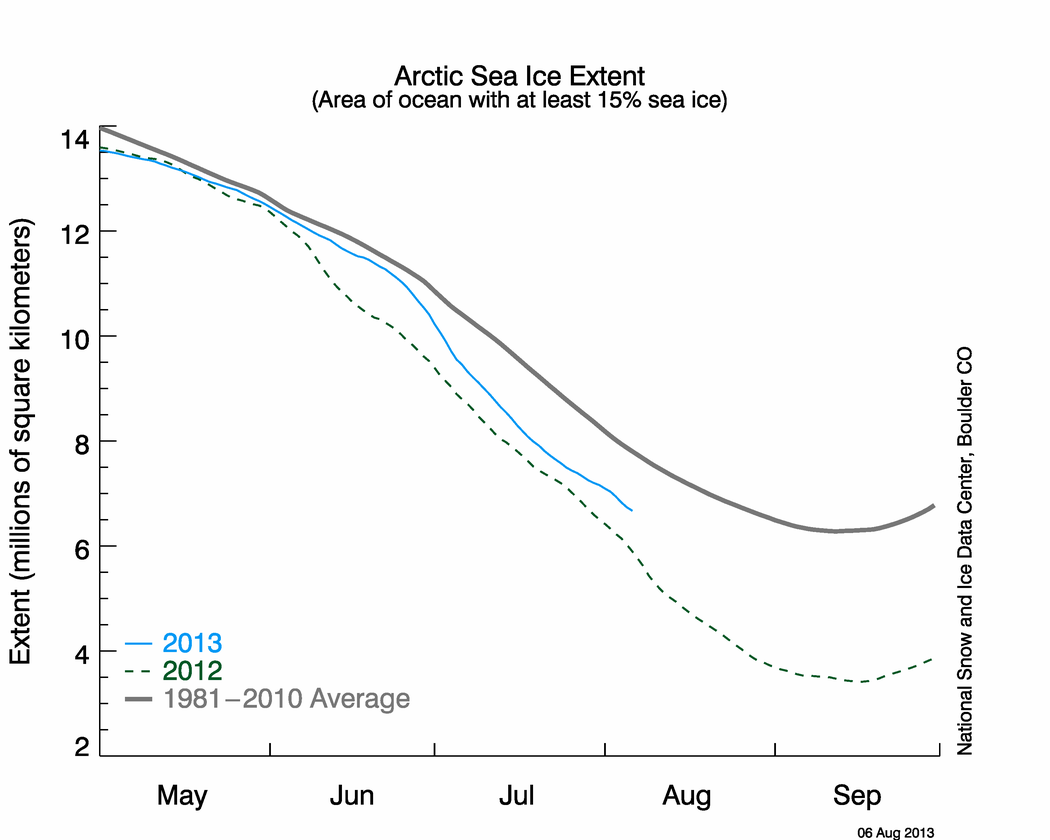
I still like this one. Rising CO2 must be good for the Arctic Ice…….
http://nsidc.org/data/seaice_index/images/daily_images/N_timeseries.png

Brendan
July 9, 2008 8:30 pm

That’s a good idea! Lets get the local groups together and have some beers. Jeez – you should begin to take a survey of where people live and figure out a few major beer drinking locations. I’m sure that survey software would be at least good for that!

July 9, 2008 8:42 pm

Duct tape all attic, crawl space vents closed. That’s where embers get sucked in. Drape AC intake with wet cloth and keep wet. Park vehicles, lawnmower, other fuel tanks inside garage with the door closed. Sprinkler on roof. Keep vigil for embers. Most homes can withstand quite a bit if properly prepped.

Editor
July 9, 2008 9:31 pm

Glenn (19:02:57) :
“Ric, how do you adjust missing data? I must be missing something.”
http://wattsupwiththat.wordpress.com/2008/04/08/rewriting-history-time-and-time-again/
describes the process pretty well.
Suppose the observer for Penacook was on vacation for part of April 1933 and hence wasn’t able to come up with the 30 days of data to compute the average for the month. Averaging the days he was around for doesn’t work, escpecially if he was away during the beginning or end of the month when temperatures are usually furthest from the mean. Replacing the missing data with daily averages might work pretty well, and may be what should be done.
Instead, the missing month’s data is filled in by the other two months in the season and the average temperature of the month in that season for all other years. As the temperature record gets longer, the amount of data gets longer.
It would make a lot more sense, at least to me, to use something like the average of the preceding month, the following month, and the previous year’s month, and the following. Maybe a few other years too, but certainly no more than a few.
Probably some use of averages for the month and adjacent ones too.
There are some algorithms for doing this, I have one that’s used to take a collection of data samples and spread them out over an even matrix. If I ever have time, I want to try going from GPS traces to topographic map and I need that step to make some contour drawing software happy.

Philip_B
July 9, 2008 11:11 pm

At the risk of stating the obvious, there is never any need or justification for infilling data that is missing for whatever reason.
This is a case where the computational algorithm is determining the data required, where it should be the other way around. And the algorithm should handle the data available. Calculating means and trends where data is missing from a time series isn’t a hard problem.
Amateur is too weak a word for this.

Glenn
July 10, 2008 1:14 am

Ric, Thanks. But I can’t see adding data where none exists is constructive here. Anything added that changes a trend (or affects the existing record in any way) would be pure speculation; weather hardly ever does what we tell it to, even if before it happens, but especially after. Perhaps I’m still missing something here, but it doesn’t sound like sound science. How far could you stretch this vacation (30 days… 3 years), how would you set limits on “accuracy”?

Editor
July 10, 2008 4:15 am

A few points…
I keep a local copy of Hadley/GISS/UAH/RSS at home. I also update the entire dataset, instead of merely adding the latest month. I was about to make a fool of myself by crowing about 12 consecutive months of temperatures falling year-over-year at GISS. Then I did a double-take. The GISS dataset with data to May 2008 showed March 2007 as 0.60 and March 2008 as 0.58, a 0.02 decline over 12 months. The GISS dataset with data to June 2008 shows March 2007 as 0.59 and March 2008 as 0.60, a rise of 0.01 over 12 months. They’re the only one showing a rise over the previous year for March 2008. Anything to deny the skeptic community a propaganda point.
The GISS 12-month running mean anomaly to June 2008 is 0.421. The GISS 12-month running mean anomaly to March 1998 was 0.422 (at least on the current GISS dataset :p ). So we’re back to where we were over 10 years ago, according to GISS.
Dr. Hansen should note that in the real world, corporate executives do not get thrown into prison for disagreeing with him, but rather for fiddling with corporate numbers. GISS restates previous years’ numbers more often than Nortel, fercryinoutloud.

July 10, 2008 4:41 am

Anthony: Odd. GISS goes down while UAH and RSS go up slightly.

Could just be noise, but it might slightly confirm my hunch that the satellite datasets react quicker and more strongly to short-term events (e.g. La Nina).

July 10, 2008 5:50 am

As a layman (relatively new to this debate – spurred by a feeling that not all is what it seems to be) I have tried to read widely from this and a number of other sites, on both sides of the debate, to get a handle on the key issues.
When dealing with issues in my working life I have always found the best question at the start is: “What is the problem we want to fix?” (BTW – the end game should always answer clearly the question – “why is this strategy/policy/plan the answer to that problem?”)
Therefore – my first question is – “Is the earth warming?” (Please stay with this point and do not get onto secondary issues such as – is it dangerous? can we forecast what will happen? – and what is causing it? – question ‘1’ has to be is the earth warming?)
Now, with all such issues as this my basic logic is to say there are 2 key factors (to me as a layman please understand)
1). what is the appropriate start point?
2). what is the data that shows this?
(Please understand I am trying to be purposefully simplistic here)
Now, depending on which side of the argument you are on you will naturally choose a start point that fits with the thesis you are trying to make. I would like to put that to one side for the moment and concentrate on getting clear in my mind an understanding of the data.
I have been singularly horrified by how much data manipulation may be going on in this area. I am not a scientist but I do suffer the consequences, as a citizen in my country, of decisions made by politicians on the basis of government policy formulations founded on the data produced about global warming/climate change.
So all I ask is:
1). ‘Is there a clear set of data that shows the average temperature of the earth over the last 100 hundred years?’
2). ‘Is this data available/reported (in its raw form as well as its adjusted form) in order that scientists around the world can evaluate it and have such assessments peer reviewed with rigour?’

Editor
July 10, 2008 6:18 am

Glenn (01:14:09) :
“But I can’t see adding data where none exists is constructive here. Anything added that changes a trend (or affects the existing record in any way) would be pure speculation; weather hardly ever does what we tell it to, even if before it happens, but especially after. Perhaps I’m still missing something here, but it doesn’t sound like sound science. How far could you stretch this vacation (30 days… 3 years), how would you set limits on “accuracy”?”
There are certainly limits, but science has always dealt with measurement errors and omissions. You certainly don’t want to throw out the entire 100 year history of a good site because someone lost a monthly data sheet or the tanscriber couldn’t make out a poorly written digit.
Stepping well beyond my statistics knowledge, one reason to fill in missing data with a good guess is that there are statistical methods that need a full history. One of them, (Principle components) was used in producing Mann’s hockey stick graph, though it had more problems with extrapolating data beyond a sample period than filling in holes. And many, many other problems to boot.
Some times the missing data can be omitted without much trouble, e.g. gaps in USHCN and COOP records during equipment relocations, Anthony frequently posts graphs with breaks in them. The breaks are convenient markers to see what short of shift in data occurs with the relocation.
Given all the other error sources in the data, filling in missing data with something close to neutral provides a lot of computational convenience at little cost.
Here’s an example – suppose a site had that April 1933 data missing. How would you compute the average temperature for that year? If you don’t, then that would suggest you couldn’t compute an annual average for the country that year because there ought to be at least one missing month somewhere for each month of the year. By splicing in neutral data, then all the simple averaging math (e.g. add up the monthly averages and divide by 12) still work.

John Finn
July 10, 2008 7:36 am

There are several reasons for the discrepancies between GISS and HadCrut in particular. But the fact that the Arctic has cooled (anomaly wise) recently while the tropics have warmed might explain the relatively low GISS anomaly for June.

Jared
July 10, 2008 9:28 am

That’s possible, Paul, but then you also have to consider that all four metrics dropped sharply to about the same level in January. Then in March, the satellites stayed fairly cool, while Hadley and especially GISS jumped way up. The overall trends are somewhat clear, though…global temps dropped a lot in January, recovered somewhat through March, and since have cooled off again through June.

Philip_B
July 10, 2008 11:32 am

Therefore – my first question is – “Is the earth warming?”
I’ll have a shot at answering this.
First of all, there are 2 questions that need answering. One is, is the world’s climate warming and the second is, is it due to a global effect. Because we know peat fires in Indonesia, coal fires in China, etc, are excerting a warming influence on the climate.
The answer to the first question is, on average, probably yes.
The answer to the second question is more important. A global effect should show up equally in both hemispheres (north and south). Even though, ex tropics, the SH has less than 5% of the population of the NH.
There has been no significant warming over the entire satellite record for the SH (about 30 years).
So the obvious conclusion is that whatever warming that has occured in the NH is not due to a global effect and therefore greenhouse gases cannot be the cause because they are distributed moreorless equally across the hemispheres.