
Update 2: Reader Jesse Michael forwarded me this animated image above, which does a better job than the flawed NASA image or it’s replacement I found below. It takes about a minute to complete the whole sequence, patience.
While looking for something else, I came across this image from the NASA visualization website. I located the hires TIFF image and annotated it as seen below. I also made a desktop wallpaper out of the TIFF file for those interested. It reminded me to remind you all about perspectives, so here is some perspective on size, solar luminosity, and on our planetary energy budget.
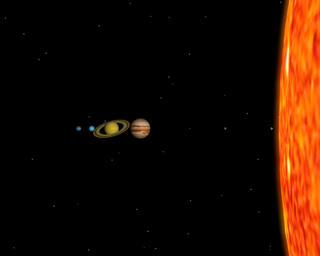

Click here for a larger (TIFF format without annotation) image from NASA
Click here for a desktop wallpaper image (1280×1024 JPEG)

UPDATE: It appears that the NASA provided image above , the source of which is from this NASA page, unbelievably, is wrong. As reader Erik points out, the sun is too large. I initially had some misgivings about the solar size also, but figured NASA wouldn’t possibly botch such a basic comparison. Shades of the Hubble mirror fiasco.
Here is another image from NASA JPL that appears to be correct:

Click for larger image from JPL
Note: image above is L-R mirrored for comparison to first image.
Note that distance is not to scale, but planetary and solar size is. To get an idea of distance scale, read this excellent example from Kitt Peak Observatory.
A few factoids:
- It would take about 109 earths to equal the width of the suns diameter (Sun=1.39 million km Earth=12,700 km)
- Over 1 million Earths would fit inside the Sun’s volume
- The sun has a total luminosity output of 386 YottaWatts
(386,000,000,000,000,000,000,000,000 watts, some background here and here)
- The total luminous energy output received by earth from the sun is 174 PETAWATTS (174,000,000,000,000,000) watts.
- A 0.1% increase in luminosity dumps an extra 174 trillion watts (174,000,000,000,000) watts into our planetary energy balance.

Data source for graph: http://www1.ncdc.noaa.gov/pub/data/paleo/climate_forcing/solar_variability/lean2000_irradiance.txt
Note: In the graph above, the low flatline from 1645-1715 is the Maunder Minimum, a period of virtually no sunspots, where the historical reports from the northern hemisphere tell a story of dramatic climate change: harsh winters, cools summers, crop failures, famine and disease.
From the abstract referenced above: “Estimated increases since 1675 are 0.7%, 0.2% and 0.07% in broad ultraviolet, visible/near infrared and infrared spectral bands, with a total irradiance increase of 0.2%. “
So its not just 0.1 %, it is 0.2% which translates to a 348 TeraWatts global irradiance increase.
Now lets put 348 trillion watts into perspective:
Hurricanes: the heat energy released by a hurricanes category 1-5 equals about 50 to 200 trillion watts or about the same amount of energy released by exploding a 10-megaton nuclear bomb every 20 minutes.
Katrina, released about 200 trillion watts over its life cycle.
Now imagine double that amount of extra energy being added to earth’s atmosphere every second by small increases in the suns output that have been documented to exist. That’s what the increase in solar irradiance is doing. Since 1675, after the depths of the Maunder Minimum, we’ve seen an increase in solar irradiance of about 2.5 watts per square meter.
Climate modelers say that the extra CO2 equates to a forcing of about 2 watts per square meter, which totals about 1.12 Petawatt (1,120,000,000,000,000 watts). The problem is, they can’t always recreate that reliably between all of the different models out there, with the positive and negative feedback mechanisms, and other variables involved. There’s disagreement on the total contribution. A lot of it. Nonetheless they seem all to agree that CO2 makes some contribution, and that’s likely true. But compared to the sun, I believe it’s minimal.
Now lets look at us: 13.5 TeraWatts is the average total power consumption of the human world in 2001.
Compared to solar variance, do you think we could change the planets atmospheric energy balance with that if we squeezed all the power we made that year together and radiated it into our atmosphere ?
What is very clear though, when you look at history, and the graph above, is that our earths atmosphere and resulting climate is extremely sensitive to variations in solar output. The sweet center point seems to be about 1365 watts per square meter of irradiance…what we consider as “normal” climate. Take 1.5 watts/sq. meter away, and we get significant cooling, harsh winters, cool summers, and increases in ice and glaciers. Add 1.5 watts,/sq. meter and we get hotter summers, mild winters, and melting of ice and glaciers.
Now irradiance aside, as it’s only one component, there’s also the chnage in the suns dynamic magnetic field and solar wind, which according to Svensmark, which modulates the number of cosmic rays that enter our atmosphere (I think there may be some possible effect also due to modulation of the earth’s magnetic field), which modulates the number of clouds that form, hence changing the net surface irradiance. Plots of changes in the suns magnetic field line up very well with climate change.
Here is a little more on perspective and our place in the universe:
There’s a tendency to view ourselves, our endeavors, and our accomplishments as the pinnacle. Yet, compared to whats in our solar system, whats in our galaxy, and whats in our universe, we are but a mere speck in the vastness of time, space, mass, and energy.


Andrew,
Ultrviolet light gives us tan, sunburn and skin cancer. Perhaps it’s life style that creates the difference. Some background: Tampa itself (about 1 hr north of my location) has no real beaches as it is not on the Gulf of Mexico. However, the entire Tampa Bay area including St Petersburg, which is on the Gulf, would normally be included in any statistics. A vast majortiy of Tampa area residents are from the north and have not lived their whole life in the strong sun. Many later life skin cancers are due to continuous overexposure during ones younger years. There is a large Latino population in the area who are less likely to get skin cancer due to their darker skin. A large portion of the population is over 60 and do not go out in the sun nor hang out at the beaches. In addition, many bingo halls are open during day light hours. 🙂
Peter
Your Greenhouse Effect lesson stands what I thought I knew about GHGs on it’s head.
I was under the impression that:
The energy of the sun that reaches us surface dwellers is mostly in the range to which the atmosphere is transparent causing the surface to heat.
The surface then emits its heat as IR and convection.
Greenhouse gasses are good absorbers of IR and when they re-emit some of this will be downward making them act like a blanket.
Is it back to school for me?
PS
I appreciate your efforts.
Regards
Terry
For TD (23:21:52)
Hi Terry
Thanks for your comments.
I can understand your problem with my rather flip explanation: I was being too brief.
I apologize in advance for the length of the current post, but you raise some interesting points and I shall try to deal with them properly.
INFRARED
Dave (10:35:41) touched on one of the keys to the solution. We have to stop thinking of radiative (heat) energy as just IR. All radiation is energy, and the higher the frequency / shorter the wavelength of a photon the more energy it contains.
When a photon is **absorbed** by a particle its energy goes into the kinetic energy of the particle and raises the quantum energies of the electrons it contains (=heating up). Under certain circumstances photon(s) of lower frequency are emitted (=cooling down). Planck’s Law describes the relationship between the temperature of a body and the energy and wavelength of the photons that are emitted.
High energy, short wavelength photons (visible light and higher) tend to interact with matter by causing the emission of lower energy, longer wavelength photons (IR). Returning to Dave’s example, a black object absorbs visible light, heats up and in turn radiates perceptible heat (=IR).
The spectrum of the solar irradiance – that is, the light that arrives at the earth – can be approximated to the radiation of a blackbody at a temperature of 5780°K. You have to look at the curve to see the full implications of this, but for our purposes we can note that the majority of the energy we receive from the Sun is mostly in the visible range of the spectrum, roughly in the wavelength range of 0.4µm (=approx. violet visible light)..1.0µm (=approx. near IR).
The photons arriving at the surface of the atmosphere – which, if we include the thermosphere, can be 150km+ thick – may or may not interact with the particles of the atmosphere in the way I sketched in my previous post. They may even survive the descent and be reflected at the Earth’s surface, only to suffer and interaction on the way out again. Interactions can be with gas molecules, aerosol particles, condensates etc. Photons can not only be scattered and absorbed, they can also trigger important photolytic reactions in the atmosphere whilst being absorbed. With so many possibilities available, describing the process numerically is a tremendously complex business.
The atmosphere is also a complex structure. I nearly jumped into the post about the beneficial effects of CO2 in the atmosphere to point out that it depends very much on where the CO2 is. In the boundary layer next to the surface (approx. 1km thick) CO2 will probably have some effect on plant life; in the troposphere or stratosphere, none at all. An aircraft that discharges its CO2 into the lower stratosphere is not going to help the beans in my garden one bit. I was so entertained by MA and Anthony, though, that I thought my trivia would be out of place.
But I digress. If you look at a graph of temperature against height of the atmosphere (here’s an example ) you will see that the temperature of the atmosphere at the top of the stratosphere has almost reached surface values. At the top of the thermosphere – although the atmosphere here is barely dense enough to be able to speak of a ‘top’ – the temperature can be well in excess of 1000°C. All this energy comes from solar irradiance.
My point is that you cannot just take visible light as – well, just light – and ignore it by just focusing on the absorption of IR. It’s all energy, and things happen when it interacts with matter at all levels of the atmosphere. In consequence, it is not terribly important for the overall energy balance for us to know which bit of the spectrum a particular gas absorbs. O3, for example, is fortunately for us a strong absorber of UV, although the interaction in this case leads principally to photodissociation. All kinds of things in the atmosphere – dust, vapours, aerosols, condensates – absorb a wide range of light wavelengths, which is why the AGW focus on CO2 is just obsessive. If a particle absorbs a photon of visible light and emits a photon of IR that seems to me to be just as important as a particle that absorbs a photon of IR (which it may have got from the first particle).
BLANKETS
The blanket keeping the Earth warm is, like greenhouses, an analogy too far in my opinion. A blanket is a device that interrupts convection effectively. A simple thought experiment will make this clear.
Imagine you are lying naked next to Julie Christie under a thick woollen blanket in the snowed-in dacha in the movie ‘Dr Zhivago’, discussing, say, convective forcing in the troposphere. Body heat would rise to the blanket, but because of the poor heat transfer through the blanket, the air above would be only slightly warmed and only a weak convective flow would be established above it.
How unpleasant this would soon become! – and how much better a simple thin silken bedsheet would be!
In this case, body heat would convect to the sheet, the sheet would heat up and establish a strong convection in the cold night air of the dacha above it, transporting the heat away and enabling us to continue our discussions in comfort far into the night.
There is no comparable blanket effect in the atmosphere – not even clouds. There is nothing that acts as a barrier to convection. As I pointed out in my first post on this subject, if the atmosphere heats up during the day it returns heat to the surface and continues absorbing a portion of heat radiated from the surface.
The absorption of energy in the atmosphere is the role played by the so called greenhouse gases. One of the principal gases is water vapor. A dry desert becomes blazingly hot on the surface during the day and freezingly cold at night because dry, clear air is a poor thermal reservoir, not because there are no clouds to blanket it and keep the heat in. You would need an awful lot of CO2 to achieve the same result.
A ‘greenhouse gas’ cools the surface during the day and warms it at night, so I think we are broadly in agreement.
I apologize once more for this windbaggery – just imagine what an earful Julie Christie would get…
Peter
Peter,
Great post. I learned as I lurked.
Thanks
Great info Peter, however, I am not sure our younger readers will understand the reference to “Imagine you are lying naked next to Julie Christie”.
I’m imagining. Oops, the blanket has turned into a tent …
Tom in Florida (17:48:41)
I think you would be surprised what young people can imagine these days.
Steve Stip (19:13:05)
LOL. Tent? Greenhouse!
Thanks for the feedback
Peter
Tom in Florida (17:48:41)
Doh! You are not referrring to the act of darkness, but the reference to an actress in a movie that was made so long ago that it contained scenes of deep snow and therefore must have been set in a time before AGW really kicked in.
Yep, from my perspective anyone under 60 could indeed be classed as ‘younger readers’, so I apologize for being so obtuse. Memo to self: drink more coffee.
In order to make the analogy relevant to the young uns out there, who would you choose?
Peter
Mars …
Courtesy of [Junk Science](http://www.junkscience.com/): For sobering perspective on reality, read on [here](http://wattsupwiththat.wordpress.com/2008/06/07/some-planetary-perspective/). Also [NASA desgin a satellite](http://science.nasa.gov/headlines/…
In reference to the discussion of carbon dioxide and infrared radiation: I work with an FTIR (Fourier Transform InfraRed) Spectroscopist who knows quite a bit about carbon dioxide. He uses a machine that bombards samples with infrared, and then analyzes the spectroscopic signal that comes from the sample. Carbon dioxide absorbs all the infrared in certain specific bands, so an FTIR spectroscopist has to ensure that the atmosphere around his sample is quite free from carbon dioxide.
If carbon dioxide re-emitted those specific bands, then there would not be a problem, because what was being absorbed would be emitted again. The carbon dioxide does not do that. It simply sucks up those specific IR energy bands, and would keep doing it forever.
The other problem with talking about radiation being absorbed and emitted, is that the radiation being emitted is always (99.999% of the time) going to be of a different wavelength, or is going to be at least an order of magnitude less strength than the original absorbed radiation. If the emitted radiation is a different wavelength, then it is probably a wavelength which is not absorbed by carbon dioxide. If the emitted radiation is a smaller amplitude, then it will have a lot less effect the next time it is absorbed. If we assume that the wavelength remains the same, it would not take very many absorption/emittance cycles before the amplitude becomes so small as to be nonexistent.
The climate modelers really want to believe that what is absorbed will always be what is emitted. They sometimes go so far as to say that from each absorption comes an emission that goes both up and down, with both emissions being the same amplitude as the original absorption (two for the price of one).
I just recieved this yesterday.So I have not have had the time to read it up well.But thought someone here might find this fascinating.A possible Sun/Jupiter sunspot modulation connection being considered.
Timo Niroma:
Sun and Jupiter.
http://personal.inet.fi/tiede/tilmari/sunspot2.html#jupiter
His main page is here:
http://personal.inet.fi/tiede/tilmari/sunspots.html#alert
Makes me wonder if some of the planets have a direct influence on the sunspot cycle.Jupiter apelhion and Perihelion cycles seems to effect the solar cycle.
Sorry all but I got confused in this post a little.
Okay so the Global Warmers believe that CO2 forcing is creating 1,120,000,000,000,000 Watts of extra heat, whereas the Solar Irradiance increase is only 348,000,000,000,000 Watts… I can see why they would think this is insignificant as 348,000,000,000,000/1,120,000,000,000,000 is a small percentage of what they feel is the real cause of global warming since the increase in solar irradiance would only account for 31% of the warming of the earth. leaving 69% attributable to CO2…
Just trying to understand. Please let me know if I am off base on this.
Janice (06:59:39)
There are lots of species your spectroscopist needs to keep out of the sample, not just CO2. Most of the gases fingered as ‘greenhouse gases’ exhibit strong absorption of infrared at various wavelengths, most of them being **very much stronger absorbers** than CO2.
Your statement about CO2, however, that it ‘simply sucks up those specific IR energy bands, and would keep doing it forever’ is not correct, since this would break the First Law of Thermodynamics, the conservation of energy.
Absorption of a photon always increases the energy of the absorber in some way. The type of energy increase depends on the wavelength of the photon. IR photons increase the vibrational energy of the absorber, in effect its temperature. At some point the absorber emits energy in the form of one or more photons, the energy of which is usually below that of the absorbed photon(s), i.e. having a longer wavelength.
Your spectroscopist would notice this as a shift or displacement: an absorption minimum that would be shadowed by an emission maximum at a lower wavelength – in other words, an emission spectrum as opposed to an absorption spectrum.
Your analogy of emitted energy becoming weaker and fizzling out after a number of absorptions and emissions also violates the First Law of Thermodynamics. The input energy has got to go somewhere, either increasing the temperature of the absorber(s) and/or emitting other photons.
‘…is that the radiation being emitted is always (99.999% of the time) going to be of a different wavelength, or is going to be at least an order of magnitude less strength than the original absorbed radiation.’ I have a particular problem with the ‘or’ in that statement.
Photons are quantum objects. Their wavelength is related to their energy. They don’t have a separate amplitude – you can’t have stronger photons and weaker photons, just more or fewer of them.
An ‘order of magnitude’ is a multiple of ten: I don’t see how this follows from your statement.
An ’emission that goes both up and down’: have you a source for this statement?
Sorry to be so picky.
Peter,
Thanks for instructing Janus and us. I did not find your post “picky” at all, but very instructive.
It may be just me, but I think I would like the guy who named the largest known star, essentially, “big dog”. Great choice for a name!
Forgive for being an ‘Idiot’ + The visual of the Sun, and the Earth, is size of a peppercorn- I believe, we are more distant, than what the models speculate. Due to the fact, with a lite over chase of clouds to filter the sun, [winter- hard baseball/summer – grapefruit]